Introduction
In the rapidly evolving landscape of modern software delivery, mastering the Certified MLOps Architect credential has become a definitive benchmark for technical excellence. This comprehensive guide is designed for software engineers, platform architects, and engineering leaders seeking to navigate the complexities of production-grade machine learning pipelines. By bridging the gap between traditional software development and scalable data science, this guide empowers professionals to make informed career decisions. For those looking to formalize their expertise, the official Certified MLOps Architect program hosted on aiopsschool provides the necessary structured pathway. Whether you are transitioning from traditional DevOps or scaling enterprise AI workloads, understanding this certification ecosystem is essential for long-term career growth.
What is the Certified MLOps Architect?
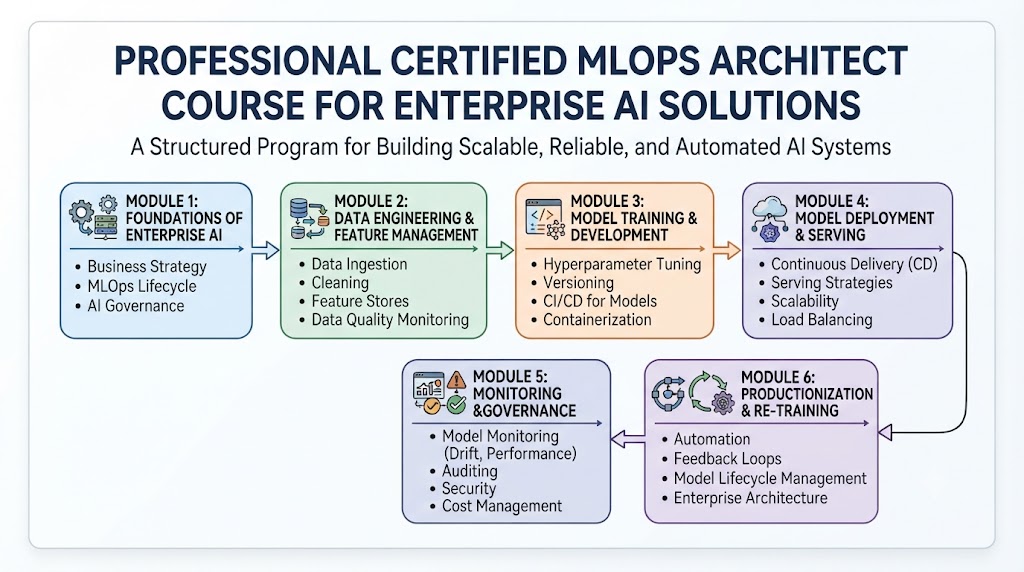
The Certified MLOps Architect represents the gold standard for validating expertise in building, deploying, and maintaining machine learning systems at scale. It exists to bridge the persistent gap between experimental data science models and reliable, automated production environments. This certification emphasizes real-world, production-focused learning over abstract theoretical knowledge, ensuring candidates can handle complex infrastructure challenges. It aligns perfectly with modern engineering workflows, CI/CD pipelines, and enterprise governance practices to guarantee operational resilience. Professionals who earn this credential demonstrate a deep understanding of continuous training, model monitoring, and automated delivery frameworks.
Who Should Pursue Certified MLOps Architect?
This certification targets a wide array of technical professionals, including DevOps engineers, Site Reliability Engineers, and cloud infrastructure specialists. Data scientists and data engineers looking to bridge the infrastructure divide will also find immense value in this structured learning path. Engineering managers and technical leaders can leverage this program to better understand machine learning lifecycles and oversee scalable AI initiatives. The curriculum provides both foundational concepts for beginners and advanced architectural strategies for seasoned enterprise practitioners. Both global organizations and rapidly expanding technology markets in India recognize this credential as a key differentiator for high-performing technical teams.
Why Certified MLOps Architect is Valuable in Modern Engineering
The demand for reliable machine learning infrastructure has skyrocketed as organizations move beyond experimental AI proofs-of-concept. This certification provides long-term career longevity by focusing on core architectural principles rather than fleeting, vendor-specific tools. Enterprise adoption of automated AI pipelines requires specialized professionals who can manage drift, scalability, and security simultaneously. Mastering these concepts helps professionals stay relevant and adaptable despite rapid technological changes in the cloud-native ecosystem. Ultimately, the credential delivers an exceptional return on time and career investment for ambitious engineers aiming for leadership roles.
Certified MLOps Architect Certification Overview
The program is delivered via and hosted on. It features multiple certification levels designed to test both theoretical comprehension and hands-on implementation capabilities. The assessment approach combines rigorous practical labs, architectural design scenarios, and proctored technical evaluations. Program ownership rests with industry-leading practitioners who continuously update the curriculum to reflect current production challenges. The overall structure is designed in practical terms to ensure graduates can immediately apply their skills in live enterprise environments.
Certified MLOps Architect Certification Tracks & Levels
The certification framework includes foundation, professional, and advanced levels to cater to diverse experience brackets. Specialization tracks branch out into areas such as automated pipelines, model monitoring, and scalable infrastructure management. Each level builds progressively upon the last, ensuring a seamless transition from basic operational concepts to complex architectural design. These structured levels align directly with industry career progression, helping engineers move from individual contributors to principal architects. This modular approach allows professionals to customize their learning journey based on their specific organizational responsibilities and career goals.
Complete Certified MLOps Architect Certification Table
| Track | Level | Who it’s for | Prerequisites | Skills Covered | Recommended Order |
| MLOps Core | Foundation | Junior Engineers, Data Scientists | Basic Python & Linux | Pipeline Basics, Version Control | 1 |
| MLOps Architecture | Professional | DevOps & Cloud Engineers | Foundation Level | CI/CD for ML, Model Serving | 2 |
| Enterprise MLOps | Advanced | Senior Architects, Tech Leads | Professional Level | Scalability, Governance, Security | 3 |
Detailed Guide for Each Certified MLOps Architect Certification
Certified MLOps Architect – Foundation Level
What it is
This entry-level certification validates foundational knowledge of machine learning lifecycles and basic pipeline automation. It ensures candidates understand how to bridge software engineering principles with data science workflows.
Who should take it
Suitable for junior software engineers, data analysts, and aspiring cloud professionals with basic programming and Linux experience. The intent is to establish a strong baseline in operationalizing machine learning models.
Skills you’ll gain
- Basic pipeline automation and workflow orchestration
- Version control for datasets and machine learning models
- Introduction to containerization using Docker for data science
- Basic monitoring and logging practices for experimental models
Real-world projects you should be able to do
- Build a simple automated training pipeline using containerized scripts
- Implement basic model versioning and artifact tracking mechanisms
- Deploy a basic inference API to a local development cluster
Preparation plan
- 7–14 days strategy: Focus on core concepts, review foundational documentation, and complete introductory reading materials.
- 30 days strategy: Build small sample pipelines, practice containerization, and review basic automation scripts daily.
- 60 days strategy: Combine theoretical study with hands-on lab exercises, participate in community discussions, and complete mock assessments.
Common mistakes
- Relying solely on theoretical memorization without practicing hands-on coding.
- Neglecting the fundamentals of containerization and dependency management.
- Skipping basic pipeline orchestration principles before moving to advanced tools.
Best next certification after this
- Same-track option: Certified MLOps Architect – Professional Level
- Cross-track option: DevOps Foundation Certification
- Leadership option: Engineering Management Essentials
Certified MLOps Architect – Professional Level
What it is
This certification validates advanced competencies in building, scaling, and maintaining production-grade machine learning pipelines. It focuses on automated deployment, model monitoring, and robust infrastructure management.
Who should take it
Designed for experienced DevOps engineers, platform architects, and senior data engineers with hands-on production experience. The intent is to prove mastery over end-to-end machine learning operational workflows.
Skills you’ll gain
- Advanced CI/CD pipeline implementation for machine learning
- Automated model testing, validation, and performance monitoring
- Scalable model serving and inference optimization strategies
- Security hardening and compliance for enterprise AI workloads
Real-world projects you should be able to do
- Construct a fully automated end-to-end CI/CD pipeline for model retraining
- Implement automated drift detection and alerting mechanisms in production
- Deploy a high-availability model serving architecture on cloud infrastructure
Preparation plan
- 7–14 days strategy: Review advanced architectural patterns and study enterprise case studies intensively.
- 30 days strategy: Build complex multi-stage pipelines and practice troubleshooting simulated production failures.
- 60 days strategy: Dedicate hours to deep-dive labs, architectural design reviews, and comprehensive exam simulations.
Common mistakes
- Underestimating the complexity of data drift and automated retraining loops.
- Failing to account for security and access control in model endpoints.
- Focusing too much on single tools rather than architectural patterns.
Best next certification after this
- Same-track option: Certified MLOps Architect – Advanced Level
- Cross-track option: Advanced SRE Practitioner Certification
- Leadership option: Enterprise AI Strategy & Leadership
Certified MLOps Architect – Advanced Level
What it is
This elite certification validates mastery in designing enterprise-wide machine learning architectures and governance frameworks. It focuses on large-scale multi-cloud deployments, cost optimization, and strategic AI leadership.
Who should take it
Targeted at principal engineers, cloud architects, and technical leaders responsible for enterprise AI strategy. The intent is to demonstrate the ability to lead organization-wide MLOps transformations.
Skills you’ll gain
- Multi-cloud and hybrid machine learning architecture design
- Enterprise governance, compliance, and risk management for AI
- Advanced cost optimization and resource allocation strategies
- Large-scale distributed training and inference orchestration
Real-world projects you should be able to do
- Design a multi-region, highly available enterprise MLOps platform
- Implement comprehensive governance and compliance frameworks for AI models
- Optimize resource consumption and operational costs for massive training clusters
Preparation plan
- 7–14 days strategy: Focus on enterprise architecture blueprints, governance standards, and case studies.
- 30 days strategy: Design complex reference architectures and review multi-cloud scalability patterns.
- 60 days strategy: Participate in architectural workshops, study advanced whitepapers, and complete rigorous scenario-based labs.
Common mistakes
- Ignoring non-functional requirements such as latency, security, and cost.
- Designing overly complex architectures without considering organizational readiness.
- Neglecting change management and team training aspects of MLOps adoption.
Best next certification after this
- Same-track option: Principal AI Infrastructure Architect
- Cross-track option: Enterprise FinOps Leader
- Leadership option: Chief Technology Officer Executive Program
Choose Your Learning Path
DevOps Path
The DevOps path focuses on establishing strong foundational automation, infrastructure as code, and continuous integration practices. Professionals learn to manage robust container registries, configuration management tools, and deployment pipelines. This track ensures that software delivery remains swift, repeatable, and reliable across various cloud environments. Mastering this journey prepares engineers to handle complex deployment workflows and collaborative development environments effectively. It serves as the bedrock upon which all advanced operational architectures are built.
DevSecOps Path
The DevSecOps path integrates security seamlessly into every stage of the software development and machine learning lifecycles. Practitioners learn vulnerability scanning, automated compliance checks, and secure secret management techniques. This track emphasizes shifting security left to catch potential risks before code reaches production environments. Engineers gain the expertise needed to protect sensitive training data and secure model endpoints against sophisticated attacks. Building this capability is critical for enterprises operating in highly regulated industries.
SRE Path
The Site Reliability Engineering path prioritizes system availability, latency optimization, and robust incident management practices. Professionals master service level objectives, error budgets, and automated root cause analysis for complex platforms. This track equips engineers to build fault-tolerant systems that can withstand unexpected traffic spikes and failures. Learners study proactive monitoring, automated remediation, and capacity planning to maintain optimal performance. Achieving excellence in this path guarantees high system reliability for enterprise-grade workloads.
AIOps / MLOps Path
The AIOps / MLOps path specializes in automating and scaling machine learning and artificial intelligence pipelines. Practitioners focus on continuous training, model drift detection, feature store management, and scalable inference. This track bridges data science experimentation with reliable, production-ready software engineering standards. Engineers learn to orchestrate complex data flows and manage lifecycle artifacts efficiently. It represents the ultimate destination for professionals building the backbone of modern intelligent applications.
DataOps Path
The DataOps path emphasizes the agile management and orchestration of data pipelines across the enterprise. Learners master data integration, quality validation, storage optimization, and real-time streaming architectures. This track ensures that high-quality, clean data is continuously delivered to analytical and machine learning systems. Professionals develop robust frameworks to handle large volumes of structured and unstructured information securely. Navigating this journey enables seamless data flow across disparate business units.
FinOps Path
The FinOps path centers on financial accountability, cloud cost optimization, and resource efficiency management. Practitioners learn to analyze spending patterns, attribute costs accurately, and implement automated budgeting policies. This track helps organizations maximize their cloud return on investment without sacrificing performance or scalability. Engineers and managers gain insights into balancing operational speed with stringent budgetary constraints. Developing these skills is essential for sustainable technology growth in enterprise environments.
Role → Recommended Certified MLOps Architect Certifications
| Role | Recommended Certifications |
| DevOps Engineer | Certified MLOps Architect – Foundation & Professional Levels |
| SRE | Certified MLOps Architect – Professional Level |
| Platform Engineer | Certified MLOps Architect – Professional & Advanced Levels |
| Cloud Engineer | Certified MLOps Architect – Foundation & Professional Levels |
| Security Engineer | Certified MLOps Architect – Professional Level (Security Track) |
| Data Engineer | Certified MLOps Architect – Foundation & Professional Levels |
| FinOps Practitioner | Certified MLOps Architect – Professional Level (Cost Optimization) |
| Engineering Manager | Certified MLOps Architect – Advanced Level |
Next Certifications to Take After Certified MLOps Architect
Same Track Progression
Deep specialization within the same track involves pursuing advanced architecture credentials and niche platform certifications. Professionals can explore specialized domains such as distributed model training, advanced feature store engineering, and real-time streaming architectures. This progression deepens technical authority and positions engineers as subject matter experts within their organizations. Continuous specialization ensures technical relevance as machine learning frameworks and infrastructure tools continue to evolve rapidly.
Cross-Track Expansion
Skill broadening across multiple tracks allows architects to combine machine learning expertise with security, reliability, and cost management. Professionals often pair their MLOps credentials with advanced Site Reliability Engineering or DevSecOps certifications. This multidisciplinary approach makes engineers exceptionally versatile and capable of overseeing entire technical ecosystems. Organizations highly value leaders who understand how machine learning intersects with security, compliance, and infrastructure reliability.
Leadership & Management Track
Transitioning to leadership involves moving from hands-on implementation to strategic technical governance and executive oversight. Professionals pursue certifications in engineering management, enterprise architecture leadership, and digital transformation strategy. This track prepares senior engineers to direct large technical teams, manage budgets, and align AI initiatives with business goals. Effective leadership ensures that technical investments drive measurable value and organizational growth.
Training & Certification Support Providers for Certified MLOps Architect
DevOpsSchool is a premier global platform offering comprehensive training and certification support for modern engineering methodologies. They provide structured learning paths, hands-in labs, and expert mentorship to help professionals master complex technologies. Their curriculum is continuously updated to reflect real-world enterprise demands and industry best practices.
Cotocus specializes in delivering high-quality technical education and consulting services for cloud-native and DevOps transformations. Their programs focus on practical implementation, ensuring candidates gain actionable skills for production environments. They empower engineering teams to adopt automation, containerization, and scalable architectures successfully.
Scmgalaxy is a well-established knowledge-sharing community and training provider focusing on software configuration management and DevOps. They offer extensive resources, tutorials, and certification guidance for engineers worldwide. Their community-driven approach fosters continuous learning and professional networking among technical practitioners.
BestDevOps provides targeted training programs designed to accelerate professional growth in cloud infrastructure and automation. Their courses emphasize practical labs and real-world scenarios to bridge the gap between theory and execution. They support candidates in achieving recognized industry credentials with confidence.
devsecopsschool focuses exclusively on integrating security into the software development and deployment lifecycle. Their specialized training programs teach engineers how to build resilient, secure, and compliant cloud-native applications. They help organizations cultivate a proactive security culture across all technical departments.
sreschool is dedicated to advancing the practice of Site Reliability Engineering through rigorous, hands-on training courses. Their programs cover observability, incident management, automation, and scalable system design. They prepare engineers to maintain high availability and performance in demanding production environments.
aiopsschool offers specialized education and certification programs in artificial intelligence operations and machine learning architectures. Their expert-led courses focus on operationalizing AI models, automated pipelines, and scalable infrastructure. They serve as a primary hub for professionals entering or advancing within the MLOps domain.
dataopsschool provides structured training in data engineering, pipeline orchestration, and agile data management practices. Their curriculum equips professionals with the skills needed to build robust, scalable data platforms. They ensure data integrity and continuous delivery for modern analytical and AI workloads.
finopsschool specializes in cloud financial management, cost optimization, and resource governance training. Their programs help organizations and engineers align technical decisions with financial accountability. They empower practitioners to maximize cloud value and manage operational expenditures effectively.
Frequently Asked Questions (General)
1. How difficult is the Certified MLOps Architect program for beginners?
The program requires a foundational understanding of programming, Linux, and basic cloud concepts. While challenging, the structured modular approach allows beginners to build their skills progressively from basic pipelines to advanced enterprise architectures.
2. How much time should I dedicate daily to preparation?
Dedication of one to two hours daily over a span of thirty to sixty days is typically recommended. Consistent practice with hands-on labs ensures better retention and mastery of complex operational concepts.
3. What are the core prerequisites before starting this journey?
Candidates should possess basic familiarity with Python programming, containerization concepts using Docker, and fundamental cloud infrastructure management. Prior experience with CI/CD pipelines is also highly beneficial.
4. What is the return on investment for this certification?
The credential significantly enhances professional marketability, often leading to career advancement, higher compensation, and leadership opportunities. Employers actively seek certified architects to lead their enterprise AI initiatives.
5. How should I sequence my learning across different tracks?
Beginners should start with foundational automation before moving to professional MLOps architecture levels. Once core competencies are established, cross-track expansion into security or reliability adds significant professional value.
6. Is practical project experience required to pass the assessment?
Yes, the certification emphasizes practical, production-grade skills over theoretical knowledge. Candidates must understand how to build, monitor, and troubleshoot real-world machine learning pipelines.
7. How often is the certification curriculum updated?
The curriculum is reviewed and updated regularly by industry practitioners to reflect the latest advancements in cloud-native technologies and machine learning tooling.
8. Can engineering managers benefit from this technical certification?
Engineering managers gain deep architectural insights that help them oversee AI projects, allocate resources effectively, and communicate technical strategies to executive stakeholders.
9. What kind of career support is provided during the training?
Providers offer expert mentorship, architectural guidance, community forums, and comprehensive lab environments to support candidates throughout their learning journey.
10. How do these certifications align with global industry standards?
The learning paths are mapped directly to current enterprise demands, ensuring that certified professionals possess skills that are universally recognized and valued across global markets.
11. What is the format of the final assessment?
The assessment typically combines theoretical multiple-choice questions with rigorous practical lab scenarios designed to test real-world problem-solving capabilities.
12. How do I maintain my certification status over time?
Maintaining certification involves engaging in continuous professional development, participating in advanced workshops, or completing periodic recertification assessments as required by the governing body.
FAQs on Certified MLOps Architect
1. What specific tools are covered in the Certified MLOps Architect curriculum?
The curriculum focuses heavily on industry-standard orchestration tools, container registries, model monitoring frameworks, and CI/CD platforms without being locked into a single vendor ecosystem.
2. How does this certification address model drift and data drift?
Candidates learn proactive monitoring strategies, automated alerting mechanisms, and continuous retraining workflows specifically designed to detect and mitigate drift in production environments.
3. Does the program cover multi-cloud machine learning deployments?
Yes, advanced levels explore architectural patterns for deploying and managing machine learning workloads across hybrid and multi-cloud environments seamlessly.
4. How are feature stores integrated into the learning modules?
Feature stores are covered as a core component of scalable data pipelines, ensuring consistent feature retrieval for both training and real-time inference.
5. What role does security play in the MLOps certification tracks?
Security is integrated throughout the curriculum, covering secure model endpoints, vulnerability scanning for dependencies, and strict access control for sensitive training artifacts.
6. Are there specific cost optimization strategies taught in the program?
Professional and advanced levels include modules on managing computational resources efficiently, optimizing GPU utilization, and controlling cloud expenditure for large training clusters.
7. How do I choose between the Professional and Advanced certification levels?
Professionals with two to four years of hands-on pipeline experience should start with the Professional level, while senior architects leading enterprise transformations should target the Advanced level.
8. What kind of hands-on lab environments are provided during preparation?
Candidates gain access to simulated production environments equipped with modern tooling, allowing them to practice deployment, monitoring, and troubleshooting in real time.
Final Thoughts: Is Certified MLOps Architect Worth It?
Investing time and effort into the Certified MLOps Architect program is a pragmatic decision for any engineer serious about enterprise AI. The industry has moved past the era of experimental data science; production-grade reliability is now the baseline expectation. This certification provides a structured, unbiased, and experience-driven roadmap to mastering those exact operational standards. It cuts through the marketing hype and focuses on the architectural principles that endure over time. If you want to build scalable, resilient machine learning systems and future-proof your career, this credential is a worthy pursuit.