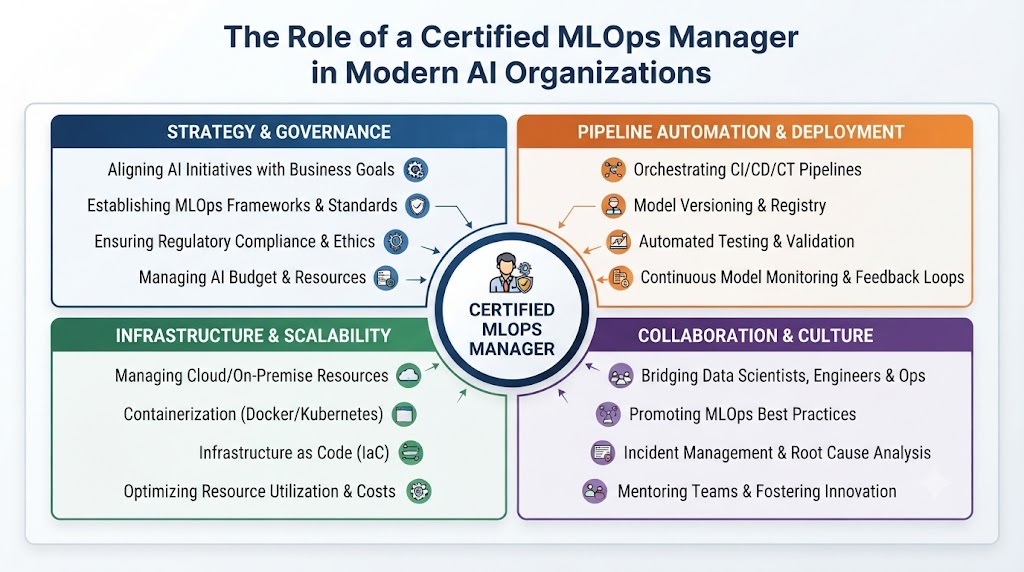
Introduction
In the modern enterprise landscape, bridging the gap between machine learning model development and robust production deployment is one of the most critical engineering challenges. This comprehensive guide is designed for software engineers, platform architects, and technical leaders who want to understand the true value of the Certified MLOps Manager credential. Positioned directly at the intersection of machine learning engineering, DevOps, and cloud-native platform architectures, this certification validates the ability to scale, monitor, and govern AI systems reliably. By exploring curriculum structures, preparation timelines, and career impacts, this guide equips professionals with the clarity needed to make strategic learning choices and advance their careers within aiopsschool.
What is the Certified MLOps Manager?
The Certified MLOps Manager certification represents an authoritative industry benchmark for professionals managing the end-to-end lifecycle of machine learning systems in enterprise production environments. It exists to replace purely theoretical data science paradigms with rigorous, repeatable, and scalable operational engineering standards. The program emphasizes real-world automation, continuous integration for machine learning, model drift monitoring, and robust data governance over abstract concepts. By aligning directly with modern cloud-native workflows, container orchestration platforms, and automated delivery pipelines, the credential prepares practitioners to handle complex enterprise AI challenges.
Who Should Pursue Certified MLOps Manager?
This professional certification is specifically tailored for a diverse range of technology practitioners operating across global markets and the growing Indian tech ecosystem. Software engineers transitioning into machine learning engineering, DevOps professionals scaling infrastructure for AI workloads, and site reliability engineers will find immense practical value. Additionally, data engineers, platform architects, and engineering managers seeking governance frameworks for artificial intelligence projects benefit greatly. Both seasoned technical leaders looking to formalize their operational expertise and mid-level engineers aiming for accelerated career growth will find the curriculum directly applicable to their daily responsibilities.
Why Certified MLOps Manager
The exponential enterprise adoption of artificial intelligence has created an unprecedented market demand for professionals who can successfully operationalize machine learning models at scale. As organizations move beyond experimental pilots into mission-critical deployments, the longevity and career stability of MLOps practitioners remain remarkably high. This certification ensures professionals stay highly relevant even as underlying tooling ecosystems and framework vendors continuously evolve. Investing time into this credential yields an exceptional return on investment by establishing verified technical leadership, bridging organizational silos between data scientists and infrastructure teams, and commanding top-tier industry compensation.
Certified MLOps Manager Certification Overview
The Certified MLOps Manager program is delivered via and hosted on aiopsschool. The certification structure combines rigorous theoretical evaluations with hands-on, practical performance assessments that reflect real-world production incidents. Ownership of the curriculum rests with industry-leading practitioners who ensure that every module addresses current enterprise security, scalability, and compliance requirements. Assessment methodologies test both architectural decision-making and tactical implementation capabilities, ensuring that certified individuals can immediately lead production initiatives upon completion.
Certified MLOps Manager Certification Tracks & Levels
The certification ecosystem is thoughtfully segmented into foundation, professional, and advanced tiers to accommodate varying levels of professional experience. Specialization tracks branch outward to cover adjacent operational domains such as infrastructure automation, site reliability engineering, and cost optimization. Foundation levels establish core workflow concepts and pipeline automation fundamentals for emerging practitioners. Professional tracks dive deep into model monitoring, feature stores, and automated retraining loops for experienced engineers. Advanced levels focus on enterprise-wide governance, multi-cloud model serving architectures, and executive risk management for technical leaders.
Complete Certified MLOps Manager Certification Table
| Track | Level | Who it’s for | Prerequisites | Skills Covered | Recommended Order |
| Core MLOps | Foundation | Junior Engineers, Data Analysts | Basic Python and Git | Pipeline Basics, Version Control | 1 |
| Engineering | Professional | DevOps, ML Engineers | Core MLOps Foundation | CI/CD for ML, Model Serving | 2 |
| Architecture | Advanced | Tech Leads, MLOps Managers | Professional Certification | Governance, Scaling, Security | 3 |
Detailed Guide for Each Certified MLOps Manager Certification
Certified MLOps Manager – Foundation Level
What it is
This entry-level credential validates fundamental knowledge of machine learning lifecycles, artifact tracking, and basic pipeline automation.
Who should take it
Suitable for junior software engineers, data analysts, and aspiring infrastructure specialists looking to enter the operational side of machine learning.
Skills you’ll gain
- Version controlling datasets and machine learning models using industry standards
- Automating simple training and evaluation scripts within basic continuous integration workflows
- Understanding artifact registries and containerization principles for data science scripts
- Implementing foundational logging and monitoring for experimental tracking servers
Real-world projects you should be able to do
- Build a repeatable training script packaged inside a standard container image
- Track model hyperparameters and output metrics using a centralized registry tool
Preparation plan
- 7 to 14 days: Focus on foundational pipeline concepts, basic containerization, and configuration management fundamentals through intensive reading.
- 30 days: Build small end-to-end experimental tracking pipelines and review core documentation thoroughly.
- 60 days: Practice sample assessment questions and replicate basic open-source MLOps workflow architectures in a local lab environment.
Common mistakes
Candidates frequently focus too heavily on complex data science algorithms rather than focusing on artifact tracking, environment reproducibility, and pipeline automation fundamentals.
Best next certification after this
- Same-track option: Certified MLOps Manager Professional Level
- Cross-track option: Certified DevOps Practitioner
- Leadership option: Agile Project Management for AI
Certified MLOps Manager – Professional Level
What it is
This intermediate credential validates advanced abilities in building robust continuous delivery pipelines, managing feature stores, and handling automated model monitoring.
Who should take it
Designed for experienced DevOps engineers, platform specialists, and machine learning engineers with hands-on production experience managing cloud workloads.
Skills you’ll gain
- Designing scalable continuous delivery pipelines for automated machine learning model deployment
- Implementing real-time model drift detection and automated performance alerting mechanisms
- Managing enterprise feature stores to ensure data consistency between training and inference
- Securing model endpoints against adversarial attacks and unauthorized data access
Real-world projects you should be able to do
- Deploy a fully automated retraining pipeline triggered by data drift metrics in a cloud environment
- Implement a robust serving infrastructure utilizing Kubernetes and automated horizontal pod autoscaling
Preparation plan
- 7 to 14 days: Review advanced Kubernetes architecture, container security scanning, and model serving design patterns.
- 30 days: Set up end-to-end production monitoring loops and experiment with automated retraining triggers in a staging cloud cluster.
- 60 days: Complete rigorous mock exams, review troubleshooting runbooks, and analyze complex enterprise case studies.
Common mistakes
Engineers often neglect latency optimization during inference serving and fail to establish comprehensive fallback mechanisms for model failures in production.
Best next certification after this
- Same-track option: Certified MLOps Manager Advanced Level
- Cross-track option: Certified SRE Professional
- Leadership option: Certified Engineering Manager
Choose Your Learning Path
DevOps Path
The DevOps path focuses heavily on infrastructure automation, container orchestration, and continuous delivery pipelines tailored for machine learning workloads. Practitioners learn to provision scalable compute clusters using infrastructure as code frameworks while ensuring high availability. Mastering this track bridges the operational gap between traditional software development life cycles and machine learning artifact management. It serves as a natural progression for engineers looking to expand their cloud-native expertise into artificial intelligence domains.
DevSecOps Path
The DevSecOps path integrates rigorous security, compliance, and vulnerability management directly into every stage of the machine learning lifecycle. Learners explore secure supply chain practices, model vulnerability scanning, and robust secret management for sensitive training data. This track ensures that enterprise artificial intelligence applications comply with global data privacy regulations and internal security policies. Professionals following this route become indispensable guardians of corporate AI infrastructure and intellectual property.
SRE Path
The Site Reliability Engineering path emphasizes production resilience, error budgeting, observability, and incident management for high-throughput AI services. Candidates study capacity planning, latency reduction strategies, and automated self-healing mechanisms for mission-critical model serving endpoints. This curriculum ensures that artificial intelligence systems maintain enterprise-grade uptime and predictable performance under heavy user loads. It provides technical leaders with the tools needed to manage complex distributed machine learning systems effectively.
AIOps / MLOps Path
The AIOps / MLOps path dives deep into the specialized operational mechanics of machine learning lifecycles, from data ingestion to model deprecation. Learners master automated retraining pipelines, feature store synchronization, and specialized model monitoring frameworks designed for complex AI systems. This dedicated route ensures practitioners can handle the unique non-deterministic nature of machine learning artifacts in production. It is the core vocational track for engineers dedicated exclusively to artificial intelligence platform engineering.
DataOps Path
The DataOps path concentrates on reliable data pipeline engineering, streaming architectures, and rigorous data quality validation mechanisms. Professionals learn to automate data cleansing, transformation, and ingestion workflows to feed high-quality inputs into machine learning models. This track eliminates data bottlenecks and ensures continuous flow between enterprise databases and training pipelines. Mastering these concepts guarantees that downstream machine learning models receive clean, synchronized, and reliable data feeds consistently.
FinOps Path
The FinOps path addresses the critical financial governance and cost optimization challenges associated with resource-intensive machine learning workloads. Candidates learn to monitor GPU utilization, optimize cloud compute expenditure, and implement intelligent resource allocation strategies. This curriculum helps organizations balance high-performance AI infrastructure requirements with strict budgetary constraints and financial accountability. It empowers technical managers to demonstrate clear financial return on investment for their enterprise artificial intelligence initiatives.
Role → Recommended Certifications
| Role | Recommended Certifications |
| DevOps Engineer | Certified MLOps Manager Foundation, Certified DevOps Practitioner |
| SRE | Certified MLOps Manager Professional, Certified SRE Professional |
| Platform Engineer | Certified MLOps Manager Professional, Certified Kubernetes Administrator |
| Cloud Engineer | Certified MLOps Manager Foundation, Certified Cloud Architect |
| Security Engineer | Certified MLOps Manager Professional, Certified DevSecOps Specialist |
| Data Engineer | Certified MLOps Manager Foundation, Certified DataOps Engineer |
| FinOps Practitioner | Certified MLOps Manager Professional, Certified FinOps Professional |
| Engineering Manager | Certified MLOps Manager Advanced, Certified Technical Leadership |
Next Certifications to Take After Certified MLOps Manager
Same Track Progression
Advancing further within the same track involves pursuing expert-level architectural credentials that focus on multi-region model federation, enterprise governance, and global AI scale. Professionals dive deeper into advanced cost governance, specialized hardware acceleration management, and multi-tenant platform design. This specialized journey establishes the practitioner as a recognized authority capable of designing enterprise-wide artificial intelligence operational strategies. Mastery at this level enables seamless transitions into principal engineering and chief AI architect roles.
Cross-Track Expansion
Expanding across adjacent tracks broadens technical versatility by incorporating site reliability engineering, financial optimization, and advanced security principles into daily operations. Engineers learn to combine machine learning operational workflows with robust infrastructure monitoring and cloud cost management techniques. This holistic skill expansion prevents professional obsolescence and enhances cross-functional collaboration with diverse engineering departments. Organizations heavily value versatile engineers who can troubleshoot issues across both data pipelines and underlying cloud infrastructure.
Leadership & Management Track
Transitioning into the leadership and management track shifts focus from hands-on tactical implementation to strategic roadmap planning, team building, and budget governance. Leaders learn to align artificial intelligence initiatives with broader business objectives while managing organizational change and cross-functional silos. This progression prepares senior engineers for executive roles such as Director of Platform Engineering, Vice President of Engineering, or Chief Technology Officer. Mastering leadership competencies ensures that technical vision successfully translates into measurable enterprise value.
Training & Certification Support Providers for Certified MLOps Manager
DevOpsSchool is a premier global training organization offering comprehensive education and certification support for professionals pursuing modern operational frameworks. Their expert-led bootcamps provide hands-on laboratory experiences that bridge theoretical knowledge with complex real-world production challenges.
Cotocus delivers specialized technical training and consulting services designed to accelerate enterprise adoption of cloud-native and automation technologies. Their experienced mentors guide candidates through intricate architectural patterns and operational best practices.
Scmgalaxy serves as a trusted community and learning hub for engineers focusing on source control management, continuous integration, and infrastructure automation. They offer extensive resource libraries and practical workshops for skill enhancement.
BestDevOps provides structured learning pathways and certification preparation courses tailored for software engineers and infrastructure professionals globally. Their curriculum emphasizes practical execution and industry-standard workflows.
devsecopsschool focuses exclusively on integrating security practices into modern development and operational pipelines through rigorous training modules. They prepare professionals to secure complex cloud and artificial intelligence architectures effectively.
sreschool delivers specialized education centered on site reliability engineering, resilience engineering, and production observability best practices. Their programs equip engineers to maintain mission-critical uptime across distributed systems.
aiopsschool is a leading authority in artificial intelligence operations education, offering targeted certifications and deep-dive technical courses. Their programs validate expertise in managing machine learning lifecycles and automated production workflows.
dataopsschool provides specialized training on data pipeline reliability, streaming architectures, and automated data quality management. Their courses ensure robust data foundations for downstream artificial intelligence initiatives.
finopsschool offers focused education on cloud financial management, cost optimization, and resource governance for modern engineering organizations. Their training empowers leaders to maximize return on cloud investments.
Frequently Asked Questions
1. What is the overall difficulty level of the Certified MLOps Manager program?
The program features a moderate to advanced difficulty level, requiring practical understanding of both software engineering workflows and basic machine learning concepts.
2. How much preparation time is typically required to pass the certification exams?
Candidates generally require between thirty to sixty days of consistent, hands-on study and practical lab work to prepare adequately.
3. What are the mandatory prerequisites for enrolling in the certification?
Basic proficiency in Python, version control systems, and fundamental cloud-native infrastructure concepts are strongly recommended before starting.
4. What is the return on investment for obtaining this certification?
Certified professionals frequently report accelerated career advancement, enhanced technical credibility, and eligibility for senior platform engineering roles.
5. How should candidates sequence their learning if pursuing multiple certifications?
It is recommended to start with foundational pipeline concepts before moving on to professional deployment and advanced governance tracks.
6. Are the certifications recognized globally across international enterprises?
Yes, the curriculum aligns with international industry standards and is recognized by top technology organizations worldwide.
7. How are the practical assessments conducted during the certification process?
Assessments combine rigorous multiple-choice conceptual questions with hands-on labs that evaluate real-world troubleshooting and pipeline building skills.
8. Do certification holders receive ongoing access to updated learning materials?
Yes, participants gain access to regularly updated curriculum modules reflecting the latest advancements in artificial intelligence operations.
9. Can software engineers without prior data science experience pursue this track?
Absolutely, because the curriculum focuses primarily on infrastructure, deployment, and operational workflows rather than complex algorithm creation.
10. How does this certification compare to traditional data science credentials?
While data science certifications focus on model accuracy and mathematics, this credential validates production reliability, scalability, and automation.
11. What kind of continuous professional development is expected after certification?
Holders are encouraged to engage with ongoing community workshops and stay updated with emerging cloud-native artificial intelligence tooling.
12. How does the certification help bridge gaps between data scientists and operations teams?
It establishes a common operational vocabulary and shared standards that streamline collaboration across cross-functional engineering departments.
FAQs on Certified MLOps Manager
1. Why is operationalizing machine learning models more challenging than traditional software deployment?
Machine learning models depend on both code and complex, continuously changing data inputs, making behavior unpredictable in production environments without rigorous monitoring and automated validation loops.
2. How does automated model drift detection prevent production failures?
Continuous drift detection identifies statistical changes in incoming data streams or declining prediction accuracy, automatically triggering alerts or retraining pipelines before business impact occurs.
3. What role do feature stores play in enterprise MLOps architectures?
Feature stores ensure consistency by centralizing feature engineering code and data definitions, preventing discrepancies between training environments and real-time inference pipelines.
4. How do containerization and orchestration platforms support scalable machine learning workloads?
Containers encapsulate model runtimes and dependencies, while orchestrators like Kubernetes automatically scale compute resources to handle fluctuating prediction request volumes efficiently.
5. What security measures are critical when deploying models into enterprise production?
Critical security practices include vulnerability scanning of container images, protecting model endpoints against adversarial evasion attacks, and encrypting sensitive training data at rest.
6. How do organizations measure the operational success of their MLOps initiatives?
Success is measured through metrics such as reduced deployment lead times, lower model downtime, automated recovery speeds, and consistent prediction accuracy over time.
7. What is the difference between continuous integration and continuous deployment in machine learning?
Continuous integration validates model code, data schemas, and training scripts, while continuous deployment automates the promotion of validated models into production serving endpoints.
8. How can engineering teams optimize infrastructure costs for heavy GPU-based training workloads?
Teams can implement dynamic resource scheduling, spot instance utilization, automated cluster scaling down during idle periods, and efficient model quantization techniques.
Final Thoughts: Is Certified MLOps Manager Worth It?
Investing time and effort into mastering machine learning operations is one of the most pragmatic career decisions a modern engineer can make. As artificial intelligence moves from experimental hype to core business infrastructure, the demand for professionals who understand production reliability will only accelerate. This certification cuts through marketing noise, focusing instead on rigorous, repeatable engineering practices that deliver tangible business value. For engineers and technical leaders committed to building resilient, scalable, and secure AI platforms, pursuing this credential offers a clear and rewarding pathway forward.