Introduction
Stepping out of school or finishing college can feel like standing at a massive crossroads. If you have recently looked at options for your next academic step, you have probably noticed a flurry of acronyms and exam names floating around: JEE Main, NEET UG, CUET UG, CLAT, UCEED, NDA, and dozens more. For students and parents, figuring out what these tests actually do can be quite confusing. Every test serves a specific purpose. Some are built for engineering or medicine, while others open doors to law, design, general university degrees, or postgraduate programs. Understanding these tests early helps you match your interests, school subjects, and career goals with the right pathway, making your higher education journey far smoother.
What Are Higher Education Entrance Exams?
An entrance exam is a standardized test conducted by educational bodies, universities, or national agencies to select candidates for admission into specific programs. These tests are widely used by colleges, universities, professional institutions, and specialized academies to evaluate a student’s readiness, subject proficiency, and general aptitude for a given course. However, it is equally important to know that not every higher education course requires an entrance exam. Many colleges and universities admit students based entirely on school board marks, graduation percentages, merit lists, personal interviews, or institutional screening processes. When an entrance exam is required, it generally acts as a standardized yardstick to manage high applicant volume and ensure fair assessment for limited seats.
Why Entrance Exams Matter for Higher Education
Educational institutions rely on these assessments for several practical reasons. First, they provide a standardized benchmark. Because grading standards across different school boards and universities can vary widely, an entrance test offers a common platform to evaluate all applicants fairly. Second, these evaluations test core subject knowledge, logical reasoning, and critical thinking skills that are vital for advanced study. Because popular professional courses often have many more applicants than available seats, entrance tests help institutions identify candidates who demonstrate the necessary aptitude and discipline. They are simply tools to gauge preparedness, not absolute measures of a student’s entire potential or future capability.
Entrance Exams After Class 12
Finishing Class 12 is a major turning point for undergraduate admissions. Depending on your academic stream and personal interests, undergraduate entrance exams are generally categorized by broad career fields rather than a one-size-fits-all formula.
Top Engineering Entrance Exams
For students inclined toward technology, applied sciences, and technical innovation, engineering entrance tests are the primary gateway.
- JEE Main: As highlighted in GurukulGalaxy’s JEE Main guides, this is a major national-level undergraduate examination used for engineering, architecture, and planning admissions across participating institutions, and it also serves as the qualifying route for JEE Advanced under current rules.
- JEE Advanced: Conducted for admission to the premier Indian Institutes of Technology (IITs), this follows qualification through JEE Main.
- State and Institutional Exams: Many individual states and private universities conduct their own engineering entrance tests. Students must verify current eligibility rules and application timelines for the current admission cycle.
Top Medical Entrance Exams
Students who pursue science with biology often look toward healthcare and medicine.
- NEET UG: GurukulGalaxy’s NEET UG resources identify this as the national-level undergraduate medical entrance examination used for eligible medical, dental, and related undergraduate health science admissions under current rules.
- Application Context: Because medical admission regulations are strictly governed by national frameworks, applicants must carefully check official updates regarding subject requirements, attempt guidelines, and counselling schedules before applying.
Top University Entrance Exams
- CUET UG: The Common University Entrance Test for undergraduate programs has changed how students apply to central and participating universities. GurukulGalaxy’s CUET UG overview describes it as a national undergraduate entrance examination used by participating universities, where final admission depends entirely on each institution’s specific eligibility criteria, subject mapping, and admission policies. It is not mandatory for every single college or university in India.
Top Law Entrance Exams
Students interested in legal studies, corporate advocacy, or public policy often look at professional law programs.
- CLAT (Common Law Admission Test) and AILET: These prominent national-level tests facilitate admission into undergraduate and postgraduate law programs at participating National Law Universities and other institutions.
- Institutional Checks: Admission rules, seat matrices, and participating colleges change yearly, so candidates should always consult official portals.
Top Design Entrance Exams
Creative minds who want to blend art, technology, and problem-solving often explore design schools.
- UCEED: GurukulGalaxy’s UCEED exam guide describes it as an undergraduate design admission examination conducted by IIT Bombay for participating institutions.
- NID DAT and NIFT: These exams evaluate creative aptitude, sketching skills, and visualization. Design admissions frequently involve multi-stage processes including studio tests, portfolio reviews, and personal interviews.
Architecture Entrance Exams
- NATA (National Aptitude Test in Architecture): This test measures aesthetic sensitivity, drawing skills, and critical thinking required for architecture courses. It works alongside qualifying academic marks to determine overall institutional eligibility.
Defence Entrance Exams After School
- NDA (National Defence Academy): For students aiming to join the Army, Navy, or Air Force straight after school, the NDA written examination conducted by the Union Public Service Commission is the initial step.
- Selection Stages: The written test is only the gateway. Successful candidates must clear rigorous SSB interviews, physical fitness standards, and comprehensive medical examinations.
Other Specialized Entrance Exams
Beyond mainstream options, numerous specialized fields conduct distinct entrance tests. These include agriculture, hotel management, pharmacy, fine arts, and performing arts. Always examine the specific admission brochure of your intended institution to understand whether an entrance score, aptitude test, or direct merit evaluation is required.
Entrance Exams for Postgraduate Education
Higher education does not stop at graduation. Many students choose to pursue Master’s degrees, specialized diplomas, or research fellowships.
- CUET PG: GurukulGalaxy lists CUET PG as a national postgraduate admission entrance test designed for central and participating universities, streamlining admissions across various Master’s disciplines.
- Other Postgraduate Routes: Depending on the field, students may encounter specialized Master’s entrance tests, institutional written exams, or professional screening interviews. Postgraduate tests place a much heavier emphasis on advanced undergraduate core concepts and analytical capability.
Entrance Exams vs. Eligibility Exams
It is easy to confuse college entrance exams with academic or professional eligibility tests.
- Entrance Exams: These are meant to secure a seat in a specific course or institution (such as undergraduate or postgraduate admissions).
- Eligibility Exams: These verify whether a candidate meets the professional or academic qualifications required for a specific role. For instance, GurukulGalaxy’s reference guides describe UGC NET not as an undergraduate college entrance test, but as a national eligibility examination primarily used to determine eligibility for Assistant Professor positions and Junior Research Fellowships across Indian universities.
Entrance Exams vs. Competitive Recruitment Exams
Another common point of confusion is mixing up academic entrance tests with government job recruitment exams. College entrance tests allow students to enter an educational institution to study a curriculum. Government recruitment exams (such as civil services or banking recruitment tests) are conducted to select candidates who have already finished their education for direct employment in public sector roles. Keeping this distinction clear prevents unnecessary stress during career planning.
Top Entrance Exams by Education Level
| Education Level | Exam Type | Examples | Main Purpose |
| Class 12 to Undergraduate | National Engineering | JEE Main, JEE Advanced | Admission to engineering and technical programs |
| Class 12 to Undergraduate | National Medical | NEET UG | Admission to medical, dental, and allied health courses |
| Class 12 to Undergraduate | Central University | CUET UG | Undergraduate admissions across participating universities |
| Class 12 to Undergraduate | Specialized Design/Law | UCEED, CLAT, NIFT | Admission to specialized professional undergraduate degrees |
| Graduation to Postgraduate | National Postgraduate | CUET PG | Admission to Master’s programs in participating universities |
How to Choose the Right Entrance Exam
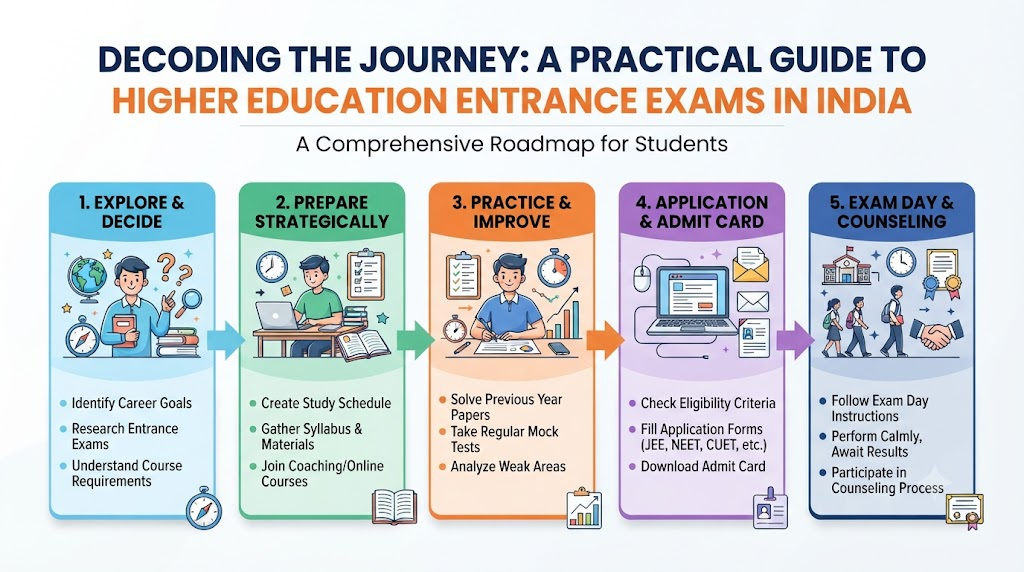
Choosing the right exam should always start with your career interests rather than peer pressure. Consider a structured decision-making framework:
- Identify Your Core Interest: Are you fascinated by building machines, healing patients, designing products, or analyzing legal statutes?
- Evaluate Your Academic Strengths: Match your school subjects and natural inclinations with the demands of the course.
- Check Institutional Requirements: Look up the colleges you hope to attend and verify what specific entrance scores they accept.
- Review Time and Resources: Assess whether you have adequate time to prepare alongside your regular school or college schedule.
Check Eligibility Before Preparing
Before investing months into preparation, carefully read the official information bulletin. Eligibility criteria often specify minimum percentage requirements in qualifying exams, mandatory subject combinations, age limits, and nationality rules. Eligibility requirements can shift from one admission cycle to another, so always rely on the most recent official notifications rather than outdated blog posts or old brochures.
Understand the Syllabus and Exam Pattern
Do not start studying blindly. Obtain the current official syllabus and examine the question paper structure. Pay close attention to:
- Core subjects and unit weightage.
- Question formats (multiple-choice questions, numerical entry, or subjective answers).
- Total duration and section timing.
- Marking schemes, including whether there is negative marking for incorrect answers.
Create a Realistic Preparation Plan
A sustainable study plan balances concept building, regular practice, and adequate rest. Break down your syllabus into manageable weekly goals. Combine your school or college studies with entrance exam preparation by focusing deeply on fundamental concepts rather than rote memorization. Consistent revision and timed practice tests are far more effective than last-minute cramming.
Use Official Exam Information
Always rely directly on official examination authorities for critical updates, including exam dates, application windows, admit card releases, official answer keys, scorecards, and counselling schedules. Educational platforms serve as helpful guides to understand the landscape, but official websites remain the single source of truth for your applications.
Common Mistakes Students Make
- Following the Crowd: Choosing an exam simply because friends are taking it often leads to burnout and mismatched career goals.
- Ignoring Eligibility Rules: Failing to check minimum percentage criteria or required school subjects can result in disqualification after clearing the test.
- Using Outdated Materials: Relying on old syllabi or outdated exam patterns can waste valuable study time.
- Skipping Mock Tests: Studying theory without practicing full-length mock tests under timed conditions leaves students unprepared for exam-day pressure.
- Missing Deadlines: Forgetting application windows or fee payment dates can force you to wait an entire year before applying again.
Managing Multiple Entrance Exams
Many students register for multiple related exams to maximize their options. While this is a common strategy, it requires careful coordination. Ensure that the syllabi overlap reasonably so you do not scatter your focus across completely unrelated subjects. Keep track of conflicting exam dates and distinct application deadlines to avoid administrative chaos.
Entrance Exam Preparation Resources
Building a solid foundation requires reliable resources. Essential study materials include official syllabi, previous years’ question papers, sample papers, standard textbooks (such as NCERT books for foundational concepts), and structured mock test series. Focus on understanding core principles deeply rather than collecting excessive reference books.
Role of Parents in Entrance Exam Planning
Parents play a vital role in a student’s higher education journey by providing emotional stability, helping organize schedules, keeping track of important deadlines, and ensuring access to appropriate study resources. Maintaining an open, supportive dialogue helps reduce anxiety and keeps preparation focused on steady, healthy progress.
How GurukulGalaxy Can Help Students
Navigating the higher education landscape can feel daunting, but you do not have to do it alone. GurukulGalaxy is designed to be a supportive educational guide, helping students and parents make sense of complex admission processes, exam patterns, and preparation requirements. Our platform features dedicated exam hubs covering major national assessments like JEE Main, NEET UG, CUET UG, UCEED, and CUET PG, alongside institution and course directories. While we provide clear, structured information to reduce confusion, we always encourage students to verify final details directly with official examination authorities.
Frequently Asked Questions
What are higher education entrance exams?
These are standardized tests used by universities and institutions to evaluate candidates and select students for admission into undergraduate, postgraduate, or professional courses.
Do I need to take an entrance exam for every college course?
No. Many colleges and institutions offer admissions based on school board marks, graduation percentages, merit lists, or direct institutional evaluations rather than an entrance test.
Which entrance exams are common after Class 12?
Major exams after Class 12 include JEE Main for engineering, NEET UG for medical programs, CUET UG for general university admissions, CLAT for law, and UCEED or NID DAT for design.
Is NEET UG compulsory for all medical-related courses?
NEET UG is required for undergraduate medical and dental programs like MBBS and BDS under national rules, but certain specialized health science courses may have distinct admission criteria.
What is CUET UG used for?
CUET UG is a national entrance test used by participating central and state universities to streamline undergraduate admissions across various academic programs.
Can I prepare for multiple entrance exams at the same time?
Yes, provided the exams share overlapping syllabi and similar core subjects. However, preparing for too many entirely different exams can dilute your focus.
How do I know if I am eligible for an entrance exam?
You must check the official information bulletin released by the exam conducting body for the current admission cycle to verify educational qualifications, age limits, and subject requirements.
Are entrance exam scores valid for more than one year?
Most undergraduate and postgraduate entrance exam scores are valid only for the specific academic admission cycle for which the test was conducted.
What is the difference between an entrance exam and an eligibility test?
An entrance exam is used to secure admission into a course or college, whereas an eligibility test (such as UGC NET) establishes your qualification for professional roles like teaching or research fellowships.
Where should I check official exam dates and application forms?
You should always check the official website of the specific exam conducting authority or governing ministry for authentic dates, application portals, and notification updates.
Conclusion
Higher education entrance exams are important stepping stones that connect your school or college background with your future career aspirations. Because entrance requirements vary significantly by course, institution, and education level, starting with your desired field of study is always the best approach. Once you identify your academic goals, carefully review the required entrance tests and verify current eligibility rules through official channels. By staying organized, relying on authentic information, and pacing your preparation thoughtfully, you can navigate your higher education journey with confidence. Explore reliable exam guides on GurukulGalaxy to support your planning every step of the way.