Introduction
The shift toward modern software delivery requires more than just understanding individual technologies. Software development and operations teams must work closely together to build, test, and release applications efficiently. Building these capabilities demands a clear understanding of engineering principles, automated workflows, and modern cloud environments. Developing these technical skills becomes much easier when learners follow a structured path rather than studying tools at random. Platforms like DevOpsSchool.org provide the educational resources, technical roadmaps, and training materials needed to help beginners and experienced professionals organize their learning journey effectively.
Understanding the Evolution of Software Delivery
Modern software delivery relies on speed, reliability, and automation. Traditional development often separated writing code from managing infrastructure, leading to delays and deployment bottlenecks. Today, software development and IT operations operate as a unified continuous process. This transformation depends heavily on automation, continuous integration, and continuous delivery. By automating repetitive tasks, engineering teams reduce manual errors and release updates more frequently. Understanding these foundational shifts helps practitioners see why learning modern methodologies is essential for building scalable applications and maintaining stable systems.
Why Structured Technical Learning Matters
Mastering modern technical practices without a plan can quickly become overwhelming. The technology ecosystem includes numerous tools, frameworks, and cloud platforms, making it difficult to know where to begin. A structured approach ensures that learners build their knowledge progressively, starting with essential concepts before moving to advanced automation and infrastructure management. Structured learning helps practitioners connect theoretical concepts with real-world applications. Instead of memorizing tool commands, learners understand the underlying architecture of software pipelines and infrastructure systems. This method builds long-term competence, enabling engineers to adapt as new technologies emerge.
What Learners Should Understand Before Getting Started
DevOps Fundamentals
Basic DevOps concepts center around collaboration, automation, and continuous improvement. Development and operations teams share responsibility for the entire software lifecycle, from initial code commit to production monitoring. Automation serves as the core mechanism that connects these stages, enabling fast and reliable releases.
Essential Technical Skills
Building technical competence requires a solid grasp of fundamental technologies. Essential skills often include Linux administration, networking basics, version control with Git, and basic scripting. These foundations provide the necessary background for managing servers, writing automation scripts, and tracking code changes.
Understanding the Learning Requirements
Every learner starts from a different background. Beginners may need extra time to understand command-line environments and networking basics, while experienced system administrators or developers can focus directly on automation pipelines and cloud platforms. Recognizing current skill levels helps learners choose the right starting point without feeling discouraged.
Building a Structured DevOps Learning Path
Approaching technical education in a logical sequence ensures steady progress. A well-designed DevOps learning path typically begins with foundational IT skills before advancing to collaborative tools and automated delivery workflows.
- Master basic operating systems, specifically Linux command-line operations.
- Learn networking fundamentals, including IP addressing, DNS, and HTTP protocols.
- Adopt version control practices using Git for tracking code changes and team collaboration.
- Practice basic scripting using languages like Bash or Python for task automation.
- Explore continuous integration and continuous delivery concepts to understand software build pipelines.
- Study cloud computing fundamentals and provision basic virtual resources.
- Learn containerization basics to package applications consistently across environments.
- Explore infrastructure automation tools to manage environments programmatically.
- Build practical projects that combine these skills into a complete delivery workflow.
Understanding the DevOps Roadmap
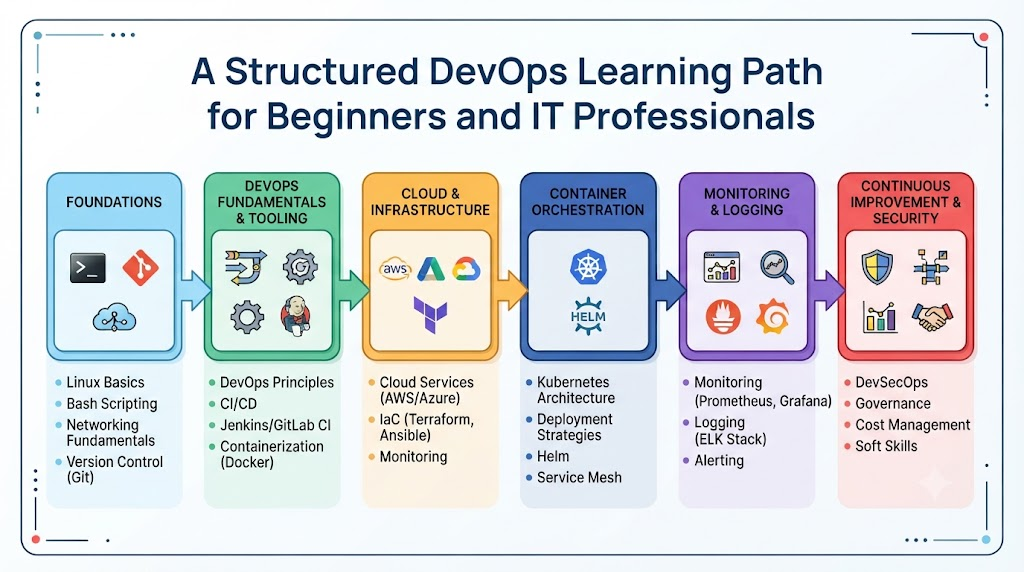
A DevOps roadmap serves as a visual guide that helps learners organize their studies across multiple domains. Organizing technical knowledge into distinct phases prevents gaps in understanding and ensures balanced skill development.
| Learning Stage | Key Skills or Topics | Practical Learning Goal |
| Foundational Skills | Linux, Networking, Git, Basic Scripting | Navigate command-line environments and manage source code repositories. |
| Automation & CI/CD | Continuous Integration, Build Pipelines, Testing | Automate software building and testing processes using CI/CD tools. |
| Containers & Orchestration | Docker, Container Registries, Kubernetes Basics | Package applications into containers and deploy them locally. |
| Cloud & Infrastructure | Cloud Providers, Infrastructure as Code | Provision and manage cloud resources programmatically. |
| Monitoring & Operations | Logging, Metrics, Observability, Alerting | Set up basic monitoring dashboards for application health tracking. |
Exploring the DevOps Engineer Roadmap
Stepping into an engineering role requires a deeper dive into technical execution, system architecture, and operational stability.
Core Technical Foundations
Day-to-day engineering tasks depend heavily on strong foundational skills. Professionals must troubleshoot Linux servers, analyze network traffic, manage code branches, and write scripts to automate routine administrative checks.
Automation and CI/CD Skills
Engineers design and maintain pipelines that build, test, and deploy applications automatically. Understanding how to configure build agents, manage artifact repositories, and handle deployment failures is critical for maintaining reliable delivery cycles.
Cloud and Infrastructure Skills
Modern systems run primarily on cloud infrastructure. Engineers work with cloud services, container platforms, and Infrastructure as Code frameworks to provision and scale environments consistently without manual intervention.
Monitoring and Operational Skills
Operational stability requires continuous visibility into application behavior. Engineers implement monitoring tools, configure log aggregation, and establish alerting rules to detect and resolve system issues before they impact users. Following a structured DevOps engineer roadmap ensures that practitioners acquire these operational competencies in a logical order.
Understanding Essential DevOps Tools
Tools simplify execution, but understanding their underlying purpose matters more than memorizing features. DevOps tools support different stages of the software delivery lifecycle, helping teams collaborate and automate workflows.
Version Control Tools
Version control systems allow multiple developers to work on the same codebase simultaneously without overwriting each other’s changes. Git remains the standard tool for tracking code history, managing branches, and coordinating team contributions.
CI/CD Tools
Continuous integration and continuous delivery tools automate the process of building, testing, and deploying code. Platforms like Jenkins, GitLab CI/CD, and GitHub Actions execute predefined pipelines whenever new code is committed to a repository.
Containerization and Orchestration Tools
Containers package an application along with its dependencies, ensuring it runs reliably across different environments. Docker provides containerization capabilities, while Kubernetes manages scaled container deployments across clusters of servers.
Infrastructure as Code Tools
Infrastructure as Code tools allow teams to define server environments, networks, and storage configurations using configuration files rather than manual setup. Terraform and Ansible are widely used to provision and configure infrastructure consistently.
Monitoring and Observability Tools
Monitoring tools collect metrics, logs, and traces from applications and infrastructure. Prometheus and Grafana help engineering teams visualize system performance and troubleshoot operational bottlenecks.
Understanding DevOps Tools Comparison
Evaluating different technologies helps organizations and learners select the right utility for specific technical requirements. A objective DevOps tools comparison looks at primary use cases, community support, and operational overhead rather than declaring a single tool superior.
| Tool | Main Purpose | Common Use Case | Important Consideration |
| Git | Version Control | Tracking source code changes and team collaboration | Requires disciplined branching strategies. |
| Jenkins | CI/CD Automation | Building and testing software pipelines | Requires maintenance of build agents and plugins. |
| Docker | Containerization | Packaging applications with dependencies | Focuses on single-node container creation. |
| Terraform | Infrastructure as Code | Provisioning cloud infrastructure resources | Uses declarative configuration files. |
Exploring DevOps Certifications
Technical credentials help validate structured learning and provide clear study objectives. DevOps certifications generally measure a practitioner’s understanding of specific cloud platforms, automation tools, or engineering methodologies. Certification preparation encourages learners to study official documentation, practice hands-on labs, and test their knowledge against established industry standards. However, credentials work best when paired with practical project experience and a genuine understanding of underlying technical principles.
Creating a DevOps Certification Roadmap
Organizing exam preparation around personal career goals prevents unnecessary studying and keeps learning focused. A thoughtful DevOps certification roadmap begins with foundational cloud or Linux credentials before advancing to specialized container orchestration or security certifications. Learners should assess their existing knowledge, review official exam domains, and gain practical experience with relevant tools before scheduling any examination.
Understanding the SRE Roadmap
Site Reliability Engineering applies software engineering principles to IT infrastructure and operations. An SRE roadmap focuses heavily on system availability, latency, performance, and capacity planning. Practitioners learn to define service-level indicators and service-level objectives, manage error budgets, and automate incident response. While DevOps emphasizes collaboration and delivery speed, SRE places additional emphasis on reliability, scalability, and reducing operational toil.
Exploring the Platform Engineering Roadmap
Platform Engineering focuses on building internal developer platforms that simplify software delivery for development teams. A Platform Engineering roadmap covers platform fundamentals, self-service infrastructure provisioning, and developer experience. Platform engineers build reusable templates and standardized workflows, allowing developers to deploy applications securely without managing underlying infrastructure complexities manually.
DevOps Skills and Career Opportunities
Organizations actively seek professionals who understand automation, cloud management, and continuous delivery. Open DevOps jobs typically require a blend of technical skills, problem-solving abilities, and collaborative experience across development and operations teams. Developing practical competence through personal projects and structured study prepares candidates for technical roles such as DevOps Engineer, Cloud Engineer, Site Reliability Engineer, or Platform Engineer.
How DevOpsSchool.org Relates to the Learning Journey
DevOpsSchool.org serves as a dedicated educational platform designed to help learners navigate technical roadmaps and skill development. By offering structured training resources, certification guides, and learning materials, the platform helps individuals understand complex engineering concepts. Exploring these resources allows beginners and working professionals to align their studies with practical industry requirements.
Practical Ways to Apply DevOps Knowledge
Theory alone is not enough to master engineering concepts. Learners should actively practice by building personal projects in local or cloud environments.
- Set up a local development environment and initialize a Git repository.
- Write a basic script to automate a repetitive local file management task.
- Build a simple continuous integration pipeline that runs automated tests on code commits.
- Package a sample web application inside a Docker container.
- Provision a virtual server using an Infrastructure as Code template.
- Configure a basic monitoring dashboard to track system resource usage.
Common Challenges in DevOps Learning
Learners often encounter obstacles such as tool fatigue, unclear priorities, and difficulty connecting theoretical guides to real-world infrastructure. Attempting to learn too many technologies at once can lead to burnout. Overcome these challenges by focusing on one core concept at a time, building solid fundamentals in Linux and scripting before tackling advanced container orchestration and cloud platforms.
Best Practices for a Practical DevOps Learning Journey
- Build strong foundations in operating systems and networking before exploring advanced automation.
- Follow a structured learning path tailored to current experience levels.
- Practice regularly with real tools in hands-on lab environments.
- Document technical projects to reinforce learning and track progress.
- Study official documentation rather than relying solely on third-party tutorials.
- Maintain patience and focus on steady, incremental skill improvement.
How to Choose a Suitable DevOps Learning Path
Selecting the right learning path depends on individual background, current job responsibilities, and long-term career goals. Developers transitioning into operations may want to focus on infrastructure and CI/CD pipelines, while system administrators might prioritize cloud computing and container orchestration. Assessing available study time and practical project requirements helps create a realistic and manageable schedule.
Frequently Asked Questions
What does a DevOps roadmap include?
A DevOps roadmap outlines the logical steps required to learn modern software delivery, starting with operating system basics and moving through version control, automation, CI/CD, and cloud infrastructure.
How can a beginner start a DevOps learning path?
Beginners should start by learning Linux fundamentals, networking basics, and Git version control before exploring scripting and automation tools.
What technical skills are relevant to a DevOps engineer roadmap?
Essential skills include Linux administration, CI/CD pipeline configuration, containerization, Infrastructure as Code, and basic system monitoring.
Which DevOps tools should learners explore first?
Learners typically start with Git for version control, Docker for containerization, Jenkins or GitHub Actions for CI/CD, and Terraform for infrastructure management.
How do DevOps certifications support technical learning?
Certifications provide structured study objectives and help validate a practitioner’s knowledge of specific tools or cloud platforms.
How does SRE differ from DevOps?
While DevOps focuses on bridging development and operations to accelerate software delivery, SRE applies software engineering practices specifically to ensure system reliability and availability.
What does a Platform Engineering roadmap cover?
A Platform Engineering roadmap focuses on internal developer platforms, self-service infrastructure, and improving developer experience through standardized tooling.
How should learners approach a DevOps tools comparison?
Learners should compare tools based on their primary use cases, community support, integration capabilities, and operational requirements rather than feature lists alone.
How can professionals organize a DevOps certification roadmap?
Professionals should review their existing skills, identify knowledge gaps, and select certifications that match their current career focus and technical goals.
What technical competencies matter most for DevOps jobs?
Employers look for practical experience with automation pipelines, cloud platforms, container management, and collaborative problem-solving abilities.
Conclusion
Mastering modern software delivery requires a balanced approach combining foundational technical knowledge, structured learning paths, and consistent hands-on practice. By understanding automation workflows, cloud infrastructure, and operational reliability, practitioners can build resilient systems and advance their careers. Platforms like DevOpsSchool.org provide valuable educational resources and roadmaps to support learners throughout their technical journey. Continuing to practice with real tools and exploring structured training materials will ensure long-term success in the evolving technology landscape.