Introduction
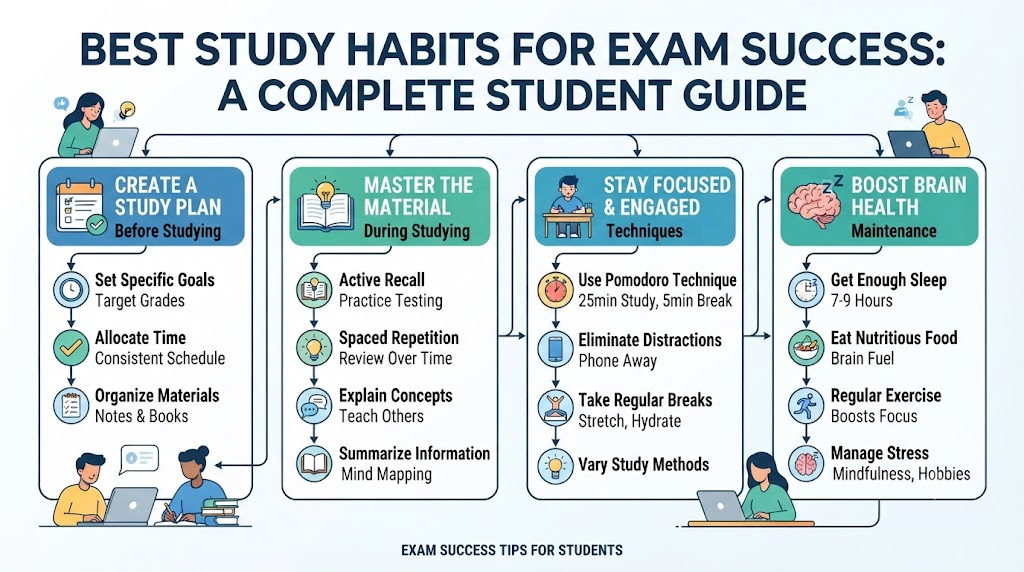
Exam preparation often feels overwhelming when students rely on last-minute cramming or unstructured reading routines. Developing effective study habits transforms academic preparation into an organized, stress-free process that builds true understanding. Small, consistent daily improvements yield far better results than exhausting marathon study sessions.
This comprehensive guide explores practical strategies to master your time, improve memory retention, and approach exams with confidence. GURUKULGALAXY.COM provides valuable educational resources and guidance to support your academic journey every step of the way. Building the right habits today sets the foundation for lifelong learning and academic achievement.
Understanding the Importance of Good Study Habits
Study habits are the routine actions and mental frameworks students use to acquire and process knowledge. Consistent routines remove the daily friction of deciding when and what to study. When learning becomes a predictable habit, cognitive energy focuses on understanding concepts rather than fighting procrastination.
Consistency always outperforms intensity in academic performance. Studying for one hour every single day builds stronger neural pathways than cramming for seven hours right before an exam. Regular review prevents the forgetting curve from erasing newly acquired information from your memory.
Active learning transforms passive listeners into engaged critical thinkers. Engaging with the material through questioning, solving problems, and summarizing prevents mental fatigue. Clear goals give every study session a distinct purpose and measurable outcome.
Studying for long hours does not guarantee better comprehension or higher marks. Exhausted brains struggle to retain details, connect ideas, or solve complex problems accurately. Quality of focus matters far more than the sheer volume of time spent sitting at a desk. Shifting focus toward steady progress reduces anxiety and eliminates panic. Celebrating small milestones keeps motivation high throughout the academic term. Steady effort compounds over time, leading to deep mastery and reliable exam readiness.
Setting Clear and Realistic Study Goals
Broad goals like “study biology” or “get better grades” often lead to confusion and delay. Vague objectives do not give your brain a clear action plan to follow. Transforming general intentions into specific daily targets makes starting much easier.
Break large chapters down into smaller, manageable topics before you begin your session. Instead of aiming to finish an entire textbook unit, target a specific subsection or problem set. Specificity removes ambiguity and directs your full attention toward an achievable outcome.
Track your completed work daily to visualize your progress and maintain momentum. Checking off finished tasks triggers a sense of accomplishment that fuels your drive for the next session. Keep a dedicated notebook or digital list for your daily academic targets.
Differentiate between broad objectives and actionable study tasks clearly. For example, change a vague thought about chemistry into reviewing one specific chemical reaction and answering five practice questions. Actionable tasks have clear starting and ending points.
Set realistic goals based on your available time and current preparation level. Pushing yourself is healthy, but setting impossibly large targets leads to frustration and burnout. Assess your schedule honestly before committing to daily study quotas.
Creating a Practical Study Timetable
A well-structured timetable balances school, college, coaching, homework, breaks, and personal responsibilities. Without a plan, precious hours slip away through distraction and poor time allocation. Your schedule should act as a supportive framework rather than a rigid prison.
Divide your available hours wisely between difficult subjects, easier topics, practice questions, and revision blocks. Tackle challenging subjects when your mental energy peaks, usually during morning hours or right after a restful break. Pair difficult topics with lighter review tasks to maintain steady productivity.
Always leave buffer time in your schedule for unexpected tasks, family duties, or fatigue. Life happens, and inflexible schedules break down at the first minor interruption. Building in flexibility ensures you can recover missed study blocks without feeling guilty.
Adjust your timetable weekly based on what you actually achieved and what remains pending. Rigid routines that never adapt to changing exam dates or syllabus updates quickly fail. Treat your schedule as a living document that evolves with your academic needs.
Consider this illustrative daily study schedule as a flexible starting point. Every learner has a unique routine, energy level, and daily commitment. Adapt these time blocks to fit your personal lifestyle and academic demands.
| Time Block | Suggested Activity | Purpose |
| 06:00 AM – 07:00 AM | Review key notes or vocabulary | Fresh morning focus for memory retention |
| 04:00 PM – 05:30 PM | Tackle challenging new subject topics | High energy for complex problem solving |
| 05:30 PM – 05:45 PM | Short break, hydration, and movement | Rest physical body and clear mental clutter |
| 05:45 PM – 06:45 PM | Practice numericals or active recall | Apply theoretical knowledge practically |
| 08:30 PM – 09:15 PM | Light revision of the day’s lessons | Solidify memory before sleeping |
Choosing a Suitable Study Environment
Your physical surroundings directly impact your ability to concentrate and retain information. A clean, quiet, and organized study space signals your brain that it is time to focus. Cluttered desks invite distraction and scatter your attention across unrelated items.
Ensure your study area has adequate lighting to prevent eye strain and physical fatigue. Comfortable seating promotes good posture and keeps you alert during long study blocks. Keep essential materials like pens, notebooks, and textbooks within arm’s reach before starting.
Manage background noise and digital distractions proactively during every study session. Put your phone in another room or turn on Do Not Disturb mode to block notifications. Close unnecessary browser tabs if you are studying using a computer or tablet.
Students who share rooms or live in busy homes can create micro-study spaces. Use noise-cancelling headphones or soft earplugs to block out household sounds. Face your desk toward a blank wall to minimize visual distractions in shared living areas.
An expensive desk or a dedicated private study room is never required for success. Many high-achieving students use kitchen tables during quiet hours or local libraries effectively. Resourcefulness and focus matter far more than luxurious furniture or expensive gear.
Using Active Learning Instead of Passive Reading
Passive reading involves running your eyes over textbook pages without truly engaging. This creates an illusion of competence where material feels familiar but cannot be recalled later. Active learning requires you to interact directly with the concepts being studied.
Ask yourself questions from memory immediately after reading a single paragraph or section. Close your textbook and try to explain the core concept in your own simple words. If you stumble during the explanation, reread that specific section carefully.
Solve practice problems, draw concept maps, and create diagrams to visualize complex relationships. Diagrams turn abstract text into concrete mental models that are much easier to remember. Transforming words into visual sketches strengthens your brain’s coding pathways.
Teach difficult topics out loud to an imaginary audience or a study partner. Teaching forces you to organize your thoughts logically and exposes hidden gaps in your understanding. If you cannot explain a topic simply, you have not mastered it yet.
Apply these active methods across different subjects, from mathematics and science to history and literature. Write your own practice questions for humanities subjects and solve varied problem sets for STEM subjects. Active engagement turns tedious study hours into rewarding problem-solving sessions.
Practising Active Recall and Spaced Repetition
Active recall is the practice of retrieving information from memory without looking at notes. Instead of rereading a chapter five times, test your ability to pull facts out unaided. This mental effort strengthens memory traces and makes future retrieval much faster.
Spaced repetition involves reviewing study material across increasing time intervals instead of cramming. Review a new topic after one day, then three days, then a week, and then a month. This scientifically proven technique defeats the natural human forgetting curve.
Flashcards are exceptional tools for combining active recall and spaced repetition in daily study routines. Write a question on the front of a card and the concise answer on the back. Digital flashcard apps can also schedule your reviews automatically based on difficulty.
Create short quizzes, topic summaries, and scheduled revision sessions to test your progress regularly. Treat every self-test as a low-stakes game rather than a stressful examination. Identifying what you forgot now saves you from failing on exam day.
These methods boost learning efficiency, but they do not eliminate the need for effort. Consistency remains the bridge between learning techniques and actual academic success. Trust the process and maintain your regular review intervals.
Taking Useful Notes
Many students waste valuable hours copying entire textbook chapters word for word into notebooks. Transcription without thinking is a slow and ineffective way to prepare for exams. Effective notes capture core concepts, key terms, and personal insights concisely.
Use headings, bullet points, and numbered lists to structure your notes logically. Highlight key terms and write down brief definitions in your own words. Include relevant examples, diagrams, and questions that highlight tricky areas for later review.
Adapt your note-taking method to match the specific subject and learning task you face. Cornell notes work wonderfully for history lectures, while mind maps excel for biology chapters. Choose formats that help your brain connect related ideas quickly.
Review your notes within twenty-four hours of taking them to lock in the initial learning. Add missing details and clarify messy handwriting while the lecture is still fresh. Clean notes make final exam revision fast, organized, and stress-free.
GURUKULGALAXY.COM offers helpful templates and subject summaries that complement your personal study notes. Combining your classroom notes with structured online guides deepens your overall subject mastery. Use every available resource to build a comprehensive revision library.
Managing Time and Avoiding Procrastination
Procrastination rarely stems from laziness; it usually arises from anxiety, overwhelm, or unclear starting steps. When a task feels too big, your brain instinctively looks for comfortable distractions to escape. Making the first step microscopic removes the emotional barrier to starting.
Break large assignments into tiny, non-threatening tasks that take less than ten minutes to complete. Tell yourself you will just write the introduction or solve three practice problems. Once you overcome inertia, momentum often carries you through the rest of the study session.
Set a clear starting time every day and communicate your study window to family members. Remove physical and digital distractions before your scheduled study block begins. Preparation prevents last-minute wandering and hesitation.
Use focused study sessions paired with short, mandatory breaks to maintain high concentration levels. The Pomodoro technique, working for twenty-five minutes followed by a five-minute break, is a popular option. Adjust session lengths to suit your personal attention span and energy levels.
Never beat yourself up over occasional delays or moments of lost focus. Acknowledge the distraction gently, refocus your attention, and return to the task immediately. Self-compassion keeps motivation alive, whereas guilt often triggers another cycle of procrastination.
Revising Regularly Before Exams
Revision should start weeks before your exam date, not the night before. Waiting until the final days forces you into panic-driven cramming that induces high stress. Regular weekly reviews keep your entire syllabus fresh and accessible in your long-term memory.
Revisit earlier topics systematically by dedicating weekend hours to cumulative review sessions. Review past mistakes from homework assignments, quizzes, and mock tests to ensure errors are not repeated. Correcting past misunderstandings builds unbreakable academic confidence.
Create a dedicated revision calendar based on your exam dates, subject difficulty, and remaining topics. Allocate more study blocks to subjects that challenge you while maintaining lighter reviews for stronger subjects. A visual calendar keeps you accountable and prevents unpleasant surprises.
Balance new learning with steady revision of previously studied material every single week. Dedicate seventy percent of your time to new concepts and thirty percent to cumulative review. This balanced ratio ensures your knowledge base expands while older topics remain sharp.
GURUKULGALAXY.COM provides structured exam revision checklists and study planners to guide your final preparation weeks. Utilizing these guides helps you organize your syllabus logically without missing critical topics. Stay consistent with your revision calendar to walk into exams feeling completely prepared.
Solving Practice Papers and Mock Tests
Past papers, sample questions, and mock tests are goldmines for serious exam preparation. They reveal the exact exam format, question styles, and marking weightages used by examiners. Solving practice papers bridges the gap between passive knowledge and active exam performance.
Always practise under strict time limits that mimic actual examination conditions. Do not look at your textbook or notes while attempting a mock test. Simulating real exam pressure trains your brain to retrieve information under stress.
Check your answers meticulously after finishing every practice paper using official marking schemes. Record every mistake in a dedicated error log and analyze why you got it wrong. Was it a conceptual gap, a calculation error, or a misread question?
Repeat difficult questions from your error log a few days later to ensure permanent correction. Mastering your past mistakes guarantees steady score improvements across successive practice tests. Reliability comes from learning directly from your weak points.
Always use reliable study materials that match your exact board syllabus and official exam pattern. Avoid outdated question papers that no longer reflect current testing standards. GURUKULGALAXY.COM features verified practice guides and sample questions aligned with modern academic standards.
Studying Difficult Subjects and Topics
Encountering difficult subjects can trigger feelings of inadequacy and frustration among students. When a topic refuses to make sense, mindless rereading only deepens your confusion. You must change your strategy and approach the barrier from a different angle.
Review basic foundational concepts before trying to master advanced applications of a difficult topic. Often, learning gaps from previous academic years cause current struggles in advanced chapters. Pinpoint the exact sub-topic where your understanding breaks down.
Work through step-by-step solved examples before attempting independent problem sets. Analyze each step of the solution to understand the underlying logic and methodology. Ask teachers, classmates, or tutors for help when you hit an absolute roadblock.
Revisit your errors with curiosity rather than frustration. Every wrong answer is a valuable data point showing you exactly what needs more attention. Transforming frustration into investigative curiosity changes your relationship with hard subjects.
Seek support from suitable learning resources, mentors, or educational platforms whenever necessary. GURUKULGALAXY.COM provides clear conceptual explanations and academic guidance across various subjects. Never hesitate to seek help when challenging topics test your patience.
Balancing Study Time With Sleep, Breaks, and Health
Academic success requires physical stamina, mental clarity, and emotional well-being. Sacrificing sleep for extra study hours is a counterproductive strategy that impairs cognitive function. Sleep deprivation wrecks memory consolidation, attention span, and emotional stability.
Take short, intentional breaks during study sessions to stretch your legs, drink water, and rest your eyes. Physical movement boosts blood flow to your brain and revitalizes your focus. Never skip meals or rely exclusively on sugary snacks and caffeine during exam season.
Make adequate nightly sleep a non-negotiable part of your daily exam preparation routine. Your brain processes and organizes memories while you sleep deeply at night. Aim for consistent sleep schedules even during heavy study weeks.
Maintain a healthy balance between rigorous academic study and personal relaxation activities. Go for a short walk, listen to calming music, or spend time with family to decompress. A balanced lifestyle sustains high performance over long academic terms.
Listen to your body and mind when they signal fatigue or burnout. Pushing through exhaustion yields diminishing returns and invites illness. Rest is an essential component of productivity, not a reward you earn only after working to exhaustion.
Managing Exam Stress and Building Confidence
Exam stress is a natural reaction to high-stakes academic evaluations and performance expectations. However, paralyzing anxiety can block your ability to think clearly during exams. Proper preparation, realistic goals, and structured routines are your best defenses against excessive stress.
Break large exam preparations into small, manageable daily tasks to maintain a calm mindset. Practising under timed exam conditions builds familiarity and lowers fear of the unknown. Prepare all your required stationery, admit cards, and materials the night before every exam.
Use calm breathing techniques when you feel tension rising during study or exam moments. Inhale slowly through your nose for four seconds, hold for four seconds, and exhale smoothly. Controlled breathing slows your heart rate and restores mental clarity instantly.
Speak with a trusted adult, school counselor, or teacher if academic stress ever becomes overwhelming. You do not have to carry heavy anxiety alone; help is always available. Building emotional resilience is just as important as mastering academic subjects.
GURUKULGALAXY.COM encourages students to maintain balanced perspectives and positive mindsets toward examinations. Exams measure your current understanding of a syllabus, not your personal worth or future potential. Approach every test as an opportunity to showcase your hard work.
| Effective Study Habit | Primary Benefit for Students | Practical Implementation Tip |
| Setting Clear Goals | Eliminates ambiguity and directs focus | Break chapters into daily, actionable tasks |
| Active Recall | Strengthens long-term memory pathways | Test yourself from memory without notes |
| Spaced Revision | Defeats the natural human forgetting curve | Review topics at 1, 3, 7, and 30-day intervals |
| Timed Practice | Improves speed and exam temperament | Solve past papers under strict time limits |
| Strategic Breaks | Restores mental energy and attention span | Use short 5-minute movement breaks |
| Error Logging | Prevents repetition of past mistakes | Maintain a dedicated notebook for wrong answers |
Common Study Mistakes to Avoid
Relying exclusively on last-minute cramming is the most common and destructive study mistake students make. Cramming stores information in short-term memory, which vanishes quickly under exam pressure. Build consistent daily study routines to ensure lasting knowledge retention.
Studying without a clear plan leads to wasted hours and scattered attention. Multitasking while studying, such as texting friends with textbooks open, destroys comprehension quality. Eliminate distractions completely during your designated focus blocks.
Ignoring weak subjects because they feel uncomfortable creates massive blind spots in your exam preparation. Face your difficult subjects early when your energy levels are highest. Skipping revision in favor of learning endless new material leaves previous topics unpolished.
Copying notes blindly without understanding the underlying concepts wastes valuable preparation time. Always process information through active recall, questions, and summaries. Avoid comparing your study progress or speed with classmates, as everyone learns at a different pace.
Keep your study methods constructive, patient, and tailored to your personal needs. Learn from common mistakes without falling into self-judgment or discouragement. Every academic challenge is an opportunity to refine your learning strategy.
Building a Study Routine That Lasts
Lasting habits are never built by changing your entire lifestyle overnight. Attempting to study for six hours a day immediately after a long break leads to rapid burnout. Start small by committing to just twenty minutes of focused study daily.
Track your daily consistency using a simple calendar checklist or habit tracker. Review your study timetable weekly to identify what worked well and what needs adjustment. Flexibility and self-awareness ensure your routine survives busy weeks.
Focus on steady consistency and deep learning rather than chasing hollow perfection. Some days will be more productive than others, and that natural fluctuation is completely normal. Keep showing up for your study blocks with a calm and determined mindset.
Celebrate your progress and reward yourself for maintaining consistent study habits over time. A sustainable routine balances academic rigor with personal health, hobbies, and rest. Build your ideal study life brick by brick with patience and dedication.
A Practical Weekly Exam Preparation Plan
A structured weekly plan balances new learning, cumulative review, practice testing, and rest. This illustrative weekly schedule helps you organize your subjects efficiently without burning out. Adapt this template to fit your specific syllabus and upcoming exam dates.
| Day of the Week | Primary Focus Area | Suggested Activities | Purpose of Session |
| Monday | New Subject Topics | Read new chapter, make concise notes | Learn foundational concepts |
| Tuesday | Problem Solving & Practice | Solve numericals, answer exercise questions | Apply theory to practice |
| Wednesday | Cumulative Revision | Review notes from last week using active recall | Strengthen long-term memory |
| Thursday | Challenging Topics | Focus on difficult concepts, consult resources | Clear specific learning blocks |
| Friday | Mock Practice | Attempt timed section from a past paper | Simulate exam conditions |
| Saturday | Error Analysis & Rest | Review mock mistakes, light reading, rest | Correct errors and recharge |
| Sunday | Weekly Planning | Organize next week’s goals and tidy study space | Prepare for a productive week |
How GURUKULGALAXY.COM Can Support Student Learning
GURUKULGALAXY.COM serves as a dedicated digital partner in your academic journey. The platform provides structured educational resources, subject guides, and exam preparation tips designed for students. Making use of these curated learning tools helps you streamline your daily study routines.
Explore GURUKULGALAXY.COM for academic guidance that complements your classroom learning effectively. Accessing reliable study materials saves you time and keeps your exam preparation focused. Let the platform support your pursuit of academic excellence with clear, practical insights.
Frequently Asked Questions
1. What are the best study habits for exam success?
The most effective habits include setting specific daily goals, practising active recall, using spaced repetition, solving timed practice papers, and maintaining consistent revision schedules.
2. How many hours should students study each day?
Study hours depend on your grade level and exam goals, but consistent daily focus of two to four high-quality hours outperforms erratic marathon study sessions.
3. How can I create an effective study timetable?
Balance difficult subjects with lighter topics, include time for practice and revision, allocate short breaks, and leave buffer time for unexpected daily tasks.
4. How can I remember what I study for longer?
Combine active recall with spaced repetition, create concise summary notes, and teach difficult concepts out loud in your own simple words.
5. What is the best way to revise before exams?
Start revision weeks in advance, revisit previous topics systematically, solve past papers under timed conditions, and maintain an error log to correct past mistakes.
6. How can I avoid distractions while studying?
Put your phone in another room, turn on Do Not Disturb mode, close unnecessary browser tabs, and study in a clean, quiet environment.
7. Is studying late at night effective?
Late-night studying can lead to fatigue and poor memory retention for students who lack adequate nightly rest; consistent daytime study is generally more productive.
8. How can I improve concentration during study sessions?
Use the Pomodoro technique with short breaks, break large tasks into tiny steps, and eliminate digital notifications before starting your work.
9. How can I prepare for exams without last-minute stress?
Follow a structured study timetable, begin revision early, maintain realistic daily targets, and prepare all required study materials in advance.
10. What should I do if I cannot understand a difficult topic?
Review foundational concepts, work through step-by-step solved examples, break the problem into smaller parts, and ask teachers or trusted resources for guidance.
Final Thoughts
Exam success is never the result of a single night of intense cramming. It is the natural outcome of small, daily habits built with patience and consistency. When you break large goals into manageable steps, use active recall, and maintain a balanced routine, learning becomes a rewarding experience rather than a stressful chore. Trust your preparation, protect your health, and keep moving forward one day at a time. GURUKULGALAXY.COM remains your steady partner in this academic journey, offering the resources and guidance you need to achieve your goals with confidence.