Introduction
Shipping software fast feels great until a small change breaks live traffic. Many teams rush new features to market without checking basic operational steps. Later, they face slow rollouts, unclear alerts, or surprise cloud bills. Engineering leaders need a clear way to judge system health before and after release.
A production readiness assessment helps teams spot weak spots early. It connects daily coding work with steady cloud operations. Good habits in Kubernetes, platform engineering, and reliability work together to protect users. Teams also need clear ways to manage incidents, track system health, and control cloud spend.
This guide explains how engineering teams build steady operations across modern clouds. You will learn how to check readiness, grow DevOps habits, and fix broken pods. We also cover platform roadmaps, reliability goals, security checks, monitoring, and cost control. Resources from OpsRoadmaps help teams map out these steps in a clear order.
What a Production Readiness Assessment Covers
A production readiness assessment checks whether a service can run safely for real users. It looks past basic code tests and checks real-world operating needs. Teams review stability, scaling, security, and recovery before going live.
Application stability comes first. Teams check how the app handles bad inputs, slow databases, and sudden traffic spikes. Infrastructure readiness checks compute nodes, networks, load balancers, and storage limits.
Security, Recovery, and Monitoring Checks
Security controls protect user data and system endpoints. Teams review role access, secrets handling, network rules, and patch status. Backup and recovery checks test whether data restores fast after a mistake.
Monitoring and alerting make sure teams see trouble right away. Teams check log flow, key metrics, and alert routing before launch. Clear runbooks and on-call schedules also help engineers act fast.
Why Readiness Is an Ongoing Habit
Readiness is not a one-time gate before a first launch. Systems change every week as teams ship code, update packages, and scale traffic. A single checklist cannot promise a smooth release on its own.
Teams do best when they review readiness with each major change. Small, regular checks catch drift before it causes an outage. This habit keeps systems safer as traffic and features grow.
Running a DevOps Maturity Assessment
A DevOps maturity assessment shows how well people, tools, and processes work together. It helps teams see how smoothly code moves from a laptop to production. Honest reviews point out slow handoffs and manual bottlenecks.
Key areas include source control, code reviews, automated tests, and release pipelines. Infrastructure as Code keeps cloud setup repeatable and easy to track. Strong feedback loops let teams fix bugs while the context is fresh.
Comparing Basic, Developing, and Advanced Habits
Basic teams often rely on manual steps and shared servers. Releases happen less often, and fixes can take days. Alerts may be noisy or tied to one person’s memory.
Developing teams use version control, basic pipelines, and shared cloud templates. Testing runs more often, and teams track deployment frequency and lead time. Advanced teams automate most routine checks, test recovery often, and refine work using real data.
Turning Assessment Results Into Action
A maturity score means little without a clear next step. Teams should pick two or three gaps that hurt delivery the most. Fixing broken tests or slow builds often unlocks faster progress.
Teams also need to respect their current starting point. Jumping straight to complex tools can slow everyone down. Steady progress builds trust across developers, operators, and security staff.
Kubernetes Production Readiness and Troubleshooting
Running containers at scale takes careful planning. A Kubernetes production readiness checklist helps teams verify cluster health and workload setup. It covers node capacity, pod placement, upgrades, and cluster access.
Workloads need clear resource requests and limits so noisy pods do not starve neighbors. Liveness and readiness probes help Kubernetes route traffic and restart stuck apps. Teams should also plan pod disruption budgets, network policies, and encrypted secrets.
Storage, Backups, and Cluster Safety
Stateful apps need reliable storage classes and clear volume lifecycle rules. Teams must test cluster and volume backups before a major data loss happens. High availability across zones helps apps survive single-zone issues.
Role-based access control limits who can change cluster resources. Security settings should block privileged containers and untrusted images where possible. Good logging and cluster metrics give teams clear visibility during busy hours.
Kubernetes CrashLoopBackOff Troubleshooting
Kubernetes CrashLoopBackOff troubleshooting starts with understanding what the status means. A pod enters CrashLoopBackOff when a container starts, exits with an error, and keeps restarting. Kubernetes backs off between restarts to protect the node.
Common causes include app startup bugs, bad commands, or missing environment variables. Wrong config maps, missing secrets, or out-of-memory kills also trigger restarts. Failing health probes or missing dependencies can stop a container from staying up.
Practical Steps and Commands for Broken Pods
Start by checking pod status and recent events across the namespace. Run kubectl get pods to see restart counts and current state. Then run kubectl describe pod <pod-name> to read scheduling and container events.
Next, check container logs to see why the process exited. Use kubectl logs <pod-name> for the current run or kubectl logs <pod-name> --previous for the prior crash. Run kubectl get events to spot wider cluster or node issues.
Do not simply delete or restart pods to hide the error. Read the logs and events first so you fix the root cause. Once you find the real issue, update the code, config, or resource limit cleanly.
| Focus Area | Core Practice | Main Operational Benefit |
| Readiness Check | Review stability, backups, and alerts | Catches launch gaps before release |
| DevOps Maturity | Track pipelines, IaC, and testing | Speeds up safe software delivery |
| Kubernetes Setup | Set probes, limits, and RBAC | Keeps workloads steady under load |
| CrashLoopBackOff | Inspect logs, events, and config | Fixes root causes instead of guessing |
Platform Engineering Adoption Roadmap
Platform engineering builds shared internal tools to ease developer toil. A platform engineering adoption roadmap helps teams roll out self-service features step by step. The goal is to give developers safe defaults without extra ticket queues.
An internal developer platform can offer golden templates, CI/CD hooks, and service catalogs. Good platform work treats internal developers like real users. Clear docs, simple guardrails, and strong platform monitoring keep adoption smooth.
How to Roll Out Platform Capabilities
Start by mapping how developers build, test, and ship code today. Look for repeated setup tasks that waste hours every sprint. Talk with developers to learn where friction slows them down.
Define clear goals and build a small platform foundation first. Add simple self-service paths, gather honest feedback, and refine each piece over time. Not every company needs a large platform team, so match scope to real needs.
SRE Adoption Roadmap and Reliability Goals
Site Reliability Engineering applies software habits to keep systems dependable. An SRE adoption roadmap helps teams set clear reliability targets and reduce toil. Instead of chasing perfection, teams focus on what users truly notice.
Teams define Service Level Indicators to measure key user actions, like request success or speed. Service Level Objectives set target levels for those indicators over time. Service Level Agreements define formal promises made to external customers.
Error Budgets, Toil, and Post-Incident Reviews
An error budget tracks how much unreliability a service can allow. When error budgets stay healthy, teams can ship changes with more speed. When budgets run low, teams pause risky changes and focus on stability.
Teams also track toil, which is repetitive, manual work with no lasting value. Automating routine fixes frees engineers to improve system design. After incidents, blameless reviews help teams learn without pointing fingers.
Incident Management Maturity Model
When systems fail, clear response steps save precious time. An incident management maturity model guides teams from ad-hoc fire drills to calm coordination. It helps teams detect issues faster and communicate clearly with stakeholders.
Good incident work starts with clean alerts tied to real user impact. Teams set clear severity levels, assign a clear incident lead, and update status channels on schedule. Clear escalation paths make sure the right experts join quickly.
Growing From Reactive Fixes to Learning
Early-stage teams often react late and rely on one hero engineer. Chats get noisy, and recovery steps live in people’s heads. More mature teams use playbooks, clear roles, and calm handoffs during long events.
After recovery, teams run root cause reviews and track corrective actions. Sharing lessons across teams prevents the same mistake in another service. Better incident habits reduce stress, though no process removes every failure.
DevSecOps Implementation Roadmap
Security works best when teams build it into daily delivery. A DevSecOps implementation roadmap adds security checks across coding, builds, and releases. It helps teams catch flaws early while fixes are still small.
Key practices include secure coding habits, static code scans, and dependency checks. Teams also scan container images, check infrastructure templates, and block leaked secrets. Strong identity controls, policy rules, and runtime checks support ongoing compliance.
Sharing Security Across the Delivery Pipeline
Begin by reviewing current risks, tools, and team habits. Pick a few high-value checks and wire them into CI/CD pipelines. Make sure developers get clear messages instead of noisy false alarms.
Define who owns each fix, track findings, and review trends often. Security is a shared duty across developers, operations, and security engineers. Automation helps catch known issues fast, but human review still matters.
Observability Maturity Model
Good monitoring tells you when a threshold crosses a line. An observability maturity model helps teams understand why complex systems behave that way. It uses system outputs to ask new questions during unknown problems.
Observability rests on three main data types: metrics, logs, and traces. Metrics track numeric trends over time, such as error rates or CPU use. Logs record detailed events, and traces follow requests across services.
Moving From Basic Alerts to Deep Insight
Basic setups often watch raw server stats and use crowded dashboards. Engineers still struggle to trace slow requests across microservices. Higher maturity adds structured logs, distributed tracing, and user journey checks.
Clear dashboards and focused alerts help teams find root causes faster. Adding more charts or alerts does not help if they lack context. Good telemetry turns guesswork into clear evidence during tough debugging.
| Practice Area | Key Focus | How Teams Grow |
| Platform Engineering | Self-service tools and templates | Start small, gather feedback, iterate |
| SRE Practices | SLIs, SLOs, error budgets, toil | Pick critical apps, automate repeat work |
| Incident Management | Triage, roles, comms, reviews | Move from ad-hoc fixes to shared playbooks |
| DevSecOps | Code, image, and secret checks | Add key CI/CD gates and clear ownership |
| Observability | Metrics, logs, and traces | Connect signals to trace real user flows |
Cloud Cost Optimization Roadmap
Cloud bills can climb fast when workloads grow without clear limits. A cloud cost optimization roadmap helps teams trim waste without hurting speed or uptime. It connects engineering choices directly to monthly cloud spend.
Teams start by reviewing current bills and tagging resources by owner or app. Right-sizing compute instances and removing idle disks or volumes often helps right away. Autoscaling and scheduled scaling match capacity to real demand across hours and days.
Balancing Cost, Speed, and Reliability
Review storage tiers and cross-zone network traffic to spot hidden spend. Set budget alerts early so teams see spikes before month-end. Where workloads are steady, reserved capacity plans may lower unit costs.
Never cut costs so hard that reliability or security drops. Keep enough buffer for traffic peaks, backups, and safe failover. Regular cost reviews keep spending aligned with business value.
Turning Assessments Into a Practical Roadmap
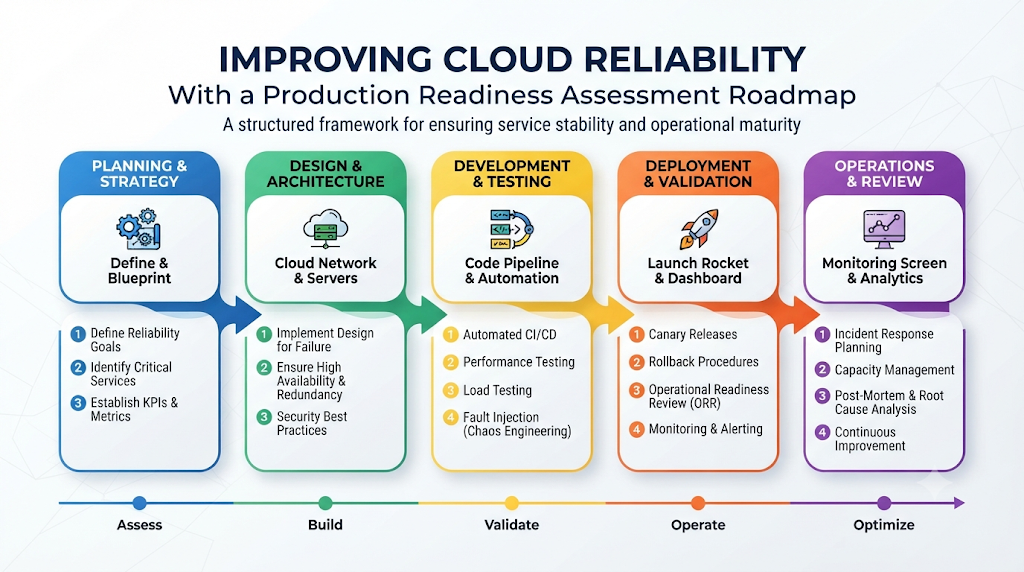
Assessments only create value when teams act on what they find. Start by reviewing your current stack, listing top risks, and setting clear goals. Rank fixes by impact and effort so teams tackle high-value items first.
Assign clear owners and set realistic timelines for each step. Avoid buying or adopting every new tool at once. Small, steady changes stick better and avoid overwhelming busy engineers.
Teams can connect production readiness, DevOps maturity, and platform work over time. Adding SRE targets, security checks, observability, and cost reviews keeps growth balanced. OpsRoadmaps offers practical roadmap perspectives that help teams plan these improvements in a logical order. Every organization has its own constraints, so adapt roadmaps as your systems evolve.
Frequently Asked Questions
What is a production readiness assessment? It is a structured review of whether a service is safe for production. Teams check stability, security, backups, scaling, and monitoring before release. It helps catch operational gaps early.
How does a DevOps maturity assessment help engineering teams? It shows how well your team automates builds, tests, and deployments. You can compare current habits against stronger practices. The results help you plan practical delivery improvements.
What belongs on a Kubernetes production readiness checklist? Include resource requests and limits, health probes, scaling rules, and network policies. Also check secrets, persistent storage, backups, access control, and cluster monitoring. Good setup helps workloads stay stable in production.
What causes Kubernetes CrashLoopBackOff errors? CrashLoopBackOff happens when a container keeps crashing and restarting. Common causes include app errors, bad arguments, missing environment variables, or memory limits. Failing probes and config errors can also cause restarts.
How should a team start a platform engineering adoption roadmap? Start by reviewing developer workflows and finding repeated manual tasks. Build a small internal platform foundation with simple self-service options. Collect developer feedback and expand only where it adds clear value.
What are the main parts of an SRE adoption roadmap? Teams define SLIs and SLOs to measure reliability for critical services. They use error budgets to balance feature speed with stability. Reducing toil and running blameless post-incident reviews are also key steps.
How does an incident management maturity model improve response? It helps teams move from reactive guesswork to clear, repeatable response steps. Teams define severity levels, clear roles, escalation paths, and post-incident reviews. This structure reduces confusion during outages.
What steps belong in a DevSecOps implementation roadmap? Start by finding key security risks and current gaps in your pipeline. Add code, dependency, container, and secret checks into CI/CD workflows. Define clear ownership and fix issues steadily over time.
How does an observability maturity model differ from basic monitoring? Basic monitoring often tracks simple server metrics and static thresholds. An observability maturity model connects metrics, logs, and traces across services. This deeper view helps teams diagnose complex issues faster.
How do you build a cloud cost optimization roadmap safely? Review current spend, tag resources, and remove unused items first. Right-size workloads, tune autoscaling, and set budget alerts before making big changes. Always protect reliability, performance, and security while cutting waste.
Conclusion
Reliable cloud systems come from steady habits rather than last-minute fixes. Checking readiness, growing DevOps practices, and fixing Kubernetes issues early protects daily operations. Clear platform work, reliability targets, incident habits, security checks, observability, and cost reviews all support healthy growth.
A clear roadmap helps teams focus on what matters most right now. Instead of chasing every trend, teams can make steady improvements that last. Using resources from OpsRoadmaps can help guide your next steps as your engineering practices mature.