Introduction
Modern software teams face heavy operational pressure. Servers crash, deployment pipelines break, and routine maintenance tasks consume h0e engineering time. To solve this, many organizations explore modern automation models. But what happens when routine operations become entirely automated? This shift is known as NoOps, a forward-looking approach where infrastructure management runs without manual intervention. This guide explores what NoOps means, how it changes software delivery, and why understanding what is NoOps can help modern tech teams build faster systems.
Understanding NoOps and Core Principles
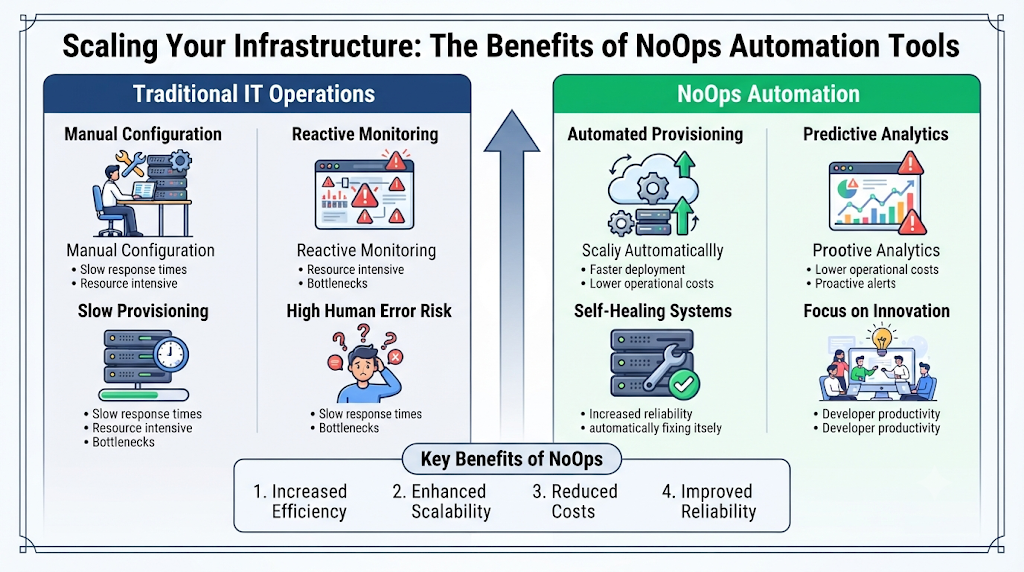
NoOps stands for “No Operations.” It does not mean that operations work disappears entirely. Instead, it means that routine operational tasks run through complete automation. Developers and platform teams build systems that provision, monitor, and scale themselves without manual tickets or human intervention. When a system can fix its own errors, teams can focus entirely on writing software features.
To achieve this level of automation, organizations rely on modern NoOps automation tools. These tools handle infrastructure provisioning, configuration management, and deployment workflows. When teams implement these practices correctly, manual server management becomes a relic of the past. Companies looking to master these workflows often explore structured learning through NoOpsSchool to build practical expertise.
How NoOps Differs From Traditional DevOps
Many professionals wonder how this model compares to existing practices. When exploring NoOps vs DevOps, it helps to understand their core goals. DevOps bridges the gap between software development and IT operations. It encourages collaboration, shared responsibility, and automated pipelines.
NoOps takes this automation a step further. In a true NoOps environment, underlying infrastructure abstracts away from developers entirely. Developers write code, push it to a repository, and automated cloud platforms handle the rest. While DevOps relies on collaboration between dedicated operations staff, NoOps minimizes or removes routine operational tickets through advanced self-healing systems and serverless architecture.
The Role of Infrastructure as Code
Infrastructure as Code forms the backbone of modern cloud automation. Instead of manually configuring servers, engineers write declarative configuration files. These files define the desired state of the cloud environment.
Tools like Terraform allow teams to spin up entire production environments with a single command. This approach ensures consistency across development, staging, and production. Automated pipelines apply these configuration changes safely. When paired with GitOps workflows, code changes automatically trigger infrastructure updates without manual oversight.
| Automation Layer | Primary Purpose | Common Technologies |
|---|---|---|
| Provisioning | Setting up cloud infrastructure | Terraform, CloudFormation |
| Orchestration | Managing container lifecycles | Kubernetes, Docker |
| Delivery | Automating code deployment | GitHub Actions, ArgoCD |
| Observability | Monitoring system health | Prometheus, Grafana |
Cloud-Native Architecture and Containerization
Modern applications run on cloud-native architectures. Containers and orchestrators make automated scaling and self-healing possible. Docker packages applications with their dependencies. Kubernetes manages those containers across distributed clusters.
If a container fails, Kubernetes automatically restarts it on a healthy node. This self-healing behavior removes the need for midnight pager alerts for basic server crashes. Engineers can design resilient applications that handle traffic spikes and hardware failures independently.
Automated Monitoring and Observability
Automation requires deep visibility into system performance. Without manual checks, teams must rely on automated monitoring and observability platforms. These tools collect logs, metrics, and traces in real time.
Advanced monitoring platforms use automated anomaly detection to spot issues before they impact users. When an error occurs, automated incident response tools can trigger rollbacks or restart services instantly. This proactive approach keeps uptime high and reduces manual troubleshooting effort.
Building Expertise With Structured Education
As cloud automation grows, professionals seek reliable ways to validate their skills. Structured learning paths help engineers master advanced cloud concepts, container orchestration, and automated pipelines. Gaining formal recognition through a recognized NoOps certification demonstrates a deep understanding of modern infrastructure automation.
Professionals can start with a comprehensive NoOps training course to learn foundational automation principles. Those aiming for technical leadership often pursue specialized NoOps architect training to design scalable, self-healing cloud systems. Organizations that want to validate deep technical skills look for engineers holding a verified NoOps engineer certification.
Team Leadership and Strategic Management
As organizations transition toward automated cloud environments, leadership needs change as well. Managers must understand how to guide teams through operational transformation. Leaders need to measure deployment frequency, lead time, and mean time to recovery.
Pursuing a targeted NoOps manager certification helps IT leaders align automation strategies with business goals. Managers learn how to build high-performing platform engineering teams, foster a culture of continuous improvement, and govern cloud spending effectively. Education providers like NoOpsSchool offer focused resources for leaders navigating these cultural and technical shifts.
Professional Services and External Expertise
Implementing advanced automation requires specialized knowledge. Many organizations do not have internal specialists to execute a complete cloud transformation. In these cases, businesses turn to external partners for specialized guidance.
Engaging expert NoOps consulting services helps companies evaluate their current infrastructure maturity. Consultants design custom automation strategies, implement robust CI/CD pipelines, and optimize cloud costs. When businesses need extra hands for a specific migration project, they often hire NoOps freelancers through trusted technical networks to accelerate their development cycles.
Frequently Asked Questions
What does NoOps mean in cloud computing? NoOps refers to an IT environment where routine operational tasks are fully automated. It allows software to run, scale, and heal itself without manual infrastructure management.
Does NoOps mean DevOps is dead? No, NoOps is an evolution of DevOps rather than a replacement. It builds upon DevOps principles by automating away repetitive operational tasks so developers can focus entirely on code.
What skills are needed for a NoOps career? Professionals need strong knowledge of cloud computing, Infrastructure as Code, container orchestration, CI/CD pipelines, and automated monitoring tools.
How does Infrastructure as Code support NoOps? Infrastructure as Code lets teams define servers and networks using configuration files. This allows automated systems to provision and update infrastructure consistently without manual intervention.
Can small businesses implement NoOps? Yes, smaller companies often benefit from NoOps by using managed cloud services and serverless architectures that require minimal operational overhead.
What is the difference between NoOps and SRE? Site Reliability Engineering focuses on applying software engineering to operations and reliability. NoOps aims to automate operational tasks entirely to remove the need for traditional operations work.
How do self-healing systems work? Self-healing systems use automated monitoring and orchestrators to detect failures. When a service crashes, the platform replaces or restarts it automatically.
Why do companies hire NoOps consultants? Companies hire external consultants to assess their infrastructure maturity, design secure CI/CD pipelines, and accelerate their transition to automated cloud environments.
How can I start learning NoOps practices? You can start by studying cloud fundamentals, learning Infrastructure as Code tools, and exploring specialized learning platforms like NoOpsSchool.
Does NoOps eliminate all human work in IT? No, NoOps does not eliminate human work. People are still needed to design system architecture, write application logic, set security policies, and govern automation workflows.
Conclusion
NoOps represents the next logical step in cloud infrastructure automation. By removing manual operational burdens through Infrastructure as Code, containerization, and self-healing systems, organizations can deliver software faster and more reliably. Whether you are an engineer looking to upgrade your technical skills, a manager guiding a cloud transition, or an organization seeking expert consulting, embracing automation is essential for modern success. Platforms like NoOpsSchool provide the educational foundation needed to navigate this transition. Start your automation journey today and build resilient systems for the future.