Introduction
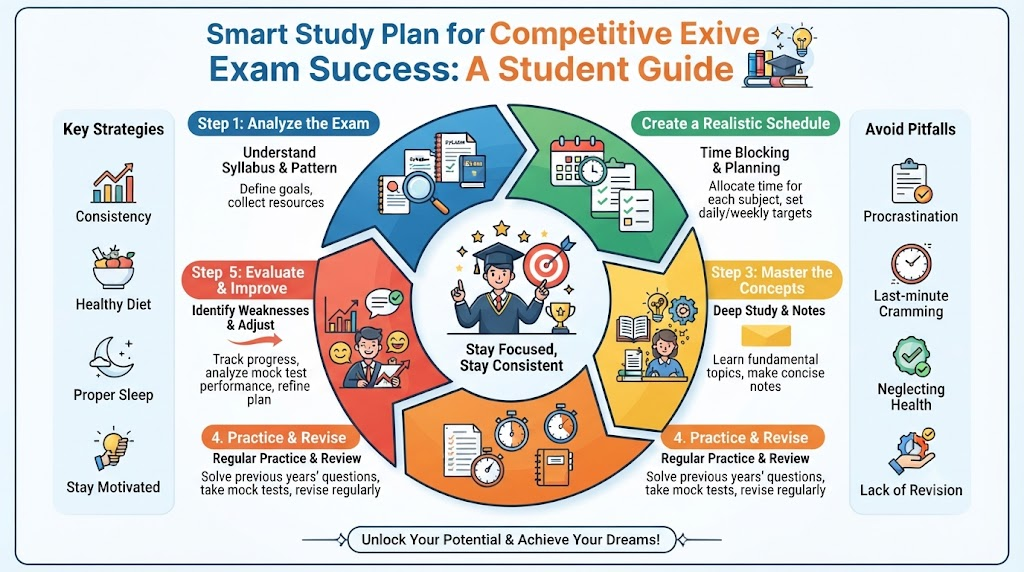
Picture this: It is a quiet Sunday evening, and your study desk is piled high with heavy reference books, printed syllabus sheets, and old practice papers. You stare at the sheer volume of topics left to cover, wondering where to begin. Should you start with mathematics, review yesterday’s physics notes, or practice reasoning questions? Within minutes, confusion sets in, and another hour slips by without opening a single page. If this scenario feels familiar, you are not alone. Thousands of students face this exact dilemma every single day when preparing for competitive examinations. Competitive exam preparation can quickly become overwhelming without a clear direction. Many aspirants mistakenly believe that success requires spending twelve to fourteen hours a day staring at books, often leading to mental burnout and diminishing returns. True productivity, however, comes from a structured approach. A smart study plan for competitive exam success is not about rigid confinement; it is a practical roadmap designed to organize your learning, streamline your revision, and maximize your retention. A useful study plan adapts to your specific examination requirements, your available hours, your current preparation level, and your personal responsibilities. This guide will walk you through the exact steps needed to build a realistic, balanced, and sustainable study strategy.
Understanding the Importance of a Smart Study Plan
A well-organized study plan acts as the backbone of your entire preparation journey. Without a structured outline, studying often becomes random and reactive, driven by sudden panic rather than logical progress.
When you implement a structured competitive exam study plan, you immediately gain several distinct advantages:
- Syllabus Breakdown: Large, daunting syllabi are divided into smaller, digestible weekly and daily tasks.
- Consistent Revision: Built-in revision intervals ensure that you do not forget foundational concepts as you learn new ones.
- Targeted Practice: Dedicated practice sessions bridge the gap between theoretical knowledge and exam-day application.
- Stress Reduction: Knowing exactly what to study each day eliminates the mental fatigue of decision-making.
- Progress Tracking: Regular check-ins allow you to measure your growth honestly and adjust your approach when a topic takes longer than expected.
Studying without clear goals leads to scattered efforts and uneven preparation. By trading chaos for structure, you transform your daily routine into a reliable engine for steady progress.
Start by Understanding Your Competitive Exam
Before you map out a single week on your calendar, you must fully understand the examination you are targeting. Every entrance test, government recruitment drive, and scholarship exam has its own unique DNA.
Review the Official Notification
Always rely on official examination notifications and bulletins for current information. Do not depend on secondhand summaries or outdated forums. Check the official website for:
- The Official Syllabus: Know exactly which topics are included and excluded.
- Examination Pattern: Understand whether the test is computer-based or pen-and-paper, and whether it includes objective or subjective questions.
- Marking Scheme: Note how many marks are awarded for correct answers and whether there is negative marking for incorrect responses.
- Eligibility and Deadlines: Keep track of educational qualifications, age limits, and important application dates.
Different examinations demand distinct preparation methods. For instance, objective-based entrance tests require high-speed calculation, elimination techniques, and factual recall. In contrast, descriptive civil services exams demand deep analytical writing, structured arguments, and broad conceptual understanding. Tailor your preparation strategy to match the specific demands of your target test.
Assess Your Current Preparation Level
Once you know what the exam demands, you need an honest evaluation of where you currently stand. Jumping straight into an advanced mock test without knowing your baseline can be discouraging, while assuming you know everything leads to careless mistakes.
Conducting a Self-Assessment
- Take a Diagnostic Test: Attempt a previous year’s paper under timed conditions without looking at the answers.
- Review the Syllabus Topic-by-Topic: Go through the official syllabus checklist and classify every topic into one of three categories:
- Familiar Topics: Concepts you understand well and can solve quickly.
- Partially Understood Topics: Areas where you grasp the theory but struggle with application or speed.
- Unfamiliar Topics: Chapters you have never studied or find extremely difficult.
An honest assessment helps you create a realistic study plan. Instead of wasting valuable weeks studying chapters you have already mastered, you can direct your energy toward strengthening your weak areas.
Set Clear and Achievable Study Goals
Vague intentions like “I will study hard this week” rarely produce results. A smart study plan relies on clear, concrete, and achievable objectives that guide your daily actions.
Breaking Down Your Targets
- Long-Term Goals: Outline what you want to achieve over the next three to six months, such as completing 80% of the core syllabus.
- Medium-Term Goals: Set monthly milestones, such as finishing specific subject modules or completing three full-length practice tests.
- Short-Term Goals: Establish daily and weekly targets, such as mastering a specific chapter and solving fifty practice questions related to it.
Prioritize learning outcomes over counting study hours. Sitting with a book for six hours while distracted yields far less value than two hours of deeply focused, distraction-free studying. Focus on completing specific tasks rather than simply logging time.
Create a Realistic Daily Study Timetable
Your daily timetable must fit your real life. Whether you are a full-time student managing college lectures, a working professional balancing a job, or an aspirant dedicating all your working hours to preparation, your schedule must respect your practical commitments.
Designing Your Routine
- Identify Peak Energy Hours: Determine whether you focus best in the early morning, late afternoon, or evening, and reserve those hours for your most challenging subjects.
- Include All Essentials: Allocate time for new concept learning, question practice, daily revision, short breaks, meals, and adequate rest.
Below is an illustrative daily timetable for a student with approximately six available study hours. You should adjust this template to fit your personal schedule and exam requirements.
Table 1: Sample Daily Study Timetable
| Time | Activity | Purpose |
| 7:00 AM–8:30 AM | Difficult subject or new concepts | Build understanding during a focused session |
| 8:30 AM–9:00 AM | Break and breakfast | Rest and refresh |
| 9:00 AM–10:30 AM | Second subject | Cover planned syllabus topics |
| 10:30 AM–11:00 AM | Short break | Maintain focus |
| 11:00 AM–12:00 PM | Practice questions | Apply concepts and find gaps |
| 12:00 PM–2:00 PM | Lunch and personal time | Rest and manage daily responsibilities |
| 2:00 PM–3:00 PM | Revision | Review previously studied topics |
| 3:00 PM–4:00 PM | Mock questions or error review | Check understanding and correct mistakes |
Divide the Syllabus into Manageable Sections
A massive competitive exam syllabus can feel intimidating when viewed as a single monolithic block. The secret to conquering it lies in systematic division.
- Subject-Level Breakdown: Split the syllabus into primary subject headings based on the exam structure.
- Chapter-Level Breakdown: Divide each subject into individual chapters, assigning an estimated number of study days to each.
- Topic-Level Checklists: Create weekly targets that track completed sub-topics.
Balance difficult topics with familiar ones in your weekly schedule to prevent burnout. Avoid leaving the entire syllabus for the final weeks before the exam. If a particular chapter takes longer than expected, gently adjust your schedule rather than panicking or abandoning your routine.
Prioritize Difficult and Important Topics
Not all topics carry equal weight in a competitive examination. Smart students study with strategic intent, focusing on areas that deliver the highest return on investment.
Determining Topic Priority
- Syllabus Weightage: Review past examination papers to identify which units or chapters appear most frequently.
- Personal Weaknesses: Highlight topics that consistently lower your practice test scores.
- Foundational Interdependence: Prioritize fundamental concepts that unlock understanding in multiple other chapters.
Do not ignore difficult subjects out of fear, but do not spend all your time on familiar topics simply because they feel comfortable. Past question patterns are exceptionally useful for planning your study sequence, but remember that examiners continually introduce fresh twists, so your preparation must remain thorough.
Use Smart Study Techniques for Better Learning
Reading the same textbook chapter three times in a row is rarely an effective way to prepare. Competitive exams test your ability to apply knowledge under pressure, requiring active engagement with the material.
- Active Recall: Close your textbook after reading a section and write down everything you remember from memory, or explain the concept out loud to an imaginary student.
- Spaced Revision: Revisit topics at increasing intervals (such as one day later, one week later, and one month later) to move information into your long-term memory.
- Concept Mapping: Draw diagrams, flowcharts, and mind maps to connect related ideas and visualize complex processes.
- Short Notes: Condense long textbook chapters into concise, bulleted summary sheets that you can review quickly before exams.
Focus on understanding underlying principles rather than relying solely on rote memorization. When you truly grasp why a formula or rule works, you can easily solve unfamiliar application questions on exam day.
Balance Learning, Practice, and Revision
A comprehensive competitive exam preparation strategy rests on three equal pillars: learning new concepts, practicing questions, and revising older topics. Neglecting any one of these pillars weakens your overall preparation.
- Learning Phase: Grasping new theories, attending lectures, and reading reference materials.
- Practice Phase: Solving textbook exercises, numerical problems, and sectional drills.
- Revision Phase: Re-reading short notes, clearing doubts, and revisiting previously solved problems.
Adjust the ratio of these three activities based on your preparation stage. In the early months, lean heavily toward learning and practice. As the examination date draws closer, shift your primary focus toward revision and mock testing.
Make Previous Year Question Papers Part of Your Plan
Previous year question papers are among the most valuable assets in your preparation toolkit. They provide an unvarnished look at how examiners test conceptual understanding.
- Understand the Format: Familiarize yourself with the exact phrasing, question length, and difficulty distribution.
- Identify Knowledge Gaps: Notice which specific sub-topics consistently trip you up during paper analysis.
- Develop Time Management: Practice pacing yourself so you do not spend too much time on a single stubborn question.
Always analyze your answers thoroughly after finishing a past paper. Do not just check your final score; review every incorrect answer to understand whether the mistake stemmed from a conceptual misunderstanding, a calculation error, or poor time management. Remember that past papers reveal historical trends, but they do not guarantee the exact content of upcoming exams.
Use Mock Tests to Measure Your Preparation
Mock tests simulate the real examination environment, testing not just your academic knowledge, but your emotional composure, stamina, and strategic decision-making.
- Start Early: Begin taking topic-wise and sectional mock tests as soon as you finish core chapters.
- Graduate to Full-Length Tests: Transition to timed, full-length mock exams a few months before the actual test date.
- Maintain an Error Log: Record every mistake you make during mock tests in a dedicated notebook and review it weekly.
Treat mock tests as diagnostic learning tools rather than final judgments of your intelligence. A low score on a practice test is a gift; it reveals a vulnerability that you can fix today, preventing it from costing you marks on the actual exam day.
Develop a Consistent Revision Schedule
Without regular revision, the human brain naturally forgets up to 70% of newly learned information within a week—a phenomenon known as the forgetting curve. A consistent revision schedule is your best defense against this memory fade.
- Daily Mini-Reviews: Spend fifteen to twenty minutes at the end of the day reviewing what you studied that morning.
- Weekly Reviews: Dedicate a block of time every weekend to look over all the notes and practice problems from the past six days.
- Monthly Reviews: Revisit major subject modules once a month using your short notes and flashcards.
If you find certain concepts particularly slippery, schedule them for more frequent review sessions until they feel second nature.
Manage Time and Avoid Common Distractions
In the digital age, attention is your most precious currency. Unplanned notifications, endless social media scrolling, and scattered study materials can quietly drain hours of productive time every day.
Practical Distraction Management
- Digital Discipline: Keep your smartphone in another room or use strict focus modes during your study sessions.
- Time Blocking: Assign strict time windows for specific tasks, treating those windows as non-negotiable appointments with your future self.
- Workspace Preparation: Gather all necessary books, pens, notes, and water bottles before you sit down so you never have an excuse to break your focus.
Remember that planned breaks are essential for maintaining concentration. Short, five-minute pauses between intense study blocks help prevent mental fatigue and keep your focus sharp.
Build a Weekly Study Plan That Works
A weekly study framework keeps your preparation organized while offering enough flexibility to handle unexpected life events.
The following table illustrates how a balanced weekly schedule distributes different learning activities.
Table 2: Sample Weekly Study Plan
| Day | Main Study Activity | Supporting Activity |
| Monday | Learn new topics in Subject 1 | Practice related questions |
| Tuesday | Learn new topics in Subject 2 | Revise Monday’s topics |
| Wednesday | Study difficult topics | Solve topic-wise questions |
| Thursday | Cover remaining syllabus topics | Review previous mistakes |
| Friday | Revise important concepts | Take a sectional test |
| Saturday | Practice a mock test | Analyze errors and weak areas |
| Sunday | Weekly revision | Rest and plan the next week |
Use this schedule as a flexible template, adapting the subject names and activities to match your specific examination requirements and personal weekly commitments.
Track Your Study Progress Regularly
What gets measured gets managed. Maintaining a simple study tracker transforms your preparation from a vague feeling of worry into visible, measurable progress.
- Use Simple Tools: A physical study diary, a wall checklist, or a digital spreadsheet works equally well.
- Record Daily Achievements: Check off completed chapters, solved practice sets, and finished revision blocks.
- Evaluate Weekly Trends: Look at your tracker every Sunday to see if you met your weekly targets or if adjustments are necessary.
Focus entirely on your own steady improvement. Comparing your daily progress with other aspirants only creates unnecessary anxiety and distraction.
Balance Study Time with Sleep and Breaks
A sustainable study plan accounts for your physical and mental well-being. Sacrificing sleep, skipping meals, or eliminating physical activity to study extra hours almost always backfires. Chronic sleep deprivation impairs memory consolidation, slows down problem-solving speed, and increases emotional reactivity—the exact opposite of what you need during competitive exam preparation. Maintain a healthy daily routine, eat nutritious meals, and give yourself permission to rest properly at the end of each productive day.
Adapt Your Study Plan as the Exam Approaches
As the examination date draws closer, your preparation priorities must evolve. The strategies that work six months before an exam differ significantly from those needed in the final four weeks.
- Shift from Learning to Refining: Stop trying to master brand-new, complex chapters in the final weeks unless they carry exceptionally high weightage.
- Intensify Mock Testing: Increase the frequency of full-length mock exams to build physical and mental stamina for test day.
- Focus on Error Correction: Dedicate your remaining time to reviewing your error logs, strengthening weak formulas, and polishing your speed.
Keep your final weeks calm, focused, and structured. Trust the foundation you built over months of consistent preparation.
Common Study Planning Mistakes Students Should Avoid
Even well-intentioned students sometimes fall into common preparation traps. Being aware of these pitfalls helps you steer clear of them:
- Copying Timetables Blindly: Trying to follow a rigid schedule designed for someone else without considering your own pace and daily routine.
- Setting Unrealistic Targets: Overloading your daily timetable with impossible goals, leading to immediate discouragement when you fall behind.
- Collecting Too Many Resources: Hoarding dozens of reference books and online PDFs without thoroughly studying even one standard textbook.
- Ignoring Revision: Studying new topics continuously while letting old chapters slip away from memory.
- Avoiding Weak Subjects: Spending all your time on subjects you already enjoy while running away from difficult or unfamiliar topics.
Recognize these habits early and correct them with kindness and patience. Consistency and adaptability always beat perfectionism.
How GurukulGalaxy Supports Students During Exam Preparation
Navigating the vast world of competitive examinations requires reliable guidance, clear information, and structured resources. Platforms like GurukulGalaxy are designed to support students by offering helpful educational insights, examination overviews, and preparation strategies. Whether you are exploring different career paths, researching entrance exam requirements, or looking for practical study tips, having access to clear and organized information makes your decision-making process much smoother. GurukulGalaxy helps students explore competitive exams naturally, empowering them to build informed preparation plans and take confident steps toward their educational goals.
A Practical Study Plan for Different Types of Students
No two aspirants share the exact same daily life. Here is how different students can tailor their study plans to fit their unique circumstances:
- School Students: Focus on aligning your competitive exam preparation with your school board syllabus. Use weekends for deeper problem-solving and mock tests, keeping weekday evenings for regular concept review.
- College Students: Utilize free periods between lectures for quick revision and flashcard practice. Dedicate fixed blocks of time in the evening for intensive chapter study and question practice.
- Working Candidates: Maximize early morning hours before your shift begins for focused study sessions. Use lunch breaks for light revision and dedicate weekends to full-length mock tests and comprehensive reviews.
- Full-Time Aspirants: Treat your preparation like a professional working day. Maintain structured study blocks with scheduled breaks, keeping your schedule balanced between learning, practice, and rest.
Frequently Asked Questions
1. How do I create a smart study plan for competitive exams?
Begin by reviewing the official syllabus and exam pattern, assessing your current knowledge level, setting clear weekly goals, and building a balanced daily timetable that includes learning, practice, revision, and rest.
2. How many hours should I study daily for a competitive exam?
Study hours depend on your personal routine and preparation stage. Quality matters far more than quantity; four to six hours of deeply focused, distraction-free studying is far more effective than twelve hours of passive reading.
3. How can I complete the competitive exam syllabus on time?
Divide the large syllabus into manageable subject blocks and weekly chapters. Track your progress regularly with a checklist, prioritize high-weightage topics, and adjust your schedule when a chapter takes longer than expected.
4. What is the best way to manage time during exam preparation?
Use time-blocking techniques to assign specific hours to specific tasks, keep your study area organized, put away your phone during study sessions, and take planned short breaks to maintain high concentration.
5. How often should I revise topics for competitive exams?
Incorporate daily mini-reviews, weekly summaries, and monthly revisions into your schedule. Spaced repetition helps move information from short-term memory into long-term retention.
6. Are mock tests important for competitive exam preparation?
Yes. Mock tests simulate real exam conditions, help you practice time management under pressure, reveal knowledge gaps, and build the stamina needed for the actual examination.
7. How can I improve concentration while studying?
Create a quiet study space, eliminate digital distractions, prepare your study materials in advance, break large tasks into smaller steps, and use short, scheduled rest pauses to keep your mind fresh.
8. How should I prepare for difficult subjects?
Break difficult topics down into smaller fundamental concepts, review past year questions to understand how examiners test them, allocate your peak energy hours to them, and seek help or explanations when needed.
9. How can I balance school or college with competitive exam preparation?
Combine overlapping syllabus topics between your coursework and your competitive exam, utilize free periods for quick revision, and dedicate your weekends to intensive practice and mock testing.
10. How can GurukulGalaxy help students with competitive exam preparation?
GurukulGalaxy provides helpful educational resources, examination overviews, and structured guidance, helping students explore competitive exams and make informed decisions about their learning journey.
Conclusion
Embarking on competitive exam preparation is a journey that tests not only your academic knowledge, but your patience, resilience, and organizational skills. As we have explored throughout this guide, achieving success is rarely about spending endless, exhausting hours with books. Instead, it is about working with purpose, strategy, and balance. By understanding your examination pattern, assessing your baseline honestly, setting achievable goals, practicing regularly, and maintaining a consistent revision schedule, you transform a daunting syllabus into an achievable path. Remember that platforms like GurukulGalaxy are here to support your educational exploration with useful information and guidance. Build a study plan that respects your individual routine, protect your health and rest, and take steady, confident steps toward your goals every single day.