Introduction
Artificial Intelligence has shifted rapidly from experimental computer science research into the operational backbone of modern commerce. Across software development, cloud operations, financial modeling, and customer intelligence, generative models and automated architectures are reshaping how business value is created and sustained. Yet, as algorithmic capabilities expand, technical leaders, software engineers, and corporate executives encounter significant implementation barriers. Transitioning from early proof-of-concept tests to resilient, production-grade enterprise software requires rigorous engineering practices, continuous data governance, and strategic workforce alignment. Without structural guidance, organizations risk fragmenting their capital on disconnected tools that fail to yield verifiable return on investment.
Overcoming these operational hurdles demands clear, practical educational pathways and actionable execution strategies rather than abstract theoretical academic lectures. Modern enterprises and ambitious professionals require an integrated ecosystem that bridges the gap between conceptual understanding and real-world software engineering. This is where AIUniverse establishes its core purpose—serving as a comprehensive digital learning hub, technical resource center, and strategic advisory platform engineered to help individuals and enterprise teams master artificial intelligence, optimize deployment pipelines, and execute sustainable digital transformations.
What is AIUniverse?
At its core, AIUniverse functions as an all-in-one educational platform, technical resource directory, and strategic advisory service created to democratize artificial intelligence for global learners and modern businesses. Rather than offering static, superficial video courses or isolated syntax exercises, AIUniverse focuses on practical software deployment and system execution. It acts as an authoritative destination where developers, software engineers, data scientists, IT operators, and executive leaders can access structured learning paths, deep technical breakdowns, tool evaluation frameworks, and strategic consulting insights.
AIUniverse was established to tackle a growing crisis across the technology sector: the widening AI skills gap. As modern breakthroughs in Generative AI, Large Language Models (LLMs), Agentic AI, MLOps, and AIOps accelerate, traditional academic curricula struggle to remain aligned with fast-moving industry requirements. AIUniverse bridges this divide by delivering continuously updated learning modules, curated tool benchmarks, hands-on certification paths, and custom enterprise training programs. Whether an individual developer aims to build multi-agent software loops or a corporate CTO needs to architect a multi-cloud model deployment, the platform provides the exact technical framework required to succeed.
In addition to supporting individual skill development, AIUniverse serves as a practical operational roadmap for engineering managers, product directors, and business executives. By pairing technical depth with real-world enterprise use cases, AIUniverse ensures that technical upskilling translates directly into measurable business efficiency, risk reduction, and operational speed.
Why AI Skills Matter Today
Digital maturity in today’s economy is defined by an organization’s and an individual’s fluency in artificial intelligence. Developing practical AI skills is no longer an optional advantage reserved strictly for specialized data science researchers; it has become a fundamental baseline requirement across software engineering, IT infrastructure management, product design, marketing operations, and corporate strategy. As routine manual tasks are automated, professionals who understand model architecture, workflow automation, and tool integration deliver far greater operational impact and problem-solving speed.
From a business perspective, upskilling internal teams is a matter of long-term market competitiveness. Companies that fail to adopt automated workflows, predictive analytics, and agentic execution risk falling behind agile competitors who operate with leaner overhead and faster feature release cycles. However, successful adoption requires much more than purchasing SaaS software subscriptions. It demands an internal workforce that thoroughly understands model limitations, data privacy boundaries, safety guardrails, prompt architecture, and system scalability. Building these internal capabilities allows organizations to innovate rapidly while preserving data integrity and regulatory compliance.
- Career Mobility & Security: Engineers equipped with verifiable credentials in specialized fields like MLOps or Agentic framework design gain significant leverage in the job market, securing pivotal roles in software architecture and technical leadership.
- Elevated Operational Throughput: Individual contributors across both technical and non-technical domains use automated workflows to eliminate administrative tasks, refocusing their energy on strategic initiatives.
- Data-Driven Innovation: Upskilled teams transform raw corporate data into actionable predictive insights, personalized customer experiences, and modern software features.
- Proactive Risk Mitigation: Understanding fundamental machine learning principles enables teams to deploy systems safely, avoiding common traps such as proprietary data leaks, algorithmic bias, unvetted outputs, and regulatory compliance failures.
Comparing Educational Pathways
Selecting an effective learning path is vital for software professionals and enterprise teams. Standard educational platforms frequently focus on theoretical concepts while ignoring the complex realities of production engineering. The comparison table below highlights how traditional educational approaches differ from the practical, production-oriented methodology delivered by AIUniverse.
Table 1: Traditional Learning vs. AIUniverse
| Learning Method | Practical Skills | AI Certifications | Business Readiness | Corporate Training | AI Consulting | Industry Relevance |
| Traditional Online Courses | Theoretical emphasis; minimal exposure to live production codebases. | Generic completion badges with limited market verification value. | Low; relies on clean toy datasets rather than messy enterprise workflows. | Fixed off-the-shelf video modules with no internal stack customization. | Non-existent; platform functions strictly as a static content directory. | Slower update cycles; frequently lags behind modern tooling developments. |
| Academic Bootcamps | Deep theoretical mathematics, but lacks pipeline orchestration skills. | Academic diplomas; high financial cost with long time commitments. | Moderate; strong mathematical basics but weak operational depth. | Rigid schedules that cannot adapt to proprietary enterprise stacks. | None; focused exclusively on individual student enrollments. | Periodic curriculum reviews; often misses rapid agentic software shifts. |
| Self-Taught / Video Tutorials | Fragmented code snippets; prone to poor architectural design habits. | Unverified or non-existent proof of technical execution ability. | Variable; carries high risk of expensive trial-and-error in production. | Inconsistent; relies completely on individual self-direction and searching. | None; relies on informal open-source community discussion boards. | Highly scattered; difficult to separate hype from true production standards. |
| AIUniverse Ecosystem | Production-first execution on architecture, MLOps, and AIOps. | Recognized, industry-aligned credentials backed by functional projects. | High; structured directly around real-world enterprise deployment. | Fully customized modules aligned with internal company tech stacks. | Integrated strategic guidance from initial audit to final deployment. | Continuously updated to reflect state-of-the-art tools and frameworks. |
AI Certification Courses Available
As industry demand for verified engineering capability accelerates, earned credentials allow professionals to prove their technical execution skills. The learning programs provided by AIUniverse go far beyond simple theoretical multiple-choice quizzes. Learners interact directly with production repositories, cloud computing environments, and enterprise deployment tools.
These comprehensive AI certification courses online deliver structured, step-by-step masterclasses engineered for specific engineering tracks. Whether your career goal involves orchestrating autonomous execution agents, automating IT infrastructure management, or deploying machine learning pipelines into production, these courses supply the practical foundation needed to excel.
Agentic AI Certification Course
The artificial intelligence landscape is rapidly evolving from static text generation toward active, autonomous system execution. An agentic AI certification course focuses on teaching software developers how to build, orchestrate, and deploy autonomous agents capable of planning multi-step workflows, interacting with external APIs, querying secure databases, and executing complex tasks with minimal human intervention. Unlike standard conversational bots that merely return text responses, agentic systems utilize dynamic reasoning loops to evaluate objectives, run code, interact with tools, and correct their own operational errors.
In this certification track, engineers gain deep expertise in leading agentic frameworks such as LangChain, AutoGen, and CrewAI. The curriculum covers fundamental architectural pillars, including long-term and short-term memory management, vector database indexing, functional tool integration, and planning algorithms. Learners design both single-agent execution scripts and complex multi-agent collaborative networks where specialized agents work together to execute business operations—such as automated market research, financial auditing, or software bug remediation.
Additionally, the program emphasizes safety, guardrail implementation, and deterministic control boundaries within non-deterministic models. Participants learn how to establish human-in-the-loop validation checkpoints, set strict API rate limits, cap token consumption budgets, and secure sensitive API keys. Graduates exit the program with a fully functional, production-ready agentic system, positioning them at the forefront of modern software engineering.
Key Topics Covered:
- Autonomous Agent Architecture: Perception, memory, planning engines, and dynamic tool execution.
- Multi-Agent Coordination: Structuring collaborative agent teams using CrewAI and AutoGen frameworks.
- API & System Tool Integration: Connecting software agents securely to external enterprise systems.
- Operational Guardrails & Safety: Managing token budgets, preventing infinite loops, and establishing access boundaries.
- Practical Capstone Project: Architecting an end-to-end autonomous business process automation agent.
MLOps Certification Course
Building a machine learning model in a localized environment is only the initial step; moving that model into a live production infrastructure where it reliably serves high-volume user traffic is a completely different engineering challenge. An MLOps certification course equips data scientists, DevOps specialists, and software engineers with the operational methodologies and tools required to automate the full machine learning lifecycle from data ingestion to continuous monitoring.
MLOps (Machine Learning Operations) addresses specific operational hurdles, including data drift, concept decay, model versioning, and continuous re-training protocols. This course guides students through building robust CI/CD (Continuous Integration/Continuous Deployment) pipelines tailored specifically for data and model artifacts. Participants gain hands-on experience using industry-standard open-source and cloud tools like MLflow, Data Version Control (DVC), Kubeflow, and Feast.
Throughout the training, engineers containerize models using Docker, scale endpoints across Kubernetes clusters, and build automated alerting systems for tracking performance drops in real time. Mastering these operational practices allows technical professionals to compress deployment cycles from months to minutes, ensuring corporate machine learning initiatives deliver continuous value.
Key Topics Covered:
- Data & Artifact Management: Versioning massive datasets and feature registries with DVC and Feast.
- Experiment Tracking & Model Registries: Organizing model lineages, parameters, and metrics with MLflow.
- CI/CD Pipelines for ML: Designing automated build, test, and deployment workflows.
- Containerization & Kubernetes Serving: Deploying scalable microservices using Docker and Kubernetes.
- Production Monitoring & Maintenance: Detecting data drift and configuring automated re-training triggers.
AIOps Certification Course
As modern cloud-native systems expand in complexity, traditional IT operations tools struggle to process the overwhelming volume of logs, system events, and performance alerts. An AIOps certification course concentrates on applying artificial intelligence algorithms, machine learning models, and big data analytics to automate IT operations, proactive fault detection, log correlation, and incident remediation.
AIOps (Artificial Intelligence for IT Operations) transforms system administration from a reactive troubleshooting model into a proactive, predictive practice. In this course, IT engineers, system administrators, and Site Reliability Engineers (SREs) learn to aggregate telemetry data across distributed cloud systems and apply machine learning algorithms to reduce operational noise, isolate root causes, and resolve infrastructure issues before end users experience downtime.
Participants gain practical experience building automated self-healing workflows where AI models not only flag infrastructure anomalies but also execute auto-scaling commands, self-correcting scripts, or intelligent ticket routing. Mastering these advanced operational strategies positions certified professionals as essential assets for enterprises maintaining high-availability cloud infrastructure.
Key Topics Covered:
- Telemetry Data Processing: Ingesting high-velocity logs, metrics, traces, and system events at scale.
- Predictive Anomaly Detection: Utilizing unsupervised machine learning algorithms to flag system outliers.
- Noise Filtering & Event Correlation: Grouping millions of operational log alerts into root-cause incidents.
- Automated Infrastructure Remediation: Configuring self-healing scripts and auto-scaling policy loops.
- Enterprise Observability Platforms: Integrating custom machine learning models into tools like Datadog and Elastic.
Corporate AI Training Programs
Upskilling individual technical employees in isolation is rarely sufficient for enterprises navigating major technological shifts. Organizations require structured, cohesive, and customized corporate AI training solutions built directly around their proprietary tech stacks, compliance standards, and strategic business goals. AIUniverse provides specialized corporate training frameworks designed to elevate overall workforce capability, reduce technical debt, and foster an internal culture of continuous technical innovation.
These enterprise programs go far beyond standard video collections. AIUniverse collaborates directly with corporate executives, engineering directors, and HR leaders to assess existing skill levels and build targeted learning paths. Whether the objective is training business analysts on prompt engineering and automated reporting, or teaching senior software engineers how to fine-tune open-source models and build vector search systems, the training is practical and immediately applicable to ongoing company projects.
By investing in custom internal upskilling, enterprises boost workforce retention, lower employee turnover, and minimize expensive reliance on third-party external agencies. Employees acquire crucial technical skills while learning to adhere to internal security guidelines, ensuring proprietary corporate data and intellectual property remain fully protected.
Key Advantages of Enterprise Workforce Upskilling:
- Tailored Curricula: Coursework is built around your enterprise’s approved cloud environments, programming languages, and industry guidelines.
- Measurable Productivity Gains: Non-technical staff master generative AI tools, saving hours weekly on administrative reporting, documentation, and communication tasks.
- Strengthened Security Posture: Technical teams learn secure coding practices, keeping internal codebases out of public AI model training feeds.
- Accelerated Delivery Cycles: Cross-functional teams establish shared technical terminology, reducing alignment friction and speeding up feature deployment timelines.
Strategic AI Consulting Services
While internal workforce upskilling establishes long-term capability, launching complex enterprise initiatives often requires immediate expert oversight, architectural design, and deployment strategy. AIUniverse provides specialized AI consulting services designed to guide corporate leaders through every implementation phase—from initial feasibility audits and data readiness checks to custom vector database engineering and production deployment.
Many companies encounter “implementation paralysis”—recognizing the urgency to adopt modern AI systems, but lacking clarity on which workflows to automate, which model architectures to select, or how to remain compliant with data privacy regulations. AIUniverse consultants act as strategic partners, conducting thorough operational audits to pinpoint high-ROI automation targets while evaluating technical feasibility and infrastructure overhead.
Once an implementation roadmap is established, consultants work side-by-side with internal engineering teams to construct robust system architectures. Whether building Retrieval-Augmented Generation (RAG) platforms over private enterprise document repositories, fine-tuning open-source models (such as Llama or Mistral) for domain-specific tasks, or designing secure multi-cloud environments, AIUniverse ensures systems remain performant, safe, and cost-effective.
Core Focus Areas of Strategic Advisory:
- Feasibility & ROI Audits: Evaluating operational workflows to identify high-value automation targets and projecting implementation returns.
- Custom RAG & Vector Search Systems: Constructing enterprise search platforms over private document repositories with strict role-based access control.
- Model Fine-Tuning & Quantization: Adapting open-source model weights to industry domain language while optimizing parameter sizes to minimize cloud compute expenses.
- Security & Governance Frameworks: Establishing red-teaming protocols, output sanitization layers, and data-masking pipelines to meet global regulatory standards.
Essential AI Tools & Infrastructure
The modern software landscape evolves at an extraordinary speed. To help teams make informed technology investments, AIUniverse evaluates, categorizes, and provides practical operational guidance on cutting-edge platforms, frameworks, and open-source tools.
Best Prompt Management Tools
As generative systems expand across customer service, software engineering, and marketing teams, managing prompt strings in scattered text files or hardcoded source code creates significant operational risk. Leveraging the best prompt management tools is critical for teams that must version control, benchmark, evaluate, and deploy prompts dynamically across multiple model backends.
A dedicated prompt management platform separates system prompts from the main application codebase. This separation allows product managers, technical writers, and domain experts to refine prompt text, adjust context windows, and execute safety tests without requiring developer intervention or full software redeployments.
Essential Features of Modern Prompt Engineering Tools:
- Granular Version Control: Tracking prompt edits over time with clear visual code diffs and instant rollback options.
- Automated Evaluation (Evals): Testing prompt variations against standardized test datasets to score accuracy, output toxicity, and latency.
- Multi-Model Playgrounds: Testing prompt instructions across OpenAI, Anthropic, Google Gemini, and open-source models side-by-side.
- API-Driven Deployment: Injecting tested, updated prompts into live applications dynamically via secure REST or GraphQL endpoints.
Federated Learning Platforms
Strict data privacy laws, international regulations, and proprietary trade secret concerns often prohibit organizations from centralizing raw data onto a single cloud server for training. Federated learning platforms solve this barrier by allowing organizations to train machine learning models across decentralized edge nodes or isolated regional server environments—without ever moving raw source data.
In a federated architecture, a central global base model is distributed to localized client devices or regional data centers. Each local node processes its internal data, updates the model locally, and transmits only the encrypted mathematical parameter updates back to the central server. The central aggregator updates the global model without ever gaining visibility into raw local records.
This privacy-first paradigm is transforming highly regulated industries like healthcare, finance, and telecommunications. Medical institutions, for example, can collaborate on diagnostic models without violating patient privacy laws (like HIPAA), while financial organizations can build shared fraud-detection systems without exposing sensitive customer transaction records.
Best MLOps Tools
Maintaining model performance in live production environments requires specialized software infrastructure for experiment tracking, data pipeline management, microservice containerization, and system observability. Utilizing the best MLOps tools allows engineering teams to transform fragile custom scripts into resilient, automated deployment pipelines.
Core Stack for Modern MLOps Engineering:
- MLflow: An open-source industry standard for tracking machine learning experiments, packaging code into reproducible runs, and managing a centralized model registry.
- DVC (Data Version Control): Extends standard Git syntax to track large datasets, feature stores, and model weight artifacts directly alongside application code.
- Kubeflow: A Kubernetes-native orchestration engine designed to deploy, run, and scale complex multi-stage machine learning workflows across cloud environments.
- Evidently AI: An open-source observability framework that tracks data drift, prediction decay, and target distribution shifts across live production data streams.
Best AI Tools for Business
For companies seeking immediate operational productivity gains, adopting the best AI tools for business can quickly transform everyday workplace operations. Rather than re-engineering core IT systems from scratch, non-technical teams can integrate specialized SaaS software applications to streamline content creation, customer support, data analysis, and project management.
These applications eliminate tedious administrative tasks, allowing team members to focus on strategic, high-value initiatives. From intelligent document assistants that analyze complex financial reports in seconds to multi-turn customer support bots, modern business tools yield immediate, verifiable productivity improvements.
- Knowledge Extraction & Document Intelligence: Tools like Claude and enterprise search platforms enable employees to query thousands of PDFs, contracts, and internal policy manuals using natural language queries.
- Code Generation & Content Automation: Platforms like GitHub Copilot, ChatGPT, and Notion AI assist employees in writing code, drafting marketing content, and summarizing long meeting transcripts instantly.
- Predictive Business Analytics: Business intelligence platforms equipped with machine learning algorithms enable sales teams to score prospective leads, forecast quarterly revenue trends, and identify customer churn risks before they happen.
AIUniverse Offerings Overview
AIUniverse pairs comprehensive educational resources with strategic consulting, practical tools, and enterprise frameworks. The table below outlines how each core service delivers concrete results for developers, managers, and enterprise organizations.
Table 2: AIUniverse Services and Benefits
| Service | Benefit |
| AI Certification Courses | Provides verifiable, industry-aligned credentials across Agentic AI, MLOps, and AIOps, validated by hands-on capstone projects. |
| Corporate AI Training | Delivers customized team training aligned directly with internal company tech stacks, elevating efficiency while maintaining strict data security. |
| AI Consulting | Offers expert architectural guidance and execution blueprints, taking enterprise applications safely from proof-of-concept to production deployment. |
| Prompt Management | Teaches developers how to version control, evaluate, test, and maintain prompts dynamically across multiple LLM endpoints. |
| MLOps Learning | Guides software teams through building robust CI/CD pipelines, experiment tracking, and continuous production model monitoring. |
| AIOps Learning | Equips SREs and IT teams with predictive system monitoring, event noise reduction, and automated incident remediation tools. |
| Enterprise AI Guidance | Provides corporate leaders with strategic frameworks for risk mitigation, feasibility testing, and technology stack selection. |
Real-World AI Business Use Cases
To appreciate the transformational power of artificial intelligence, it is useful to analyze how these technologies operate across real-world enterprise environments. Across diverse global industries, leading organizations leverage machine learning models, autonomous agent networks, and MLOps principles to overcome operational bottlenecks, improve decision precision, and scale services efficiently.
Financial Services: Real-Time Fraud Prevention & Regulatory Auditing
In digital banking, manually reviewing millions of daily transactions for fraudulent activity is impossible. By deploying real-time anomaly detection pipelines built on AIOps and MLOps infrastructure, major financial institutions evaluate transaction metadata within milliseconds. Machine learning models score each transaction against historical behavior patterns, flagging high-risk actions instantly while keeping false positives low. Concurrently, generative models equipped with prompt management frameworks allow compliance teams to parse dense regulatory documents instantly, reducing legal auditing times dramatically.
Healthcare & Pharmaceuticals: Federated Diagnostics & Accelerated Drug Discovery
Strict medical privacy regulations prevent healthcare networks from centralizing patient records on central cloud servers. Using federated learning platforms, research institutions train diagnostic imaging models across dozens of independent hospital environments simultaneously. Raw patient scans never cross hospital firewalls; only encrypted mathematical weight updates are aggregated centrally. This collaborative framework speeds up diagnostic research and drug development while ensuring complete compliance with patient privacy laws.
E-Commerce & Retail: Autonomous Agentic Customer Ops & Dynamic Supply Chains
Modern e-commerce brands are moving beyond simple rule-based chatbots toward fully autonomous agentic workflow systems. These software agents connect directly with inventory databases, logistics APIs, and payment systems. When a customer requests an order modification or refund, the agent uses dynamic reasoning loops to verify user identity, check warehouse tracking statuses, confirm return policy rules, process refund credits, and email return shipping labels automatically—all without human staff intervention. Meanwhile, predictive MLOps models forecast local warehouse demand spikes, optimizing inventory levels and shipping routes in real time.
Enterprise AI Adoption Strategy
Successfully implementing artificial intelligence across an enterprise requires far more than adopting trendy software tools or launching isolated pilot tests. It demands a unified adoption strategy that aligns technical software systems with broader business goals, risk governance policies, and team readiness. Without a coherent blueprint, companies risk accumulating fragmented software experiments that fail to transition into reliable production tools.
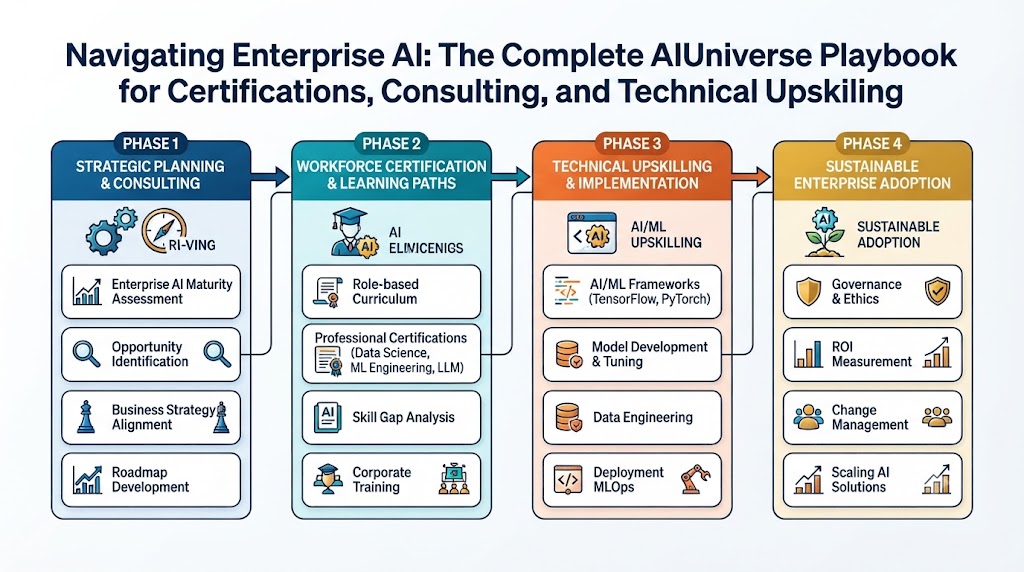
A successful enterprise strategy builds internal capability across four foundational pillars: Data Readiness, Technical System Architecture, Workforce Capability, and Security Governance. Organizations must organize internal data stores, build automated deployment pipelines, upskill employees, and implement safety controls to protect corporate intellectual property.
- Target High-ROI Workflows: Focus initial adoption on operational bottlenecks with clear, measurable impact metrics—such as reducing customer support ticket resolution times or automating invoice data extraction.
- Audit Data Foundations: Ensure corporate data stores are organized, clean, permissioned, and accessible through secure internal APIs before training or fine-tuning models.
- Deploy MLOps & Guardrail Infrastructure: Implement production-grade CI/CD pipelines, observability tools, and prompt safety layers to ensure applications run reliably and safely.
- Invest in Ongoing Workforce Training: Empower internal teams with practical hands-on courses and workshops, ensuring your workforce can build, maintain, and scale systems independently over time.
Common Mistakes to Avoid in AI Learning & Implementation
While the opportunities offered by artificial intelligence are vast, corporate teams and individual developers often make avoidable mistakes that stall technical progress, waste budget, and cause project failures. Recognizing these traps early is essential for building sustainable engineering capabilities.
- Prioritizing Abstract Theory Over Practical Code Execution: Many learners spend months studying theoretical math without writing functional code, configuring CI/CD pipelines, or deploying live endpoints. True technical fluency requires hands-on building, debugging production code, and managing cloud deployments.
- Treating AI Implementations Like Standard Deterministic Software: Machine learning applications are non-deterministic; their output depends continuously on changing real-world data feeds. Applying standard software workflows without MLOps drift monitoring and automated re-training routines leads to fast performance degradation.
- Ignoring Fundamental Data Engineering Requirements: Teams frequently rush to fine-tune complex models while neglecting underlying data cleanliness. Feeding unstructured, inaccurate, or biased data into a model yields poor output—regardless of model size or architecture complexity.
- Overlooking Security Controls and Access Governance: Launching public LLM interfaces or internal vector databases without proper API security, prompt injection defenses, or data masking exposes companies to severe data breaches and regulatory penalties.
- Chasing Hype Instead of Measurable Business Impact: Adopting every newly released model framework without evaluating its operational stability, compute cost, and direct business ROI results in fragmented, overly complex tech stacks.
Best Practices for Successful AI Learning & Adoption
To achieve long-term technical success and execute reliable transformations, developers and enterprise leaders should follow field-tested best practices. Taking a structured approach ensures that technical effort, time, and financial investments produce production-ready results.
1. Build a Solid Foundational Tech Stack
Before attempting complex multi-agent setups or custom open-source model fine-tuning, master core software engineering fundamentals: Python programming, REST API design, microservices architecture, containerization, and basic cloud infrastructure. A strong software engineering core makes learning advanced tools seamless.
2. Emphasize Portfolio-Driven Applied Learning
Instead of accumulating passive video completion certificates, focus on building a robust, public GitHub portfolio containing functional software applications. Build production-grade RAG pipelines over complex technical manuals, configure MLOps pipelines using MLflow and Docker, or construct multi-agent execution workflows that solve actual operational problems.
3. Integrate Guardrails and Cost Management Early
When building generative applications, put strict execution guardrails, token budget tracking, and API rate limits in place during early development. This practice prevents budget overruns and keeps non-deterministic model outputs aligned with business rules.
4. Commit to Continuous Production Observability
View initial software deployment as the start of the operational lifecycle, not the end. Continuously monitor real-world data drift, latency metrics, user feedback, and output accuracy using dedicated MLOps observability tools to maintain long-term system stability.
The Future of AI Skills: What Lies Ahead
As artificial intelligence technologies evolve, the skill sets required to remain competitive in software engineering and enterprise operations are changing fast. Tracking these emerging trends allows developers and business leaders to future-proof their capabilities and stay ahead of market demands.
- From Prompt Crafting to Autonomous Agent Orchestration: While basic prompt writing was a key initial skill for generative apps, future engineering demand will center on designing multi-agent execution graphs, dynamic tool selection frameworks, and deterministic state-machine architectures.
- Expansion of Domain-Specific Small Language Models (SLMs): Driven by rising cloud compute expenses and strict data privacy regulations, enterprises are pivoting from large external API models toward compact open-source models trained specifically on proprietary corporate data.
- Operational Integration of Safety and Governance: As AI systems handle critical operational tasks, specialists skilled in automated auditing, safety guardrails, red-teaming, and regulatory compliance frameworks will become essential enterprise hires.
- Democratization of Enterprise Developer Workflows: Low-code platforms and natural language interfaces will continue empowering non-technical business teams to build simple operational workflows, allowing core engineering teams to focus on complex, high-scale system architecture.
Frequently Asked Questions
1. What unique educational resources does AIUniverse provide for learners?
AIUniverse provides structured learning modules, industry-aligned certification pathways, curated tool evaluation directories, and hands-on project blueprints. It helps learners transition from basic programming fundamentals to advanced production system design.
2. Are AIUniverse certification paths suitable for mid-career software engineers?
Yes. AIUniverse crafts its curriculum specifically for mid-career software engineers, DevOps specialists, and data scientists seeking to transition into specialized roles like MLOps Architect, AIOps Engineer, or Agentic Systems Developer.
3. How does AIUniverse structure customized training for corporate clients?
AIUniverse analyzes an enterprise client’s current tech stack, internal coding guidelines, and business goals to build targeted workforce training tracks. Modules focus on practical tool implementation, secure data handling, and automated workflow design.
4. What core skills are taught within the Agentic AI certification curriculum?
The Agentic AI curriculum focuses on building autonomous software loops, multi-agent frameworks (such as CrewAI and AutoGen), long/short-term memory management, vector database search, API tool calling, and deterministic safety guardrails.
5. Why is establishing MLOps practices critical for modern software teams?
MLOps establishes the continuous automation needed to manage data versioning, experiment tracking, pipeline orchestration, model containerization, and production drift monitoring—preventing model performance decay over time.
6. How does AIOps improve incident management for cloud infrastructure?
AIOps utilizes machine learning to analyze high-velocity cloud telemetry data (logs, metrics, events). It filters out background operational noise, isolates root cause incidents automatically, and triggers self-healing remediation routines before downtime occurs.
7. What services are included in AIUniverse strategic consulting engagements?
AIUniverse consulting engagements include technical feasibility audits, enterprise RAG and vector database design, open-source model fine-tuning and quantization, and the establishment of custom security, data-masking, and compliance frameworks.
8. How do prompt management platforms simplify application development?
Prompt management tools isolate prompt strings from core application source code. This architecture allows non-technical product managers and domain specialists to update, evaluate, and version-control prompts dynamically without triggering developer code deployments.
9. Why is federated learning ideal for privacy-sensitive industries?
Federated learning allows multiple organizations to train a shared machine learning model collaboratively without exchanging raw source data. Training takes place on local servers, and only sanitized parameter updates are sent to a central aggregator.
10. How can non-technical corporate employees leverage generative tools safely?
Non-technical workers can use enterprise generative tools to automate document analysis, summarize meeting transcripts, draft communications, and construct simple low-code automated workflows while adhering to strict corporate data privacy rules.
11. Which primary software tools form a standard production MLOps stack?
A standard production MLOps stack includes MLflow for experiment tracking, DVC for dataset versioning, Kubeflow for Kubernetes pipeline orchestration, Docker for microservice containerization, and Evidently AI for production performance drift monitoring.
12. How does AIUniverse keep its content aligned with modern AI releases?
AIUniverse continuously reviews and updates its course modules, certification requirements, and tool recommendations to incorporate breakthrough releases across open-source models, agentic frameworks, and MLOps tools.
13. What dictates whether a business should select RAG or model fine-tuning?
RAG is ideal when an application requires access to frequently updated private documents and strict citation accuracy. Fine-tuning is preferred when adapting an open-source model’s internal tone, coding style, or specialized industry terminology.
14. What key indicators signal that an enterprise AI project is failing?
Common warning signs include lack of clear ROI metrics, continuous reliance on manual data cleanup, absence of production MLOps drift tracking, low workforce adoption rates, and escalating compute expenses without clear operational output.
15. How should decision-makers evaluate new AI tools for team adoption?
Decision-makers should assess tools based on integration compatibility with existing cloud infrastructure, strict data security standards, transparent compute/subscription pricing, ease of developer adoption, and vendor reliability.
16. What measures protect enterprise models against prompt injection attacks?
Protecting models requires deploying strict input sanitization layers, enforcing system prompt isolation, utilizing deterministic guardrail frameworks, restricting tool access permissions, and running automated red-teaming security audits.
17. How does earning a specialized AI certification accelerate career growth?
Earning a specialized certification validates your technical execution capabilities through hands-on project builds. It proves to employers that you can design, deploy, and maintain production-grade systems, separating you from theoretical applicants.
Conclusion
The rapid growth of artificial intelligence presents unprecedented opportunities for ambitious professionals to advance their careers and for organizations to optimize operational efficiency, cut costs, and launch innovative software products. However, moving successfully from initial concept to secure, production-grade deployment requires structured educational paths, proven system architectures, and disciplined engineering execution. Navigating this evolving technological domain demands a commitment to practical skill development, strong data governance, and continuous workforce upskilling.
Platforms like AIUniverse play an essential role in this technological evolution by delivering comprehensive learning resources, verifiable certification tracks, tailored corporate training solutions, and strategic consulting services. Whether you are an individual engineer mastering autonomous agent orchestration, an IT leader building predictive AIOps pipelines, or an enterprise executive executing a secure digital transformation, having access to structured, authoritative guidance is crucial for long-term success. By committing to continuous upskilling, building practical hands-on portfolios, and adhering to sound system design principles, individuals and organizations can confidently lead in the future of artificial intelligence.