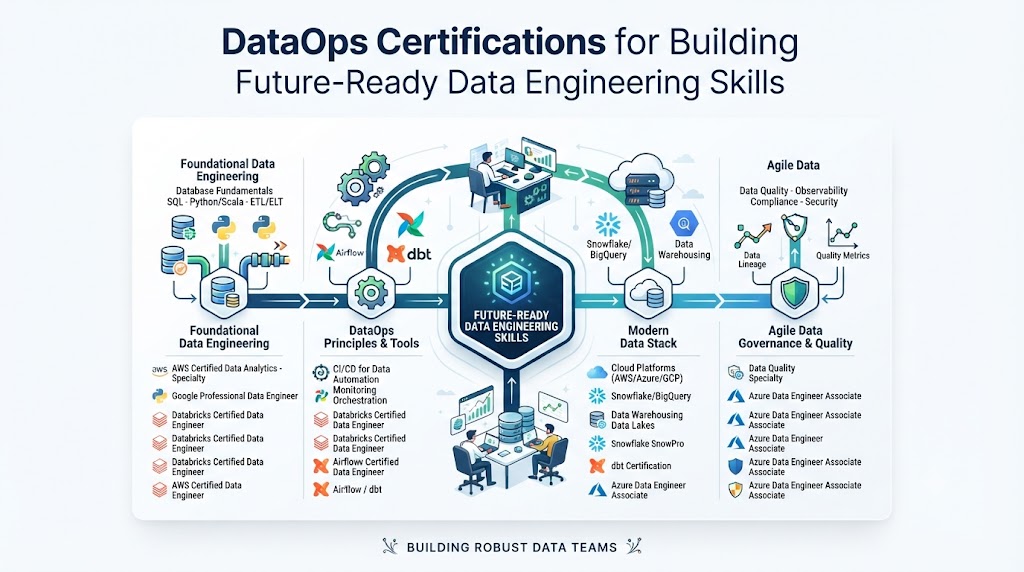
Introduction
As data volumes explode across modern enterprises, organizations struggle to deliver clean, reliable, and production-ready data to consumers. Traditional data management approaches fail under the weight of manual processes, siloed teams, and brittle infrastructure. This comprehensive guide is designed for software engineers, data professionals, and engineering leaders seeking to navigate data operations professionally. We examine the core value, difficulty levels, prerequisites, and long-term career impact of the Certified DataOps Manager program. By exploring these insights, professionals can make informed career decisions and align their learning with enterprise demands.
What is the Certified DataOps Manager?
The Certified DataOps Manager represents an industry-recognized validation of advanced data pipeline orchestration, automated testing, and continuous delivery. It exists to bridge the gap between traditional data engineering and modern agile software delivery principles. Rather than focusing solely on theoretical concepts, the curriculum emphasizes real-world, production-focused learning in live environments. It aligns seamlessly with modern engineering workflows, version control, and automated enterprise practices. Professionals learn to eliminate data bottlenecks and guarantee data quality across complex distributed architectures.
Who Should Pursue Certified DataOps Manager?
This certification benefits software engineers, data engineers, platform architects, and infrastructure specialists aiming to master pipeline reliability. System reliability engineers and cloud professionals will find immense value in applying SRE methodologies to data workloads. Engineering managers and technical leaders can leverage this credential to standardize data delivery practices across their teams. It caters effectively to beginners seeking structured growth as well as experienced practitioners validating advanced competencies. Both global enterprises and fast-growing organizations in India increasingly demand these specialized operational capabilities.
Why Certified DataOps Manager
Enterprise adoption of automated data workflows has driven unprecedented demand for skilled data operations professionals. This credential provides long-term career longevity by focusing on foundational principles rather than fleeting tool sets. It helps professionals stay relevant despite rapid shifts in the broader technology landscape. The return on time and career investment is substantial, often leading to accelerated promotions and leadership opportunities. Organizations actively seek certified practitioners who can reduce incident resolution times and improve data trust.
Certified DataOps Manager Certification Overview
The program is delivered via and hosted on. It features structured certification levels designed to test both conceptual knowledge and hands-on execution. The assessment approach combines rigorous theoretical evaluations with practical, scenario-based problem-solving tasks. Program ownership rests with industry veterans dedicated to maintaining high standards in data operations. The structured learning path ensures candidates build confidence progressively from foundational concepts to advanced management.
Certified DataOps Manager Certification Tracks & Levels
The foundation level establishes core data operations principles, version control, and basic pipeline automation. The professional level dives deep into continuous integration, continuous delivery, and advanced data quality monitoring. Advanced tracks focus on enterprise scalability, governance, security compliance, and organizational transformation. Specialization tracks allow practitioners to align their expertise with specific cloud and platform ecosystems. These progressive levels map directly to career progression from individual contributor to enterprise architect.
Complete Certified DataOps Manager Certification Table
| Track | Level | Who it’s for | Prerequisites | Skills Covered | Recommended Order |
| Core DataOps | Foundation | Beginners and Junior Engineers | Basic Python and SQL | Git, CI/CD Basics, Pipeline Monitoring | 1 |
| Advanced DataOps | Professional | Data Engineers and DevOps Leads | Foundation Certification | Orchestration, Automated Testing, Observability | 2 |
| Enterprise DataOps | Advanced | Architects and Technical Leaders | Professional Certification | Governance, Security, Multi-Cloud Scaling | 3 |
Detailed Guide for Each Certified DataOps Manager Certification
Certified DataOps Manager – Foundation Level
What it is
This certification validates foundational knowledge of data pipeline automation, version control, and agile data workflows.
Who should take it
Suitable for junior data engineers, software developers, and aspiring platform specialists starting their data operations journey.
Skills you’ll gain
- Understanding core data pipeline lifecycle stages
- Implementing basic version control for data assets
- Setting up simple automated alerts and logging
- Applying agile methodologies to data tasks
Real-world projects you should be able to do
- Build a reproducible data pipeline using open-source orchestrators
- Configure automated unit tests for incoming raw datasets
- Establish basic monitoring dashboards for pipeline execution health
Preparation plan
- Spend 7 to 14 days reviewing core principles and introductory documentation.
- Dedicate 30 days to hands-on practice labs and sample pipeline deployments.
- Use the 60-day window for comprehensive revision and mock exam practice.
Common mistakes
- Relying purely on theoretical memorization without building actual pipelines.
- Ignoring fundamental version control practices for database scripts.
Best next certification after this
- Same-track option: Certified DataOps Manager Professional Level
- Cross-track option: DevOps Foundation Certification
- Leadership option: Agile Engineering Management
Certified DataOps Manager – Professional Level
What it is
This certification validates advanced proficiency in building robust, observable, and continuously delivered data systems.
Who should take it
Targeted at experienced data engineers, DevOps practitioners, and backend developers with production management experience.
Skills you’ll gain
- Designing enterprise-grade CI/CD pipelines for data
- Implementing advanced data observability and anomaly detection
- Managing containerized data workloads with Kubernetes
- Optimizing pipeline performance and resource utilization
Real-world projects you should be able to do
- Deploy an end-to-end automated data pipeline with integrated quality gates
- Configure real-time alerting for data drift and schema failures
- Scale containerized data transformation jobs across cloud clusters
Preparation plan
- Dedicate the first 14 days to mastering orchestration and monitoring tools.
- Spend 30 days building complex multi-stage deployment pipelines in a lab environment.
- Utilize up to 60 days for deep technical dives into failure recovery and troubleshooting.
Common mistakes
- Neglecting data quality testing phases during CI/CD pipeline execution.
- Overcomplicating architecture without establishing proper baseline metrics.
Best next certification after this
- Same-track option: Certified DataOps Manager Advanced Enterprise Level
- Cross-track option: Certified SRE Engineer
- Leadership option: Director of Data Platform Engineering
Choose Your Learning Path
DevOps Path
The DevOps path focuses on bridging development and operations through automation and robust infrastructure management. Professionals learn to build resilient deployment pipelines and manage scalable cloud environments effectively. It forms the backbone of modern software delivery and infrastructure orchestration. Mastering this path enables seamless collaboration between engineering teams and rapid feature releases.
DevSecOps Path
The DevSecOps path integrates security practices directly into every stage of the software development lifecycle. Learners master vulnerability scanning, automated compliance checks, and secure coding standards. It ensures that security is a shared responsibility across development and operations teams. This path protects enterprise data assets while maintaining high deployment velocity and agility.
SRE Path
The SRE path emphasizes system reliability, automated incident management, and proactive capacity planning. Practitioners learn to define service level objectives and eliminate operational toil through software engineering. It empowers teams to build fault-tolerant architectures that scale effortlessly under heavy loads. This path is crucial for maintaining high availability in mission-critical enterprise systems.
AIOps Path
The AIOps path leverages machine learning and big data analytics to automate operational processes. Engineers learn to apply intelligent algorithms for anomaly detection, event correlation, and predictive remediation. It transforms traditional reactive IT operations into proactive, self-healing systems. This specialty is vital for managing complex, hyper-scale cloud environments efficiently.
MLOps Path
The MLOps path standardizes the deployment, monitoring, and lifecycle management of machine learning models. Practitioners learn to automate feature stores, model training pipelines, and inference tracking. It bridges the gap between data science experimentation and reliable production software delivery. This path ensures AI models remain accurate, scalable, and auditable in production.
DataOps Path
The DataOps path applies agile and DevOps principles specifically to data analytics and engineering workflows. Learners master pipeline automation, data quality testing, and continuous delivery for data assets. It eliminates data silos and accelerates the time-to-insight for enterprise stakeholders. This path creates a reliable foundation for data-driven decision-making across organizations.
FinOps Path
The FinOps path focuses on financial accountability and cloud cost optimization across engineering teams. Professionals learn to analyze usage patterns, allocate cloud spend, and implement cost-saving governance. It empowers organizations to maximize business value from their cloud investments without sacrificing performance. This path aligns engineering efficiency with strategic financial objectives.
Role Recommended Certified DataOps Manager Certifications
| Role | Recommended Certifications |
| DevOps Engineer | Certified DataOps Manager Foundation |
| SRE | Certified DataOps Manager Professional |
| Platform Engineer | Certified DataOps Manager Professional |
| Cloud Engineer | Certified DataOps Manager Foundation |
| Security Engineer | Certified DataOps Manager Enterprise |
| Data Engineer | Certified DataOps Manager Professional |
| FinOps Practitioner | Certified DataOps Manager Foundation |
| Engineering Manager | Certified DataOps Manager Enterprise |
Next Certifications to Take After Certified DataOps Manager
Same Track Progression
Deep specialization involves advancing into enterprise architecture and multi-cloud data governance roles. Practitioners can pursue expert-level credentials focusing on zero-trust data security and global scale orchestration. This path allows engineers to become recognized authorities in complex data operations ecosystems.
Cross-Track Expansion
Skill broadening encourages branching out into adjacent disciplines like site reliability engineering or machine learning operations. Combining data operations with AI or infrastructure automation creates versatile, highly sought-after technical leaders. This expansion ensures adaptability across diverse engineering departments.
Leadership & Management Track
Transitioning to leadership involves moving from individual technical execution to managing enterprise data strategy. Professionals focus on team governance, budget optimization, and aligning data capabilities with business goals. This path prepares engineers for director and vice president technology roles.
Training & Certification Support Providers for Certified DataOps Manager
DevOpsSchool is a premier global training platform offering comprehensive certification bootcamps for modern IT professionals. Their programs combine rigorous theoretical instruction with extensive hands-on lab work led by veteran industry practitioners. They focus on real-world enterprise scenarios, ensuring candidates gain practical skills immediately applicable in production environments.
Cotocus specializes in advanced technology training, focusing on open-source tools, cloud computing, and DevOps methodologies. The platform provides structured learning paths designed to help software engineers transition into specialized operational roles. Their expert instructors bring decades of field experience to every training cohort.
Scmgalaxy serves as a prominent knowledge-sharing and training hub for software configuration management and automation. It offers curated learning resources, tutorials, and certification preparation courses for global engineering teams. The community-driven approach fosters continuous professional growth and technical collaboration.
BestDevOps delivers targeted training programs aimed at mastering cloud-native infrastructure, CI/CD, and platform engineering. Their curriculum emphasizes practical implementation, troubleshooting, and industry best practices for modern development teams. Learners benefit from structured mentorship and up-to-date course material tailored to current job market demands.
devsecopsschool.com focuses exclusively on embedding security into software development and operational pipelines. The platform provides specialized training on vulnerability management, compliance automation, and secure cloud architectures. Their certifications validate critical skills needed to protect modern enterprise applications against evolving threats.
sreschool.com offers specialized education in site reliability engineering, observability, and incident response automation. Their courses teach engineers how to build highly available systems and manage production complexity effectively. The training bridges traditional system administration with modern software engineering principles.
aiopsschool.com provides cutting-edge education on applying artificial intelligence and machine learning to IT operations. Professionals learn to build automated remediation workflows and intelligent monitoring systems for cloud scale. The curriculum prepares engineers for the future of autonomous IT management.
dataopsschool.com is dedicated to advancing data operations through rigorous training and certification programs. It helps data engineers and analysts master pipeline automation, testing, and continuous delivery. The platform sets high standards for operational excellence in enterprise data analytics.
finopsschool.com specializes in cloud financial management and cost optimization training for engineering and finance teams. Their programs teach professionals how to analyze cloud spend, establish governance, and drive financial accountability. The training ensures organizations achieve maximum efficiency from their cloud infrastructure.
Frequently Asked Questions (General)
1. How difficult is the Certified DataOps Manager certification to pass?
The difficulty level is moderate to high, requiring practical experience with data pipelines and automation tools.
2. How much preparation time is typically required?
Most professionals need between thirty to sixty days of consistent, hands-on study to prepare effectively.
3. What are the formal prerequisites for enrolling?
A foundational understanding of Python, SQL, and basic Git version control is strongly recommended.
4. What is the return on investment for this credential?
Certified professionals often experience accelerated career growth, higher salary packages, and increased job security.
5. How should candidates sequence their learning path?
Candidates should start with foundational automation principles before progressing to advanced enterprise orchestration tracks.
6. Is this certification recognized globally by employers?
Yes, the credential holds strong industry recognition across global enterprises and technology hubs.
7. Are practical hands-on labs included in the program?
Programs feature extensive practical lab environments simulating real-world production data challenges.
8. How often is the certification curriculum updated?
The curriculum undergoes regular reviews to incorporate emerging tools and modern industry best practices.
9. Can engineering managers benefit from this technical certification?
Engineering managers gain valuable oversight capabilities to standardize team workflows and improve delivery predictability.
10. What support is available during the learning journey?
Learners receive access to expert mentorship, discussion forums, and comprehensive technical documentation.
11. How are the final assessments conducted?
Assessments combine multiple-choice conceptual questions with practical, scenario-based execution tasks.
12. Does the certification expire or require renewal?
Certifications typically require periodic renewal or continuing education credits to maintain active status.
FAQs on Certified DataOps Manager
1. What core tools are covered in the Certified DataOps Manager curriculum?
The curriculum covers popular orchestration tools, version control systems, and automated data testing frameworks.
2. How does this certification differ from traditional data engineering courses?
It focuses specifically on operations, automation, and continuous delivery rather than just database design.
3. Will this certification help in transitioning from software development to data operations?
It provides a clear, structured roadmap for developers looking to specialize in data workflow management.
4. Are cloud-specific data services included in the training modules?
Training modules cover multi-cloud environments and platform-agnostic data operations methodologies.
5. How does pipeline monitoring get addressed in the advanced levels?
Advanced levels teach proactive data observability, anomaly detection, and automated incident alerting.
6. Can small startup teams benefit from adopting DataOps practices?
Startups use these practices to scale data delivery efficiently without increasing operational headcount.
7. What role does data quality testing play in the certification?
Automated data testing forms a core pillar of the curriculum to ensure absolute data reliability.
8. How do employers verify the authenticity of the certification?
Employers can instantly verify credentials through secure digital badge systems provided upon successful completion.
Final Thoughts
Mastering data operations requires dedication, practical experimentation, and a commitment to continuous improvement. The Certified DataOps Manager credential provides a reliable framework for validating your expertise in modern data delivery. Approach your preparation with a focus on hands-on execution rather than rote memorization. Build real pipelines, break them, fix them, and understand how they behave under production stress. True professional growth comes from solving complex operational challenges and delivering measurable business value to your organization.