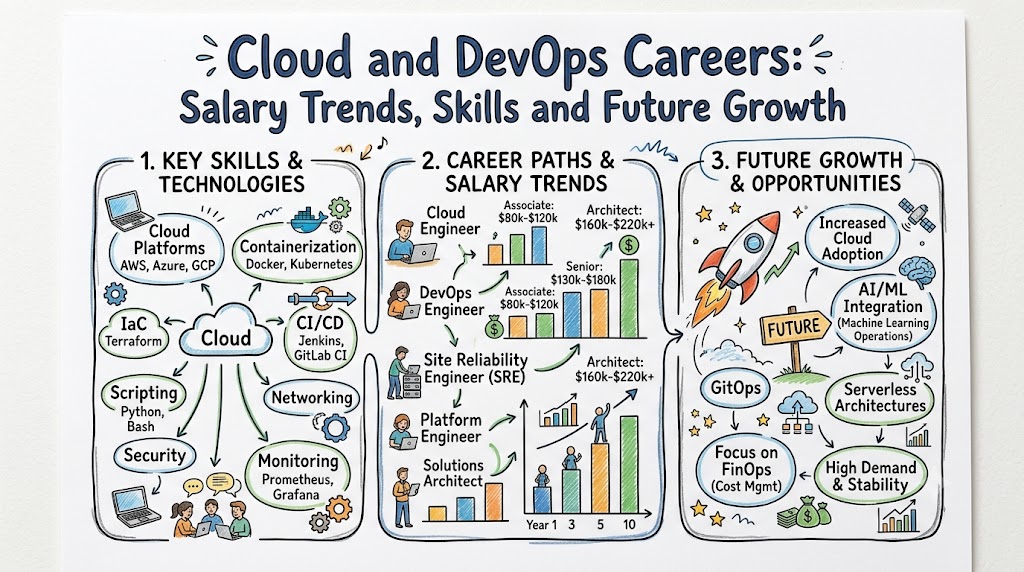
Introduction
The global tech landscape has evolved. While general software engineering has seen shifting tides, infrastructure automation and system uptime have become absolute priorities for businesses. Keeping a digital product fast, available, and secure requires specialized engineering. This reality is what makes DevOps one of the highest-paying IT careers today.
Globally, DevOps salaries are experiencing strong upward momentum. Organizations across the spectrum—from agile startups to heavily regulated legacy enterprises—realize that slow deployments and system downtime directly translate to lost revenue. As cloud computing moves from simple server migration to complex cloud-native architectures, the demand for professionals who can bridge the gap between development and operations has exploded.
However, the modern market has shifted its valuation. The days of earning a premium just for knowing basic scripting or a single automation tool are fading. Today, real skills, architectural understanding, and operational accountability matter far more than a collection of entry-level badges. The highest compensation packages go to engineers who understand distributed systems, data privacy, and cost efficiency.
This comprehensive guide breaks down the true state of global DevOps compensation using verified, data-backed insights from the Best DevOps Salary Report. Whether you are a fresher looking to enter the field or an IT veteran planning a strategic career pivot, this report outlines the explicit paths, high-paying specializations, and regional trends that dictate your earning potential.
Why DevOps Salaries Are High
The premium compensation associated with DevOps isn’t an accident. It is driven by several critical structural shifts in how software is built and maintained:
- Accelerated Cloud Adoption: Organizations are moving beyond baseline cloud setups toward complex multi-cloud environments. Managing these environments requires sophisticated, automated architectures that only skilled infrastructure specialists can construct.
- The Mandate for Automation: Manual server setups and deployments are slow and error-prone. Companies heavily incentivize engineers who can treat infrastructure entirely as code (IaC), eliminating human intervention from the deployment process.
- Containerization & Kubernetes Complexity: Containers have revolutionized software shipping, but managing hundreds of containers at scale requires orchestration platforms like Kubernetes. The steep learning curve of these systems creates a natural supply shortage, driving up market rates for those who master them.
- Continuous Integration & Continuous Delivery (CI/CD): Modern businesses require code to be shipped multiple times a day safely. Building, maintaining, and securing these rapid delivery pipelines requires a deep engineering skill set.
- The Rise of DevSecOps: Security can no longer be an afterthought handled by a separate team at the very end of a project. Embedding security policies directly into automated software pipelines (policy-as-code) is a highly valued, premium skill set.
- A Persistent Talent Scarcity: There is a distinct shortage of engineers who possess a deep understanding of both software development lifecycles and hard core systems engineering. This supply-and-demand mismatch keeps compensation high.
Who Should Read This Guide
This guide is designed for individuals navigating various stages of their IT journey:
- Freshers: Beginners trying to filter through the industry noise to see if DevOps is a viable, high-growth entry point.
- Software Developers: Engineers who want to break out of pure feature writing and significantly boost their market value by mastering infrastructure.
- Linux/Systems Administrators: Legacy infrastructure professionals aiming to modernize their skill sets into automated cloud workflows.
- Cloud & Automation Engineers: Current specialists looking to transition into highly compensated fields like Site Reliability Engineering (SRE) or Platform Engineering.
- DevSecOps & Platform Professionals: Active practitioners seeking precise data to benchmark their current compensation and plan their next career tier.
DevOps Salary Overview
According to global data, DevOps compensation is fragmenting into three distinct tiers: high-growth product organizations (which lean heavily on equity packages), regulated enterprises (which favor performance bonuses), and IT service firms (driven by standard client billing rates).
While title inflation exists, corporate leveling systems have become far more precise. True compensation peaks when your work is tied to revenue uptime, regulatory compliance, or optimizing major cloud expenditures.
Generic “pipeline configuration” or basic “Kubernetes operation” is increasingly treated as a baseline requirement. The highest salary premiums are shifting toward platform ownership, incident command, and architectural governance.
DevOps Salary by Experience Level
Your position on the engineering ladder dictates your scope of responsibility and overall earning potential. The table below outlines how responsibilities change as you scale your career:
| Experience Level | Typical Roles | Skills Expected | Salary Growth Potential | Career Scope |
| Fresher / Junior | Junior DevOps Engineer, Cloud Associate | Basic scripting, git fundamentals, executing predefined automation tasks, on-call basics. | Baseline | Highly focused on execution and learning underlying infrastructure patterns. |
| Mid-Level | DevOps Engineer, SRE, Cloud Engineer | Independently shipping infrastructure modifications, managing CI/CD pipelines, container management. | Moderate to High | Owns specific application pipelines; independent execution without constant oversight. |
| Senior | Senior DevOps Engineer, Senior SRE | Designing complex systems, leading incident responses, setting monitoring metrics, mentoring juniors. | Significant Premium | High design authority; responsible for service reliability, uptime, and architecture. |
| Lead / Architect | Platform Engineer, Cloud Architect, Principal Engineer | Cross-team technical architecture, org-wide standards, platform product thinking, long-term reliability strategies. | Maximum Market Cap | High organizational influence; shapes internal developer platforms and major technical choices. |
Highest Paying DevOps Roles
Not all DevOps paths pay equally. Specialized subsets that carry higher operational risk or require deeper architectural knowledge command noticeable market premiums over baseline roles.
| Role | Main Skills | Difficulty Level | Salary Potential vs Baseline | Career Demand |
| DevOps Engineer | CI/CD pipelines, basic automation, infrastructure provisioning | Moderate | Baseline Market Rate | Strong, steady corporate baseline |
| Site Reliability Engineer (SRE) | SLO tracking, error budgets, distributed systems, incident command | High | +0% to +15% Premium | High across mature tech orgs |
| Platform Engineer | Building internal developer platforms, paved roads, tool aggregation | High | +5% to +20% Premium | Exploding demand in mid-to-large enterprises |
| DevSecOps Engineer | Pipeline security, policy-as-code, secrets governance, vulnerability management | High | +10% to +30% Premium | Critical in regulated and enterprise spaces |
| Cloud Architect | Multi-cloud architecture, landing zones, structural IAM patterns | High | Varying Premium | Highly sought after for enterprise migrations |
| Security Platform Engineer | Scalable security controls, developer security enablement | Very High | +15% to +35% Premium | Scarcity-driven high compensation |
| Cloud Engineer | Baseline cloud resource provisioning, general systems administration | Low to Moderate | -5% to +10% relative to baseline | Broad but highly competitive market |
DevOps Salary by Skills
Your specific technological depth directly influences your position within a corporate compensation band.
- The Baseline Toolkit: Proficiency in Linux, Git, and Docker is no longer considered a differentiator; it is the minimum entry requirement. Similarly, basic knowledge of a single public cloud platform (like AWS, Azure, or Google Cloud) serves as your foundation.
- The Automation Core: Mastering Terraform for Infrastructure as Code and Jenkins or modern alternatives for CI/CD anchors you firmly in the mid-level compensation tier.
- The High-Value Triggers: True salary growth occurs when you display deep expertise in Kubernetes at scale, implement advanced GitOps deployment models, and specialize in DevSecOps (automated security guardrails).
- The Business Leverage: Engineers who understand Observability (advanced telemetry, tracing, and logging architecture) and can manage cost engineering (FinOps) command the highest salaries because their work directly affects corporate gross margins and application uptime.
DevOps Salary by Certification
Note: The following data targets primary tracks highlighted in the Best DevOps Salary Report.
| Certification Focus | Best For | Career Level | Skills Covered | Salary Impact |
| Cloud Architecture & Engineering | Validation of major public cloud systems (AWS / Azure / GCP) | Entry to Mid-Level | Cloud networking, core compute, IAM patterns, resource provisioning | Serves as a baseline validator to pass HR screening filters. |
| Kubernetes & Container Orchestration | Deep engineering roles, SRE, and Platform tracks | Mid to Senior | Cluster architecture, workload scheduling, container networking, troubleshooting | High impact; signals the ability to handle complex modern container ecosystems. |
| Security & DevSecOps | Specializing in secure automated delivery pipelines | Mid to Senior | Automated compliance, vulnerability scanning, secret management, policy-as-code | Very High impact; unlocks specialized, regulated corporate compensation tiers. |
DevOps Salary by Country or Region
Local cost-of-living differences, regional business maturity, and talent availability create distinct base salary structures across different geographies.
- United States: Stands as the highest base salary market globally. Base ranges for mid-level DevOps engineers typically hover around a median of $115,072 USD, scaling up for specialized SRE, Platform, and DevSecOps professionals.
- Switzerland: Leads the European landscape with premium base structures, showing a local median baseline of approximately 111,204 CHF for standardized DevOps roles.
- Western Europe (Netherlands, France, Spain): Salaries display clear regional tiers. The Netherlands sits at a high median baseline (~75,757 EUR), followed by strong markets in France (~68,120 EUR), and competitive entry brackets in Spain (~58,326 EUR).
- Emerging European Hubs (Poland): Serves as a vital tech engineering hub. A standard DevOps local median approaches 211,077 PLN, balancing strong engineering output with efficient local market cost structures.
- Middle East & Asia-Pacific (UAE, Singapore, South Korea): High-growth regions with distinct compensation characteristics. Singapore features strong local medians (~113,412 SGD), matched by robust infrastructure demand in the UAE (~290,345 AED local median) and steady technology growth tracks in South Korea.
- India: A massive, highly competitive engineering market driven by tier-1 product entities and major global delivery centers. The local baseline median sits around 2,085,429 INR, with specialized SRE and security disciplines commanding substantial upward premiums.
- African Markets (Kenya, Nigeria): Growing tech ecosystems. Kenya shows a local baseline median of 1,965,270 KES, while Nigeria records a local median footprint of 2,947,906 NGN, reflecting the emerging nature of automated infrastructure careers in these regions.
DevOps Salary by Company Type
The type of organization you join dictates not only your financial compensation but also the pace of your professional development:
- Product-Driven & Big Tech Companies: These organizations operate at massive scale, meaning infrastructure failure instantly risks millions in revenue. Consequently, they offer top-of-market compensation packages that are often heavily weighted with stock options and equity. They maintain strict engineering standards and provide unmatched learning exposure regarding distributed systems.
- Cloud-Native Startups: Startups provide exceptional learning speed. Because teams are small, you will touch everything—from initial network setups to automated deployment pipelines. While base salaries can be highly competitive, overall stability is lower, and long-term reward depends significantly on company stock success.
- Traditional Multinationals (MNCs) & Enterprises: These environments are highly structured and slow-moving. They favor financial bonuses, stability, and structured career ladders over high equity risk. The work heavily emphasizes governance, compliance, and gradual modernization.
- Service & Outsourcing Companies: Compensation here is tied directly to client billable rates. While they offer steady employment and exposing you to a variety of client projects, the salary ceiling is lower compared to product companies, and the work often focuses on maintaining existing pipelines rather than designing new architectures.
Factors That Affect DevOps Salary
Your market valuation isn’t a fixed number; it is shaped by a matrix of specific competencies:
The Compensation Rule: DevOps compensation reflects business risk, not just tool knowledge. If you can directly tie your day-to-day actions to application reliability, regulatory compliance, or cloud margin efficiency, your salary potential changes fundamentally.
- Experience & Deep Leveling: Progressing from simple task execution to cross-team system design and architectural ownership.
- Practical Kubernetes Mastery: The capability to manage live production clusters, debug network routing issues, and configure secure scaling parameters.
- Infrastructure Automation (IaC): Writing clean, modular, reusable code to manage infrastructure instead of clicking through manual cloud dashboards.
- Multi-Cloud Engineering: The ability to move fluently between different major cloud environments without breaking underlying architectural patterns.
- A Metrics-Driven Mindset: Knowing how to design and evaluate Service Level Objectives (SLOs) and manage error budgets to protect application uptime.
- Clear Communication Skills: Translating complex technical infrastructure problems into plain business terms for stakeholders and leading teams calmly through major live production incidents.
Best Skills for High DevOps Salary
To scale your earnings efficiently, focus your education on a clear progression of skills:
[BEGINNER]              [INTERMEDIATE]            [ADVANCED]
Linux Scripting   --->   Docker Containers  --->   Kubernetes Orchestration
Git & Networking        CI/CD & Terraform         Platform & DevSecOps
1. Beginner Skills
- Linux Systems Administration: Deep familiarity with command-line operations, user permissions, process management, and the underlying filesystem.
- Git Version Control: Confident branch management, pull request workflows, merge conflict resolution, and clean repository histories.
- Core Networking Basics: Understanding DNS, HTTP/S protocols, basic subnets, firewalls, and routing architectures.
- Shell Scripting: Writing clean Bash or Python scripts to automate basic system maintenance tasks.
2. Intermediate Skills
- Containerization (Docker): Creating secure, optimized container images and managing multi-container setups locally.
- Infrastructure as Code (Terraform): Using declarative configurations to safely stand up, update, and version cloud infrastructure resources.
- Core CI/CD Foundations: Setting up automated pipelines to build, test, and package application code cleanly.
3. Advanced Skills
- Production Kubernetes Orchestration: Managing live container deployments, understanding ingress routing, storage classes, and cluster security configurations.
- Platform Engineering & Paved Roads: Bundling complex underlying infrastructure tools into simple internal developer platforms (IDPs).
- GitOps Delivery Workflows: Using tools to sync your live cluster states directly with declarative Git repositories automatically.
- Advanced Observability Tooling: Constructing centralized logging, tracing pipelines, and meaningful system alert matrices.
- Automated DevSecOps Governance: Integrating automated vulnerability scanning and strict compliance rules directly inside active build chains.
Real-World Career Scenarios
Scenario A: The Fresher Entering the Space
A university graduate or career switcher should avoid trying to learn every single DevOps tool at once. Focus entirely on building solid roots in Linux, Git, and basic cloud provisioning. Your entry-level salary will reflect your potential to learn and execute structured tasks safely. Your fastest path to a pay bump is demonstrating reliable on-call support execution and clean pipeline script maintenance.
Scenario B: The Developer Transitioning into DevOps
Software developers already understand code structures and the software development life cycle (SDLC). By adding cloud infrastructure engineering, containerization, and automated deployment architectures to your toolkit, you make yourself highly valuable. Your ability to build internal automation tools instantly qualifies you for lucrative Platform Engineering positions.
Scenario C: The SysAdmin Moving to Cloud DevOps
Legacy systems administrators already possess a deep understanding of Linux systems and networking fundamentals. Your path to modernizing your salary profile involves shifting from manual operations to an Infrastructure-as-Code (IaC) workflow. Once you replace manual configurations with automated Terraform scripts, your earning potential scales rapidly.
Scenario D: The SRE & Platform Engineering Specialist
For experienced infrastructure engineers, maximum career compensation is achieved by specializing. Moving from simply maintaining pipelines to owning global system reliability (SRE) or building developer enablement platforms shifts your corporate mapping to a software engineering ladder, unlocking top-tier base salaries and major equity packages.
Common Mistakes That Reduce Salary Growth
Many engineers inadvertently stall their own earning potential by falling into predictable career traps:
- Theoretical Learning Without Real Projects: Memorizing tool configurations for a test without ever running live, broken infrastructure workloads.
- Skipping Core Linux Basics: Attempting to manage advanced container orchestrators like Kubernetes without understanding how basic Linux processes and networks operate underneath.
- Focusing Solely on Certificate Collection: Gathering multiple certifications while lacking the practical engineering ability to write a clean, modular deployment script from scratch.
- Ignoring Production Cloud Costs: Building complex infrastructure setups without considering the financial cloud cost efficiency of those designs.
- Weak Interpersonal and Communication Skills: Staying isolated in a silo, unable to lead engineering design reviews or coordinate effectively during major live production outages.
- Operating Without an Engineering Portfolio: Lacking a public GitHub repository or documented architecture diagrams to prove your hands-on engineering capabilities to hiring teams.
Hands-On Projects to Increase Salary Opportunities
To break through rigid salary bars, you must show verifiable evidence of practical execution. Consider constructing these real-world projects for your professional portfolio:
- The Automated GitOps Pipeline: Construct an application deployment pipeline that automatically syncs live Kubernetes cluster states with changes made inside a production Git repository.
- The Secure DevSecOps Pipeline: Build a code assembly line that automatically scans application containers for security vulnerabilities, checks code for exposed secret keys, and halts deployment if safety policies are violated.
- Multi-Cloud Infrastructure Automation: Write reusable Terraform blueprints that reliably stand up identical, isolated development environments across two separate cloud providers simultaneously.
- The Observability and Alerting Matrix: Set up a centralized system that tracks cluster resource utilization, tracks specific application response times, and sends automated notifications to a communication channel when errors spike.
Career Roadmap for Better Salary Growth
To ensure stable, long-term financial progression, focus your professional development on a structured, step-by-step path:
[PATH 1: THE CORE]         [PATH 2: THE SCALE]        [PATH 3: THE SPECIALIZATION]
Linux Systems Admin  --->  Terraform Automation --->  Advanced Kubernetes Strategy
Git Version Control        CI/CD Architecture         DevSecOps & Platform Design
Docker Containers          Public Cloud Mastery       SRE & Financial Cost Engineering
- Phase 1 (The Core Foundations): Focus on mastering Linux system tools, understanding standard networking behaviors, and containerizing simple applications using Docker.
- Phase 2 (The Automated Scale): Transition to writing automated infrastructure code using Terraform, building reliable continuous integration pipelines, and mastering core public cloud components.
- Phase 3 (The Specialized Architecture): Scale into advanced infrastructure systems by managing production Kubernetes environments, designing internal developer platforms, embedding security boundaries, and mastering site reliability frameworks.
Frequently Asked Questions
Is DevOps a high-paying career?
Yes. Because it sits at the critical crossroads of software development, corporate revenue uptime, and cloud cost management, it ranks consistently as one of the most highly compensated paths in the global technology sector.
Which DevOps skill gives the highest salary?
The highest salary premiums are awarded for architectural specializations, including production-scale Kubernetes management, building internal developer platforms, DevSecOps policy automation, and reliability engineering (SRE).
Is Kubernetes good for salary growth?
Absolutely. Because managing container orchestration at scale features a steep learning curve, true engineering expertise in Kubernetes remains scarce, allowing qualified professionals to command a distinct market premium.
Which cloud platform pays more?
Earning potential depends on architectural depth rather than the specific cloud provider name. Deep, production-level engineering mastery of AWS, Azure, or Google Cloud all command premium market rates.
Does certification increase salary?
Certifications help pass initial human resource filters and validate structured knowledge. However, true salary growth is determined by practical project execution, experience levels, and system design capabilities.
Is DevOps better than software development?
Neither is inherently superior; they address different engineering problems. Pure software development focuses on user features, while DevOps focuses on deployment velocity, system reliability, and infrastructure scale—both tracks offer high compensation caps at senior levels.
How long does it take to become a DevOps engineer?
For individuals with an IT or systems administration background, mastering the core automation toolkit typically requires 6 to 12 months of dedicated, hands-on practice.
Final Recommendation
Building a high-paying career in DevOps requires a shift in mindset: move away from simply collecting technical certificates and focus on building practical engineering capabilities.
True value lies in understanding how distributed systems behave under stress, keeping applications secure by default, and building smooth workflows that help development teams ship code safely. Start by setting up real, hands-on projects, learn how to troubleshoot complex system failures, and focus on building reliable infrastructure. The industry values engineering competence above everything else—focus your energy on mastering the underlying systems, and your career compensation will naturally follow.