Introduction
The intersection of software infrastructure and algorithmic deployment is where many enterprise systems break down. The MLOps Foundation Certification serves as a definitive roadmap for software engineers, systems administrators, cloud infrastructure specialists, and engineering managers who need to stabilize their data delivery lifecycles. As organizations scale their data operations, understanding how to manage the operational journey of structural assets becomes an absolute prerequisite for modern tech teams. This deep dive strips away the theoretical noise, offering platform teams and technical leaders a realistic strategy for professional development. Moving beyond basic scripting into production-ready environments demands a structured path, and this overview builds that exact foundation using the industry frameworks available at aiopsschool.com.
What is the MLOps Foundation Certification?
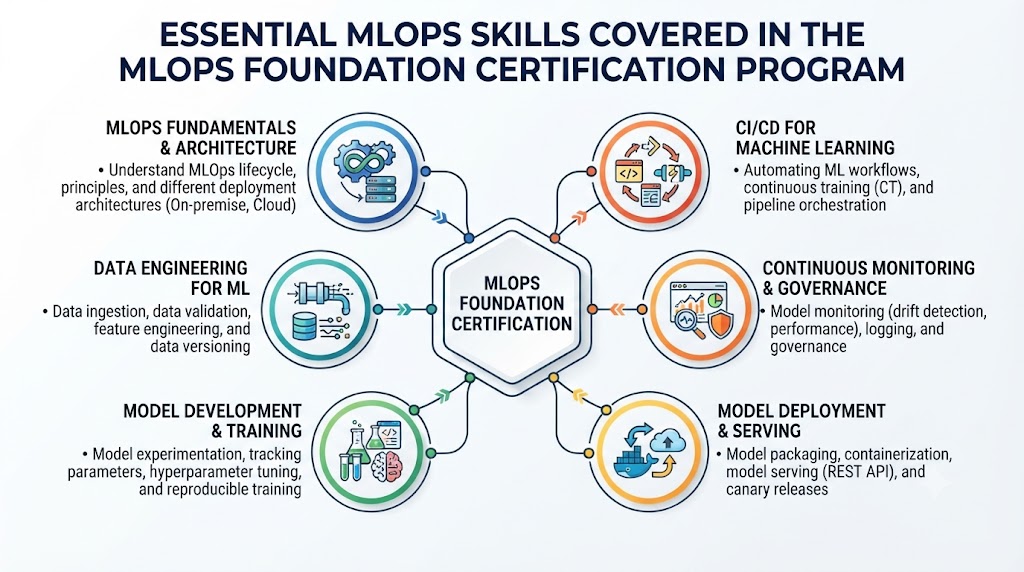
The MLOps Foundation Certification is an objective evaluation standard designed to address the systemic gap between data science experimentation and enterprise infrastructure execution. It exists because the lifecycle of an automated deployment introduces architectural complexities—such as continuous training loops and system dependencies—that standard software engineering frameworks simply aren’t built to handle. This program emphasizes concrete, production-focused engineering competencies over abstract mathematical modeling, ensuring that certified professionals can manage continuous validation tracks. By integrating directly with cloud-native architectures, the credential equips engineers to confidently establish repeatable pipelines, manage versioned data assets, and maintain cluster stability.
Who Should Pursue MLOps Foundation Certification?
This certification is purpose-built for technical practitioners responsible for designing, deploying, and maintaining automated data systems inside modern enterprise networks. Systems engineers, site reliability engineers, and infrastructure architects will gain a distinct advantage by mastering the specific resource provisioning and configuration demands of production data models. Data specialists and backend developers can use this curriculum to pivot toward automated pipeline engineering, while security analysts will learn how to audit automated data streams. Furthermore, engineering managers and delivery leads operating worldwide, including those in India’s expanding tech sectors, can utilize this framework to standardize operational expectations across their cross-functional teams.
Why MLOps Foundation Certification
The demand for reliable infrastructure capable of supporting automated intelligence is growing rapidly as enterprises realize that most data initiatives stumble during the final deployment phase. This certification offers lasting career value because it highlights fundamental architectural principles, data lineage tracking, and infrastructure management rather than confining a professional to one vendor’s toolkit. As corporate technology environments migrate between hybrid cloud setups and open-source stacks, engineers holding this credential retain a highly versatile skill set. The actual return on your time investment comes from an increased capacity to minimize system drift, lower infrastructure overhead, and shorten the time it takes to bring data products to production.
MLOps Foundation Certification Overview
This structured educational pathway is delivered through the main learning platform and hosted on the specialized enterprise training infrastructure at the website. The evaluation methodology relies on rigorous, scenario-based examinations that challenge candidates to resolve actual pipeline bottlenecks rather than recite definitions from a textbook. The underlying curriculum is owned and continuously updated by active industry specialists who ensure the material keeps pace with shifting cloud-native architectures. Structurally, the program is broken down into clear, modular learning paths, allowing working professionals to progress smoothly from foundational operational mechanics to advanced continuous delivery frameworks.
MLOps Foundation Certification Tracks & Levels
The curriculum architecture is organized into three progressive tiers: foundation, professional, and advanced levels, allowing engineers to enter the program at the exact stage of their career maturity. The foundational tier sets the baseline by introducing core concepts of pipeline orchestration and data tracking, establishing a shared technical language for the entire engineering organization. The professional track offers specialized routes tailored to specific engineering roles, allowing cloud architects, reliability specialists, and cost optimization practitioners to apply operational principles to their core focus. Finally, the advanced track focuses on enterprise architecture, governance, and long-term tech strategy, matching the needs of principal engineers and technical directors.
Complete MLOps Foundation Certification Table
| Track | Level | Who it’s for | Prerequisites | Skills Covered | Recommended Order |
| Infrastructure Ops | Foundation | Infrastructure Teams, Data Admins | Linux Basics, Python Familiarity | Pipeline Configuration, Core Versioning | Initial Step |
| Automation Engineering | Professional | SREs, Cloud Engineers | Foundational Certificate | Infrastructure as Code, CI/CD Loops | Secondary Step |
| Strategic Governance | Advanced | Principal Architects, Tech Leads | Professional Certificate | Compliance auditing, Cost Analysis | Final Step |
Detailed Guide for Each MLOps Foundation Certification
MLOps Foundation Certification – Infrastructure Ops Level
What it is
This level validates a practitioner’s fundamental grasp of operational lifecycles, automated validation triggers, and the primary integration points between storage repositories and production compute environments.
Who should take it
It is tailored for systems administrators, junior backend developers, and data coordinators looking to build a structured foundation in automated deployment pipelines.
Skills you’ll gain
- Configuring automated code and data validation checkpoints.
- Implementing structured data versioning within production environments.
- Troubleshooting common integration errors within continuous testing setups.
Real-world projects you should be able to do
- Construct a basic pipeline that automatically packages data artifacts upon new code commits.
- Deploy a localized version-control repository to track environmental changes across multiple releases.
Preparation plan
- 7–14 days strategy: Study the official exam modules daily, make sure you understand the core glossary, and complete all available practice problem sets on the learning platform.
- 30 days strategy: Allocate an hour daily to building test repositories, analyzing pipeline log outputs, and studying structural system documentation.
- 60 days strategy: Combine rigorous reading with hands-on lab environments, design mock workflows from scratch, and collaborate with peers to review tricky architectural problems.
Common mistakes
- Spending too much time debugging data analysis algorithms instead of mastering the delivery pipeline infrastructure.
- Skipping basic container configuration practice before attempting the hands-on portions of the exam.
Best next certification after this
- Same-track option: MLOps Professional Systems Architect
- Cross-track option: Cloud Infrastructure Specialist
- Leadership option: Technical Product Delivery Track
Choose Your Learning Path
DevOps Path
Engineers on this track focus on expanding traditional continuous integration and deployment systems to accommodate data-heavy assets. The core goal is to build automated workflows that test both code efficiency and statistical consistency before any production release occurs. Professionals will master managing secure artifact repositories that store operational weights alongside traditional software packages. This ensures a reliable, predictable deployment cycle across all corporate infrastructure layers.
DevSecOps Path
This discipline concentrates on the stringent security boundaries needed to safeguard automated data pipelines and deployment frameworks. Engineers study techniques for securing data ingestion endpoints, scanning dependencies for vulnerabilities, and ensuring regulatory compliance during automated updates. The curriculum shows practitioners how to build fine-grained access controls to prevent unauthorized parameter modifications in production.
SRE Path
Reliability specialists focus entirely on the availability, speed, and scaling performance of the underlying compute clusters hosting data models. This path teaches engineers to establish specific metrics that measure processing latency, system throughput, and resource utilization under high traffic volumes. Practitioners learn how to build self-healing, auto-scaling environments that absorb sudden computational spikes without service degradation.
AIOps Path
This focused discipline instructs engineers on how to deploy algorithmic monitoring tools directly across corporate networks, log managers, and infrastructure components. The goal is to design highly automated monitoring systems that identify anomalies and execute automated incident response tasks. Tech professionals learn to process massive amounts of telemetry data and transform it into clear, actionable system insights.
MLOps Path
Dedicated strictly to the operational lifecycle of data models, this path prioritizes the systematic transition from experimental environments to live production. Engineers focus on orchestrating automated continuous training loops, managing centralized feature stores, and establishing explicit tracking metrics. The courses prepare specialists to resolve the real-world challenge of aligning code updates with shifting data baselines over time.
DataOps Path
Focusing directly on the upstream data journey, this pathway ensures that clean, well-structured data streams consistently into operational layers. Specialists focus on automating data extraction, transform, and load steps while setting up automated quality control checks. This path bridges the gap between massive data lakes and active, automated deployment endpoints.
FinOps Path
This business-focused path teaches technical professionals how to audit, manage, and optimize the compute costs associated with running large-scale data workflows. Engineers learn to monitor utilization metrics, implement resource tags for large computing tasks, and adjust cluster sizes appropriately. The final goal is balancing operational speed and system accuracy against strict corporate financial constraints.
Role → Recommended MLOps Foundation Certification Certifications
| Role | Recommended Certifications |
| DevOps Engineer | MLOps Foundation + Professional Automation Track |
| SRE | MLOps Foundation + Professional Reliability Track |
| Platform Engineer | MLOps Foundation + Advanced Systems Architecture |
| Cloud Engineer | MLOps Foundation + Cloud Infrastructure Specialist |
| Security Engineer | MLOps Foundation + Secure Pipeline Specialist |
| Data Engineer | MLOps Foundation + DataOps Lifecycle Track |
| FinOps Practitioner | MLOps Foundation + Cloud Cost Optimization Track |
| Engineering Manager | MLOps Foundation + Technical Team Leadership |
Next Certifications to Take After MLOps Foundation Certification
Same Track Progression
Moving forward within this dedicated engineering track means progressing directly into professional-level automation and advanced infrastructure architecture credentials. These next milestones focus on complex, multi-region cluster management, deep pipeline customization, and massive scaling operations. Engineers will dive into advanced fallback workflows, automated traffic routing, and resilient pipeline design patterns.
Cross-Track Expansion
Diversifying your technical capabilities can be achieved by expanding into related fields such as Site Reliability Engineering or DevSecOps security paths. This educational approach broadens an engineer’s perspective, teaching them how core platform stability and zero-trust security frameworks protect automated pipelines. Gaining these secondary skills makes a professional highly effective within modern cross-functional engineering units.
Leadership & Management Track
Transitioning toward strategic leadership requires certifications that focus heavily on engineering governance, delivery metrics, and department resource planning. The leadership track prepares senior engineers to design corporate tech strategies, handle vendor ecosystems, and align technological decisions with business growth. This track moves away from command-line configurations and shifts entirely toward team development, risk evaluation, and operational efficiency.
Training & Certification Support Providers for MLOps Foundation Certification
DevOpsSchool offers deeply structured educational bootcamps designed to help technical professionals master deployment automation, container management, and continuous delivery systems. Their courses emphasize practical lab exercises that mirror genuine enterprise environment problems.
Cotocus provides specialized architecture training focused on cloud-native delivery structures, cluster orchestration, and high-availability environment setups. Their training programs assist senior engineers in deploying resilient system architectures across modern infrastructure.
Scmgalaxy maintains an extensive digital archive of system tutorials, technical breakdowns, and reference materials centered around version control frameworks and build automation. It serves as an essential reference point for engineering professionals.
BestDevOps designs pragmatic certification prep courses that target daily infrastructure management, configuration versioning, and tool integration strategies. Their approach ensures that candidates fully comprehend day-to-day environment maintenance.
devsecopsschool focuses exclusively on integrating security verification, automated compliance scanning, and access authorization patterns directly into delivery pipelines. They prepare technical professionals to maintain highly secure deployment systems.
sreschool concentrates deeply on teaching system resilience, continuous tracking setups, incident management, and performance budgets. Their courses instruct engineers on maintaining maximum uptime across volatile enterprise software operations.
aiopsschool provides targeted training courses that focus on the intersection of system metrics, predictive automation frameworks, and enterprise infrastructure management. They help engineers deploy automated intelligence across corporate systems.
dataopsschool specializes in educational structures built around enterprise data orchestration, pipeline validation, and data lifecycle management. Their programs connect raw data storage platforms with active delivery channels.
finopsschool instructs financial managers and tech teams on cloud cost monitoring, compute resource tagging, and cloud efficiency techniques. Their curriculum assists organizations in scaling infrastructure in a cost-controlled manner.
Frequently Asked Questions (General)
- What is the central purpose of earning an enterprise operations certification?The primary focus is validating your practical capability to build, protect, and maintain automated software pipelines that handle code and data assets efficiently in production.
- How much time should a working engineer dedicate to pass the foundational exam?Most professionals find that thirty to sixty days of preparation, dedicating roughly one to two hours per day to practical exercises, is sufficient for success.
- Are there major coding prerequisites required before starting the educational program?A foundational comfort with basic scripting languages like Python and solid familiarity with the Linux terminal are highly recommended to clear the lab practicals.
- Does this certification preparation focus on one proprietary cloud vendor’s environment?No, the course materials cover cloud-agnostic engineering concepts and open-source workflows that apply across hybrid environments and multiple cloud providers.
- What is the main operational difference between DevOps and data pipeline engineering?Standard workflows focus primarily on tracking and deploying static source code, while data pipeline engineering must simultaneously manage dynamic data versions, weights, and configurations.
- How does adding this credential to a portfolio improve career prospects?It provides clear evidence that you know how to build and stabilize automated pipelines, directly addressing a widespread skills shortage in the enterprise tech sector.
- Is a live practical exam included in the final certification process?Yes, the testing setup requires candidates to solve real-world configuration errors and build functional deployment loops within a simulated cloud lab environment.
- Can an engineering manager get real value out of the foundational course tier?Yes, the foundational track gives technical leaders the vocabulary and architectural insights needed to manage project timelines, guide teams, and select software tools.
- How regularly does the hosting body update the course syllabus?The educational curriculum is modified systematically throughout the year to integrate shifting industry standards, new security patterns, and updated cloud practices.
- What post-certification support options are available to successful candidates?Certified engineers receive access to professional alumni directories, ongoing learning updates, and early alerts for advanced technical certification paths.
- Are practice tests and digital workbooks included upon registration?Yes, every candidate receives comprehensive study guides, interactive laboratory environments, and mock exams designed to match the format of the actual test.
- Does the foundational curriculum cover cloud spending efficiency and resource tags?Yes, basic infrastructure cost governance, efficient cluster sizing, and resource tracking are built directly into the core architectural modules.
FAQs on MLOps Foundation Certification
- What specific deployment challenges does the MLOps Foundation Certification solve for enterprise teams?This program explicitly targets common production issues including model drift, broken continuous training loops, version mismatches between data and code, and computing bottlenecks during high-volume inference processing.
- Do I need an advanced degree in statistical mathematics or data science to pass this course?No, the curriculum is entirely focused on delivery pipelines, infrastructure as code, automated monitoring, and environmental configuration rather than the algorithmic math behind data models.
- How does this training material cover data compliance and secure access control within pipelines?It details precise engineering methods for configuring secure data access perimeters, safeguarding environmental variables, and maintaining automated data lineage logs for corporate compliance audits.
- What exact tools will I use during the hands-on lab segments of this program?The practical labs focus on standard container systems, automation engines, specialized version control utilities, and pipeline orchestrators that are frequently utilized across enterprise data networks.
- In what way does this certification benefit an experienced Site Reliability Engineer?It provides the SRE with deep insights into specialized monitoring metrics, such as tracing data drift and inference performance, allowing them to better manage application uptime budgets.
- Is the MLOps Foundation Certification accepted internationally by modern enterprise employers?Yes, the framework maps directly to global open-source infrastructure standards and enterprise cloud patterns, ensuring its value across all major technology regions.
- What is the recommended timeframe for renewing or updating this technical credential?The credential adheres to standard industry lifecycles, recommending that practitioners recertify or step up to an advanced professional level every two years to maintain alignment with technology.
- Are custom training options available for corporate engineering groups?Yes, tailored corporate learning tracks can be organized through the site, allowing engineering teams to train simultaneously using examples that match their company’s specific infrastructure.
Final Thoughts: Is MLOps Foundation Certification Worth It?
Investing your time into the MLOps Foundation Certification is a highly pragmatic step for any technologist operating at the crossroads of system infrastructure and data systems. This course leaves out the typical industry marketing buzzwords and focuses completely on the real-world mechanics of keeping deployment pipelines stable, safe, and cost-efficient. By mastering these core pipeline automation and validation principles, you establish yourself as an indispensable asset to engineering organizations struggling to move their data systems out of staging. If you want to move past basic infrastructure maintenance and start designing resilient enterprise platform architectures, this credential offers the grounded, experience-driven roadmap you need to succeed.