Introduction
In the rapidly shifting world of artificial intelligence, the biggest bottleneck isn’t building a great model; it is figuring out how to run that model reliably in the real world. The Certified MLOps Professional program is built for the engineers and architects who are tired of the notebook-to-production disconnect and are ready to build systems that actually last. As infrastructure becomes more complex, the ability to automate pipelines and maintain model health is what separates a prototype from an enterprise-grade solution. This guide walks you through how this certification at aiopsschool acts as a blueprint for your career, helping you make smarter, more practical decisions in your journey toward becoming a seasoned ML systems engineer.
The Core Essence of MLOps Mastery
At its heart, the Certified MLOps Professional credential isn’t just about a certificate; it represents a philosophy of managing machine learning through the lens of robust software engineering. It exists because the industry has matured beyond the “research-only” phase and now requires professionals who can treat ML models like any other mission-critical production service. By focusing on production-grade automation, scalable infrastructure, and continuous delivery, this path aligns your technical skills with the actual needs of modern engineering teams. It moves the focus away from abstract theory and places it firmly on the practical realities of keeping AI services stable, efficient, and governable in a busy enterprise environment.
Who Truly Benefits from This Expertise
This certification is a natural fit for software engineers, data scientists, and SREs who find themselves acting as the glue between data teams and infrastructure teams. It is equally relevant for technical leaders and engineering managers who need to speak the language of AI deployment to make informed architectural choices. Whether you are currently working in the Indian tech sector or supporting a global cloud-native team, the skills taught here are universal. From early-career engineers looking to specialize to senior practitioners wanting to formalize their operational knowledge, this program provides the structured roadmap needed to navigate the complexities of production ML.
Why This Skill Set Remains Relevant Over the Long Haul
As AI features become a standard layer in our software stack, the demand for people who can bridge the “ML-Ops gap” will only grow. This certification is a strategic move to stay relevant because it emphasizes core operational principles over the flavor-of-the-month tools that often distract engineers. By mastering the fundamental patterns of automated training, drift detection, and governance, you build a foundation that survives as the technology around you changes. It is an honest investment of your time that signals to employers that you possess the discipline and technical maturity required to manage high-stakes deployments, providing long-term career stability.
The Framework of the Certification
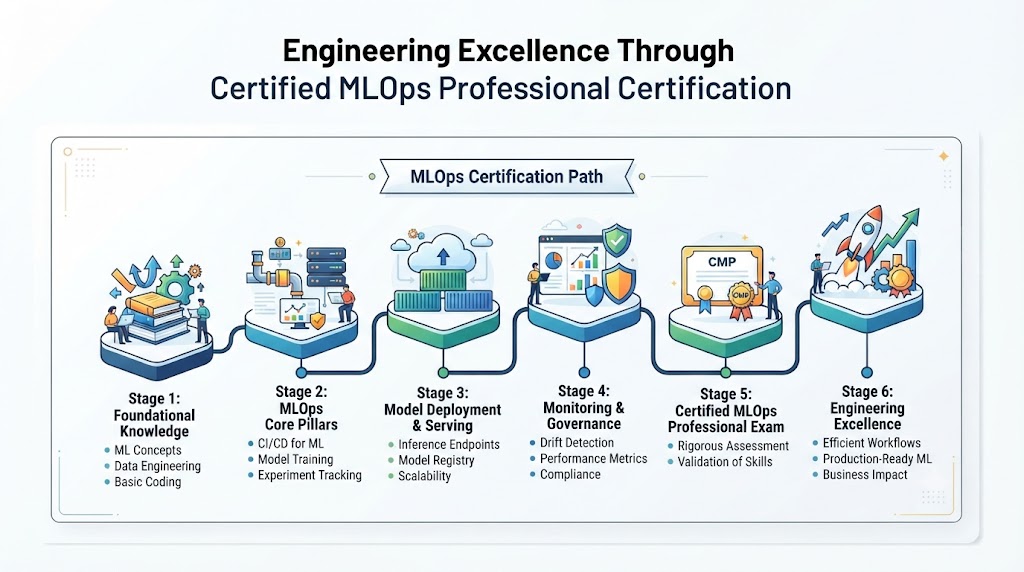
The program is delivered via the official Certified MLOps Professional curriculum and hosted on aiopsschool. We have stripped away the fluff, ensuring the assessment process focuses entirely on your ability to apply MLOps patterns to real-world scenarios rather than just testing your memory. The certification is layered, allowing you to build your expertise incrementally from foundational operational concepts to the intricacies of large-scale architecture. Holding this credential is a clear indicator that you are committed to high professional standards and that you have the practical experience to handle the messy reality of production systems.
Understanding Your Progression Levels
The program offers a logical climb from foundation to professional, and finally to advanced levels, each matching a different phase of your career development. The foundation tier establishes the essential “why” and “how” of automated workflows, while the professional tier digs deep into complex pipeline orchestration and monitoring strategies. The advanced tier is crafted for those who are building and governing large, distributed ML ecosystems. With specialized tracks available, you can align your learning path with your current job responsibilities or target a transition into a more specialized role, ensuring every hour of study moves you closer to your specific career goals.
Mapping Your Certifications and Skill Growth
| Track | Level | Who it’s for | Prerequisites | Skills Covered |
| MLOps Core | Foundation | Beginners | Basic Python | Version control, Basic Pipelines |
| MLOps Pro | Professional | Engineers | Foundation Cert | CI/CD for ML, Monitoring |
| MLOps Expert | Advanced | Architects | Pro Certification | Multi-cloud ML, Governance |
Deep Dive into the Professional Certification Level
The Foundational MLOps Milestone
What you will master
This stage validates your grasp of the essential ML lifecycle and why automation is the only way to succeed in data-intensive roles.
The ideal candidate
Software developers and data scientists eager to move their code from a local environment into reliable, automated production pipelines.
Practical skills you will acquire
- Versioning data and models with precision.
- Writing automated tests for ML model code.
- Building and managing basic containerized environments.
Real-world outcomes you will deliver
- Designing a pipeline that automates the model training process.
- Establishing a model registry for version control.
- Writing unit tests that validate model inputs before they cause production issues.
Strategic preparation steps
- 7–14 days: Refresh your knowledge of DevOps foundations and standard ML workflows.
- 30 days: Engage with the hands-on labs to build muscle memory for these tools.
- 60 days: Lead a mock project to practice environment parity and configuration management.
Common pitfalls to avoid
- Over-prioritizing the model code while neglecting data versioning.
- Forgetting to maintain consistency between development and production environments.
Choosing your next step
- Same-track: Certified MLOps Professional – Professional Level.
- Cross-track: Certified DevOps Professional.
- Leadership: Engineering Management Foundations.
Navigating Your Unique Career Path
The DevOps Engineering Route
Focus on mastering the automation of delivery pipelines and core infrastructure. By integrating MLOps into your current workflow, you become the person who makes model deployment as routine as deploying a standard web service, ensuring your pipelines are both scalable and reliable.
The DevSecOps Security Route
Integrate security into the heart of your ML pipelines. This path teaches you how to automate security scanning for models and data, which is essential for working in regulated industries where transparency, auditability, and data privacy are mandatory requirements.
The SRE Reliability Route
Become the guardian of production health. This track focuses on monitoring model performance, drift detection, setting clear service-level objectives, and mastering incident response for ML services to keep your AI features running smoothly under any load.
The AIOps Operational Route
Shift toward the “intelligence” side of operations. You will learn how to apply ML models to your infrastructure data to automate anomaly detection and speed up remediation, positioning you at the forefront of automated IT operations.
The MLOps Lifecycle Route
This is the core specialization for those who want to live and breathe model lifecycles. You will build and maintain resilient systems that automate training, validation, and deployment, making you the primary architect for an organization’s machine learning delivery.
The DataOps Data Management Route
Focus on the plumbing that makes ML possible. This path covers high-quality data flow, lineage, and versioning, ensuring your data pipelines are robust enough to support complex AI models without failing during critical updates.
The FinOps Financial Route
Master the intersection of cloud costs and ML performance. You will learn how to optimize training and inference budgets, ensuring that your organization’s AI investments deliver actual business value without blowing through the cloud infrastructure budget.
Recommended Certification Roadmap by Role
| Role | Recommended Certifications |
| DevOps Engineer | Certified MLOps Professional |
| SRE | Certified MLOps Professional, Advanced MLOps |
| Platform Engineer | Certified MLOps Professional |
| Cloud Engineer | Certified MLOps Professional |
| Security Engineer | DevSecOps and Certified MLOps Professional |
| Data Engineer | DataOps and Certified MLOps Professional |
| FinOps Practitioner | FinOps and Certified MLOps Professional |
| Engineering Manager | Certified MLOps Professional Leadership Track |
Planning Your Professional Evolution
Deepening Your Technical Expertise
Once you have conquered the professional level, move toward expert certifications that focus on multi-cloud strategies and global scale. This is where you master the “how-to” for the most complex systems, ensuring your technical skills remain in the top percentile of the industry.
Widening Your Operational Horizon
Expand your reach by picking up certifications in FinOps or Security. Understanding how to manage infrastructure spending or secure deep-learning pipelines adds a layer of professional maturity that makes you a standout candidate for lead engineering roles.
Transitioning into Leadership
If you are moving toward management, shift your focus to certifications that emphasize architecture and team strategy. These programs give you the framework to lead cross-functional teams and align your technical roadmap with the high-level business goals of your company.
Your Training and Support Partners
DevOpsSchool is a primary leader, providing deep, hands-on training for modern infrastructure and development practices for enterprises worldwide.
Cotocus delivers intensive, project-heavy modules designed to help engineers bridge the gap between theory and actual, production-ready experience.
Scmgalaxy focuses on the technical nuances of configuration management, pipeline automation, and enterprise-grade software delivery methodologies.
BestDevOps specializes in practical, no-nonsense tutorials and certifications that center on industry-standard tools and high-efficiency workflows.
devsecopsschool offers highly focused certification paths that help you weave robust security practices into modern development lifecycles.
sreschool is the go-to for reliability engineering, covering everything from complex monitoring to incident management in large-scale production environments.
aiopsschool acts as the central hub for intelligence-driven operations, providing the core framework and standards for all MLOps professionals.
dataopsschool provides extensive training on managing high-quality data pipelines, which are the backbone of any successful AI application.
finopsschool delivers expert-led training on managing the critical balance between cloud cost efficiency and engineering excellence.
Frequently Asked Questions for Aspiring Professionals
- How tough is it to pass the Certified MLOps Professional exam?The exam is intentionally rigorous because it focuses on your ability to solve real-world engineering problems rather than just testing your ability to recall definitions.
- What is the typical time commitment to get fully prepared?A realistic estimate is between 30 and 60 days, though this depends entirely on your background and the amount of time you can dedicate to the labs.
- Are there any hard prerequisites I need to meet first?While you don’t need a specific degree, a solid grasp of Python and basic DevOps principles will make your learning path much smoother and more effective.
- Will this certification actually boost my career potential?Yes, it acts as a strong, industry-recognized signal that you possess the specialized operational skills currently in high demand across the tech sector.
- Is it better to take the foundation level before moving up?Absolutely, the foundation builds the vocabulary and mental model you need to handle the advanced complexities you will face in the professional tier.
- How often should I look to update my knowledge?Given the speed at which AI tooling changes, setting aside time to update your expertise every 12 to 18 months is a professional best practice.
- Is this credential respected in the Indian technology market?It is highly relevant, especially as companies across India aggressively adopt AI-driven features and require skilled engineers to manage those services.
- Do I need to set up my own expensive infrastructure for the labs?No, the program provides pre-configured lab environments so you can focus on learning the core concepts without worrying about infrastructure setup.
- Do hiring managers globally recognize this training?Yes, because the curriculum focuses on platform-agnostic, core engineering principles that apply to standard practices used by all major tech companies.
- Is this certification specific to one cloud vendor?No, it is deliberately vendor-neutral, ensuring you learn engineering principles that apply regardless of whether you use AWS, Azure, or GCP.
- Where can I go if I get stuck during my studies?The certification community provides a direct channel to mentors and peers who can help you work through any technical roadblocks you encounter.
- Is this a good fit for engineering managers who aren’t coding every day?Yes, it is excellent for leaders who need to understand the architecture and operational overhead of ML systems to guide their teams effectively.
Focused Clarity on the Certified MLOps Professional Journey
- What is the primary differentiator of this certification?It prioritizes production-grade reliability and operational stability over the purely academic or model-centric focus of other programs.
- Does the program cover automated model monitoring?Yes, we cover how to set up robust monitoring, detect drift, and automate alerting so your models don’t silently fail in production.
- How does this program handle model governance and compliance?Governance is built into every step, covering model lineage, versioning, and the audit trails required to keep your AI deployments compliant.
- Will I get hands-on experience with CI/CD for machine learning?Yes, this is a cornerstone of the curriculum, with detailed, practical labs that teach you how to build automated training and deployment pipelines.
- Does the certification include practical, scenario-based labs?Yes, completing these labs is a mandatory part of the program, ensuring you have the technical proficiency to back up your credential.
- Can this help me shift my focus from Data Science to Engineering?It is arguably the best path to bridge that gap, giving you the software engineering mindset required to become a top-tier MLOps engineer.
- Is cost optimization for ML models part of the training?Yes, we treat financial efficiency as an engineering problem, teaching you how to optimize infrastructure spending for your training and inference tasks.
- Is this certification aimed only at massive enterprises?While the patterns we teach are designed for scale, the operational discipline is a massive benefit for any organization looking to deploy models consistently.
Closing Thoughts: Is This Investment Worth It?
If you are genuinely looking to build a long-term, high-impact career in the operational side of AI, this certification is a solid, honest investment of your time. It does not promise you a magical shortcut to success, but it does provide a clear, proven path to mastering the complexities of modern deployments. In an industry often cluttered with marketing hype, this program stays grounded by focusing on the core engineering habits that matter. If you are ready to put in the work to learn, build, and apply these concepts, the knowledge you gain will become one of the most valuable tools in your engineering toolkit.