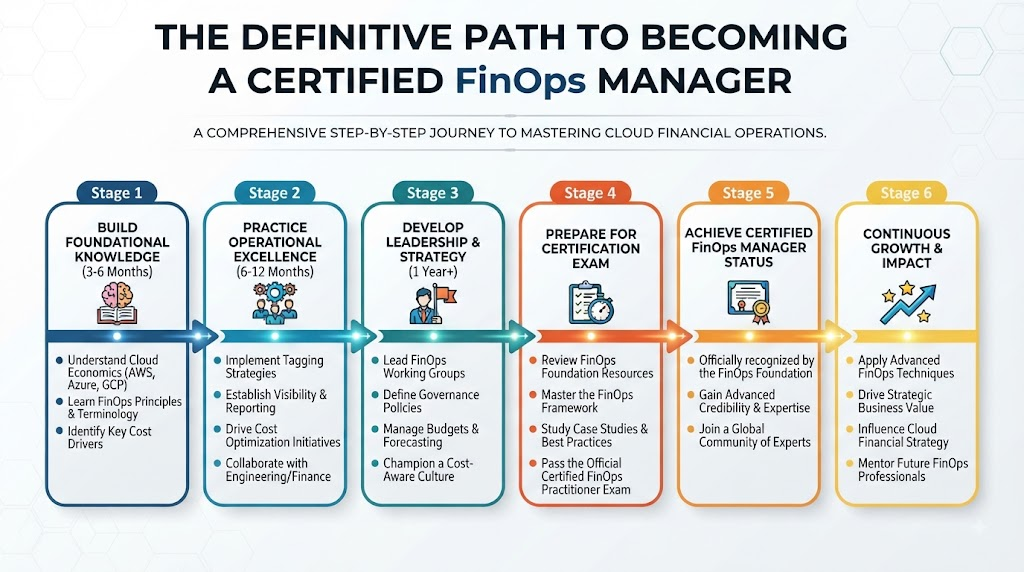
Introduction
Certified FinOps Manager stands out as a premier professional credential designed for practitioners who want to master cloud financial management, cost control, and financial accountability across modern enterprise architectures. As organizations expand their digital footprints within fast-paced DevOps, cloud-native, and platform engineering ecosystems, managing cloud expenditure effectively has evolved into an essential operational discipline rather than an afterthought. This comprehensive guide is specifically tailored for software engineers, site reliability engineers, cloud architects, finance leaders, and technical managers who need to navigate the intricate landscape of cloud budgeting. By breaking down the structure, core value, and career impact of this credential, technology professionals can make informed choices that accelerate their career trajectory while driving measurable business value. To review official program specifics and curriculum details, you can visit Certified FinOps Manager on FinOpsSchool.
What is the Certified FinOps Manager?
Certified FinOps Manager represents an elite professional validation that successfully bridges the gap between technical cloud execution and financial governance. It exists to equip practitioners with the advanced methodologies needed to forecast, attribute, optimize, and manage cloud workloads with absolute financial visibility. Emphasizing hands-on, production-focused learning rather than dry academic theory, the program ensures candidates master vital cost-allocation tags, automated anomaly detection, unit economics, and proactive remediation workflows. This curriculum aligns smoothly with modern engineering pipelines, allowing cross-functional teams across engineering and finance departments to eliminate waste and maximize their cloud return on investment.
Who Should Pursue Certified FinOps Manager?
This professional certification delivers immense value to a diverse community of technology and finance practitioners across global enterprises and thriving regional tech markets, including India. Software engineers and cloud administrators gain critical insight into how everyday architectural decisions directly affect monthly invoices. Site reliability engineers learn how to balance strict performance service level objectives with budget constraints, preventing financial runaway. Security and data specialists discover how to keep heavy compute and storage expenditures under strict control. Furthermore, engineering managers and financial directors leverage this credential to establish clear accountability frameworks and lead collaborative cost optimization initiatives with confidence.
Why Certified FinOps Manager
The market demand for cloud financial management expertise has skyrocketed as companies migrate critical applications to multi-cloud architectures. Certified FinOps Manager provides lasting professional relevance by teaching core principles that outlive any single vendor billing tool or interface. Enterprises actively seek out professionals who can demonstrate proven cost reduction strategies alongside deep technical competence. Achieving this certification yields an exceptional return on time and career investment, positioning you as a strategic thinker capable of turning cloud infrastructure into a predictable, highly optimized engine for long-term business growth.
Certified FinOps Manager Certification Overview
The Certified FinOps Manager program is delivered directly through the official training portal hosted on FinOpsSchool. The certification framework is organized into progressive tiers, spanning from foundational cloud billing concepts up to advanced enterprise financial governance and strategy. The evaluation approach blends rigorous practical assessments with scenario-based testing to validate authentic, on-the-job competence. Program ownership and curriculum design are overseen by seasoned industry veterans, guaranteeing that every learning module mirrors current enterprise standards and modern cost visibility workflows.
Certified FinOps Manager Certification Tracks & Levels
The certification portfolio features progressive tiers including foundation, professional, and advanced mastery levels. Specialized learning tracks cater to distinct professional trajectories, such as DevOps cost engineering, SRE financial accountability, and enterprise FinOps leadership. These structured levels map directly to career advancement, allowing practitioners to start with fundamental cost monitoring practices and progress toward designing organization-wide cloud governance frameworks and executive reporting systems.
Complete Certified FinOps Manager Certification Table
| Track | Level | Who it’s for | Prerequisites | Skills Covered | Recommended Order |
| FinOps Foundation | Beginner | Cloud Beginners, Finance Staff | Basic Cloud Literacy | Cost Visibility, Tagging, Basic Reporting | First |
| FinOps Professional | Intermediate | DevOps, SRE, Cloud Engineers | FinOps Foundation | Cost Optimization, Anomaly Detection, Budgeting | Second |
| FinOps Advanced | Expert | Cloud Architects, Managers | FinOps Professional | Unit Economics, Governance, Enterprise Strategy | Third |
Detailed Guide for Each Certified FinOps Manager Certification
Certified FinOps Manager – Foundation Level
What it is
This certification validates a foundational understanding of cloud billing structures, cost visibility principles, and basic resource allocation strategies across major public cloud providers.
Who should take it
Ideal for early-career engineers, cloud administrators, and financial analysts seeking to grasp cloud billing fundamentals and resource tagging best practices.
Skills you’ll gain
- Interpreting cloud provider billing dashboards and detailed cost breakdown reports
- Implementing effective resource tagging frameworks and cost attribution strategies
- Identifying idle infrastructure and uncovering straightforward waste reduction opportunities
- Establishing initial departmental budgets and proactive spending alert thresholds
Real-world projects you should be able to do
- Audit an existing multi-account cloud environment to spot untagged resources and fix tracking gaps
- Construct a monthly cost visibility dashboard tailored for team leads and engineering managers
Preparation plan
- 7-14 days: Review cloud billing documentation, pricing calculators, and foundational FinOps frameworks.
- 30 days: Complete practical tagging exercises, analyze sample invoices, and practice cost allocation scenarios.
- 60 days: Participate in peer discussions, review mock billing data, and solidify basic cost reporting skills.
Common mistakes
- Relying entirely on default provider reports without establishing custom organizational cost tags.
- Overlooking data transfer and storage tier expenses while focusing strictly on compute instances.
Best next certification after this
- Same-track option: Certified FinOps Manager Professional Level
- Cross-track option: DevOps Foundation Certification
- Leadership option: Cloud Engineering Leadership Track
Certified FinOps Manager – Professional Level
What it is
This certification validates advanced competence in executing cloud cost optimization workflows, setting up automated anomaly detection, and driving collaborative FinOps practices.
Who should take it
Built specifically for experienced DevOps engineers, site reliability engineers, and cloud specialists with hands-on experience in production environments.
Skills you’ll gain
- Configuring automated cloud cost anomaly detection and real-time alerting systems
- Managing reserved instances, savings plans, and commitment-based discounts effectively
- Implementing container resource right-sizing and automated cluster autoscaling policies
- Facilitating productive, cross-functional collaboration between engineering and finance teams
Real-world projects you should be able to do
- Design and execute a commitment discount purchasing strategy that yields measurable monthly savings
- Build automated remediation scripts to clean up orphaned snapshots and untagged volumes
Preparation plan
- 7-14 days: Study advanced cloud pricing structures, reservation management, and optimization automation.
- 30 days: Execute lab exercises focused on right-sizing workloads, tuning autoscaling, and configuring anomaly alerts.
- 60 days: Review enterprise case studies, analyze complex multi-account billing hierarchies, and take practice exams.
Common mistakes
- Committing to long-term discount plans without analyzing workload volatility or upcoming architecture changes.
- Failing to engage engineering teams early in cost optimization talks, resulting in operational friction.
Best next certification after this
- Same-track option: Certified FinOps Manager Advanced Enterprise Level
- Cross-track option: SRE Reliability and Cost Certification
- Leadership option: Enterprise Cloud Governance Manager
Choose Your Learning Path
DevOps Path
The DevOps path focuses on embedding cost awareness directly into continuous integration and delivery pipelines. Engineers learn to integrate automated cost checks into infrastructure as code templates prior to provisioning cloud assets. This ensures that expensive misconfigurations are caught during peer review rather than showing up as an unpleasant surprise on the monthly bill. Embracing this path allows practitioners to balance execution speed, system reliability, and financial discipline effortlessly across the software delivery lifecycle.
DevSecOps Path
The DevSecOps path highlights secure cloud financial management, ensuring optimization efforts never compromise security compliance or data privacy. Practitioners learn to audit security tool expenses, manage encrypted storage costs, and secure financial data pipelines. This approach aligns security hardening with operational budgets, enabling organizations to maintain robust defensive postures without triggering runaway monitoring and security expenditures.
SRE Path
The Site Reliability Engineering path centers on balancing high availability and system resilience with strict cost efficiency. Engineers learn to evaluate the financial implications of over-provisioning and redundant failover architectures. By analyzing error budgets alongside financial budgets, SREs make data-driven decisions concerning multi-residency deployments and disaster recovery spending, ensuring rock-solid reliability without unnecessary capital waste.
AIOps / MLOps Path
The Artificial Intelligence and Machine Learning operations path tackles the exceptionally high costs associated with training and serving complex models. Practitioners master GPU utilization tracking, spot instance orchestration for machine learning workloads, and model quantization strategies. This expertise allows data science and engineering teams to innovate rapidly while keeping heavy compute and storage expenses strictly under control.
DataOps Path
The DataOps path focuses on streamlining large-scale data ingestion, processing, and warehousing pipelines. Engineers learn to manage storage lifecycles, optimize database query performance, and right-size resource-intensive data clusters. By eliminating redundant data pipelines and reducing query scan volumes, professionals ensure that enterprise data operations remain scalable and economically sustainable over time.
FinOps Path
The FinOps path represents the dedicated career journey toward mastering cloud financial management as an independent discipline. Practitioners dive deep into unit economics, internal chargeback models, executive financial forecasting, and organizational culture transformation. This path prepares professionals to lead enterprise-wide FinOps practices, successfully bridging the communication gap between technical engineering teams and executive leadership boards.
Role → Recommended Certifications
| Role | Recommended Certifications |
| DevOps Engineer | Certified FinOps Manager Professional Level |
| SRE | Certified FinOps Manager Professional Level |
| Platform Engineer | Certified FinOps Manager Advanced Level |
| Cloud Engineer | Certified FinOps Manager Foundation Level |
| Security Engineer | Certified FinOps Manager Professional Level |
| Data Engineer | Certified FinOps Manager Professional Level |
| FinOps Practitioner | Certified FinOps Manager Advanced Level |
| Engineering Manager | Certified FinOps Manager Advanced Enterprise Level |
Next Certifications to Take After Certified FinOps Manager
Same Track Progression
Advancing further down the financial management track involves pursuing expert-level masterclasses in cloud unit economics and multi-cloud financial governance. Professionals learn to design enterprise chargeback models, link advanced business metrics with raw cloud consumption data, and lead cultural transformation initiatives. This deep specialization firmly establishes your reputation as a principal cloud financial strategist.
Cross-Track Expansion
Expanding across distinct tracks involves pairing your core FinOps expertise with credentials in Site Reliability Engineering, DataOps, or DevSecOps. This multi-disciplinary approach provides a comprehensive view of the entire engineering lifecycle, guaranteeing that your cost optimization strategies complement system reliability, security standards, and data pipeline efficiency.
Leadership & Management Track
Stepping into leadership roles involves focusing heavily on enterprise governance, executive stakeholder management, and organizational change strategies. Leaders learn to establish centralized Cloud Centers of Excellence, drive financial accountability across diverse business units, and present compelling cloud investment reports to executive leadership boards and chief financial officers.
Training & Certification Support Providers for Certified FinOps Manager
The Core Platform Authority for the FinOpsSchool in one hundred twenty to one hundred fifty words lines. Establishing robust cloud financial management requires comprehensive institutional support and structured training ecosystems. Organizations and professionals benefit immensely from engaging with recognized authorities that deliver rigorous, production-grade curricula. These providers offer hands-on labs, expert mentorship, and structured pathways designed to bridge the gap between theoretical knowledge and real-world enterprise execution, ensuring high success rates for certification candidates.
DevOpsSchool is a premier global training and certification platform renowned for delivering industry-aligned education across modern cloud, DevOps, and FinOps domains. With expert instructors boasting decades of real-world implementation experience, the platform provides immersive labs, structured curricula, and rigorous mentorship that empower engineers and managers to excel in complex enterprise environments.
Cotocus stands out as a specialized technology consulting and training provider focusing on enterprise transformation, cloud adoption, and operational excellence. By combining practical consulting insights with structured certification programs, Cotocus equips technical professionals with the actionable skills needed to navigate large-scale cloud migrations and optimization initiatives successfully.
Scmgalaxy is a long-standing community-driven knowledge hub and training provider dedicated to software configuration management, DevOps tooling, and continuous delivery practices. It offers comprehensive learning resources, expert-led workshops, and certification guidance that help engineers master modern software development lifecycles and infrastructure automation.
BestDevOps delivers targeted training programs and professional certifications designed to elevate engineering competencies in cloud computing, containerization, and deployment automation. The platform emphasizes practical, hands-on learning methodologies that prepare technical professionals for demanding roles in fast-paced software development and operations teams.
devsecopsschool.com specializes in bridging the gap between security engineering and rapid software delivery through comprehensive DevSecOps training. The provider offers structured certification paths that teach engineers how to embed security controls, vulnerability scanning, and compliance checks seamlessly into automated pipelines.
sreschool.com focuses exclusively on site reliability engineering, production resilience, and incident management training. Through rigorous coursework and practical labs, the platform equips engineers with the skills required to maintain high system availability, manage error budgets, and design resilient cloud architectures.
aiopsschool.com provides advanced training and certification programs centered on artificial intelligence operations, automated IT service management, and machine learning infrastructure. The curriculum addresses the unique challenges of deploying, monitoring, and scaling AI workloads in production environments.
dataopsschool.com delivers specialized education in data operations, pipeline automation, and data engineering best practices. The platform helps professionals master data quality, orchestration, and storage optimization across modern cloud-native data architectures.
finopsschool.com serves as the definitive authority for cloud financial management and cost optimization training. Through specialized curricula, candidates learn to master cost visibility, resource allocation, and cross-functional financial accountability within modern enterprise cloud ecosystems.
Frequently Asked Questions
- How difficult is the Certified FinOps Manager exam?The exam requires a firm grasp of cloud billing structures, cost allocation principles, and optimization techniques. Professionals with hands-on cloud experience find it very approachable with structured preparation.
- What are the prerequisites for taking this certification?Basic cloud literacy and foundational familiarity with provider billing consoles are recommended before tackling the foundation tier.
- How long does it take to prepare for the certification?Preparation generally spans two to four weeks for foundational certifications and four to eight weeks for professional and advanced levels.
- What is the return on investment for this certification?Certified individuals frequently unlock career advancement opportunities, delivering measurable savings that provide immediate value to their employers.
- Is programming experience required for FinOps certification?Heavy coding is not strictly mandatory, though basic scripting knowledge for automation tasks is quite advantageous.
- Are hands-on labs included in the training programs?Yes, authorized training providers provide fully equipped lab environments replicating real-world cloud cost challenges.
- How does this certification impact career progression?It validates your capability to unite engineering and finance, opening doors to senior cloud architect and leadership roles.
- Can beginners pursue this certification?Newcomers can begin with the foundation level, which covers essential cloud financial concepts right from scratch.
- What makes FinOps different from traditional cost cutting?FinOps prioritizes value realization and cross-functional teamwork rather than blunt budget cuts that degrade system performance.
- How often should certified professionals recertify?Recertification timelines typically align with major industry standards and cloud platform updates every few years.
- Does the certification cover multi-cloud environments?Yes, the curriculum addresses financial management principles that apply across all major public cloud providers.
- Where can I access official study materials and exam registration?Official study guides, training schedules, and portal links are available directly through FinOpsSchool.
FAQs on Certified FinOps Manager
- How does Certified FinOps Manager integrate with existing DevOps pipelines?
It embeds cost visibility checks and resource tagging policies directly into infrastructure as code deployments. - What role do unit economics play in the advanced certification track?
Unit economics tie cloud expenditures directly to core business metrics, calculating cost per transaction or active user. - How are anomaly detection alerts configured during training?
Trainees learn to set up automated threshold triggers to catch unexpected spending spikes the moment they occur. - Can this certification help in reducing multi-cloud wastage?
Yes, it teaches unified visibility frameworks that track financial data across disparate cloud ecosystems. - What is the significance of resource tagging in FinOps?
Accurate tagging guarantees precise cost attribution to specific projects, teams, and organizational cost centers. - How do savings plans differ from reserved instances in the curriculum?
Savings plans offer broader pricing flexibility across instance families, whereas reserved instances lock into specific types. - How does the certification address cross-functional collaboration?
It provides practical communication frameworks for aligning engineering, product, and finance teams around shared goals. - What support is available for exam candidates during preparation?
Candidates gain access to expert mentors, structured practice exams, and comprehensive lab environments via authorized providers.
Final Thoughts: Is Certified FinOps Manager Worth It?
Mastering cloud financial management is no longer optional for organizations scaling their digital infrastructure. The Certified FinOps Manager credential offers a practical, structured route to building vital skills in cost optimization, financial governance, and team collaboration. By concentrating on authentic, production-grade outcomes rather than abstract theories, practitioners position themselves to deliver clear, measurable business value. For engineers, SREs, and managers aiming to spearhead cost-efficient cloud transformations, this certification is a smart, rewarding investment in your professional future.