Introduction
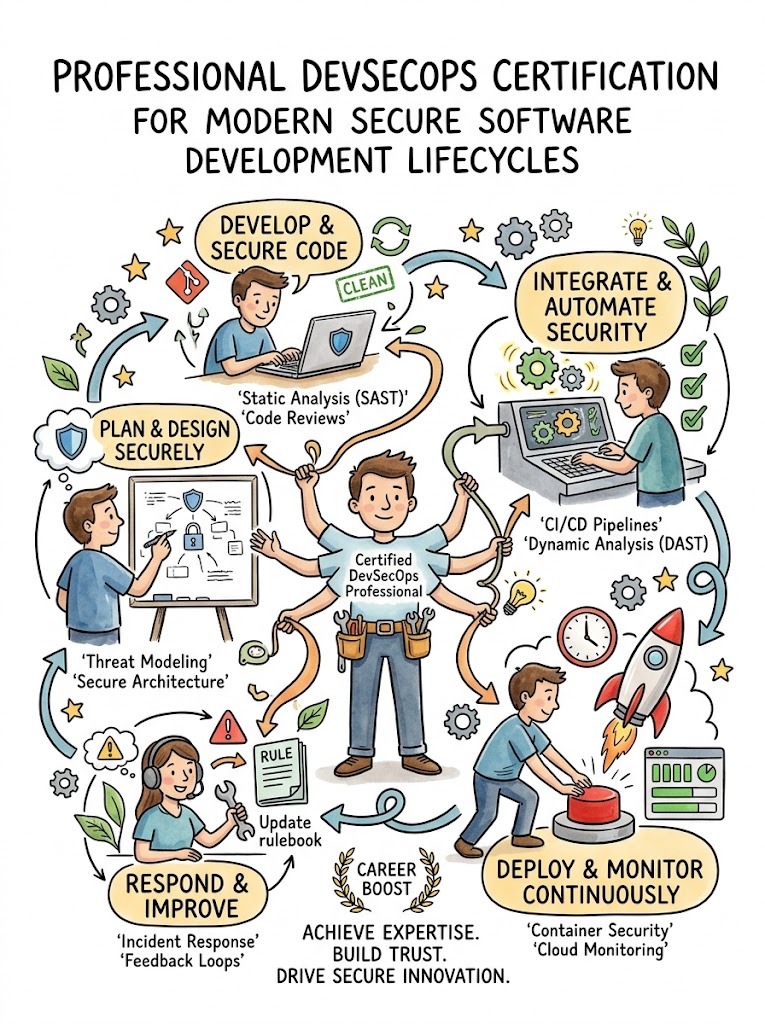
The integration of security into DevOps—often called DevSecOps—is no longer just a trend; it is a fundamental requirement for reliable software delivery. This guide is designed for developers, system administrators, and security analysts who aim to enhance their technical toolkit through the Certified DevSecOps Professional. By focusing on automated security controls and proactive risk management, professionals can significantly reduce deployment bottlenecks. This resource provides a deep dive into the certification path, ensuring that you have the clarity needed to make informed decisions about your career trajectory and technical specialization.
What is the Certified DevSecOps Professional?
The Certified DevSecOps Professional is a professional designation that validates your capability to maintain security and compliance within high-velocity delivery pipelines. It goes beyond theoretical knowledge, emphasizing the application of security-as-code principles in production-grade environments. By focusing on practical workflows, it ensures that engineers can manage vulnerabilities and enforce security policies without hindering the speed of development. It aligns with enterprise needs by fostering a culture where security is a shared responsibility, deeply embedded in every stage of the software lifecycle.
Who Should Pursue Certified DevSecOps Professional?
This certification is ideal for a diverse group of technical professionals. Software engineers, platform architects, and SREs who want to add a security layer to their existing skill set will find it highly beneficial. Furthermore, security professionals looking to transition into cloud-native roles and engineering managers aiming to lead high-performing, secure teams will gain actionable insights. Whether you are currently working in a major technology hub or looking to elevate your standing in the global market, this program offers the structure required to advance into more complex operational and security-focused positions.
Why Certified DevSecOps Professional
The demand for professionals who can simultaneously manage infrastructure reliability and security is rapidly increasing. Holding this certification acts as a signal to employers that you possess both the technical aptitude and the mindset required to handle the complexities of modern, distributed systems. It provides you with a robust framework to stay relevant, as the core principles taught are designed to withstand the fast-paced evolution of tooling. Investing in this certification offers a high return by equipping you with the ability to solve critical business problems, mitigate risks, and drive long-term technical value for your organization.
Certified DevSecOps Professional Certification Overview
The program is managed through the official portal at and is curated by devopsschool to meet the demands of real-world production environments. The certification approach is grounded in hands-on application, requiring candidates to demonstrate their ability to implement security controls effectively. By focusing on structured learning paths and project-based evaluation, it ensures that every certified individual can confidently handle tasks such as automated vulnerability scanning, secure pipeline orchestration, and policy-based infrastructure management.
Certified DevSecOps Professional Certification Tracks & Levels
The certification is organized into logical tiers, allowing you to build your expertise sequentially. Foundation levels establish the baseline knowledge of security-integrated pipelines. The Professional level shifts focus to intermediate tasks, such as managing secrets and automating compliance gates. Advanced levels are intended for those who oversee system architecture and organizational risk strategy. These tracks allow you to align your certification journey with your current career stage, providing a clear map that connects your learning to professional growth opportunities across various engineering disciplines.
Complete Certified DevSecOps Professional Certification Table
| Track | Level | Who it’s for | Prerequisites | Skills Covered | Recommended Order |
| Foundation | Entry | Developers/System Admins | Foundational DevOps | Basic SecOps, Pipeline Basics | 1 |
| Professional | Intermediate | Engineers/SREs | Foundation Cert | Automated Scans, IaC Security | 2 |
| Advanced | Expert | Architects/Managers | Professional Cert | Risk Governance, Strategy | 3 |
Detailed Guide for Each Certified DevSecOps Professional Certification
Certified DevSecOps Professional – Foundation Track
What it is
This certification confirms your fundamental understanding of security principles within a DevOps environment, focusing on the core concepts of automated security. It provides the necessary baseline for engineers to begin integrating protective measures into the software delivery lifecycle.
Who should take it
This track is ideal for aspiring DevOps engineers or developers who want to integrate security early in their development process. It is also well-suited for professionals looking to transition their existing skill set into the security-integrated operations domain.
Skills you’ll gain
- Understanding the DevSecOps lifecycle.
- Basic automated threat identification.
- Introduction to secure CI/CD principles.
- Essential policy-as-code concepts.
Real-world projects you should be able to do
- Setting up a basic secure pipeline.
- Identifying common security vulnerabilities in code.
- Implementing simple automated testing scripts.
- Documenting security best practices for team use.
Preparation plan
- 7–14 days: Focus on foundational security theory and common tool categories.
- 30 days: Complete guided lab tasks and foundational exercises.
- 60 days: Build a sample project to showcase basic pipeline security.
Common mistakes
A common pitfall is overlooking the cultural aspect of DevSecOps or relying only on automated tools without developing a deeper understanding of the underlying security risks inherent in the architecture.
Best next certification after this
- Same-track: Certified DevSecOps Professional (Professional).
- Cross-track: Certified SRE Foundation.
- Leadership: Team Lead Fundamentals.
Choose Your Learning Path
DevOps Path
This path centers on the automation of infrastructure and application delivery. You will focus on scaling systems, improving deployment frequency, and ensuring that your operational environments are stable and resilient against failures.
DevSecOps Path
The DevSecOps path emphasizes the fusion of security and development workflows. You will master the art of implementing security guardrails that are invisible to developers, ensuring protection without compromising development velocity or team efficiency.
SRE Path
The SRE path is dedicated to optimizing system reliability through engineering solutions. This path teaches you how to manage incidents, monitor performance, and enforce reliability standards in complex, distributed systems at scale.
AIOps Path
The AIOps path focuses on leveraging machine learning to enhance IT operations. You will learn to detect anomalies in real-time, automate remediation, and improve the overall intelligence of your operational monitoring systems.
MLOps Path
The MLOps path provides the structure for managing the complete lifecycle of machine learning models. It covers everything from data versioning and model training pipelines to secure deployment and monitoring in production environments.
DataOps Path
The DataOps path emphasizes the agile management of data ecosystems. You will focus on automating data flows, ensuring high-quality outputs, and implementing governance policies that protect data integrity across all analytical platforms.
FinOps Path
The FinOps path deals with the financial management of cloud resources. It teaches you how to analyze usage patterns, optimize costs, and align technical decisions with business financial goals to achieve cloud efficiency.
Role → Recommended Certified DevSecOps Professional Certifications
| Role | Recommended Certifications |
| DevOps Engineer | Certified DevSecOps Professional (Professional) |
| SRE | Certified DevSecOps Professional (Professional + SRE Track) |
| Platform Engineer | Certified DevSecOps Professional (Advanced) |
| Cloud Engineer | Certified DevSecOps Professional (Professional) |
| Security Engineer | Certified DevSecOps Professional (Advanced) |
| Data Engineer | Certified DevSecOps Professional (Foundation) |
| FinOps Practitioner | Certified DevSecOps Professional (Foundation) |
| Engineering Manager | Certified DevSecOps Professional (Advanced) |
Next Certifications to Take After Certified DevSecOps Professional
Same Track Progression
Deepening your knowledge within the security track involves moving toward architecture and governance. Focus on advanced topics such as cloud-native compliance and automated incident response to solidify your expertise as a domain specialist.
Cross-Track Expansion
Broadening your technical horizon by exploring SRE or DataOps tracks can make you a significantly more versatile engineer. Understanding how security principles apply to reliability or data integrity is a highly valued trait in enterprise settings.
Leadership & Management Track
For those interested in the management side, consider focusing on team leadership, project governance, and organizational transformation. These certifications help you translate technical goals into business outcomes, preparing you for senior leadership roles.
Training & Certification Support Providers for Certified DevSecOps Professional
DevOpsSchool is a key provider offering structured courses and mentorship for those who want to excel in modern technical operations.
Cotocus delivers practical training modules designed to help candidates gain the hands-on experience required for advanced industry certifications.
Scmgalaxy focuses on real-world implementation, helping professionals master the tools and practices essential for secure delivery.
BestDevOps provides flexible training paths that cater to different experience levels, from foundational concepts to expert implementation strategies.
devsecopsschool stands as the definitive resource for specialized training that sits at the intersection of development, security, and operations.
sreschool offers focused curricula for engineers aiming to master the complexities of system reliability and site engineering.
aiopsschool provides guidance for professionals integrating intelligent automation and machine learning into their operational workflows.
dataopsschool supports learners in mastering the technical requirements for secure and scalable data pipeline management.
finopsschool specializes in training for engineers and managers who need to balance cloud costs with high-performance operational requirements.
Frequently Asked Questions (General)
- How does this certification improve my career?
It provides verifiable proof of your technical skills, helping you secure better job opportunities and proving your ability to handle modern security challenges. - Is it difficult to get certified?
The difficulty is balanced by the hands-on nature of the training, which prepares you for real-world scenarios you will actually encounter on the job. - What is the typical timeframe to finish the program?
While self-paced, most students find that 30 to 60 days of consistent effort allows them to fully grasp the material and complete the requirements. - Do I need to be a security expert to start?
No, the foundation level is designed to welcome professionals from various backgrounds, provided they have a basic understanding of DevOps principles. - Is the certification recognized globally?
Yes, the skills validated by this program are in high demand across global tech markets, making it a valuable asset regardless of your location. - How should I prepare for the assessments?
Focus on practical lab exercises and building real-world projects, as these are the best ways to internalize the concepts taught in the course. - Are there ongoing costs after certification?
Generally, there are no ongoing costs, though staying updated with new modules as tools evolve is highly encouraged for maintaining your edge. - Can I use this for internal career advancement?
Many companies value this certification as it aligns with their internal efforts to improve security culture and operational maturity. - What if I have trouble with the lab exercises?
Support forums and community channels provided by the training partners offer a great place to troubleshoot and learn from peers. - Is there a requirement for renewal?
While certification never strictly expires, taking refresher courses every couple of years is recommended to keep up with changing security threats. - Does it require specific hardware?
A standard laptop with a reliable internet connection is sufficient, as most of the labs are cloud-based and accessible remotely. - What is the best way to leverage this?
Apply what you learn directly to your current project, demonstrating the value of improved security practices to your team and manager.
FAQs on Certified DevSecOps Professional
- What is the primary focus of this certification?
The main focus is the integration of automated security controls into the CI/CD pipeline to ensure secure delivery. - Does it cover Kubernetes security?
Yes, securing containerized environments and Kubernetes clusters is a fundamental part of the professional curriculum. - Can it help me with compliance requirements?
Absolutely, it teaches you to use policy-as-code to automatically enforce compliance standards across your infrastructure. - Is it useful for non-security roles?
Yes, every DevOps engineer benefits from understanding the security implications of their infrastructure choices. - How does it help with threat management?
It provides the framework for proactive threat modeling, allowing you to identify and address vulnerabilities early. - Does it include secret management?
Yes, secure handling of secrets and credentials is a critical skill covered in the practical lab sessions. - Will it change how I write code?
It will encourage you to adopt security-first habits, such as writing secure configuration files and using static analysis tools. - Is it useful for management?
It provides managers with the vocabulary and framework to better support their teams and make informed resource decisions.
Final Thoughts: Is Certified DevSecOps Professional Worth It?
Ultimately, the Certified DevSecOps Professional is a powerful investment for those who are serious about long-term growth in the engineering sector. It moves you beyond simple tool usage and toward a deeper understanding of how systems can be both fast and secure. There is no magic shortcut to mastery; it requires hands-on practice, curiosity, and a commitment to refining your craft. By taking this path, you are not just obtaining a certification—you are actively building the expertise that modern enterprises desperately need. Focus on the labs, stay consistent with your learning, and you will find that these skills serve you well for years to come.