Introduction
Let’s bypass the industry hype. Modern infrastructure has grown too complex, too distributed, and too noisy for traditional, human-dominated operations management. When you are dealing with millions of metrics, logs, and traces pulsing through microservices every second, relying on manual dashboards and fixed threshold alerts isn’t just inefficient—it’s a systemic risk. The future belongs to data-driven operational design. This guide cuts through the corporate buzzwords to outline the realistic path toward mastering automated, algorithmic operations management. For engineers and technology leaders aiming to ground their career progression in verifiable, production-grade skills, the definitive benchmark is the Certified AIOps Manager program managed by aiopsschool.
What is the Certified AIOps Manager?
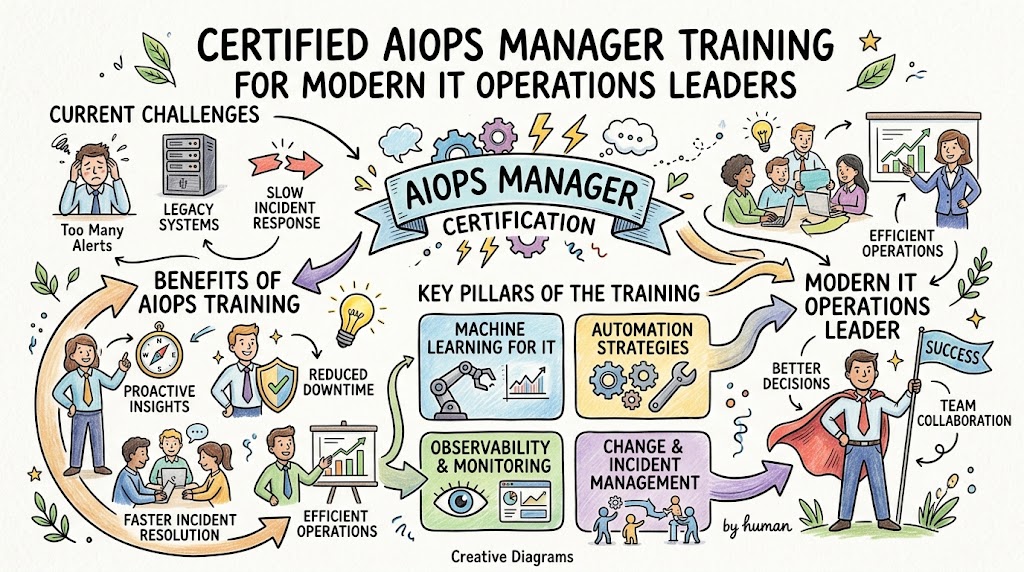
The Certified AIOps Manager framework is an engineering standard centered on embedding mathematical models, telemetry aggregation, and machine learning directly into production infrastructure. It is explicitly not an academic exercise in theoretical data science.
Instead, it is a hands-on methodology for designing environments that can automatically ingest massive operational data streams, isolate hidden anomalies, correlate disparate infrastructure alerts, and safely trigger self-healing runbooks. It exists to replace human guesswork with real-time statistical inference.
Who Should Pursue Certified AIOps Manager?
This professional track is engineered for mid-to-senior level practitioners who keep enterprise production systems alive: DevOps engineers, SRE specialists, platform architects, and engineering managers. If your daily work involves balancing system availability with deployment velocity, this specialization applies directly to you.
The demand is explicitly global. Across tech hubs from India to North America, enterprises are hitting a wall where scaling their infrastructure footprint outpaces their ability to hire monitoring staff. This program builds the specialized leaders who fix that structural bottleneck.
Why Certified AIOps Manager
The real-world value of this specialization boils down to long-term engineering leverage. Cloud features, container runtimes, and specific vendor dashboard tools will inevitably shift over the next decade. However, the mathematical foundation of data ingestion, pattern filtering, and automated anomaly isolation remains unchanged.
Investing your engineering hours here ensures your skill set remains highly decoupled from specific tool vendor lifecycles, turning you into a strategic asset capable of dropping operational toil across any enterprise stack.
Certified AIOps Manager Certification Overview
The formal evaluation process is orchestrated entirely through the official curriculum blueprints hosted natively on the aiopsschool platform. Rather than testing simple syntax or basic multi-choice recognition, the program forces candidates to prove their capabilities via production-realistic challenges.
The core ownership of the program guarantees that the validation criteria shift alongside real-world engineering standards. The tiers are distinctly organized to allow practitioners to scale up from baseline data ingestion to complex operational governance.
Certified AIOps Manager Certification Tracks & Levels
The curriculum breaks down into three distinct operational milestones. The Foundation level focuses entirely on infrastructure data literacy: parsing log structures, clean telemetry streaming, and filtering basic system noise.
The Professional tier transitions into deep algorithmic implementation, where you learn to deploy mathematical models against streaming metrics and write automated mitigation scripts. Finally, the Advanced level steps away from pure code to focus on organizational transformation, cost architecture, and engineering team leadership.
Complete Certified AIOps Manager Certification Table
| Track | Level | Who it’s for | Prerequisites | Skills Covered | Recommended Order |
| Infrastructure Data | Foundation | Systems Administrators & Cloud Practitioners | Systems & Network Basics | Log routing, Telemetry streaming, Metric filtering | First |
| Automation Engineering | Professional | Senior DevOps Engineers & SREs | Python & Distributed Systems | Anomaly detection models, Root-cause math, Self-healing loops | Second |
| Operational Governance | Advanced | Tech Leads, Managers & Directors | Multi-year Engineering Leadership | Vendor economics, Team scaling, Incident risk strategy | Third |
Detailed Guide for Each Certified AIOps Manager Certification
Certified AIOps Manager – Foundation Level
What it is
This tier verifies an engineer’s capability to architect clean telemetry pipelines and successfully eliminate alert fatigue within modern enterprise observability platforms.
Who should take it
Systems administrators, network engineers, and application support professionals who need to escape manual monitoring loops and master algorithmic data collection.
Skills you’ll gain
- Building decoupled telemetry streams for metrics, traces, and application logs.
- Writing event correlation rules to compress thousands of raw alerts into single operational incidents.
- Implementing dynamic baseline configurations to replace unstable, fixed threshold monitoring rules.
Real-world projects you should be able to do
- Construct a real-world logging pipeline that automatically normalizes and structures dirty, multi-format application log streams.
- Implement a centralized alerting profile that suppresses repetitive system notifications during a simulated network drop.
Preparation plan
- 7-14 Days: Deconstruct the core architecture of telemetry frameworks and study how raw systems data is structured for ingestion.
- 30 Days: Practice configuring open log aggregation backends and study patterns of alert distributions in distributed environments.
- 60 Days: Stand up a local cluster environment, configure real-time streaming metrics, and build working event-filtering profiles.
Common mistakes
- Focusing blindly on learning specific vendor UI buttons rather than understanding the underlying architecture of data streaming pipelines.
- Forgetting to master basic Linux operating system metric behaviors before attempting to layer automated rules on top of them.
Best next certification after this
- Same-track option: Certified AIOps Manager – Professional Level
- Cross-track option: Cloud Infrastructure Engineering Specialist
- Leadership option: Systems Team Lead Foundation
Certified AIOps Manager – Professional Level
What it is
This certification validates the advanced engineering skill needed to deploy, test, and manage production-grade machine learning models built explicitly for system reliability.
Who should take it
Senior Site Reliability Engineers, platform engineers, and automation specialists responsible for defending strict enterprise SLA agreements.
Skills you’ll gain
- Deploying unsupervised statistical clustering models to spot stealth application anomalies before they cause a hard outage.
- Writing non-destructive automated runbooks that safely isolate failing microservices off human call schedules.
- Analyzing real-time distributed trace graphs to map exact causal relationships behind multi-tier service degradation.
Real-world projects you should be able to do
- Code a predictive auto-scaling framework that scales cloud computing nodes based on request rate acceleration rather than reactive resource use.
- Design a self-healing loop that automatically intercepts an memory-leaking process, dumps diagnostics, and restarts the container safely.
Preparation plan
- 7-14 Days: Master time-series data principles, regression analytics, and standard data patterns typical of distributed microservice setups.
- 30 Days: Focus on leveraging Python data stacks to process real-time events coming from message brokers like Kafka.
- 60 Days: Simulate complex cascading cluster failures in an isolated environment and optimize your models to pinpoint the root issue.
Common mistakes
- Over-engineering the operational solution by building complex neural networks when simpler, lighter statistical models are more stable.
- Ignoring model drift, which causes automated systems to become unreliable when developers change the application code footprint.
Best next certification after this
- Same-track option: Certified AIOps Manager – Advanced Strategy Level
- Cross-track option: Enterprise DevSecOps Automation Architect
- Leadership option: Advanced Engineering Management Track
Certified AIOps Manager – Advanced Strategy Level
What it is
This credential validates an individual’s capability to direct large technical teams, manage high-scale observability budgets, and execute modern operational modernizations.
Who should take it
Principal engineers, engineering directors, and technical managers responsible for operational tool choice, cloud budgets, and team delivery structures.
Skills you’ll gain
- Designing financial cost guardrails for high-throughput enterprise logging and analytics systems.
- Managing the architectural and human shifts needed to move legacy operations divisions toward modern automation.
- Executing technical risk evaluations to choose between long-term open-source projects and vendor platforms.
Real-world projects you should be able to do
- Author an end-to-end technical strategy and budget blueprint detailing the complete modernization of a global operations department.
- Build a cross-organizational post-mortem framework that maps technical system metrics straight to business revenue impact.
Preparation plan
- 7-14 Days: Analyze corporate risk compliance models and the economic patterns tied to running large-scale cloud operations.
- 30 Days: Read deeply through production case studies of successful enterprise infrastructure modernizations to learn common organizational failure modes.
- 60 Days: Compile a comprehensive operational modernization roadmap, complete with engineering milestone targets and concrete tool choices.
Common mistakes
- Solving only the technical side of the automation equation while ignoring the team re-skilling necessary to make the changes stick long-term.
- Underestimating the compute and storage overhead that continuous machine learning pipelines demand from your cloud budget.
Best next certification after this
- Same-track option: Executive Technical Leadership Development
- Cross-track option: Corporate Data Governance Specialist
- Leadership option: Technical Director Strategy Program
Choose Your Learning Path
DevOps Path
This path maps out how to route real-time operational insights straight back into your continuous integration and deployment pipelines. The objective is to configure infrastructure so that when an anomaly occurs post-deployment, system telemetries automatically notify development queues with rich diagnostic data. It bridges the divide between runtime behavior and initial application development.
DevSecOps Path
Security requires high-scale data analysis, and this specialized trajectory concentrates on spotting malicious behavior masked as common system anomalies. Practitioners learn to build automated tracking baselines that differentiate standard infrastructure bugs from active data exfiltration patterns or privilege escalation attempts, blending security defense right into your data layers.
SRE Path
Site Reliability Engineering centers on systematically destroying operational toil through software engineering. This path delivers the statistical and automation frameworks needed to track error budgets automatically, predict SLO exhaustions before they impact users, and implement highly resilient self-healing patterns across complex distributed architectures.
AIOps Path
This path deep-dives straight into the low-level data engineering required to maintain large operations tracking systems. Engineers focus on running distributed time-series databases, tuning specialized analytical data engines for low-latency querying, and maintaining the backend streaming architectures that process billions of events daily.
MLOps Path
Focused entirely on the model lifecycle, this track addresses the engineering required to host, evaluate, and retrain the machine learning models running within your monitoring stacks. It covers creating automated pipelines that catch model degradation early, ensuring that application upgrades do not blind your automated alert triggers.
DataOps Path
Data processing systems are inherently fragile, and this track focuses on applying automated health checking to big data infrastructure. Engineers master the skills to trace data lineage, predict performance drops in real-time streaming engines, and automate recovery workflows when processing pipelines hit malformed data blocks.
FinOps Path
Uncontrolled cloud scaling can decimate software margins, making this path essential for cost-conscious engineering leaders. It covers tying algorithmic infrastructure scaling to business spend targets, automating cloud waste discovery, and using historical operational data to build highly accurate resource budget forecasts.
Role → Recommended Certified AIOps Manager Certifications
| Role | Recommended Certifications |
| DevOps Engineer | Certified AIOps Manager – Professional Level |
| SRE | Certified AIOps Manager – Professional Level |
| Platform Engineer | Certified AIOps Manager – Professional Level |
| Cloud Engineer | Certified AIOps Manager – Foundation Level |
| Security Engineer | Certified AIOps Manager – Professional Level |
| Data Engineer | Certified AIOps Manager – Foundation Level |
| FinOps Practitioner | Certified AIOps Manager – Advanced Strategy Level |
| Engineering Manager | Certified AIOps Manager – Advanced Strategy Level |
Next Certifications to Take After Certified AIOps Manager
Same Track Progression
Once the core manager tracks are complete, your next tactical milestone is to explore advanced algorithmic system tuning and large-scale custom model development. The progression focuses on shifting from implementing third-party automation tools to building proprietary, business-specific operational platforms that treat infrastructure as a continuous data science problem.
Cross-Track Expansion
To round out your engineering portfolio, you should look toward advanced cloud security architectures or planetary-scale data storage frameworks. Understanding the mechanics of how automated telemetry backends interact with zero-trust network configurations allows you to design hardened environments that scale without introducing hidden security liabilities.
Leadership & Management Track
For senior engineers ready to transition completely into high-level business execution, the ideal next step covers corporate financial modeling, technology risk management, and organizational design. This shift swaps day-to-day scripting for long-term capability planning, technical contract negotiation, and running cross-functional global technology divisions.
Training & Certification Support Providers for Certified AIOps Manager
DevOpsSchool offers structured learning tracks, technical bootcamps, and live lab instances designed to step engineers smoothly through the process of modernizing legacy infrastructure monitoring practices.
Cotocus focuses heavily on delivering production-grade sandbox setups, architecture deep-dives, and technical mentorship sessions mapped to actual engineering team scenarios.
Scmgalaxy maintains an extensive community-led database of technical configuration guides, architectural documentation, and blueprint breakdowns to assist candidates preparing for formal validation.
BestDevOps specializes in practical engineering blueprints, hosting simulated cluster breakdowns that train professionals to handle real-world infrastructure failures calmly and methodically.
devsecopsschool ensures that secure coding and compliance standards are woven directly into standard automation training curricula, allowing engineers to build resilient, secure infrastructure.
sreschool delivers deep engineering courses focused explicitly on systemic reliability metrics, event compression architectures, and the construction of self-healing software platforms.
aiopsschool serves as the primary technical registrar and validation platform for modern automated operations paths, maintaining core documentation and technical lab engines.
dataopsschool centers its training resources on the stability of data pipelines, helping engineers build highly reliable distributed environments for high-throughput processing systems.
finopsschool couples deep cloud financial modeling with technical resource automation, providing engineering professionals with the exact frameworks needed to maximize cloud infrastructure efficiency.
Frequently Asked Questions (General)
- What is the practical return on investment for an automated operations credential?It moves your skill profile from reactive, manual system administration to proactive, data-driven platform architecture, directly increasing your organizational value.
- How much time should a senior engineer allocate for the professional exam?Most working professionals find that thirty to sixty days of consistent hands-on lab practice and architectural study is the optimal preparation window.
- Can I pass the baseline foundation track if I am not an expert software developer?Yes, the foundation tier tests your comprehension of data structures, ingestion pipelines, and systems concepts rather than advanced software engineering.
- Is the curriculum built around a specific vendor ecosystem like AWS or Google Cloud?No, the program prioritizes open-source standards and architectural abstractions that can be deployed across any public, private, or hybrid cloud architecture.
- How does this specialization change an engineer’s day-to-day routine?It shifts your daily focus away from sitting on incident call rotations and chasing log files toward writing systemic software that manages incidents for you.
- Why should an engineering director invest time into an advanced infrastructure track?It gives leaders the architectural literacy needed to protect telemetry budgets, run objective tool selections, and build highly optimized engineering teams.
- What is the fundamental engineering difference between monitoring and observability?Monitoring asks “is a specific component broken based on an alert limit,” while observability uses systemic telemetry data to explain why an implicit failure happened.
- What is the recommended renewal cycle for these technical credentials?Given how fast infrastructure automation patterns pivot, validating your skill profiles every two to three years is the industry best practice.
- Do I need a formal university degree in statistics to pass these tracks?No, the curriculum is built from the ground up for systems engineers, breaking down required data science and regression concepts into practical operations examples.
- Are the examinations based on theoretical questions or live system configurations?The professional and advanced tracks use interactive lab environments where you must repair broken telemetry pipelines and optimize actual runtime setups.
- How does an automated operational model interface with legacy ITIL processes?It replaces manual ticket generation and triage steps with instant programmatic correlation, injecting data directly into your existing service desks.
- How are these specialized technical credentials viewed by global enterprise employers?Enterprises handling massive digital scale actively look for professionals who hold validated, systemic automation credentials over generic cloud certifications.
FAQs on Certified AIOps Manager
- What concrete engineering bottleneck does the Certified AIOps Manager course fix?It removes the human bottleneck in incident response by training engineers to construct streaming pipelines that automatically filter out alert white noise and pinpoint root causes.
- Can a legacy infrastructure engineer successfully execute this training transition?Yes, the blueprint is designed as a direct practical bridge, mapping core systems administration concepts straight into modern data-driven software platform engineering.
- How are the practical laboratory assessments on aiopsschool structured?The testing platform boots up live, multi-service environments where you are presented with complex cascading outages and must write automated code to resolve them.
- Does the Certified AIOps Manager program prioritize specific logging frameworks?No, it focuses entirely on universal telemetry standards and data manipulation patterns, ensuring your skills apply universally regardless of the specific tool stack.
- Is model management and training drift covered within this framework?Yes, the engineering tracks spend significant time on the maintenance, evaluation, and validation of infrastructure tracking models to ensure alert accuracy.
- How does an enterprise evaluate the success of a Certified AIOps Manager on their team?Success shows up directly in localized engineering metrics: a steep drop in MTTR, fewer high-severity escalations, and reduced overall cloud infrastructure spend.
- Are open-source telemetry tools emphasized over enterprise vendor packages?Yes, the curriculum concentrates heavily on open-source standards to make sure your skills remain fully portable across different enterprise platforms.
- Can I attempt the professional certification assessment without completing the foundation tier?Yes, if you possess verifiable, multi-year experience managing distributed telemetry pipelines, you can skip the introduction and test directly at the professional level.
Final Thoughts: Is Certified AIOps Manager Worth It?
Let’s be realistic about career longevity. The days of earning a premium simply for configuring virtual machines or building manual dashboards are over. As automation platforms take over basic configuration tasks, infrastructure professionals must move higher up the stack into system intelligence.
The Certified AIOps Manager track offers a direct, non-marketing framework to master the data-driven systems that will govern future corporate platforms. If your objective is to stay deeply relevant, command technical authority, and lead high-scale engineering operations through the next phase of enterprise infrastructure design, committing to this specialization is a completely logical and highly defensive career move.