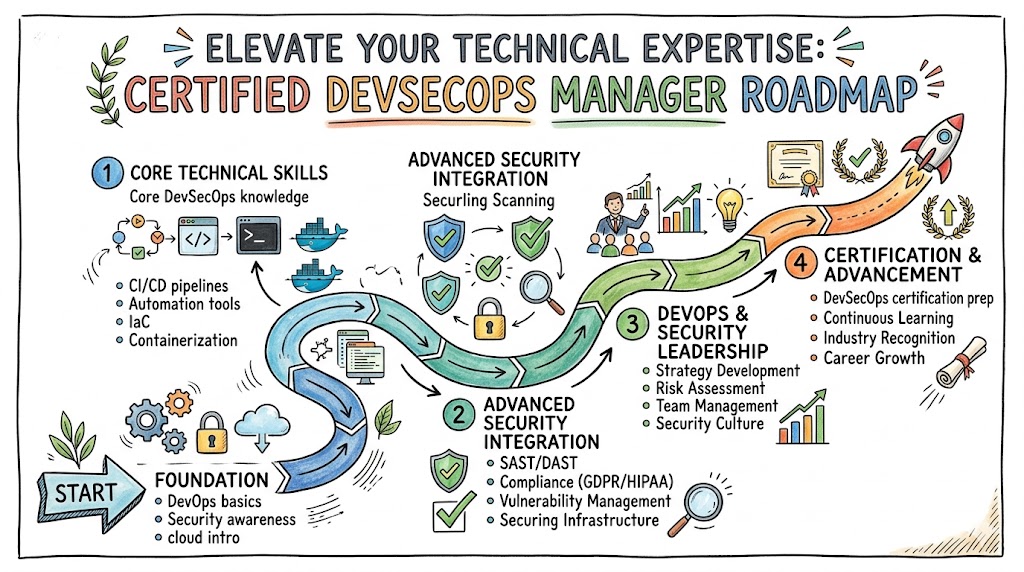
Introduction
In the rapidly evolving landscape of modern software delivery, integrating security into the development lifecycle is no longer optional. The Certified DevSecOps Manager credential provides a rigorous framework for professionals tasked with bridging the gap between rapid deployment and robust security posture. This guide is designed for engineering leaders, security practitioners, and platform architects aiming to formalize their expertise. Whether you are scaling infrastructure or securing complex cloud-native environments, understanding how to manage risk without stifling velocity is critical. By exploring resources from devopsschool or aiopsschool, professionals can build the competency required to lead high-performing teams in a secure, automated fashion.
What is the Certified DevSecOps Manager?
The Certified DevSecOps Manager represents a high-level standard for professionals who oversee the convergence of development, operations, and security. It exists to solve the fundamental conflict between the need for speed in feature delivery and the mandate for uncompromising system integrity. Unlike purely theoretical certifications, this designation focuses on the pragmatic implementation of security controls within CI/CD pipelines and infrastructure as code. It provides managers with the language and technical depth to make data-driven decisions regarding risk mitigation. By moving beyond simple tool usage, the curriculum emphasizes building a culture where security is a shared responsibility across the entire software development lifecycle.
Who Should Pursue Certified DevSecOps Manager?
This certification is designed for those who have moved beyond individual contribution and are now responsible for the architectural and cultural success of a team. It is ideal for engineering managers, lead SREs, security architects, and senior platform engineers who need to integrate security at scale. Whether you are working in a startup or a large-scale enterprise, the principles remain consistent. Professionals in India and across the globe will find that this program addresses the specific challenges of managing distributed teams and complex regulatory requirements. If you are looking to formalize your leadership approach to secure software engineering, this path is highly relevant.
Why Certified DevSecOps Manager
As organizations shift toward more autonomous, cloud-native architectures, the demand for leaders who understand security integration continues to rise. This certification ensures professionals remain relevant even as specific toolsets, languages, and cloud providers evolve. It provides a foundational understanding of the underlying principles of secure automation that are not tied to any single vendor. By investing in this credential, engineers and managers demonstrate a commitment to enterprise-grade security standards. The return on investment is realized through improved team velocity, reduced security incidents, and a stronger alignment between technical execution and business objectives.
Certified DevSecOps Manager Certification Overview
The Certified DevSecOps Manager program is delivered via and hosted on devopsschool. It is built for practitioners who require a balance of technical rigor and strategic management capability. The certification is structured to validate your ability to oversee security automation, manage policy-as-code, and influence organizational behavior. Assessment is conducted through practical, scenario-based evaluations that mirror real-world production environments. By focusing on outcomes rather than rote memorization, the certification ensures that those who achieve it are prepared to handle the realities of modern, high-stakes engineering.
Certified DevSecOps Manager Certification Tracks & Levels
The program offers a tiered structure, including foundation, professional, and advanced levels to suit different career stages. Specialization tracks allow candidates to focus on specific domains such as SRE-driven security, FinOps-integrated risk management, or platform security architecture. Each level is carefully designed to build upon the last, ensuring a logical progression from individual competency to enterprise-wide leadership. These levels are mapped to standard industry career progressions, allowing engineers to plan their development over months or years. Whether you are focused on hands-on pipeline security or strategic organizational change, there is a clear track to follow.
Complete Certified DevSecOps Manager Certification Table
| Track | Level | Who it’s for | Prerequisites | Skills Covered | Recommended Order |
| Security Operations | Foundation | Aspiring Security Engineers | Basic Linux & Networking | Vulnerability Scanning | First |
| Pipeline Security | Professional | DevSecOps Engineers | 2+ Years Experience | CI/CD Integration | Second |
| Enterprise Strategy | Advanced | Engineering Managers | 5+ Years Experience | Risk & Governance | Third |
Detailed Guide for Each Certified DevSecOps Manager Certification
Certified DevSecOps Manager – Professional Level
What it is
This certification validates the ability to architect, implement, and manage a holistic security strategy within an automated software delivery pipeline.
Who should take it
It is intended for senior engineers and team leads with solid experience in CI/CD automation who are ready to take on security governance responsibilities.
Skills you’ll gain
- Policy-as-code implementation.
- Automated vulnerability assessment and remediation.
- Incident response orchestration.
- Security compliance mapping.
Real-world projects you should be able to do
- Designing a secure software supply chain with automated binary authorization.
- Setting up automated compliance reporting for cloud infrastructure.
- Implementing zero-trust architecture patterns within Kubernetes clusters.
Preparation plan
- 7–14 days: Focus on foundational policy-as-code concepts and security tool documentation.
- 30 days: Build three distinct CI/CD pipelines with integrated security scanning and manual gate controls.
- 60 days: Perform a comprehensive security audit of a mock production application and document a remediation plan.
Common mistakes
- Focusing too much on individual tool features rather than overall system design.
- Neglecting the cultural aspects of security, such as team communication and incident blame-free culture.
Best next certification after this
- Same-track: Advanced Security Architecture Certification.
- Cross-track: Certified SRE Manager.
- Leadership: IT Governance and Compliance Certification.
Choose Your Learning Path
DevOps Path
The DevOps path focuses on the automation of the entire software delivery process while maintaining high stability. You will learn to embed security checks within automated testing, deployment, and monitoring workflows. This path is essential for those who want to ensure that speed does not come at the cost of system integrity or production reliability.
DevSecOps Path
The DevSecOps path is dedicated to the integration of security tools and cultural shifts across development, operations, and security teams. You will gain expertise in shifting security left, implementing automated threat modeling, and managing complex security workflows. This path prepares you to be a leader in a security-conscious organization.
SRE Path
The SRE path emphasizes reliability and the management of large-scale, complex distributed systems. You will learn how to integrate security controls without negatively impacting service level objectives (SLOs) or error budgets. This is a critical area for those managing production environments with high availability requirements.
AIOps Path
The AIOps path focuses on using machine learning and data analytics to optimize operations and security monitoring. You will learn to automate anomaly detection and incident response in highly dynamic, data-rich environments. This path is for forward-thinking engineers looking to leverage artificial intelligence for system health.
MLOps Path
The MLOps path is specialized for the secure lifecycle management of machine learning models. You will focus on securing model training, deployment pipelines, and the integrity of training datasets. This path ensures that security governance is applied to the unique challenges of machine learning operations.
DataOps Path
The DataOps path emphasizes the secure management and delivery of data pipelines at scale. You will learn how to implement security controls for data ingestion, processing, and storage while maintaining high data quality and accessibility. This is vital for organizations that are heavily data-driven.
FinOps Path
The FinOps path focuses on the intersection of cloud financial management and security operations. You will learn how to optimize cloud costs while ensuring that security controls are not bypassed to save money. This ensures that security and cost-efficiency are both maintained as top priorities.
Role → Recommended Certified DevSecOps Manager Certifications
| Role | Recommended Certifications |
| DevOps Engineer | Certified DevSecOps Manager Foundation |
| SRE | Certified SRE Manager / DevSecOps Professional |
| Platform Engineer | Certified DevSecOps Manager Professional |
| Cloud Engineer | Certified Cloud Security Manager |
| Security Engineer | Certified DevSecOps Manager Advanced |
| Data Engineer | Certified DataOps Security Lead |
| FinOps Practitioner | Certified FinOps & Security Manager |
| Engineering Manager | Certified DevSecOps Manager Advanced |
Next Certifications to Take After Certified DevSecOps Manager
Same Track Progression
Once you have achieved your initial certification, the logical next step is to pursue deep specialization in niche security domains. This includes areas like cloud-native security orchestration, advanced container security, or distributed systems threat hunting. By deepening your expertise, you become the subject matter expert that other team members look to for guidance on complex architectural problems.
Cross-Track Expansion
Broadening your skillset by moving into complementary domains like FinOps or AIOps will make you a more versatile leader. Understanding how cost management or machine learning impacts security posture allows you to participate in cross-departmental strategy. This cross-pollination of skills is highly valued in modern organizations that are breaking down traditional silos.
Leadership & Management Track
For those interested in moving into executive roles, the next step involves certifications related to enterprise governance, risk, and compliance. This allows you to speak the language of the business and align technical security initiatives with broader corporate objectives. Managing people, budgets, and organizational change becomes as important as technical capability.
Training & Certification Support Providers for Certified DevSecOps Manager
DevOpsSchool
This provider is a foundational player in the ecosystem, offering comprehensive training programs that span the entire breadth of modern software delivery practices. They focus on practical, lab-based learning that prepares students for the realities of current industry standards.
Cotocus
Cotocus emphasizes specialized, high-intensity training designed to bridge the gap between theoretical knowledge and expert execution. Their approach is particularly useful for teams looking to accelerate their adoption of new methodologies through targeted, effective workshops.
Scmgalaxy
Scmgalaxy is well-known for providing technical depth in configuration management and automation workflows. Their curriculum is geared toward professionals who need to master the intricacies of build systems and continuous integration environments at a granular level.
BestDevOps
BestDevOps focuses on delivering streamlined, highly practical training modules that help professionals quickly gain proficiency in specific DevOps toolsets. Their content is curated for speed and relevance, making it an excellent resource for busy engineers.
devsecopsschool
As a specialized provider, they offer deep-dive training focused exclusively on the intersection of development, security, and operations. Their curriculum is highly authoritative and recognized for its practical application in real-world security challenges.
sreschool
This provider excels at teaching the principles of site reliability engineering and system observability. Their training is essential for anyone looking to master the management of large-scale, high-availability production environments.
aiopsschool
aiopsschool offers forward-thinking training on the integration of machine learning into operational workflows. They are a leader in preparing engineers for the next generation of automated system management and incident response.
dataopsschool
This provider focuses on the technical challenges associated with managing data lifecycles securely and efficiently. Their programs are highly relevant for professionals working in data-intensive environments that require strict governance.
finopsschool
finopsschool provides critical training on managing cloud spend without sacrificing performance or security. Their courses are essential for engineering managers who need to balance budget constraints with technical excellence.
Frequently Asked Questions (General)
- What are the primary prerequisites for enrolling in the Certified DevSecOps Manager program?While experience requirements vary by level, a solid understanding of Linux, basic networking, and CI/CD concepts is generally expected for all candidates.
- How long does it typically take to prepare for a professional level certification?
Preparation times vary, but most candidates dedicate between four to eight weeks of focused study and practical lab work to reach proficiency. - Does the certification process include hands-on lab examinations?
Yes, the program emphasizes practical assessment where candidates must solve real-world problems in simulated environments. - Is this certification recognized globally by enterprise employers?
The certification is increasingly recognized due to its focus on vendor-neutral, production-focused skills that are applicable in diverse enterprise settings. - Can I pursue multiple certification tracks simultaneously?
It is possible, though it is usually recommended to master one track before expanding, as the workload for advanced certifications is significant. - What is the return on investment for obtaining this certification?
The ROI is typically seen through improved career prospects, increased confidence in managing complex systems, and better leadership capabilities. - How often is the curriculum updated to reflect industry changes?
The content is regularly reviewed and updated to ensure it remains relevant to the latest tools, practices, and security threats in the industry. - Are there specific study materials provided upon registration?
Yes, all registered candidates receive access to comprehensive guides, lab exercises, and reference material to support their learning journey. - What happens if I do not pass the assessment on my first attempt?
Most providers offer structured feedback and the option to retake the assessment after a designated period of further study. - Is this certification suitable for individuals with a non-security background?
Absolutely, it is designed to help professionals from various backgrounds gain the security knowledge necessary to be effective in modern engineering roles. - Do I need to maintain this certification through continuing education?
Yes, maintaining the certification typically requires periodic updates or additional learning to ensure your knowledge stays current. - Are there any team-based training options available for organizations?
Many of the listed providers offer custom, team-oriented training programs to help organizations upskill entire departments simultaneously.
FAQs on Certified DevSecOps Manager
- How does this certification differ from traditional security certifications?
It focuses on integration and automation within the software lifecycle rather than static compliance or perimeter-based security concepts. - Can this help me transition from a pure developer role to a management position?
Yes, it provides the strategic insight into risk and governance that is essential for effective engineering management. - Are there specific coding languages I need to know before starting?
Proficiency in at least one scripting language like Python or Bash is highly recommended for automating security tasks. - Does this certification cover cloud-specific security implementations?
The curriculum includes modules on cloud-native security patterns that are applicable across major cloud service providers. - Will this certification help me with incident response planning?
It covers foundational principles of automated incident detection and response workflows within the DevSecOps framework. - How does this program handle the cultural side of DevSecOps?
A significant portion of the curriculum is dedicated to organizational change, team collaboration, and fostering a security-first culture. - Is it possible to complete the certification entirely remotely?
Yes, the programs are designed for remote participation, including all lab work and final assessments. - What is the best way to leverage this credential in an interview?
Focus on explaining how your certified knowledge allows you to solve specific organizational pain points regarding security and velocity.
Final Thoughts: Is Certified DevSecOps Manager Worth It?
Ultimately, this certification is a powerful tool for those ready to take their technical leadership to the next level. It is not a shortcut; it is a commitment to mastering the complex, multifaceted challenges of modern software delivery. If you are looking to elevate your career and drive meaningful change in your organization, the investment of time and effort is well worth it. Success in this field requires a blend of technical expertise and strategic thinking, and this program provides exactly that. Approach your learning with a focus on practical application, and you will find the results translate directly into your daily work.