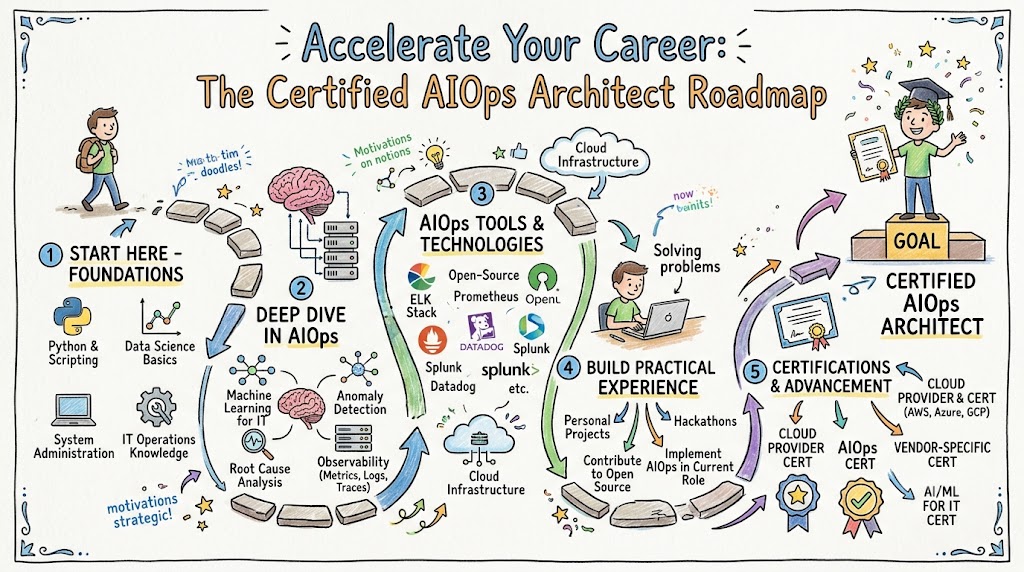
The transition from manual monitoring to automated, intelligent infrastructure is no longer a luxury; it is a necessity for modern enterprise stability. The Certified AIOps Architect curriculum, available via aiopsschool, offers a comprehensive framework for engineers to master the complexities of AI-enhanced operations. This guide serves as a practical roadmap for SREs, DevOps professionals, and platform engineers aiming to refine their expertise. We explore how this certification validates the ability to architect self-healing systems and drives professional growth in the competitive global tech industry.
What is the Certified AIOps Architect?
The Certified AIOps Architect program is a specialized training and validation track focused on the practical application of machine learning within IT operations. It exists to solve the fundamental problem of operational scale: how to manage thousands of microservices without drowning in alert noise. Unlike traditional certifications that focus on tool-specific configuration, this program emphasizes the architectural logic required to build resilient, data-driven platforms. It aligns with the shift toward proactive observability, teaching professionals how to move from reactive troubleshooting to predictive, automated system maintenance.
Who Should Pursue Certified AIOps Architect?
This path is perfectly suited for mid-to-senior level engineers who are ready to transition from managing tools to designing intelligent platforms. SREs will find the curriculum essential for automating SLO compliance, while DevOps engineers will appreciate the integration of AI into CI/CD pipelines. Security specialists and data architects also stand to gain immense value by understanding how operational intelligence can be applied to their respective domains. Whether you are working in a fast-paced startup or a large-scale enterprise in India, this certification provides the standardized knowledge required to solve complex, high-pressure infrastructure challenges.
Why Certified AIOps Architect
The demand for AIOps expertise is surging as companies realize that human operators cannot keep up with the volume of modern telemetry data. This certification helps professionals remain relevant by focusing on the “how” and “why” of intelligent operations, which transcends the volatility of specific software vendors. By earning this credential, you demonstrate a commitment to enterprise-grade stability and efficiency. It serves as a tangible return on investment, signaling to employers that you possess the advanced capability to reduce operational costs and enhance system reliability through smarter, automated workflows.
Certified AIOps Architect Certification Overview
The Certified AIOps Architect program is managed through aiopsschool and features a comprehensive, performance-oriented structure. The certification approach is designed to test your ability to think through architectural trade-offs, data ingestion requirements, and the lifecycle of machine learning models in production. It is highly practical, focusing on the real-world application of intelligence to solve common operational hurdles. Candidates are assessed not just on terminology, but on their ability to design holistic systems that leverage data for better operational outcomes.
Certified AIOps Architect Certification Tracks & Levels
The certification structure is tiered to accommodate different stages of your professional journey. Entry-level tracks establish the basic language and data processing concepts, while professional-tier certifications focus on the integration of observability stacks with AI engines. The advanced levels are tailored for architects who must design end-to-end, multi-cloud operational strategies. By choosing the right specialization, you can align your certification goals with your specific career ambitions, whether you aim to be a technical specialist or an architectural leader.
Complete Certified AIOps Architect Certification Table
| Track | Level | Who it’s for | Prerequisites | Skills Covered | Recommended Order |
| Operational Intelligence | Associate | Junior Ops Engineers | Monitoring Fundamentals | Alert Correlation | 1 |
| Predictive Systems | Professional | DevOps / SRE | Cloud/Linux Skills | Anomaly Detection | 2 |
| Strategic Architecture | Expert | Architects / Leads | Systems Design | Automated Remediation | 3 |
Detailed Guide for Each Certified AIOps Architect Certification
Certified AIOps Architect – Intelligent Operations Expert
What it is This certification confirms your proficiency in designing systems that utilize machine learning to filter noise and identify critical production issues before they impact users.
Who should take it It is designed for experienced SREs and platform engineers who already manage high-scale distributed systems and want to introduce intelligent automation.
Skills you’ll gain
- Mastery of time-series data handling and storage.
- Implementation of noise-reduction algorithms.
- Integration of intelligent patterns into incident response playbooks.
Real-world projects you should be able to do
- Designing a custom alert-correlation dashboard that reduces false positives by over 50%.
- Building an automated response script that triggers based on predictive anomaly scoring.
Preparation plan
- 7–14 days: Review the core principles of AIOps and common architectural patterns.
- 30 days: Engage in hands-on lab exercises that simulate real-world incident scenarios.
- 60 days: Conduct a pilot study of AIOps principles within your current production environment.
Common mistakes Many candidates try to apply AI to every single data point, failing to identify the most valuable telemetry signals for their specific business needs.
Best next certification after this
- Same-track: Certified AIOps Strategist (Leadership).
- Cross-track: Certified DataOps Master.
- Leadership: Enterprise Cloud Architect.
Choose Your Learning Path
DevOps Path
The DevOps path focuses on embedding AIOps into the development lifecycle. You will learn how to catch performance regressions early by using automated intelligence during the testing and deployment phases.
DevSecOps Path
The DevSecOps path bridges the gap between security and operational intelligence. You will discover how to detect anomalous behavior that may indicate a security breach, allowing for faster incident isolation.
SRE Path
The SRE path is dedicated to reliability. You will learn to architect systems that use predictive analytics to maintain uptime, ensuring that your infrastructure is always performing within defined SLOs.
AIOps Path
This path provides a deep dive into the algorithmic side of operations. It covers the end-to-end management of models, ensuring they remain accurate and relevant as your infrastructure evolves.
MLOps Path
The MLOps path is designed for those who want to operationalize machine learning models. You will learn to manage the continuous integration and delivery of the models themselves, ensuring they are scalable.
DataOps Path
The DataOps path emphasizes the quality and flow of data. You will gain skills in building pipelines that ensure your AIOps models receive clean, relevant, and timely data for accurate decision-making.
FinOps Path
The FinOps path leverages intelligence to manage cloud costs. You will learn how to forecast resource consumption and use AIOps to optimize your environment, significantly reducing cloud waste.
Role → Recommended Certified AIOps Architect Certifications
| Role | Recommended Certifications |
| DevOps Engineer | Certified AIOps Architect – Associate |
| SRE | Certified AIOps Architect – Professional |
| Platform Engineer | Certified AIOps Architect – Professional |
| Cloud Engineer | Certified AIOps Architect – Associate |
| Security Engineer | Certified AIOps Architect – Professional |
| Data Engineer | Certified AIOps Architect – Professional |
| FinOps Practitioner | Certified AIOps Architect – Associate |
| Engineering Manager | Certified AIOps Architect – Expert |
Next Certifications to Take After Certified AIOps Architect
Same Track Progression
Deepen your expertise by tackling advanced certification levels that address complex global-scale challenges, such as multi-region failover and autonomous infrastructure governance.
Cross-Track Expansion
Diversify your knowledge by exploring certifications in data engineering or cloud-native security, allowing you to bridge the gap between operational intelligence and other critical infrastructure domains.
Leadership & Management Track
Transition into strategic roles by focusing on management-level certifications. These focus on business value alignment, team orchestration, and the long-term ROI of adopting intelligent operational strategies.
Training & Certification Support Providers for Certified AIOps Architect
DevOpsSchool offers intensive, cohort-based training that prepares students for the rigors of modern AIOps certification through hands-on technical labs.
Cotocus provides advanced workshops focusing on the practical application of AI in SRE, helping professionals bridge the theory-to-production gap effectively.
Scmgalaxy focuses on the cultural shift required for AIOps, teaching engineers how to introduce intelligent automation into existing, legacy-heavy environments.
BestDevOps provides concise, high-impact learning materials that help busy professionals build a solid foundation in AIOps principles quickly.
devsecopsschool offers specialized tracks that integrate security and operations, ensuring architects can build systems that are both automated and resilient to threats.
sreschool provides targeted certification training for Site Reliability Engineers who want to reduce toil through intelligent incident management and predictive modeling.
aiopsschool serves as the central authority for all AIOps-related credentials, providing a standardized path for those looking to validate their operational expertise.
dataopsschool provides the essential training for data engineers to build the high-velocity, reliable data pipelines required for successful AI initiatives.
finopsschool offers focused learning on cost optimization, teaching how to apply predictive analytics to manage complex cloud spending patterns successfully.
Frequently Asked Questions
- How does this certification improve my chances of promotion? By proving you can lead complex automation projects, you distinguish yourself as a high-value architect capable of solving enterprise-level problems.
- Is this certification appropriate for beginners? While anyone can start, it is designed for those with some foundational knowledge of infrastructure management or DevOps.
- How does the curriculum stay relevant to new AI tools? The program focuses on the core principles and logic of AIOps, which are designed to remain effective even as tools evolve.
- Will I need to perform live coding during the exam? Most assessments focus on architectural scenarios and logic, though practical application is highly emphasized during training.
- Can I transition from a manual operations role to an AIOps role? Yes, this certification is specifically designed to help professionals make exactly that transition through structured learning.
- What is the typical commitment required for the lab components? Most students dedicate a few hours per week to complete the labs, allowing for flexibility while working full-time.
- Does the program include ongoing access to resources? Many programs provide continued access to labs and updated content to help you stay current after your initial certification.
- How does this help in a competitive job market? It acts as a formal validation of a niche skill set that is in high demand, setting your resume apart from generalist candidates.
- Are there networking opportunities for certified professionals? Yes, certification usually grants access to an exclusive community of peers and industry experts for knowledge sharing.
- How long does the certification process take? The timeline varies, but most dedicated professionals complete their chosen track within 2 to 3 months.
- Can this replace on-the-job training? It complements it; while on-the-job training is specific to your employer, this provides the universal best practices of the industry.
- Is there a path for managers who don’t want to code? Yes, there are tracks focused on the strategy and architectural oversight of AIOps implementation rather than direct coding.
FAQs on Certified AIOps Architect
- What is the difference between AIOps and standard automation? AIOps introduces intelligence to the decision-making process, rather than just executing static, rules-based scripts.
- Can I use my existing monitoring data for certification labs? The labs typically provide controlled environments, but you are encouraged to apply the same principles to your production data.
- Does the certification cover legal and compliance issues? It addresses the necessary data governance practices for handling sensitive operational information in compliance with standards.
- Is this only for AWS or Azure environments? No, the methodology is designed to be vendor-agnostic and applicable to any cloud, hybrid, or on-premises environment.
- How does this help with root cause analysis? It teaches you how to use AI to correlate disparate signals and pinpoint the root cause of complex outages automatically.
- Are there any required proprietary tools? No, the program emphasizes open-source patterns and universal design principles over proprietary software.
- How does this impact the SRE “Toil” metric? It directly addresses toil by automating repetitive, noise-heavy tasks, allowing SREs to focus on high-value engineering work.
- Can I apply these skills to legacy systems? Absolutely, the core principles of AIOps apply to legacy infrastructure just as well as modern microservices.
Final Thoughts: Is Certified AIOps Architect Worth It?
Taking the step to become a Certified AIOps Architect is an investment in your long-term viability as an engineer. The industry is moving toward autonomous operations, and those who understand the underlying architecture will lead the charge. Focus on the foundational principles taught in the program, and don’t be afraid to experiment with them in your daily work. If you are looking for a way to formalize your experience and gain a structured perspective on the future of infrastructure management, this certification is a highly practical choice. It is a commitment to professional excellence and a powerful way to unlock new, higher-level architectural opportunities.