Introduction
Finding reliable guidance when exploring fertility treatment can feel overwhelming. Individuals and couples often face a vast landscape of medical terminology, varying clinic options, and complex financial considerations. Understanding how assisted reproduction works, what to look for in a provider, and how to interpret treatment expenses are crucial steps in the decision-making process. Platforms designed to simplify provider discovery and patient education play a valuable role in helping people navigate this journey. This guide explores how online resources assist individuals in researching IVF clinics, evaluating treatment costs, understanding success rates, and exploring various fertility-care options.
What Is IVFHospitalsNow.com?
IVFHospitalsNow.com serves as a specialized online platform designed to help individuals research fertility care, discover reproductive healthcare providers, and access educational resources related to assisted reproductive technology. The platform aims to connect users with organized information about IVF clinics, fertility hospitals, and reproductive specialists, making it easier to explore available medical services without navigating scattered sources. When individuals begin looking into reproductive care, finding centralized information can reduce the friction of initial research. The website provides structured details that allow users to explore various clinics, understand different treatment pathways, and review location-based provider options. By organizing essential details such as clinic offerings, treatment categories, and geographical availability, the platform functions as an informative starting point for patients seeking clarity on their fertility journey.
Why Reliable Fertility Information Matters
Navigating fertility treatment involves making significant medical, emotional, and financial decisions. Accessing accurate and objective information helps patients approach consultations with clarity and confidence. When researching fertility care, individuals frequently encounter conflicting data, complicated medical jargon, and varying claims regarding success rates and expenses. A reliable information platform helps demystify these elements by presenting facts in a clear, neutral manner. Understanding the fundamentals of reproductive medicine empowers patients to ask informed questions during consultations with fertility specialists. Furthermore, reliable resources emphasize that every medical journey is unique, helping individuals set realistic expectations regarding treatment timelines, success probabilities, and financial commitments.
What Can People Explore When Researching IVF Clinics?
IVF Treatment Information
Before committing to a specific healthcare provider, patients often seek a general understanding of how in vitro fertilization operates. The treatment typically follows a structured medical timeline designed to support egg production, fertilization, and embryo development.
- Initial Consultation and Testing: Reviewing medical history and performing baseline fertility assessments.
- Ovarian Stimulation: Using hormone medications to encourage the development of multiple mature eggs.
- Egg Retrieval: A minor surgical procedure to collect the eggs from the ovaries.
- Fertilization: Combining eggs and sperm in a laboratory setting, either through standard insemination or specialized microinjection.
- Embryo Development and Transfer: Monitoring embryos in the laboratory before transferring one into the uterus or preserving them for future use.
Fertility Specialists and Medical Teams
Evaluating the medical team behind a practice is an essential part of clinic research. Patients often look into the credentials, board certifications, and clinical experience of reproductive endocrinologists and embryologists. Understanding the expertise of the staff, the quality of the on-site laboratory facilities, and the scope of available diagnostic and therapeutic services helps individuals gauge the overall standard of care a clinic provides.
Clinic Location and Accessibility
Logistics play a practical role in fertility treatment, which often requires frequent monitoring appointments, blood tests, and ultrasounds over a span of several weeks. When searching for IVF clinics near me, patients examine travel distances, appointment availability, and clinic operating hours to ensure the location accommodates their daily schedules. For those traveling from outside the immediate area, proximity to lodging and transport networks becomes an important consideration.
Treatment and Support Services
Comprehensive fertility centers often offer additional services beyond standard IVF. These may include genetic testing, donor-sperm or donor-egg programs, psychological counseling, and specialized care for specific underlying reproductive conditions. Reviewing these offerings helps patients determine whether a facility can support their comprehensive medical needs under one roof.
Understanding IVF Treatment Cost
Financial planning is one of the most prominent aspects of preparing for assisted reproduction. The total IVF treatment cost can vary significantly depending on multiple clinical and geographic variables. Understanding the components that contribute to the final expense helps patients avoid unexpected financial surprises.
Key factors influencing total expenses include:
- Geographic Location: Clinic pricing often reflects regional operational costs and local healthcare market dynamics.
- Medication Expenses: Hormonal medications required for ovarian stimulation represent a substantial portion of the overall budget and can vary based on individual dosage requirements.
- Laboratory Procedures: Specialized techniques such as ICSI, embryo freezing, storage fees, and pre-implantation genetic testing add incremental costs to the base cycle fee.
- Number of Cycles: Some patients may require more than one cycle to achieve a successful pregnancy, impacting the overall financial investment.
- Additional Services: Diagnostic blood work, ultrasound monitoring, anesthesia during egg retrieval, and initial specialist consultations may or may not be bundled into advertised package rates.
Patients should always request a detailed, itemized breakdown from a clinic to understand precisely what a quoted price covers.
Understanding IVF Success Rates
Interpreting clinical outcomes requires careful consideration, as success metrics can be influenced by numerous variables. When reviewing IVF success rates, readers should look closely at how the data is categorized and reported.
Important factors that shape reported outcomes include:
- Patient Age: Age is one of the most influential predictors of success in assisted reproduction, affecting both egg quality and quantity.
- Underlying Diagnosis: The specific medical reason for seeking fertility care can alter expected outcomes.
- Definition of Success: Statistics may measure clinical pregnancy rates, positive heartbeat confirmations, or live birth rates per cycle started versus per embryo transfer.
- Treatment Protocols: The use of donor eggs, genetic testing, or specific stimulation protocols can shift statistical results.
Comparing two clinics based solely on raw success percentages can be misleading if the patient demographics and reporting standards differ. Statistics should be viewed as broad indicators of laboratory competence rather than guarantees of individual success.
How to Compare IVF Clinics
Evaluating multiple providers allows patients to find a facility that aligns with their clinical needs and personal preferences. Utilizing a structured approach to compare IVF clinics helps ensure all critical aspects are reviewed objectively.
| Comparison Factor | What to Check | Why It Matters |
| Treatment Options | Range of assisted reproductive technologies offered | Ensures the clinic provides the specific care required for your diagnosis |
| Specialist Information | Qualifications, experience, and board certifications of doctors | Confirms the medical team possesses relevant expertise |
| Location | Distance, travel time, and appointment availability | Impacts convenience during frequent monitoring visits |
| Cost Details | Itemized pricing, package inclusions, and hidden fees | Provides transparency for financial planning |
| Success-Rate Reporting | Definitions, patient age groups, and reporting methodology | Allows for a more accurate interpretation of outcomes |
| Laboratory Services | On-site lab quality, technology, and embryology standards | Directly influences embryo culture and fertilization success |
| Accreditation or Licensing | Official health department credentials and professional memberships | Indicates adherence to established safety and regulatory standards |
| Patient Support | Availability of counseling, nursing support, and clear communication | Ensures emotional and logistical support throughout the process |
| Follow-Up Care | Continuity of care from retrieval through early pregnancy monitoring | Supports a smooth transition to obstetric care |
Finding IVF Clinics Near Me
Proximity can greatly influence the day-to-day experience of undergoing fertility treatment. When exploring IVF clinics near me, individuals should balance geographical convenience with the quality and specialization of the care provided. While local clinics minimize travel fatigue and time away from work, some patients may choose to travel further for specialized programs or specific clinical expertise. Assessing travel requirements, local support networks, and appointment flexibility helps patients find a balanced solution.
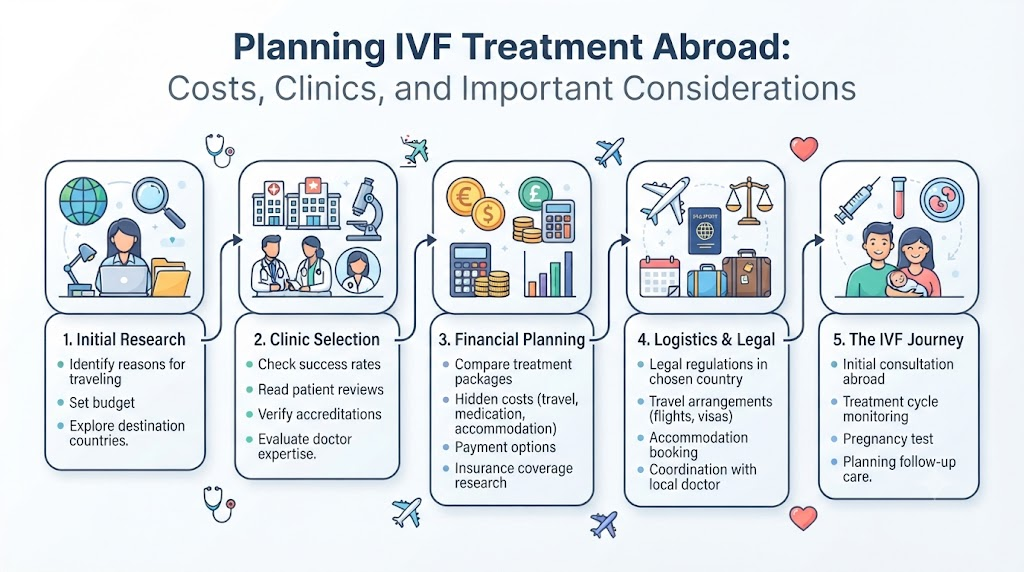
Exploring IVF Treatment Abroad
Some individuals choose to look beyond domestic borders for reproductive care. Exploring IVF treatment abroad involves researching international healthcare standards, travel logistics, and regulatory environments in different destination countries.
Key considerations for international care include:
- Clinic Accreditation: Verifying international medical licenses and quality control standards.
- Communication: Ensuring fluent communication with doctors and support staff in your preferred language.
- Travel and Recovery: Planning for the duration of stay required for stimulation, retrieval, and transfer, as well as clearance to fly post-procedure.
- Continuity of Care: Coordinating medical records and follow-up monitoring with local healthcare providers upon returning home.
Understanding IVF Cost by Country
Financial considerations often motivate patients to research international options. The IVF cost by country can differ dramatically due to varying healthcare infrastructure, government subsidies, insurance regulations, and local economic factors. When comparing international pricing, patients must factor in travel, accommodation, translation services, and the cost of shipping or storing genetic material if follow-up cycles are needed. Currency fluctuations and the specific inclusions within international treatment packages also require careful financial evaluation.
Exploring Different Fertility Treatment Options
Assisted reproductive technology encompasses a wide spectrum of medical interventions. Understanding the range of available fertility treatment options helps patients discuss tailored approaches with their physicians.
Common modalities include:
- Fertility Medications: Oral or injectable hormones designed to stimulate ovulation.
- Intrauterine Insemination (IUI): Placing washed sperm directly into the uterus around the time of ovulation.
- In Vitro Fertilization (IVF): Combining eggs and sperm in a laboratory to create embryos for transfer.
- Fertility Preservation: Freezing eggs or sperm for future family planning.
Each pathway carries distinct clinical indications, success probabilities, and procedural requirements.
ICSI vs IVF
A common decision point in laboratory fertilization procedures involves choosing between standard insemination and microinjection. Understanding the differences in ICSI vs IVF helps patients comprehend how fertilization is achieved in the laboratory.
| Factor | IVF (Standard Insemination) | ICSI (Intracytoplasmic Sperm Injection) |
| Basic Process | Sperm and eggs are placed together in a culture dish, allowing natural fertilization to occur. | A single sperm is carefully selected and injected directly into the center of the mature egg. |
| Fertilization Method | Sperm must independently penetrate the outer shell of the egg. | The embryologist bypasses natural penetration by manually inserting the sperm. |
| Common Clinical Considerations | Typically used when sperm parameters are normal. | Frequently recommended in cases of male factor infertility, previous fertilization failure, or when using frozen sperm. |
| Laboratory Involvement | Lower manual manipulation during the initial fertilization phase. | High level of technical precision and specialized micro-manipulation equipment required. |
| Treatment Similarities | Follows the exact same ovarian stimulation, egg retrieval, and embryo transfer stages. | Follows the exact same ovarian stimulation, egg retrieval, and embryo transfer stages. |
| Important Considerations | Does not guarantee fertilization; success depends on natural sperm motility and egg receptivity. | Does not eliminate genetic risks associated with male factor infertility; should be discussed with a specialist. |
Understanding Egg Freezing Cost
Fertility preservation has become an increasingly discussed option for individuals wishing to safeguard their reproductive potential. When researching egg freezing cost, patients must evaluate expenses across multiple stages of the preservation process.
Estimated cost categories typically include:
- Initial diagnostic consultations and ovarian reserve testing.
- Ovarian stimulation medications.
- Monitoring appointments (blood tests and ultrasounds).
- Surgical egg retrieval procedure and anesthesia fees.
- Laboratory freezing (vitrification) processing.
- Annual cryopreservation storage fees.
Total expenses accumulate over time, particularly regarding long-term storage fees, making it important to clarify future billing policies with the clinic.
How to Evaluate IVF Clinic Information
Reviewing clinic data effectively requires a methodical approach. Patients should cross-reference information found online with official clinic communications, professional accreditation bodies, and verified healthcare listings. Ensuring that staff credentials, laboratory certifications, and pricing structures are transparent helps build trust before scheduling an initial consultation.
Questions to Ask an IVF Clinic Before Treatment
Preparing a list of targeted questions can make initial consultations more productive. Useful topics to raise with a reproductive specialist include:
- What diagnostic tests are recommended for our specific situation?
- What treatment protocol do you recommend, and why?
- Can you provide an itemized estimate of all expected costs, including medications and lab fees?
- How do you calculate and report your success rates for patients in our age bracket?
- What is your policy on single-embryo transfer versus multiple-embryo transfer?
- What provisions are in place for emergency support during the stimulation cycle?
Who Can Use IVFHospitalsNow.com?
People Beginning Fertility Research
Individuals taking their first steps into reproductive health can use organized platform resources to familiarize themselves with basic medical terminology, treatment categories, and general care pathways without feeling overwhelmed.
Couples Exploring IVF
Couples actively considering in vitro fertilization can utilize provider discovery tools to research clinic locations, compare facility offerings, and compile relevant questions for upcoming medical consultations.
People Comparing Fertility Clinics
Users looking to narrow down their choices can review structured comparison factors, helping them weigh location, specialist expertise, and service offerings side by side.
People Researching Treatment Abroad
Patients exploring international reproductive care can gather foundational insights regarding global clinic options, regulatory differences, and travel considerations.
People Exploring Fertility Preservation
Individuals interested in proactive family planning can access educational materials detailing egg freezing procedures, timelines, and associated financial components.
People Seeking Fertility Treatment Information
Anyone looking to deepen their understanding of assisted reproduction can review evidence-based educational content designed to support informed conversations with qualified specialists.
Step-by-Step Guide to Researching Fertility Care
- Understand Your Fertility Information Needs: Identify what specific aspects of treatment, cost, or clinic location you need to learn about first.
- Research Available Treatment Options: Familiarize yourself with general fertility pathways, from basic medications to advanced reproductive technologies.
- Find Relevant IVF Clinics: Use provider discovery tools to locate fertility centers matching your geographical and clinical preferences.
- Review Clinic and Specialist Information: Examine doctor credentials, laboratory standards, and facility offerings.
- Understand Treatment Costs: Request comprehensive, itemized pricing outlines and identify potential out-of-pocket expenses.
- Review Success-Rate Information Carefully: Analyze outcome statistics with proper context regarding patient age and diagnosis.
- Prepare Questions for the Clinic: Write down specific inquiries regarding your proposed treatment plan and financial breakdown.
- Discuss Your Options With a Qualified Fertility Specialist: Schedule consultations to receive personalized medical guidance tailored to your unique health profile.
Common Challenges When Researching IVF Treatment
Navigating the fertility landscape often presents distinct hurdles. Patients frequently report feeling overwhelmed by conflicting online advice, complex medical terminology, and varying interpretations of success statistics. Additionally, comparing clinic prices can be difficult when fee structures are bundled differently across providers. Establishing a clear research framework and relying on structured, objective platforms helps mitigate these challenges and keeps the focus on factual, actionable information.
Best Practices for IVF Clinic Research
- Consult multiple relevant providers to gain a broad perspective on potential care plans.
- Verify all clinic details and specialist credentials directly through official channels.
- Clarify every component included in a quoted financial estimate.
- Examine success rates alongside the specific patient populations they represent.
- Maintain organized medical records throughout your research and consultation phase.
- Discuss all findings and personal treatment goals with a board-certified reproductive endocrinologist.
How to Use Online Fertility Information Responsibly
Digital resources serve as valuable educational tools, but they cannot replace professional medical guidance. Users should always verify information across credible medical societies, ensure data is current, and consult qualified healthcare providers before making health-related decisions. Relying on verified facts rather than promotional claims or anecdotal testimonials ensures a grounded, safe approach to family planning.
Frequently Asked Questions
What is IVFHospitalsNow.com?
It is a specialized digital platform designed to help individuals research fertility care, discover reproductive healthcare providers, and access educational resources related to assisted reproductive technology.
How can people find IVF clinics?
Users can explore organized provider directories that categorize fertility centers by location, available treatments, and clinical services, helping them identify relevant facilities.
What factors affect IVF treatment cost?
Total expenses are influenced by geographic location, medication dosages, laboratory procedures such as ICSI or genetic testing, storage fees, and the number of cycles required.
How should patients understand IVF success rates?
Success metrics should be interpreted with attention to patient age, underlying diagnosis, reporting definitions, and whether statistics reflect clinical pregnancies or live births.
How can people compare IVF clinics?
Clinics can be compared using neutral criteria such as specialist credentials, laboratory standards, cost transparency, location convenience, and available support services.
What should people check when searching for IVF clinics near them?
Patients should evaluate travel distances, appointment availability, clinic hours, and whether the local facility offers the specific advanced services required for their care.
What should patients consider before IVF treatment abroad?
International patients must weigh clinic accreditation, language barriers, travel logistics, legal regulations, and the coordination of follow-up care upon returning home.
Why can IVF cost by country vary?
Pricing differences stem from local healthcare systems, operating expenses, government subsidies, insurance regulations, and the specific inclusions of local treatment packages.
What is the difference between ICSI and IVF?
Standard IVF allows sperm and eggs to fertilize naturally in a dish, whereas ICSI involves an embryologist manually injecting a single sperm directly into the egg.
What factors can affect egg freezing cost?
Expenses are shaped by initial diagnostic tests, stimulation medications, monitoring appointments, the surgical retrieval procedure, laboratory freezing fees, and long-term storage contracts.
Conclusion
Navigating the world of assisted reproduction requires patience, research, and careful planning. Platforms that organize fertility information and provider details empower individuals to approach their healthcare journey with clarity. By understanding treatment options, evaluating costs transparently, and interpreting clinical success metrics responsibly, patients can lay a strong foundation for their research. Ultimately, every fertility journey is deeply personal, and all major medical decisions should be made in close consultation with qualified reproductive specialists who can provide tailored, professional medical advice.