Introduction
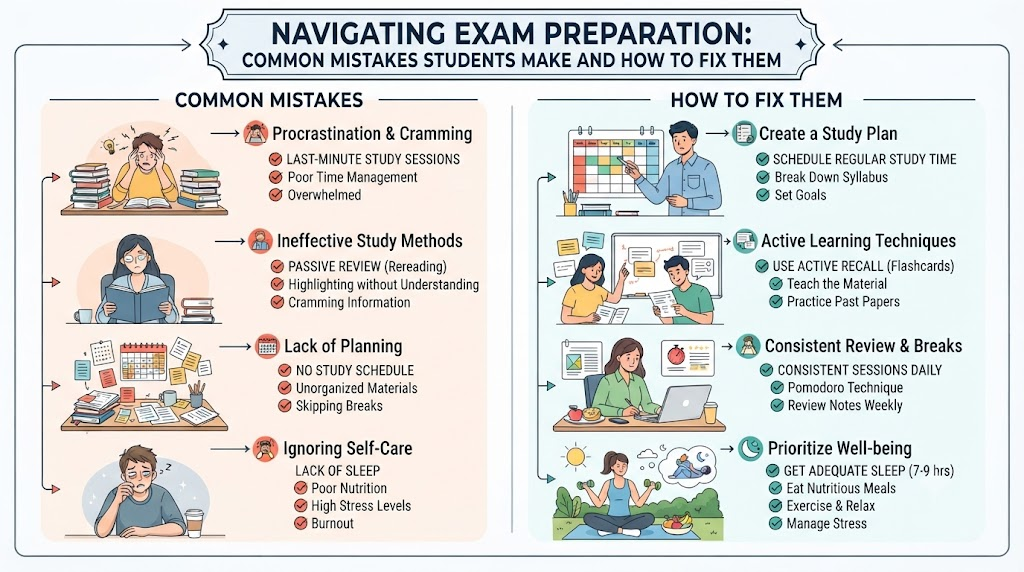
Picture this: It is two weeks before a major exam, and a student is sitting at a desk surrounded by tall stacks of textbooks, printed notes, and highlighters. They have been studying for eight hours every single day, yet a persistent feeling of worry remains. When they try to recall key concepts, the information feels scattered. Practice papers take twice as long as expected, and simple questions lead to careless errors. This scenario happens because exam preparation challenges often stem from study structure rather than a lack of effort. Good exam preparation is not only about studying more hours. It is also about studying with a clear plan, regular practice, systematic revision, and healthy habits. When students understand the common habits and planning mistakes that make preparation harder, they can adjust their routines and build a more effective approach.
Why Students Make Exam Preparation Mistakes
Students often make preparation mistakes because they are unsure where to start, underestimate the syllabus, feel pressure, follow poor study habits, or copy methods that work for someone else. Academic environments can feel competitive and overwhelming, leading learners to adopt frantic study styles simply to keep up with peers. Making mistakes is a normal part of learning. Every student encounters study hurdles, whether they are in school, college, or preparing for board examinations and entrance tests. The goal is to identify problems early and improve the study process over time. Recognizing these missteps without feeling discouraged allows learners to turn ineffective study hours into focused, productive learning sessions.
Starting Without Understanding the Syllabus
One of the earliest stumbling blocks occurs when students begin reading textbooks without reviewing the official syllabus. Diving straight into chapters can lead to wasted time on outdated topics or non-essential details, while leaving critical areas unaddressed. Students should understand the official syllabus before creating a study plan. Reviewing the curriculum helps learners identify subjects, units, chapters, marks distribution where officially available, and important exam requirements. Checking official exam sources ensures that study efforts remain aligned with current testing standards.
Creating an Unrealistic Study Schedule
An ambitious timetable can look impressive on paper, but overly rigid schedules often break down within a few days. Some students plan for twelve-hour study sessions, attempt to cover too many demanding subjects in a single day, or set targets that leave no room for fatigue. Instead, students can create smaller daily targets that fit their actual routine. Consistency matters far more than unrealistic study hours. A manageable two-hour routine maintained every day yields better long-term retention than an exhausting schedule that gets abandoned after forty-eight hours.
Studying Only When Exams Are Near
Last-minute preparation is a frequent source of academic stress. When students delay serious study until the weeks before an exam, they face rushed learning, poor retention, limited revision time, and a severe lack of practice. Starting earlier allows students to divide the syllabus into manageable sections. The ideal preparation period depends on the exam, syllabus size, starting level, and individual circumstances, but giving oneself adequate time transforms studying from a state of panic into a structured journey.
Reading Without Testing Yourself
Passive reading is a habit where students read chapters repeatedly, highlight lines, and assume they understand the material because the text looks familiar. However, recognizing information on a page is entirely different from being able to recall it during an exam. Active recall changes this dynamic. Students can use self-testing, practice questions, flashcards, short quizzes, and problem-solving without looking at the answer key. Active recall helps students quickly identify topics they do not fully understand, ensuring that study time goes toward bridging knowledge gaps.
Ignoring Revision
Finishing a chapter does not mean the learning process is complete. Human memory naturally fades over time if information is not revisited. Waiting until the final week to review everything creates a massive memory overload. Spaced revision, weekly reviews, short revision sessions, and revisiting difficult topics help lock information into long-term memory. Students can build revision directly into their original study plan instead of leaving it for the final days before the test.
Solving Too Few Practice Questions
Reading and understanding a theory is only half the battle. Practice matters deeply, especially for exams that include problem-solving, numerical questions, multiple-choice questions, writing tasks, or time-based sections. Solving practice problems improves familiarity with question formats and reveals hidden knowledge gaps. When students complete practice exercises, reviewing wrong answers matters just as much as counting how many questions they completed correctly.
Avoiding Mock Tests
Mock tests simulate the actual testing environment, yet many students avoid them out of fear of getting low scores. This avoidance prevents learners from building essential test-taking skills like time management, question selection, pacing, and handling pressure. Mock tests are useful only when students analyze their performance afterward. Platforms like GurukulGalaxy have also highlighted mock tests as a way for students to practice, check performance, learn from mistakes, and build exam confidence. Mock tests do not guarantee better marks, but they prepare the mind for the realities of exam day.
Using Too Many Study Resources
Information overload happens when students collect too many books, video lectures, notes, apps, websites, and coaching materials. Switching constantly between different resources creates confusion and makes steady progress difficult. Students benefit most by choosing a small set of reliable resources and using them consistently until completion. More study material does not automatically mean better preparation; depth and consistency outweigh variety.
Memorizing Without Understanding
Memorization alone can be risky for subjects that require deep concepts, reasoning, application, or problem-solving. Memorizing steps in mathematics or science without understanding the underlying principle leaves students vulnerable when exam questions are phrased in a new way. There is a distinct difference between understanding an idea and simply remembering words. For instance, in science or mathematics, knowing why a formula works prevents errors when variables change. At the same time, memorization still plays a vital role where foundational facts, formulas, definitions, vocabulary, or historical dates must be recalled accurately.
Ignoring Weak Subjects or Topics
It is natural for students to spend most of their time on subjects they enjoy while pushing difficult topics to the back burner. However, avoiding challenging areas creates larger gaps that can hurt overall scores. Dividing study time based on academic need rather than personal comfort makes preparation more balanced. Students can identify weak areas through regular tests and practice rather than relying only on how they feel about a subject.
Not Analyzing Mistakes
Simply completing mock tests and practice papers is not enough if errors go unexamined. When students treat a wrong answer as a dead end, they miss valuable learning opportunities.
Categorizing mistakes helps learners spot repeating patterns. Useful categories include:
- Concept not understood.
- Forgotten information.
- Calculation error.
- Misread question.
- Poor time management.
- Careless mistake.
- Guessing error.
Maintaining a mistake log allows students to notice these patterns and address them before the actual exam.
Studying for Long Hours Without Proper Breaks
Nonstop studying often leads to mental fatigue, decreased focus, and burnout. Sitting at a desk for hours without moving can make information retention much harder. Incorporating short breaks, light movement, hydration, and reasonable study sessions keeps the mind fresh. Students should build a sustainable study rhythm rather than forcing themselves through exhausting marathons.
Ignoring Sleep and Basic Well-Being
Treating sleep as wasted study time is a common trap. Sleep deprivation impairs memory consolidation, focus, and emotional balance. Regular sleep, proper meals, hydration, movement, and rest are essential during long preparation periods. Students experiencing severe or persistent stress, sleep problems, or mental health concerns should discuss them openly with a parent, teacher, school counselor, or qualified professional.
Comparing Your Preparation With Other Students
Comparing one’s study hours, syllabus progress, or mock test scores with peers creates unnecessary pressure. Every student has a unique starting point, set of strengths, daily schedule, and learning speed. Tracking personal progress keeps the focus where it belongs. Improvement should be measured against yesterday’s performance, not against every other candidate in the classroom.
Ignoring Doubts Until the Last Moment
Unresolved doubts tend to snowball into larger gaps over time. Hesitating to ask questions out of shyness or fear of judgment slows down academic growth. Students can ask teachers, tutors, mentors, classmates, or trusted learning resources for help as soon as confusion arises. Preparing specific questions makes doubt-solving much faster. For instance, GurukulGalaxy currently allows users to search expert teachers and tutors by subject, type, experience, and city, which can be particularly useful when students need additional academic support.
Following Someone Else’s Study Plan Exactly
Copying a topper’s or friend’s daily schedule rarely works for everyone. Schedules differ based on school or college timings, personal learning speeds, existing strengths, and available hours. Instead of copying routines blindly, students should adapt strategies to fit their personal lifestyle and commitments.
Ignoring Previous Exam Papers
Previous exam papers provide a window into question formats, recurring concepts, difficulty patterns, and time requirements where applicable. Ignoring past papers means walking into an exam room without knowing what to expect. Students should use recent and officially relevant papers where available to test their readiness. Past papers help build familiarity, though questions may vary.
Not Reviewing the Exam Pattern and Instructions
Entering an exam hall without checking the current exam pattern and marking rules can cause panic. Question types, duration, marking schemes, sections, and permitted materials matter greatly. Verifying current guidelines from the official exam authority ensures that students face no unwelcome surprises on exam day.
Common Exam Preparation Mistakes Compared With Better Habits
| Common Mistake | Why It Causes Problems | Better Study Habit |
| Starting without the syllabus | Creates an unclear study path | Review the official syllabus first |
| Unrealistic timetable | Becomes difficult to maintain | Set practical daily targets |
| Last-minute study | Leaves little time for revision | Start early and divide the syllabus |
| Passive reading | May hide knowledge gaps | Use active recall and practice |
| Ignoring revision | Older topics may become weaker | Schedule regular revision |
| Too many resources | Creates confusion and overload | Use a small set of reliable resources |
| Avoiding weak topics | Leaves important gaps | Give extra time to difficult areas |
| Skipping mock tests | Limits timed practice | Take practice tests and analyze them |
| Ignoring mistakes | Problems repeat | Maintain a mistake log |
| Poor rest | Can make preparation harder to sustain | Build reasonable breaks and sleep into the routine |
Students do not need to fix every habit in one day. Small, intentional changes can make the entire study process much more manageable.
How to Build a Better Exam Preparation Routine
Developing a steady study routine helps eliminate daily guesswork. Students can follow a simple framework to organize their preparation:
- Understand the exam requirements and official guidelines.
- Check and print the official syllabus.
- Set realistic, achievable daily targets.
- Divide the syllabus into manageable weekly topics.
- Choose a small, trusted set of study resources.
- Create a balanced weekly plan that includes rest.
- Dedicate extra time to difficult subjects and concepts.
- Practice problem-solving and writing regularly.
- Take timed mock tests to check pacing.
- Review mistakes thoroughly using a mistake log.
- Revise older topics on a recurring schedule.
- Adjust the study plan when new weak areas appear.
Keeping the routine flexible ensures that students can adapt when unexpected schedule changes occur.
How Tutors and Mentors Can Help Students Avoid Preparation Mistakes
Teachers, tutors, and mentors provide valuable external perspective when students struggle with planning or difficult subjects. Personalized feedback, targeted doubt-solving, structured study planning, and accountability help learners stay on track. Not every student requires paid coaching or private tutoring. The right level of support depends entirely on individual needs, independent study habits, and academic goals.
How GurukulGalaxy Can Support Students During Exam Preparation
GurukulGalaxy functions as an education discovery platform that brings together tutors and teachers, institutions, courses, and exam guides in one place. Users can search teachers by subject, type, experience, and city, while its exam guides provide information related to areas such as eligibility, exam patterns, dates, and preparation. Having access to organized education information helps students research learning options and find suitable academic support. GurukulGalaxy is designed to simplify the search for educational resources without making exaggerated promises.
A Simple Weekly Mistake-Check for Students
Self-review keeps preparation on track. Students can ask themselves these quick questions at the end of each week:
- Did I follow my study plan?
- Which topics remain weak?
- How many practice questions did I solve?
- What mistakes did I repeat?
- Did I revise older topics?
- Did I complete a timed practice session?
- Did I spend too much time on one topic?
- What should I change next week?
A weekly review helps students adjust their preparation before small problems become major gaps.
Frequently Asked Questions
What are the most common exam preparation mistakes?
Common mistakes include starting without a syllabus, studying without a plan, relying on last-minute cramming, ignoring revision, skipping practice questions, and failing to analyze mistakes.
Why is studying without a syllabus a problem?
Studying without a syllabus can lead to wasted time on irrelevant topics, leaving critical chapters uncovered and creating blind spots in understanding.
How can students avoid last-minute exam preparation?
Students can avoid last-minute rushes by starting early, breaking the syllabus down into smaller weekly goals, and maintaining a consistent study schedule.
How important is revision during exam preparation?
Revision is essential for long-term memory retention. Regular review prevents knowledge from fading and builds confidence before the exam.
Why should students take mock tests?
Mock tests help students practice time management, build stamina, understand exam pressure, and identify weak areas that need more attention.
How can students manage too many study resources?
Students should select a small, reliable set of books or notes and stick with them consistently rather than constantly switching between different materials.
What should students do after making mistakes in practice tests?
Students should review their incorrect answers, understand why the mistake happened, and log the error to ensure it is not repeated.
How can students improve weak subjects?
Students can improve weak areas by dedicating extra time to them, seeking help from teachers or mentors, and practicing targeted problems regularly.
Should students follow another student’s study timetable?
Not necessarily. Every student has a different learning speed and daily schedule, so timetables should be personalized rather than copied blindly.
How can GurukulGalaxy help students with exam preparation?
GurukulGalaxy helps students explore exam guides, discover experienced tutors by subject and city, and research learning resources to support their academic journey.
Conclusion
Exam preparation is not about studying for the longest possible hours. True progress comes from clear planning, active practice, regular revision, mistake analysis, realistic goals, and healthy study habits. Identifying mistakes early gives students ample time to improve their approach and build lasting academic confidence. GurukulGalaxy serves as an education discovery platform where students can explore tutors, courses, institutions, and exam-related resources to support their learning journey.