Introduction
Choosing a career path after completing school or college is one of the most important steps in a student’s life. Many students in India consider government jobs because they offer stable career options, respectable positions, and opportunities to serve the public. However, the world of government exams can feel very confusing for beginners. There are dozens of different tests conducted by various recruitment boards for different education levels, departments, and career interests. Before you start your preparation, it is very important to understand your options. Rushing into an exam without knowing what it requires can lead to wasted time and effort. Your education level, age, subject strengths, and personal career goals play a huge role in deciding which exam is right for you. For instance, an exam that suits a Class 10 student will be very different from an exam meant for a college graduate. This article will cover everything you need to know about government exams in India. We will look at what these exams are, why students choose them, the different categories available after Class 10, Class 12, and graduation, and how you can start your preparation wisely with the help of Gurukul Galaxy.
What Are Government Exams?
Government exams are competitive tests conducted by central government bodies, state governments, and public sector organizations to select eligible candidates for various government jobs. When government offices, banks, railways, and public departments need new employees, they do not hire people directly through random interviews. Instead, they conduct structured recruitment examinations to find the most capable and hardworking candidates in a fair and transparent manner. These exams are designed to test a student’s general knowledge, reasoning ability, mathematical skills, language proficiency, and sometimes technical knowledge depending on the specific job. Once a student clears all the stages of a recruitment exam and meets all verification requirements, they are offered a position in a government department. Because different departments require different skill sets and educational qualifications, the types of exams vary widely. Understanding these differences helps students pick a path that matches their background.
Why Students Consider Government Exams
There are many reasons why government exams attract millions of students across India every year. While every student has personal motivations, some common factors include:
- Diverse Career Options: Government recruitment covers a massive range of fields, from clerical work and administrative management to technical engineering, banking services, law enforcement, and teaching.
- Central Government Jobs: Working with central ministries and departments allows employees to handle national-level responsibilities and administrative tasks.
- State Government Jobs: State-level departments offer opportunities to serve local communities within specific states and regions.
- Banking Jobs: Public sector banks provide stable career paths in financial services, customer management, and monetary administration.
- Railway Jobs: Indian Railways is one of the largest employers in the country, offering technical, operational, and administrative roles.
- Defence Jobs: Serving in the armed forces allows students to protect the nation, build strong discipline, and pursue a proud career.
- Teaching Jobs: Academic and education-related exams open doors for teaching positions in government schools and higher education institutions.
- Administrative Roles: Civil services and administrative exams attract students who want to be involved in policy-making and large-scale public management.
It is important to remember that preparing for these exams requires dedication, patience, and consistent hard work. Every exam has its own rules, syllabus, and selection stages.
Government Exams After Class 10
Completing Class 10 is a major milestone for school students. While most students choose to continue their higher secondary education, some start exploring early entry options into government recruitment.
SSC MTS (Multi-Tasking Staff)
The Staff Selection Commission conducts the Multi-Tasking Staff exam to recruit candidates for general administrative and support roles in various central government departments. The basic education requirement is passing Class 10. The exam tests basic aptitude, reasoning, English, and general awareness. It is a popular entry point for young aspirants looking to enter government service early.
Railway Group D
Indian Railways conducts recruitment exams for various entry-level positions often referred to as Group D posts. These roles include track maintainers, helpers, and assistants in different technical and operational departments. The minimum educational qualification is generally a Class 10 pass or an equivalent industrial training certificate.
Note: Always check the latest official notification before applying for any exam to confirm current eligibility rules, age limits, and application procedures.
Government Exams After Class 12
Students who have completed their higher secondary education (Class 12) have access to a broader range of competitive recruitment exams and national entry tests.
SSC CHSL (Combined Higher Secondary Level)
The Staff Selection Commission conducts the CHSL exam for roles such as Lower Division Clerk, Junior Secretariat Assistant, and Data Entry Operator. Students who have passed Class 12 from a recognized board can apply. The exam evaluates basic arithmetic, general intelligence, English language skills, and general awareness across multiple tiers.
Railway Recruitment Options
Railways also offer various recruitment categories for Class 12 pass students, including positions for train clerks, commercial cum ticket clerks, and junior-level technical assistants, depending on the specific recruitment cycle.
Defence Exams Such As NDA
The National Defence Academy exam is conducted by the Union Public Service Commission for students who have completed or are appearing for Class 12. It serves as a gateway to join the Army, Navy, and Air Force wings of the Indian Armed Forces. The selection process involves a written test followed by extensive intelligence and personality tests conducted by the Services Selection Board.
Government Exams After Graduation
Graduation opens up the highest level of government recruitment exams in India. These exams offer prestigious administrative, management, and specialized professional roles.
UPSC Civil Services Examination
Often considered one of the most prominent exams in the country, the Civil Services Examination selects candidates for elite administrative services such as the Indian Administrative Service, Indian Foreign Service, and Indian Police Service. Graduates from any discipline can apply, provided they meet the age criteria.
SSC CGL (Combined Graduate Level)
The SSC CGL exam is conducted to recruit graduates for various officer and assistant-level posts in ministries, departments, and organizations under the central government. It evaluates quantitative aptitude, reasoning, English comprehension, and general knowledge.
Banking Exams (IBPS PO, SBI PO, and Clerk)
Public sector banks conduct major recruitment drives through bodies like the Institute of Banking Personnel Selection and the State Bank of India. Exams like IBPS PO, SBI PO, and various clerical exams test candidates on reasoning, numerical ability, English, computer awareness, and banking knowledge.
RRB NTPC (Non-Technical Popular Categories)
Conducted by the Railway Recruitment Boards, this exam is meant for graduates and undergraduate students looking for administrative, commercial, and station master roles within the railway network.
RBI Grade B and NABARD Grade A
These are specialized exams for graduates looking to build a career in central banking, economic policy, agricultural rural development, and financial management.
State Public Service Commission Exams
State-level commissions conduct civil services and administrative exams (such as UPPSC PCS, BPSC PCS, and MPSC State Service Exam) to recruit administrative officers for respective state governments.
Gurukul Galaxy currently covers several of these graduate-level exam areas, helping students understand eligibility, exam structure, and preparation methods.
UPSC Exams Students Should Know
The Union Public Service Commission conducts several high-level national examinations. Understanding these exams helps students choose the right defense, civil, or technical career path:
- UPSC Civil Services Examination: For general administrative services and central government departments.
- UPSC Indian Forest Service Examination: For forestry and environmental management roles.
- UPSC CAPF: For recruitment of Assistant Commandants in Central Armed Police Forces.
- UPSC NDA: For entry into the armed forces after Class 12.
- UPSC CDS: For graduates aspiring to join the Indian Military Academy, Naval Academy, or Air Force Academy.
- UPSC EPFO: For administrative and enforcement officer roles in provident fund organizations.
- UPSC IES/ISS: For engineering and statistical service positions.
Gurukul Galaxy lists these exams among its core competitive exam topics to help students explore diverse central recruitment opportunities.
SSC Exams Students Should Know
The Staff Selection Commission conducts multiple exams catering to different education levels. The most prominent ones include:
- SSC CGL: For graduate-level officer and assistant positions.
- SSC CHSL: For Class 12 pass candidates seeking clerical and data entry roles.
- SSC MTS: For Class 10 pass candidates looking for multi-tasking support roles.
- SSC GD: For recruitment of general duty constables in police and paramilitary forces.
- SSC CPO: For sub-inspector roles in Delhi Police and Central Armed Police Forces.
- SSC JE: For junior engineer posts in civil, electrical, and mechanical disciplines.
Gurukul Galaxy currently provides detailed exam guides for SSC CGL, SSC CHSL, and SSC MTS to assist beginners in understanding the basics.
Banking Exams Students Should Know
Public sector banking offers structured career growth and professional stability. Key banking exams include:
- IBPS PO and SBI PO: Probationary Officer exams for management and administrative roles in public sector banks.
- IBPS Clerk and SBI Clerk: Clerical cadre exams focused on customer service and bank operations.
- RBI Grade B and RBI Assistant: Specialized exams conducted by the Reserve Bank of India.
- NABARD Grade A: Focused on rural development banking and agricultural financing.
These exams test speed, accuracy, and analytical skills. Gurukul Galaxy includes several banking exams in its regular exam coverage.
Railway Exams Students Should Know
Indian Railways recruits staff across technical and non-technical departments through specialized boards:
- RRB NTPC: For non-technical popular categories like clerks, ticket collectors, and guards.
- RRB Group D: For track maintainers and operational support helpers.
- RRB JE: For junior engineers across railway engineering departments.
- RRB ALP: For assistant loco pilots and technicians.
Gurukul Galaxy currently covers RRB NTPC, RRB Group D, RRB JE, and RRB ALP topics to help railway aspirants.
Defence Exams Students Should Know
Defence exams test physical endurance, mental sharpness, and leadership potential. Key exams include:
- NDA: National Defence Academy exam for school leavers.
- CDS: Combined Defence Services exam for college graduates.
- AFCAT: Air Force Common Admission Test for flying and ground duty branches.
- CAPF: Central Armed Police Forces exam for officer positions in security forces.
Always check the official notifications for physical and medical standards before applying.
Teaching and Education-Related Exams
Teaching exams do not provide direct job appointments in every case; rather, they serve as eligibility benchmarks for educators.
- CTET (Central Teacher Eligibility Test): Conducted to determine the eligibility of teachers for central government schools.
- State TET Exams: Conducted by individual states for teaching eligibility in state schools.
- UGC NET and CSIR UGC NET: National-level exams to determine eligibility for assistant professorship and junior research fellowships in universities and colleges.
Gurukul Galaxy currently lists CTET, TET, UGC NET, and CSIR UGC NET among its featured education topics.
State Government Exams
In addition to central exams, every state in India conducts its own recruitment tests through State Public Service Commissions and subordinate staff selection boards. Examples include:
- UPPSC PCS (Uttar Pradesh)
- BPSC PCS (Bihar)
- RPSC RAS (Rajasthan)
- MPPSC State Service Exam (Madhya Pradesh)
- MPSC State Service Exam (Maharashtra)
- TNPSC Group 1 (Tamil Nadu)
- KPSC KAS (Karnataka)
- WBPSC WBCS (West Bengal)
- GPSC (Gujarat)
- APPSC Group 1 (Andhra Pradesh)
Eligibility, syllabus, local language requirements, and age relaxations vary significantly across states. Always review the respective state commission’s official portal.
Related exam guides you may find helpful
| No. | Suggested Sentence | Anchor Text | Target Page/URL | Why This Link Is Useful |
| 1 | If you want to prepare for central staff recruitment, you can explore the detailed SSC CGL exam guide to understand the syllabus and tiers. | SSC CGL exam guide | /ssc-cgl-exam-guide | Helps students understand SSC CGL preparation steps. |
| 2 | For students who have finished higher secondary school, reading the SSC CHSL preparation tips can clarify exam patterns. | SSC CHSL preparation tips | /ssc-chsl-preparation | Explains eligibility and subjects for Class 12 graduates. |
| 3 | Aspirants interested in banking careers should review the banking exam syllabus overview before starting their practice. | banking exam syllabus overview | /banking-exam-syllabus | Details common subjects tested in banking recruitment. |
| 4 | To explore railway recruitment stages, check out the RRB NTPC recruitment details for clear insights. | RRB NTPC recruitment details | /rrb-ntpc-details | Explains railway non-technical exam patterns. |
| 5 | Candidates looking into civil services can read the UPSC exam eligibility criteria to verify age and qualification rules. | UPSC exam eligibility criteria | /upsc-eligibility-guide | Clarifies basic rules for civil services aspirants. |
How to Choose the Right Government Exam
With so many choices available, selecting a single exam can be challenging. Instead of choosing an exam randomly, evaluate your choices based on these practical factors:
- Current Education Level: Match the exam requirement with whether you have passed Class 10, Class 12, or graduation.
- Age Eligibility: Verify that you fall within the prescribed age limits for the specific recruitment cycle.
- Subject Strength: If you are strong in mathematics and reasoning, quantitative-heavy exams might suit you well. If you excel in social sciences and general awareness, civil services or teaching exams could be a better fit.
- Career Interest: Choose a field that matches your personal interests, whether it is banking, railways, public administration, or teaching.
- Preparation Time: Some exams require several years of dedicated study, while others can be cleared with shorter, focused preparation.
Check Eligibility Before Preparation
Before investing your time and energy into studying for any government exam, always verify your eligibility. Check the official educational qualifications, age limits, nationality rules, and any physical standards required for the post. Relying on outdated information can lead to disappointment during the application stage. Always consult the latest official notification released by the recruitment board.
Understand the Exam Pattern
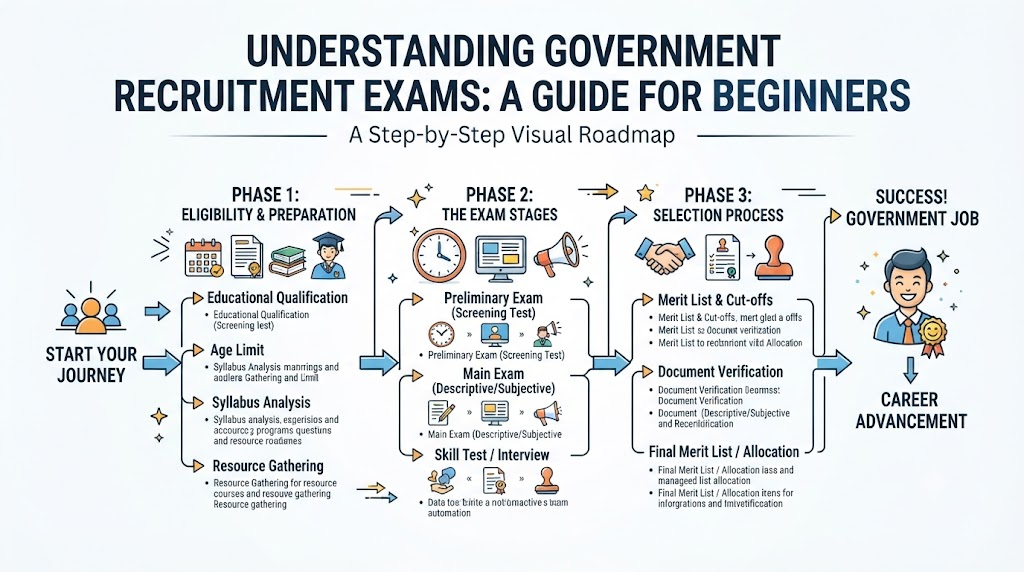
Every competitive exam follows a specific structure. Some exams have multiple tiers involving computer-based tests, descriptive papers, skill tests, or interviews. Understanding the marking scheme, negative marking rules, and section timings helps you practice effectively and manage your time during the actual test.
How Students Can Start Preparing
Starting your preparation in an organized manner reduces stress and improves consistency:
- Choose an Exam: Select one or two exams that align with your education and interests.
- Read the Syllabus: Obtain the latest official syllabus and review every topic.
- Understand the Pattern: Note the number of stages, question types, and duration.
- Make a Study Plan: Create a realistic daily or weekly schedule that covers all subjects.
- Gather Study Material: Select standard books and trusted resources.
- Practice Regularly: Solve previous years’ question papers to understand question trends.
- Take Mock Tests: Practice timed online tests to build speed and accuracy.
- Review Mistakes: Analyze incorrect answers and work on weak areas.
- Stay Updated: Follow current affairs and official recruitment notifications.
- Maintain Consistency: Study regularly rather than trying to cram everything at the last minute.
Common Mistakes Students Should Avoid
Avoiding common pitfalls can significantly improve your preparation journey:
- Preparing for Too Many Exams at Once: Spreading your focus across too many contradictory exams can slow down your progress.
- Ignoring Eligibility: Studying for an exam without meeting the age or education criteria results in wasted effort.
- Using an Old Syllabus: Exams update their patterns and topics; always use current guidelines.
- Not Checking Official Notices: Missing application deadlines or rule changes can ruin your chances.
- Studying Without a Plan: Random studying without structure leads to incomplete preparation.
- Ignoring Mock Tests: Skipping practice tests makes it difficult to manage time during the real exam.
- Not Reviewing Mistakes: Repeating the same errors prevents score improvement.
- Following Too Many Sources: Using dozens of books for the same topic creates confusion.
- Spending Too Much Time on One Topic: Neglecting other sections can lower your overall score.
- Starting Without Knowing the Pattern: Blind preparation without understanding exam stages leads to poor strategy.
How Gurukul Galaxy Can Help Students
Gurukul Galaxy is designed to support students exploring competitive exams, exam guidance, study resources, important dates, admissions, and learner discussions. Whether you are looking to understand exam patterns, check eligibility rules, read exam guides, or follow important recruitment updates, the platform provides structured information to help you navigate your career choices. You can also explore different exam options and connect with fellow learners to share preparation tips in a collaborative environment.
Benefits of Knowing Different Government Exams
Understanding the full landscape of government recruitment offers several advantages:
- Better awareness of diverse career paths available after school and college.
- Easier comparison between different exam requirements and workloads.
- Ability to plan long-term preparation strategies without confusion.
- Clear understanding of eligibility rules to avoid mismatched applications.
- Access to useful study resources and structured guidance.
Government Exams and Career Planning
Connecting your exam preparation with your long-term career goals ensures that you are moving in the right direction. Consider what kind of work environment you prefer, how much preparation time you can commit, and what skills you want to develop. Choosing an exam based on a thoughtful career plan makes the preparation journey more purposeful and rewarding.
Important Note About Exam Dates and Rules
Government recruitment rules, application dates, exam schedules, eligibility criteria, and syllabus outlines are subject to change by the respective authorities. Always verify current details directly from the latest official notification published by the conducting board before applying or making major preparation decisions.
Frequently Asked Questions
- What are the main government exams students should know?The main government exams include UPSC Civil Services, SSC exams like CGL and CHSL, banking exams like IBPS PO and SBI PO, railway exams like RRB NTPC, and various state public service exams.
- Which government exams are available after Class 10?Students who have passed Class 10 can explore early recruitment options such as SSC MTS and Railway Group D, subject to official age and eligibility criteria.
- Which government exams can students take after Class 12?After Class 12, students can appear for exams like SSC CHSL, railway recruitment tests, and defence exams such as the National Defence Academy (NDA) examination.
- Which government exams are available after graduation?Graduates have access to a wide range of exams, including UPSC Civil Services, SSC CGL, IBPS PO, SBI PO, RBI Grade B, and State Public Service Commission exams.
- What are the main SSC exams?Major Staff Selection Commission exams include SSC CGL, SSC CHSL, SSC MTS, SSC GD, SSC CPO, and SSC JE, catering to different education levels.
- What are the main UPSC exams?Important UPSC exams include the Civil Services Examination, Indian Forest Service, CAPF, NDA, CDS, EPFO, and IES/ISS.
- Which banking exams can graduates prepare for?Graduates can prepare for public sector bank exams such as IBPS PO, IBPS Clerk, SBI PO, SBI Clerk, RBI Grade B, and NABARD Grade A.
- Which railway exams should students know about?Key railway recruitment exams include RRB NTPC, RRB Group D, RRB JE, and RRB ALP.
- How should students choose a government exam?Students should choose an exam by evaluating their current education level, age eligibility, subject strengths, career interests, and available preparation time.
- How can Gurukul Galaxy help with government exam preparation?Gurukul Galaxy helps students by providing exam guides, eligibility details, exam pattern overviews, study resources, important dates, and a space for learner discussions.
Conclusion
Navigating government exams requires a clear understanding of your education level, eligibility, exam patterns, and career interests. Knowing your options before starting preparation helps you avoid confusion and focus your energy on the right path. Always rely on current official notifications for the latest rules and updates. Explore comprehensive exam guides, eligibility details, and preparation resources on Gurukul Galaxy to make informed career decisions and take your next step with confidence.