Introduction
The modern software engineering landscape is moving at a breakneck pace. As engineering architectures transition from monolithic systems to microservices, containerized deployments, and production-grade AI systems, traditional infrastructure management is no longer sufficient. Organizations now demand professionals who can seamlessly merge software development with IT operations while embedding automated security, strict reliability engineering, and continuous deployment data pipelines. This rapid technological evolution has made navigating the vast ecosystem of modern IT careers highly rewarding but deeply confusing.
Aspiring engineers, system administrators, and seasoned developers frequently struggle with decision paralysis. With hundreds of overlapping vendor badges, broad frameworks, and highly specialized automation tools available, finding the right starting point or upskilling path can feel overwhelming. This comprehensive guide cuts through the industry noise to establish a definitive, role-based roadmap. It highlights the most respected industry credentials designed to validate your practical expertise, dramatically boost your hiring visibility, and accelerate your engineering career across the modern cloud lifecycle.
What is a DevOps Certification?
A DevOps certification is an industry-recognized credential that validates an engineer’s practical capability to design, implement, and operate automated software delivery workflows across real-world production environments. Rather than simply proving surface-level familiarity with a specific tool or vendor ecosystem, modern certifications focus heavily on foundational delivery principles, automation-first architectural patterns, and end-to-end operational ownership.
These validation programs provide structured, rigorous learning tracks that challenge candidates to master the entire software development lifecycle (SDLC). By completing these targeted curricula, engineers learn how to successfully synthesize automated continuous integration and continuous delivery (CI/CD) pipelines, scale secure cloud-native infrastructure, enforce robust site reliability standards, and proactively monitor system health. Most importantly, these certifications validate that an IT professional possesses the structured knowledge and production-ready engineering confidence required to break down traditional operational silos and drive measurable business outcomes.
Why DevOps Certifications Matter
In a highly competitive global tech market, specialized certifications serve as a standardized baseline of engineering excellence. For hiring managers filtering through hundreds of technical resumes, these industry credentials offer verified proof that a candidate can step into a complex cloud environment and contribute to live infrastructure pipelines from day one.
Beyond acting as an impactful resume differentiator, preparing for a high-quality certification forces engineers to fill the critical gaps in their self-taught knowledge. It transitions professionals from executing disconnected, repetitive manual scripts to architecting highly robust, declarative, and entirely reproducible infrastructure systems. The structured preparation process builds an engineering mindset centered around scale, resilience, and business velocity.
The Certification and Upskilling Process
- Identify Current Architectural Gaps: Assess your day-to-day engineering limitations, noting where manual intervention, slow deployments, or system visibility gaps hinder your delivery speed.
- Select a Target Certification Domain: Choose a specific, high-value validation track (such as container orchestration, infrastructure as code, cloud security, or production MLOps) that directly matches your long-term career trajectory.
- Engage with Structured Coursework: Dive deep into comprehensive, instructor-led training modules, architectural whitepapers, and rigorous official exam blueprints.
- Build Hands-On Projects in Isolated Sandboxes: Actively configure production-grade environments, deliberately cause system failures, and practice live troubleshooting in isolated lab sandboxes.
- Pass the Practical Performance Examination: Successfully clear the comprehensive vendor or foundation exam to officially validate your technical expertise in the industry.
- Deploy Automated Workflows to Live Production: Apply your validated architectural strategies to your organization’s engineering ecosystem to accelerate delivery, improve system uptime, and eliminate manual bottlenecks.
Who Should Take DevOps Certifications?
DevOps certifications are intentionally designed to support professionals at every stage of their technology career, offering clear structural pathways to match diverse engineering backgrounds and future professional goals.
- Students and Freshers: Ambitious newcomers aiming to break into the tech industry by building a verified, competitive baseline of cloud-native automation skills before entering the job market.
- Software Engineers and Developers: Specialists focused on expanding their core coding capabilities to fully understand underlying runtime environments, automated test deployments, and cloud-native architectures.
- System Administrators and Network Engineers: Infrastructure veterans transitioning away from legacy manual server maintenance toward automated, scalable, and fully declarative infrastructure-as-code management.
- Cloud and Platform Engineers: Cloud professionals looking to advance their architectural skills by building highly resilient multi-tenant environments and internal developer platforms (IDPs).
- SRE and DevSecOps Specialists: Reliability and security professionals seeking to deeply embed continuous vulnerability scanning, automated policy enforcement, and proactive, zero-downtime monitoring into live application pipelines.
- Data and ML Engineers: Data scientists and machine learning professionals focused on moving complex analytical models out of local testing notebooks and into highly scalable, reliable, and automated production pipelines.
- Continuous Integration & Continuous Delivery (CI/CD): Building automated, reproducible pipelines that instantly compile, thoroughly test, and securely deploy code changes, significantly reducing manual delivery errors and time-to-market.
- Infrastructure as Code (IaC): Treating physical and cloud-native infrastructure identically to application code by provisioning, updating, and destroying environments using version-controlled, declarative configuration files.
- Containerization & Orchestration: Abstracting applications away from underlying host operating systems to ensure completely consistent runtime environments while seamlessly managing automated scaling, networking, and service self-healing.
- Site Reliability & Observability (SRE): Transitioning from basic, reactive system monitoring to proactive observability by tracking structured logs, detailed metrics, distributed traces, and clear Service Level Objectives (SLOs) to ensure high availability.
- Continuous DevSecOps Security: Shifting security checks directly into early-stage development pipelines via automated vulnerability scanning, secure secret management, and strict compliance-as-code policies.
- Declarative GitOps Workflows: Utilizing version-controlled Git repositories as the absolute single source of truth for an entire system’s desired operational state, leveraging automated controllers to continuously reconcile live cluster discrepancies.
- Production MLOps & AI Infrastructure: Designing fully automated, highly scalable pipelines specifically tailored to handle continuous data engineering, distributed model training, rapid versioning, and low-latency model serving.
Comprehensive Overview of Top Credentials
The following table organizes twenty of the most respected industry credentials across cloud providers, tool-specific validations, and emerging engineering disciplines.
Table 1: Best DevOps Certifications Ecosystem
| Certification Name | Best For | Skill Level | Career Direction |
| DevOps Certified Professional (DCP) | Core Framework Foundations & Pipeline Concepts | Beginner | DevOps Engineer |
| DevSecOps Certified Professional (DSOCP) | Automated Security Pipelines & Compliance | Intermediate | DevSecOps Engineer |
| Site Reliability Engineering (SRE) Certified Professional | High Availability, SLOs, & Fault Tolerance | Advanced | SRE Professional |
| Master in DevOps Engineering (MDE) | Enterprise Lifecycle Architecture & Automation | Advanced | DevOps Architect |
| Master in Azure DevOps | Enterprise Microsoft Azure Cloud Ecosystems | Advanced | Azure Cloud Engineer |
| AWS Certified DevOps Professional | Production AWS Environments & Scale | Advanced | AWS DevOps Specialist |
| Master in Python Programming | Automation Scripting & Advanced Data Tooling | Intermediate | Automation Engineer |
| Hashicorp Certified Terraform Associate | Multi-Cloud Declarative Infrastructure as Code | Intermediate | Infrastructure Engineer |
| Certified Kubernetes Administrator (CKA) | Production Container Orchestration & Networking | Advanced | Kubernetes Administrator |
| Docker Certified Associate (DCA) | Containerization Essentials & Engine Architecture | Intermediate | Container Specialist |
| Envoy ISTIO Certification Training | Microservices Service Mesh & Traffic Management | Advanced | Platform Engineer |
| MLOps Certification Training Course | Machine Learning Lifecycle Lifecycle Pipelines | Advanced | MLOps Engineer |
| Google Cloud Professional Cloud DevOps Engineer | SRE Practices & Google Cloud Platforms | Advanced | GCP Cloud Engineer |
| Master in Machine Learning | Predictive Algorithmic Engineering & Modeling | Advanced | ML Scientist |
| Master in Artificial Intelligence | Neural Networks & Enterprise Intelligent Systems | Advanced | AI Engineer |
| Master in AppDynamics | Enterprise Application Performance Management | Intermediate | Observability Engineer |
| Master in Data Science | Analytical Statistical Modelling & Engineering | Advanced | Data Architect |
| Master in Deep Learning | Complex Multi-layer Architecture Deployment | Advanced | Research Engineer |
| Prometheus with Grafana | Metric Monitoring & Multi-source Dashboards | Intermediate | Systems Monitor |
| GitOps Certified Professional (GOCP) | Declarative Continuous Delivery & Git Control | Intermediate | GitOps Engineer |
Certification Deep Dive
To give you a clear, practical understanding of what preparing for a high-quality certification actually entails, let us examine the foundational engineering pillars through a unified technical blueprint. This unified blueprint details exactly how a major project transitions from a loose collection of source files into a resilient, production-ready system.
Real-World Use Case
Consider an enterprise financial services application migrating from an on-premises legacy data center to a multi-cloud, containerized microservices architecture. To meet strict regulatory and operational standards, the organization requires an entirely automated deployment engine.
The pipeline must provision secure, isolated cloud networks via reusable code templates, build and verify lean container images, validate that application packages are entirely free of security vulnerabilities, orchestrate deployments across dynamic clusters, and provide sub-second dashboard observability into system performance.
Skills You Will Learn
- Declarative System Provisioning: Writing highly reusable infrastructure modules to reliably deploy multi-region networking infrastructure, computing clusters, and managed database engines.
- Secure Container Engineering: Designing multi-stage build files that minimize attack surfaces, optimize image caching, and isolate local runtimes.
- Advanced Pipeline Assembly: Constructing multi-stage, branching integration engines that run automated testing suites, handle secure secret rotation, and execute canary or blue-green release strategies.
- Production Observability Architecture: Engineering real-time monitoring infrastructure to capture high-cardinality metrics, collect structured logs, track distributed application traces, and configure actionable alerts.
Career Scope
Professionals who thoroughly master these automation skills are highly sought after across tech sectors. They quickly step into senior individual contributor and architectural leadership roles, including Cloud Platform Architect, Infrastructure Engineer, Senior SRE, and DevSecOps Director. These vital positions carry significant operational ownership and regularly command premium compensation packages globally.
Difficulty Level
- Intermediate to Advanced: Requires a dependable baseline understanding of Linux systems administration, standard networking concepts (DNS, TCP/IP, VPC routing), and basic shell or Python scripting capabilities.
Best Career Fit / Who Should Take It
- Systems Administrators eager to transition away from manual server updates and embrace automated cloud infrastructure.
- Mid-level Software Engineers who want to break down operational boundaries and take complete, end-to-end architectural control over how their code runs in live production environments.
Hands-On Projects
- The Multi-Stage Automated GitOps Pipeline: Create a source-controlled repository that uses declarative Terraform files to spin up an enterprise Kubernetes cluster. Configure an automated GitOps controller within the cluster to watch your application code.
- The Vulnerability Shield: Integrate automated security scanning engines into your pipeline to block builds containing critical code vulnerabilities.
- The Self-Healing Cluster: Connect real-time Prometheus monitoring rules directly to your cluster’s auto-scalers, forcing systems to automatically scale out or restart individual components during traffic surges or memory leaks.
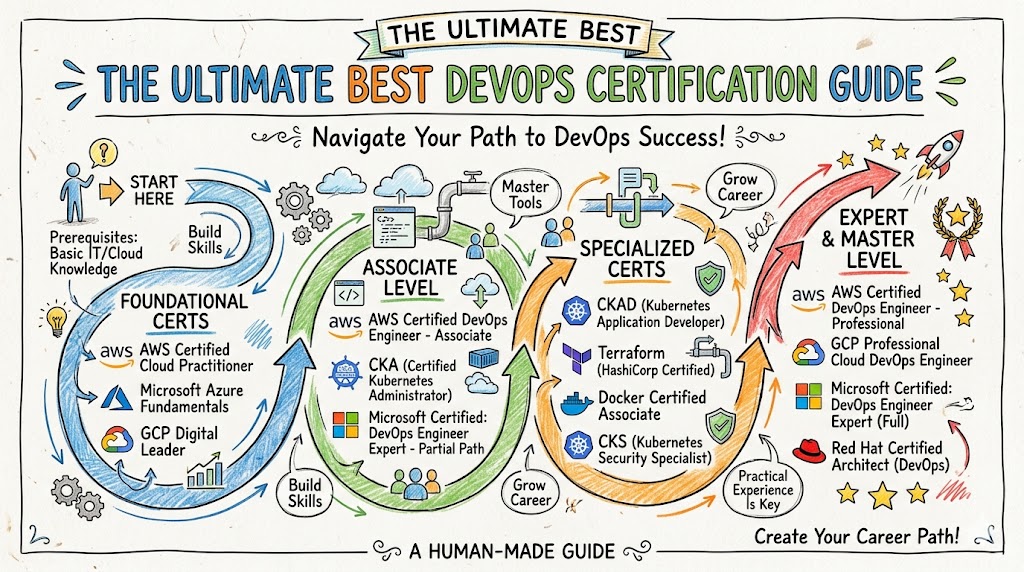
DevOps Certification Roadmap
Achieving career success requires mapping your upskilling efforts to clear, logical milestones. The table below outlines targeted paths tailored to specific, real-world career trajectories.
Table 2: Tactical Upskilling Paths
| Career Goal | Recommended Certification Path | Why It Fits |
| Enterprise Cloud Architect | DCP ➔ HashiCorp Terraform ➔ AWS/Azure DevOps Professional ➔ MDE | Establishes a rock-solid tooling foundation before mastering complex enterprise cloud architectures. |
| Cloud-Native Platform Engineer | DCA ➔ Certified Kubernetes Administrator (CKA) ➔ Envoy Istio ➔ GitOps Professional | Provides deep expertise in container runtime management, mesh networking, and declarative GitOps pipelines. |
| SecOps & Infrastructure Defender | DCP ➔ DevSecOps Professional (DSOCP) ➔ HashiCorp Terraform | Blends infrastructure-as-code automation with continuous vulnerability scanning and strict compliance rules. |
| Production AI/ML System Engineer | Master in Python ➔ Data Science ➔ MLOps Training ➔ Master in AI | Transitions data science professionals out of local sandboxes to run large-scale automated modeling workflows. |
| Observability & SRE Lead | Site Reliability Engineering (SRE) ➔ Prometheus & Grafana ➔ AppDynamics | Focuses entirely on minimizing system downtime by tracking advanced metrics and establishing proactive alerting. |
Types of DevOps Certifications
+--------------------------------------------------------------------------+
|                  CATEGORIES OF TECHNICAL CERTIFICATION                   |
+--------------------------------------------------------------------------+
|  [FOUNDATIONAL]    -->   [VENDOR-SPECIFIC]   -->   [ROLE-SPECIALIZED]   |
|  DCP / Frameworks        AWS / Azure / GCP         CKA / MLOps / SRE     |
+--------------------------------------------------------------------------+
To optimize your training time and budget, it is helpful to categorize industry credentials into three distinct types:
1. Foundational & Methodology Certifications
These certifications focus primarily on the core cultural values, team workflows, and fundamental delivery concepts that define the DevOps philosophy. Programs like the DevOps Certified Professional (DCP) or Master in DevOps Engineering (MDE) teach engineers how to dismantle traditional organizational silos, design effective continuous feedback loops, and optimize end-to-end software delivery pipelines regardless of a company’s specific underlying technology stack.
2. Cloud Provider-Specific Certifications
These certifications validate your deep technical mastery within a specific public cloud environment. Highly respected tracks like the AWS Certified DevOps Engineer – Professional, Microsoft Certified: Azure DevOps Engineer Expert, or Google Professional Cloud DevOps Engineer confirm your practical ability to design, deploy, and manage automation tools natively built inside that vendor’s global cloud ecosystem.
3. Tool-Specific & Role-Specialized Certifications
These deep-dive validations verify an engineer’s advanced technical proficiency with critical, industry-standard cloud-native tools or specialized operating models. Examples include the Certified Kubernetes Administrator (CKA) for enterprise container orchestration, the HashiCorp Certified Terraform Associate for cross-cloud infrastructure automation, and advanced tracks in MLOps or Site Reliability Engineering (SRE) tailored for cutting-edge engineering environments.
Common Mistakes to Avoid
- Chasing Paper Badges Without Real-World Practice: Brain-dumping exam answers to collect digital badges without spending the time to build deep, practical troubleshooting experience in a real lab sandbox environment.
- Memorizing Specific Tool Syntax Instead of Core Architectural Principles: Focusing entirely on learning specific, volatile command-line flags rather than mastering the underlying architectural patterns that apply across all tools.
- Completely Ignoring Application Logging and Post-Deployment Visibility: Investing heavily in perfecting initial code deployment pipelines while failing to set up the necessary metrics and logging systems to monitor production environment health.
- Treating Security Validation as a Final, Isolated Step: Leaving critical vulnerability scanning, access control checks, and secret management out of your automated pipelines until right before production release.
- Failing to Match Selected Certifications with Clear Career Paths: Collecting random, unrelated technology badges that do not align with your daily professional responsibilities or long-term career advancement goals.
5 Real-Life Examples of DevOps Transformations
To see how these core certification concepts function in the real world, let us look at five tangible examples of organizations using automated practices to solve major business challenges.
- Global Financial Platform Migrates to GitOps: A major retail banking platform used declarative Terraform configurations and automated GitOps engines to provision identical, isolated testing environments in minutes, cutting compliance audit times from weeks to hours.
- E-Commerce Leader Automatically Scales for Peak Traffic: A retail enterprise connected its cluster auto-scalers directly to live Prometheus metrics, allowing its web architecture to dynamically handle millions of holiday shopping requests without a single second of downtime.
- Healthcare Provider Embeds Automated DevSecOps Pipelines: An enterprise health insurance provider integrated continuous container vulnerability scanning into its build pipelines, blocking insecure packages early and ensuring absolute compliance with strict regulatory data protection standards.
- Streaming Media Platform Improves System Visibility via Distributed Tracing: A global streaming service deployed a microservices service mesh to manage heavy data traffic, using real-time tracing dashboards to isolate and fix application performance issues before they affected users.
- Automotive Manufacturer Automates Global AI Model Training: An autonomous driving engineering group utilized production MLOps pipelines to continuously ingest new road data, retrain deep learning navigation models on scalable cloud clusters, and automatically serve low-latency updates safely to test vehicles.
Frequently Asked Questions
Q1: Can I successfully break into a professional DevOps career if I have no prior coding background?
A: Yes, you can absolutely get started, but you will need to establish a dependable baseline of technical fundamentals first. Beginning with a structured program like the Master in Python Programming or the DevOps Certified Professional (DCP) will help you comfortably pick up core scripting logic, common Linux server administration workflows, and foundational cloud-native automation patterns.
Q2: What is the primary difference between standard DevOps methodologies and specialized SRE roles?
A: DevOps focuses on breaking down organizational silos and creating automated pipelines to safely speed up software delivery. Site Reliability Engineering (SRE) is a specific, practical implementation of DevOps that applies software engineering principles directly to infrastructure challenges, focusing on system uptime, service latency, fault tolerance, and clear Service Level Objectives (SLOs).
Q3: Why is the Certified Kubernetes Administrator (CKA) exam considered so valuable across the tech industry?
A: Unlike typical multiple-choice exams, the CKA is an entirely performance-based, hands-on technical test. Candidates must solve complex, real-world troubleshooting scenarios on live Kubernetes clusters within a timed window, making it a reliable proof of an engineer’s practical command over container orchestration.
Q4: How exactly does a specialized DevSecOps certification protect live engineering pipelines?
A: DevSecOps certifications train engineers to move security verification early in the lifecycle by embedding automated security checkpoints directly into continuous integration pipelines. This ensures that application vulnerabilities, outdated dependencies, and exposed access credentials are automatically flagged and blocked before any code reaches production.
Q5: Is it better for my career to focus on single-vendor cloud paths or tool-specific certifications?
A: The most effective approach is to combine both. A strong vendor path (like AWS or Azure DevOps Professional) gives you a comprehensive understanding of core cloud architecture, while tool-specific validations (like HashiCorp Terraform or CKA) prove you can design highly flexible, multi-cloud platforms.
Q6: How frequently do these cloud-native and DevOps certifications require renewal?
A: Most major cloud and tool certifications (including AWS, Azure, Google Cloud, and CNCF certifications) are valid for two to three years. Because cloud tools change rapidly, professionals must complete recertification exams to show they remain up to date with current engineering best practices.
Q7: What exactly is MLOps, and why is it becoming an essential engineering specialization?
A: MLOps brings proven DevOps automation practices to data science and machine learning workflows. It replaces manual model tracking with automated pipelines that manage continuous data ingestion, large-scale model training, version-controlled storage, and low-latency production deployment.
Q8: Can obtaining a high-quality DevOps certification help me secure a higher salary?
A: Yes. Industry reports show that certified DevOps, SRE, and cloud platform engineers earn significantly higher average salaries than general IT professionals. This premium reflects their specialized ability to reduce system downtime, optimize cloud costs, and accelerate software delivery.
Q9: What role do Prometheus and Grafana play in modern enterprise cloud observability?
A: Prometheus acts as a powerful data engine that continuously collects high-resolution timeseries metrics from your applications and infrastructure. Grafana connects to this data to display real-time performance dashboards, transforming raw system logs into actionable visual insights for engineering teams.
Q10: How does a GitOps validation course change how teams handle continuous application delivery?
A: GitOps validation teaches engineers to manage infrastructure states through version-controlled Git repositories. Instead of running manual scripts, teams deploy changes via standard Git code reviews, using automated controllers to keep production clusters synchronized with repository configurations.
Conclusion
Building a successful career in today’s rapidly changing cloud landscape requires a committed shift from performing manual infrastructure tasks to designing fully automated, highly resilient systems. Whether you are an ambitious student mastering core automation scripting or a senior engineer diving deep into complex microservices architectures, your professional development path must match real-world industry demands.
By following a structured learning roadmap, securing respected industry credentials, and consistently building comprehensive, hands-on technical projects, you will systematically eliminate knowledge gaps and stand out to top-tier engineering organizations. Take the next definitive step in your engineering journey today by exploring the BestDevOps Certification Hub to discover the perfect professional development track to accelerate your career.
Call to Action
Your transition toward mastering cloud-native infrastructure architecture begins with a single, focused commitment to upskilling. Evaluate your current technical toolkit, select an industry-recognized certification track that directly complements your professional aspirations, and begin building real-world projects inside a local testing sandbox.