Introduction
The complexity of modern IT environments is growing at an unprecedented rate. As organizations shift from monolithic applications to distributed microservices, Kubernetes-based platforms, and multi-cloud architectures, the sheer volume of data generated is overwhelming traditional monitoring tools. IT teams are drowning in a sea of alerts, struggling to distinguish meaningful signals from background noise. This is where AIOpsSchool bridges the gap, providing the expertise, certification, and training necessary to navigate this complex landscape.
Consider a typical enterprise scenario: A minor configuration change in a microservice triggers a cascading failure across five different services. Traditional monitoring alerts thousands of engineers, but nobody knows the root cause. This “alert fatigue” leads to burnout and extended downtime. AIOps shifts the paradigm by utilizing machine learning to correlate these events, identify the root cause in seconds, and even suggest automated remediation.
What Is AIOps?
AIOps (Artificial Intelligence for IT Operations) is the application of machine learning, analytics, and automation to IT operations data. It collects vast amounts of logs, metrics, and traces from diverse sources to detect patterns, predict potential issues, and automate incident responses, allowing teams to focus on innovation rather than fire-fighting.
Understanding AIOps
What Is Artificial Intelligence for IT Operations?
At its core, AIOps is about data intelligence. It transforms raw, chaotic operational data into actionable insights. Instead of manual dashboard watching, AIOps platforms act as a brain that understands the relationship between infrastructure components.
In Simple Terms
Think of traditional monitoring as a smoke detector—it tells you there is a fire. AIOps is like an automated sprinkler system that identifies exactly where the fire started, why it started, and puts it out before the whole building is affected.
Why Traditional IT Operations Are No Longer Enough
Traditional monitoring relies on static thresholds (e.g., alert if CPU > 80%). In dynamic cloud environments, thresholds are useless because workloads fluctuate constantly. AIOps uses dynamic baselining, which learns what “normal” looks like based on time of day, week, or business cycles.
Real-World Example
An e-commerce company experiences a spike during a flash sale. Traditional systems trigger false alerts because usage is high. An AIOps-enabled system recognizes this as expected behavior and ignores the “high load” alert, focusing only on genuine anomalies like service latency or checkout failures.
Evolution from Monitoring to Intelligent Operations
| Traditional Operations | AIOps-Driven Operations |
| Manual incident correlation | Automated event correlation |
| Static thresholds | Dynamic baselining |
| Reactive troubleshooting | Proactive incident prediction |
| Siloed data analysis | Unified observability platform |
Why AIOps Skills Are Becoming Essential
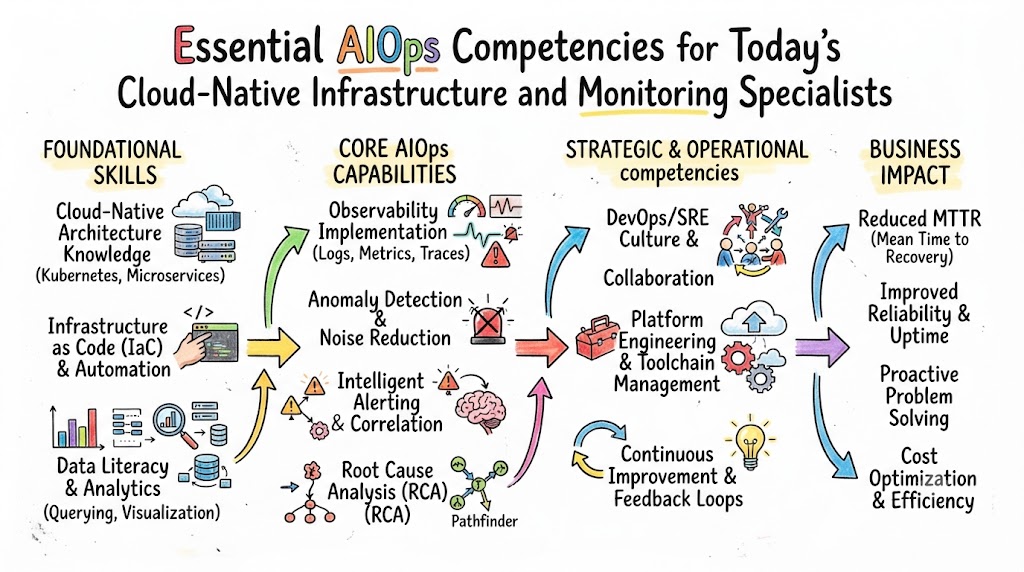
The demand for AIOps professionals is skyrocketing as organizations realize that manual management of cloud-native infrastructure is unsustainable.
Why It Matters
For a business, downtime is measured in lost revenue and customer trust. For an engineer, being able to implement AIOps means moving from a reactive, stressed role to a strategic architect who builds self-healing systems.
- Reliability: Direct impact on uptime and SLOs.
- Efficiency: Drastic reduction in mean time to resolution (MTTR).
- Scalability: Managing thousands of nodes with the same headcount.
AIOps Certification Explained
What Is an AIOps Certification?
It is a formal validation of your ability to design, implement, and maintain AI-powered operations workflows. It proves you understand data science principles applied to IT, observability platforms, and incident automation.
Who Should Pursue It?
- DevOps/SRE Engineers: To automate manual toil.
- Cloud Architects: To manage complex multi-cloud visibility.
- IT Managers: To lead digital transformation initiatives.
AIOps Training and Courses
Effective training goes beyond tools; it teaches the philosophy of AI observability.
Key Study Areas
- Event Correlation: Learning how to group related alerts.
- Root Cause Analysis: Using AI to trace errors through distributed systems.
- Observability: Mastering the “three pillars” (Logs, Metrics, Traces).
- OpenTelemetry: Standardizing data collection across the enterprise.
AIOps Engineer Career Roadmap
Learning Sequence
- Foundations: Linux, Networking, and Cloud fundamentals.
- Observability: Become an expert in metrics and traces.
- Data Proficiency: Basic Python and data manipulation.
- AIOps Tools: Implementation of correlation and anomaly detection platforms.
- Strategy: Learning how to map AIOps to business goals.
| Level | Skills | Outcome |
| Beginner | Monitoring basics, Linux | Observability Practitioner |
| Intermediate | Automation, Python, Log Analysis | AIOps Implementer |
| Advanced | ML Ops, Predictive Analytics, Strategy | AIOps Architect |
AIOps for SRE and DevOps Engineers
AIOps acts as the ultimate force multiplier for Site Reliability Engineering. By reducing “noise,” it allows SREs to focus on “toil reduction.” When the system automatically filters out 90% of false-positive alerts, SREs can spend time improving the underlying architecture rather than staring at ticket queues.
Enterprise AIOps Consulting and Implementation
Implementing AIOps is not just a software install—it is a cultural and process shift. Consulting services focus on assessing your current “operational maturity” and designing a roadmap that avoids common pitfalls like “data swamps” (collecting too much irrelevant data).
Implementation Workflow
- Assessment: Audit current telemetry and tool gaps.
- Design: Architect the data pipeline and AI logic.
- Integration: Connect data sources (logs, cloud events, CMDB).
- Optimization: Configure automated workflows for incident remediation.
Real-World Enterprise Use Cases
- Banking: Detecting fraudulent transaction patterns alongside system latency issues.
- Healthcare: Ensuring 99.999% availability for patient monitoring systems.
- SaaS: Predictive capacity planning to save on cloud costs before a surge.
Common Challenges & Solutions
- Data Quality: “Garbage in, garbage out” is a major risk. Solution: Start by cleaning your telemetry data before feeding it into models.
- Organizational Resistance: Fear of AI replacing jobs. Solution: Position AIOps as a tool to remove “boring” work, not people.
Future of AIOps
The future is Autonomous Operations. We are moving toward self-healing infrastructures where, when a service fails, the system automatically detects the issue, rolls back a faulty deployment, and alerts the team only after the problem is mitigated.
Why Learn with AIOpsSchool
At AIOpsSchool, we focus on practical, industry-aligned education. Whether you are a student looking to start your career or a firm looking to implement enterprise-grade observability, our programs provide the roadmap you need. We bridge the gap between abstract AI concepts and the realities of running a production environment.
FAQ SECTION
- What is AIOps Certification? It is a formal credential that validates a professional’s expertise in using machine learning and AI to optimize IT operations, incident management, and observability.
- Who should learn AIOps? DevOps engineers, SREs, cloud architects, and IT operations managers looking to automate workflows and reduce manual toil.
- What skills are required for AIOps Engineers? Proficiency in cloud infrastructure, monitoring tools, basic programming (Python), observability principles, and data analysis.
- How does AIOps help DevOps teams? It significantly reduces alert fatigue, speeds up root cause analysis, and enables proactive incident management, allowing teams to ship code faster with higher confidence.
- What is AI Observability? It is the practice of using AI to gain deeper insights into the performance and health of distributed systems by analyzing logs, metrics, and traces simultaneously.
- What is OpenTelemetry? An open-source standard for collecting and exporting telemetry data (logs, metrics, and traces) to ensure vendor-neutral observability.
- How long does it take to learn AIOps? Depending on your background, a solid foundation can be built in a few months, with advanced mastery achieved through hands-on implementation and certification training.
- What are AIOps Implementation Services? These are professional consulting services that help enterprises assess their operational maturity, select the right tools, and deploy AIOps workflows effectively.
- Is AIOps a good career choice? Absolutely; as organizations shift to AI-driven operations, skilled AIOps engineers are among the most sought-after professionals in the IT sector.
- What is the future of AIOps? The future lies in fully autonomous, self-healing systems that predict and fix infrastructure issues without human intervention.
FINAL SUMMARY
AIOps is no longer a “nice to have”—it is a necessity for modern engineering teams. By mastering these skills, you position yourself at the forefront of the next wave of IT innovation. Whether through certification, hands-on training, or expert consulting, adopting AIOps will transform how you handle incidents, reliability, and system performance. Explore the programs at AIOpsSchool to begin your journey toward mastering AI-powered operations.