Introduction
In the rapidly evolving landscape of modern software delivery, maintaining system stability while shipping features at high velocity is the hallmark of elite engineering teams. The Certified Site Reliability Manager stands as a pivotal credential for professionals aiming to bridge the gap between technical execution and strategic oversight. As organizations shift toward cloud-native architectures, the need for leaders who understand error budgets, incident management, and automated toil reduction has never been higher. This guide is designed to help software engineers, DevOps practitioners, and platform leads navigate the complexities of site reliability engineering. Whether you are scaling infrastructure or building resilient systems, mastering these concepts will sharpen your professional edge. For those exploring broader operational disciplines, our resources also extend to specialized domains like aiopsschool to provide a comprehensive view of the current industry landscape.
What is the Certified Site Reliability Manager?
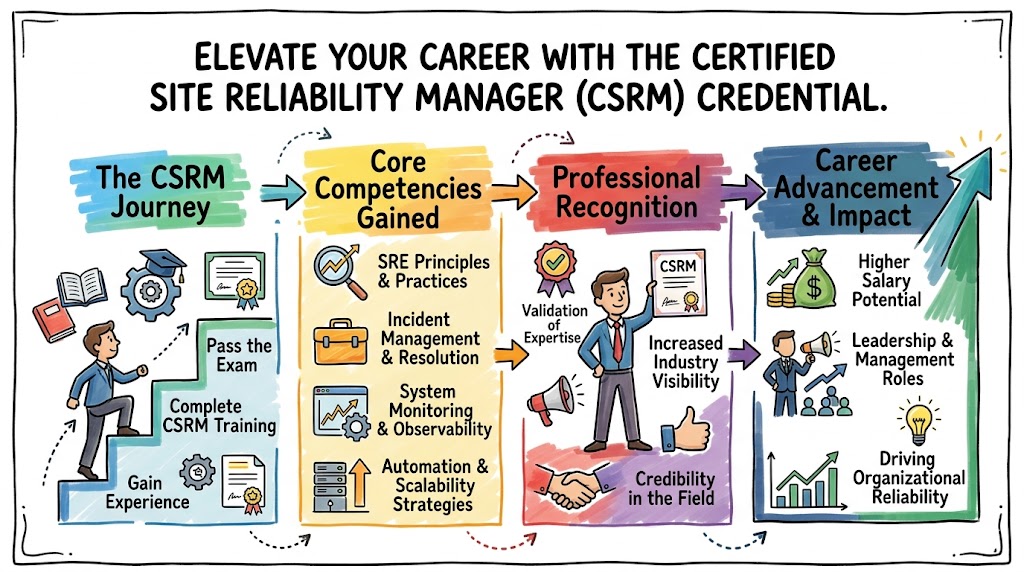
The Certified Site Reliability Manager certification is a benchmark for professionals who oversee the reliability, scalability, and performance of mission-critical systems. It moves beyond basic tool usage and focuses on the organizational and engineering mindset required to maintain high availability in production environments. This certification validates your ability to define service level objectives, manage risk through error budgets, and cultivate a culture of blameless post-mortems. It is built upon the foundational principles of reliability engineering, ensuring that managers can align technical output with broader business uptime goals. By focusing on production-grade outcomes, the program ensures that certified individuals are prepared for the realities of modern enterprise operations.
Who Should Pursue Certified Site Reliability Manager?
This certification is designed for a broad spectrum of technical professionals currently working in or transitioning into reliability-focused roles. It is ideal for experienced software engineers who are moving into lead positions and need to manage infrastructure health alongside code quality. DevOps and Platform Engineers who want to codify their operational experience into a recognized framework will find immediate utility here. Additionally, Engineering Managers and Team Leads who are tasked with building SRE teams or maturing existing incident response protocols will benefit significantly from this structured approach. The content is crafted to be relevant for both global teams and the rapidly growing engineering ecosystem in India, where operational excellence is becoming a primary competitive differentiator.
Why Certified Site Reliability Manager
In the current technological era, the complexity of distributed systems means that downtime is not just a technical issue but a major business failure. Professionals who hold the Certified Site Reliability Manager credential demonstrate a deep understanding of how to maintain system equilibrium under pressure. This certification remains valuable because it focuses on methodologies and principles rather than vendor-specific tools, ensuring your expertise does not expire as specific technologies lose relevance. Employers prioritize candidates who can manage risk effectively, making this certification a high-leverage asset for career growth. Investing in these skills ensures you can lead teams through outages, prevent system degradation, and drive long-term architectural stability.
Certified Site Reliability Manager Certification Overview
The program is delivered via the Official Course and is hosted on sreschool. The assessment approach focuses on practical application, requiring candidates to demonstrate knowledge of incident lifecycles and reliability frameworks. The certification is structured to be rigorous, ensuring that only those who grasp the core tenets of the discipline achieve recognition. Ownership of the certification lies with the certifying body, which maintains high standards for curriculum updates and examination integrity. It serves as a clear signal to stakeholders that the holder possesses the technical maturity to manage complex, production-ready systems effectively.
Certified Site Reliability Manager Certification Tracks & Levels
The certification hierarchy is designed to accommodate various career stages, from those beginning their journey to those managing complex, global infrastructures. Foundation levels focus on core SRE concepts and terminology, providing a solid grounding for further study. Professional levels challenge candidates to apply these concepts in simulated production environments, covering topics like observability and capacity planning. Advanced levels are reserved for those who are architecting large-scale systems and leading culture shifts within their organizations. Specialization tracks ensure that whether you are focused on cloud operations, security integration, or data reliability, there is a path that aligns with your specific career objectives.
Complete Certified Site Reliability Manager Certification Table
| Track | Level | Who it’s for | Prerequisites | Skills Covered | Recommended Order |
|---|---|---|---|---|---|
| SRE Fundamentals | Foundation | Beginners | Basic DevOps knowledge | Error budgets, SLIs/SLOs | 1 |
| SRE Practitioner | Professional | SREs / Devs | Foundation cert | Incident mgmt, Toil reduction | 2 |
| SRE Architecture | Advanced | Lead Engineers | Professional cert | Distributed system design | 3 |
| SRE Leadership | Management | Team Leads | Advanced cert | Strategy, Culture, ROI | 4 |
Detailed Guide for Each Certified Site Reliability Manager Certification
Certified Site Reliability Manager – Professional Level
What it is This certification validates the ability to implement and manage SRE practices within an active production environment, focusing on operational maturity.
Who should take it It is intended for engineers with at least two to three years of experience in operations or software development who need to formalize their reliability expertise.
Skills you’ll gain
- Mastery of Service Level Objectives and Error Budgets.
- Advanced incident response and management techniques.
- Strategic reduction of operational toil through automation.
- Implementation of blameless post-mortem processes.
Real-world projects you should be able to do
- Designing a comprehensive monitoring strategy with clear SLOs for a microservices architecture.
- Executing a full incident lifecycle simulation to test team response readiness.
- Automating a repetitive manual operational task to improve system efficiency.
Preparation plan
- 14 days: Deep dive into the core SRE literature and basic definitions to ensure you have the vocabulary down.
- 30 days: Hands-on practice by applying SLOs to your current work environment and identifying sources of toil.
- 60 days: Reviewing case studies of system failures and practicing communication strategies for incident management.
Common mistakes Focusing too much on the tooling rather than the underlying reliability principles, or failing to understand the business impact of downtime.
Best next certification after this
- Same-track: Certified SRE Architect.
- Cross-track: Certified FinOps Practitioner.
- Leadership: Certified Engineering Manager.
Choose Your Learning Path
DevOps Path
The DevOps path focuses on the intersection of development and operations, emphasizing CI/CD and infrastructure as code. You will learn how to build pipelines that integrate reliability from the initial commit. This path is essential for those who want to bridge the gap between fast feature delivery and system stability.
DevSecOps Path
The DevSecOps path incorporates security into the reliability lifecycle, ensuring that your systems are not only available but also secure. It covers automated security testing and risk mitigation strategies in high-traffic environments. This path is for professionals looking to protect production systems against modern threats.
SRE Path
The SRE path is the core journey for those dedicated to system reliability and performance. It emphasizes the engineering approach to operational problems, moving from reactive fire-fighting to proactive system design. This is the primary path for anyone wanting to become an elite site reliability expert.
AIOps / MLOps Path
The AIOps / MLOps path explores how machine learning can automate operational decision-making and performance tuning. You will learn to use data-driven insights to predict outages and optimize resource allocation. This path is critical for managing large-scale, dynamic systems.
DataOps Path
The DataOps path focuses on the reliability of data pipelines and the continuous delivery of high-quality data products. You will learn to apply SRE principles to data engineering, ensuring that systems remain consistent and available. This is vital for modern data-heavy organizations.
FinOps Path
The FinOps path centers on the cost-efficiency of cloud operations while maintaining performance standards. You will learn to balance the trade-offs between reliability and resource expenditure. This path is ideal for those who manage high-spend infrastructure and need to demonstrate fiscal responsibility.
Role → Recommended Certified Site Reliability Manager Certifications
| Role | Recommended Certifications |
|---|---|
| DevOps Engineer | SRE Foundation, SRE Practitioner |
| SRE | SRE Practitioner, SRE Architect |
| Platform Engineer | SRE Practitioner, SRE Architecture |
| Cloud Engineer | SRE Foundation, FinOps Practitioner |
| Security Engineer | SRE Practitioner, DevSecOps Specialist |
| Data Engineer | SRE Foundation, DataOps Specialist |
| FinOps Practitioner | FinOps Practitioner, SRE Practitioner |
| Engineering Manager | SRE Leadership, SRE Architect |
Next Certifications to Take After Certified Site Reliability Manager
Same Track Progression
Once you have mastered the foundational management concepts, you should move toward the architecture and advanced practitioner levels. These certifications force you to look at system design from a holistic, top-down perspective, preparing you for senior-level roles in large organizations.
Cross-Track Expansion
Diversifying your skill set is essential in the current market. Expanding into areas like FinOps or DevSecOps allows you to provide more comprehensive value. Understanding how cost and security intersect with reliability will make you an indispensable asset to your team.
Leadership & Management Track
Moving into leadership requires a shift from technical execution to people and process management. Certifications in engineering management will help you build teams, set strategy, and align your technical vision with the overall business objectives of the firm.
Training & Certification Support Providers for Certified Site Reliability Manager
DevOpsSchool provides comprehensive training modules for those looking to formalize their knowledge in operational excellence. Their programs are built by industry veterans to ensure relevance.
Cotocus focuses on providing hands-on learning experiences that translate theory into practical skills, helping candidates pass their certifications with confidence.
Scmgalaxy offers a wide range of learning materials that cover the entire spectrum of modern engineering practices, ensuring a deep understanding of core principles.
BestDevOps is dedicated to providing high-quality educational resources that simplify complex topics for engineers and managers alike, fostering growth at every level.
devsecopsschool specializes in integrating security into the operational workflow, providing specialized paths for professionals focused on the safety and reliability of their systems.
sreschool is the primary authority for reliability engineering certifications, offering structured paths that lead to globally recognized professional credentials.
aiopsschool focuses on the intersection of operations and artificial intelligence, providing the knowledge needed to manage future-ready, automated infrastructure.
dataopsschool provides specialized training for data engineers who want to bring reliability and high availability to their data platforms and pipelines.
finopsschool teaches the financial side of cloud engineering, ensuring that reliability managers can operate within budget while delivering maximum system performance.
Frequently Asked Questions (General)
- What is the typical difficulty level of these certifications? The certifications are designed to be challenging, requiring both theoretical understanding and practical application of the concepts in real-world scenarios.
- How much time should I dedicate to study per week? Most successful candidates dedicate at least 8 to 10 hours per week to gain a deep understanding of the course materials and practice their skills.
- Are there specific prerequisites for the foundation levels? While there are no formal prerequisites for the foundation level, having basic experience in software development or operations is highly recommended.
- What is the return on investment for this certification? The ROI is significant, as these certifications act as a signal to employers that you possess the skills required to manage high-stakes production environments.
- Can I take these exams completely online? Yes, the certification programs are designed to be accessible globally through online portals, allowing you to learn and certify from anywhere.
- How often is the certification content updated? The curriculum is reviewed and updated regularly to ensure it reflects the latest industry trends, tools, and best practices in the field.
- Is this certification recognized globally? Yes, the certifications are designed to meet international standards, making them highly respected by employers across the globe, including in India.
- What if I have experience but no formal education in this field? Your hands-on experience is a significant asset, and these certifications serve to formalize that experience and fill any knowledge gaps you might have.
- Can I pursue multiple tracks simultaneously? It is generally recommended to master one track before starting another to ensure you have a solid foundation before expanding your expertise.
- How do I maintain my certification after passing? Most programs offer recertification or continuing professional development credits to ensure your knowledge stays current with evolving technology.
- Do these certifications cover specific cloud providers like AWS or Azure? The core principles taught are platform-agnostic, meaning they apply regardless of which cloud provider your organization utilizes.
- Is there a community or network for certified professionals? Yes, many programs provide access to exclusive communities where you can network with other professionals and share industry insights.
FAQs on Certified Site Reliability Manager
- What is the core focus of the Certified Site Reliability Manager? The program focuses on managing system reliability through SLOs, error budgets, and proactive engineering.
- Is this certification for managers or individual contributors? It is suitable for both, as it covers both the technical mechanics of reliability and the leadership skills needed to drive a culture of stability.
- How does this differ from standard DevOps training? This certification emphasizes the production-grade reliability and risk management aspects over just delivery automation.
- Does this certification help with career advancement in India? Absolutely, as Indian enterprises are rapidly adopting SRE practices to stay competitive globally.
- Can I use my existing experience to bypass some levels? You may be able to demonstrate competence, but completing the progression ensures a complete grasp of the methodology.
- Are there any hands-on lab requirements? Yes, most certification levels require practical demonstrations of your ability to manage incident lifecycles effectively.
- How does this certification improve team productivity? By reducing toil and improving incident response, teams spend less time fire-fighting and more time on productive feature development.
- Is this suitable for a startup environment? Yes, establishing reliability early is a critical success factor for any growing startup looking to scale effectively.
Final Thoughts: Is Certified Site Reliability Manager Worth It?
If you are serious about a career in high-stakes engineering, the Certified Site Reliability Manager certification is an excellent investment. It provides a structured, vendor-neutral framework that teaches you how to manage the most critical aspects of modern software: reliability and scale. In a world where systems are increasingly complex, the ability to manage uncertainty is a rare and valuable skill. This certification does not just teach you tools; it teaches you a disciplined approach to managing production environments that will serve you throughout your career. Whether you aim to lead an SRE team or become a more effective architect, the knowledge gained here will provide the foundation for your long-term success.