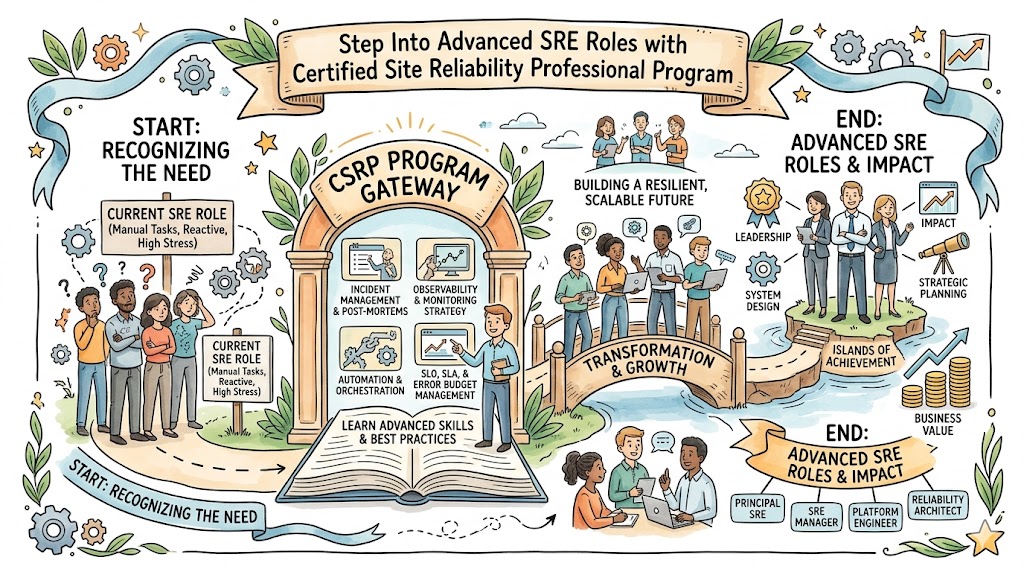
Introduction
In the rapidly evolving landscape of cloud-native infrastructure, the Certified Site Reliability Professional stands out as a benchmark for technical competence and operational excellence. This guide is designed for software engineers, systems administrators, and engineering leaders who aim to transition into or solidify their expertise within the SRE domain. As industries shift toward distributed systems and high-availability demands, mastering site reliability becomes a non-negotiable skill set. Whether you are navigating your journey through platforms like sreschool or exploring specialized knowledge areas via aiopsschool, this document provides a clear framework to help you make informed decisions about your professional growth. By understanding how this certification fits into the broader DevOps and platform engineering ecosystems, you can effectively map your learning path to achieve long-term career success and technical authority.
What is the Certified Site Reliability Professional?
The Certified Site Reliability Professional represents a comprehensive validation of an individual’s ability to manage large-scale, mission-critical systems. It moves far beyond superficial theory, focusing instead on the rigorous, production-focused engineering practices required to maintain high availability and reliability. This certification validates that an engineer understands the fundamental principles of incident management, capacity planning, and service level objectives in a real-world enterprise environment. It aligns directly with the modern transition from manual operations to automated, code-driven workflows that power today’s global digital infrastructure. By prioritizing practical application, this certification ensures that professionals can handle the complexity of distributed systems, manage technical debt, and implement observability frameworks that provide actionable insights rather than mere noise.
Who Should Pursue Certified Site Reliability Professional?
This certification is designed for a broad spectrum of professionals currently operating within the IT and engineering sectors. Software engineers looking to bridge the gap between development and operations will find it essential for building more resilient applications from the ground up. SREs and Cloud engineers who are looking to formalize their experience and standardize their operational knowledge will benefit significantly from the structured methodology provided. Furthermore, security professionals who need to understand the reliability implications of security patches and data engineers managing high-throughput pipelines will find the curriculum highly relevant. In the Indian market and globally, where firms are increasingly adopting microservices and hybrid cloud architectures, this certification acts as a bridge for engineers moving from traditional administration roles to high-value reliability engineering positions.
Why Certified Site Reliability Professional
The demand for reliable, performant, and scalable software is increasing exponentially, making the skills validated by this certification more critical than ever. As toolsets change and platforms evolve, the core engineering principles of reliability, automation, and system design remain the constant foundation of a successful career. Professionals who hold this certification demonstrate an ability to handle extreme scale and complexity, which provides significant career longevity in an era of rapid technological churn. It offers a substantial return on investment by positioning engineers to lead critical infrastructure projects and handle high-pressure environments. By mastering these concepts, you ensure your continued relevance in an industry that rewards those who can keep complex systems stable under load.
Certified Site Reliability Professional Certification Overview
The program is managed and delivered via the official curriculum found at and is hosted on sreschool. This certification takes a practical approach to assessment, often requiring candidates to demonstrate their knowledge through a combination of theoretical understanding and technical scenarios. Ownership of this credential signals to potential employers that the holder has reached a defined standard of professional competency. The structure is designed to be rigorous, ensuring that only those who have internalized the concepts of reliability and automation can successfully attain the title. It serves as a comprehensive tool for validating skill sets in environments where uptime and performance are the primary business drivers.
Certified Site Reliability Professional Certification Tracks & Levels
The certification ecosystem is organized into tiered levels, starting from foundational concepts and moving toward professional and advanced expert domains. The foundation level focuses on core SRE principles, incident response, and service level management. The professional level expands into automation, observability, and advanced system architecture. Specialization tracks allow candidates to focus on specific areas such as DevOps, FinOps, or AIOps, ensuring that the certification evolves with the candidate’s specific career trajectory. These levels provide a clear roadmap for progression, allowing an engineer to start by proving their basic proficiency and eventually attaining mastery in specialized, high-impact technical domains.
Complete Certified Site Reliability Professional Certification Table
| Track | Level | Who it’s for | Prerequisites | Skills Covered | Recommended Order |
| Core SRE | Foundation | Junior Engineers | Basic Linux/Cloud | Incident Basics, SLIs, SLOs | 1 |
| Advanced SRE | Professional | SRE / DevOps | Foundation Cert | Observability, Capacity | 2 |
| Specialist | Advanced | Lead Engineers | Professional Cert | Distributed Systems, Scaling | 3 |
Detailed Guide for Each Certified Site Reliability Professional Certification
Certified Site Reliability Professional – Professional Level
What it is
This certification validates deep operational knowledge and the ability to manage production systems under stress. It confirms that the professional can bridge the gap between development teams and operations, ensuring high availability through automated processes and disciplined incident management.
Who should take it
This is best suited for experienced DevOps engineers, SREs with 2+ years of hands-on experience, and system administrators looking to specialize in reliability engineering. It is also ideal for team leads responsible for the uptime of critical production applications.
Skills you’ll gain
- Advanced monitoring and observability design.
- Error budget management and SLO implementation.
- Infrastructure as Code (IaC) for reliability.
- Post-incident analysis and blameless culture adoption.
Real-world projects you should be able to do
- Design and implement a robust SLO framework for a microservices architecture.
- Build an automated alerting and incident escalation workflow.
- Execute a capacity planning project based on historical traffic patterns.
- Automate the remediation of a common production failure scenario.
Preparation plan
- 7–14 days: Intensive review of core SRE principles and incident response playbooks. Focus on understanding the trade-offs between speed and reliability.
- 30 days: Hands-on lab work focused on setting up observability stacks and defining SLOs for existing services. Engage with real-time incident simulation.
- 60 days: Deep dive into distributed systems architecture, capacity planning methodologies, and cross-functional collaboration strategies. Prepare for scenario-based assessment questions.
Common mistakes
- Over-focusing on specific tool syntax rather than the underlying reliability principles.
- Ignoring the cultural aspect of SRE, such as blameless post-mortems.
- Failing to understand how SLOs map to business goals.
Best next certification after this
- Same-track option: Advanced Certified Site Reliability Professional.
- Cross-track option: Certified DevOps Professional.
- Leadership option: Certified Engineering Manager.
Choose Your Learning Path
DevOps Path
The DevOps path focuses on the integration of development and operations through automation and continuous delivery. This path is essential for those who want to build the pipelines that make high-velocity deployments possible. You will learn to manage infrastructure as code, integrate security, and streamline the software development lifecycle. Mastery in this path allows you to remove silos between teams, leading to faster feature delivery and improved system stability.
DevSecOps Path
The DevSecOps path incorporates security practices directly into the development and operations lifecycle. You will learn to identify vulnerabilities in code, secure containerized environments, and automate compliance audits. This path is critical for organizations moving toward a shift-left security model. By taking this route, you ensure that security is not a bottleneck but a fundamental component of the deployment process.
SRE Path
The SRE path is the core of system reliability and performance management. This path focuses on the scientific approach to operations, emphasizing the use of software engineering to solve operational problems. You will gain expertise in managing distributed systems, performing complex capacity planning, and ensuring that services meet strictly defined performance targets. This path prepares you to be the primary guardian of service uptime.
AIOps Path
The AIOps path integrates artificial intelligence and machine learning into operational workflows. You will learn to use data-driven insights to predict system failures before they occur and automate incident responses. This path is for engineers who want to stay at the cutting edge of infrastructure management. It transforms operations from a reactive state to a predictive, proactive capability.
MLOps Path
The MLOps path is dedicated to the lifecycle management of machine learning models. You will learn to automate model training, deployment, and monitoring in production environments. This path is essential for organizations that rely on AI to drive business value. By focusing on reproducibility and reliability, you ensure that your ML models remain accurate and performant at scale.
DataOps Path
The DataOps path focuses on the lifecycle and reliability of data pipelines. You will learn to automate data collection, transformation, and storage processes while ensuring data quality and security. This path is vital for engineers supporting data-heavy applications. It ensures that data remains available, consistent, and reliable for consumption by analytical and production systems.
FinOps Path
The FinOps path centers on the financial accountability of cloud infrastructure. You will learn to track, analyze, and optimize cloud spending to ensure cost-efficiency. This path is critical for organizations managing multi-cloud environments. You will gain the skills to align technical architecture with business budgets, ensuring that scalability does not lead to financial waste.
Role → Recommended Certified Site Reliability Professional Certifications
| Role | Recommended Certifications |
| DevOps Engineer | Certified DevOps Professional, Certified Site Reliability Professional |
| SRE | Certified Site Reliability Professional, Certified AIOps Professional |
| Platform Engineer | Certified Platform Engineering Professional, Certified SRE |
| Cloud Engineer | Certified Cloud Architect, Certified Site Reliability Professional |
| Security Engineer | Certified DevSecOps Professional, Certified SRE |
| Data Engineer | Certified DataOps Professional, Certified SRE |
| FinOps Practitioner | Certified FinOps Professional, Certified SRE |
| Engineering Manager | Certified Engineering Manager, Certified SRE |
Next Certifications to Take After Certified Site Reliability Professional
Same Track Progression
Once you have mastered the foundational and professional levels of the certification, the next logical step is to pursue the Advanced or Expert tiers within the same track. This progression involves tackling more complex, architect-level scenarios such as multi-region failovers and global traffic management. It demonstrates that you can not only maintain systems but also design them for extreme scale and resilience.
Cross-Track Expansion
After gaining a solid grounding in reliability, expanding into related domains like FinOps or AIOps is highly recommended. This cross-track growth allows you to see the “big picture” of the modern tech stack, combining reliability engineering with financial optimization or intelligent automation. This makes you a more versatile engineer, capable of handling multifaceted operational challenges.
Leadership & Management Track
For those looking to move into management, the next step is to transition toward certifications that focus on organizational design, team coaching, and strategic technical planning. Moving from individual contributor to engineering manager requires a shift in focus from “how to build it” to “how to organize teams to build it reliably.” These certifications bridge the gap between technical execution and business strategy.
Training & Certification Support Providers for Certified Site Reliability Professional
DevOpsSchool is a prominent provider offering structured learning paths for professionals looking to master operational excellence. They provide comprehensive resources that align with industry standards, helping candidates gain both theoretical knowledge and practical expertise necessary for certification success.
Cotocus delivers high-quality training sessions focused on modern infrastructure practices. Their programs are designed to be intensive and hands-on, ensuring that engineers are well-prepared to tackle real-world challenges in cloud and reliability engineering environments.
Scmgalaxy specializes in deep-dive training for DevOps and SRE topics. By focusing on tool integration and process automation, they help candidates build a robust skill set that is immediately applicable to enterprise-level operational requirements.
BestDevOps offers a range of training modules that cater to both beginners and advanced practitioners. Their approach emphasizes the practical application of concepts, ensuring that learners are equipped to manage complex, distributed systems with confidence and precision.
devsecopsschool provides a niche focus on integrating security into the development lifecycle. Their training programs are essential for professionals who want to understand the intersection of security and reliability in modern software delivery.
sreschool is the primary hub for all things related to site reliability engineering certification. They offer dedicated tracks that are specifically designed to help candidates master the principles of SRE and prepare for professional assessment.
aiopsschool offers cutting-edge training on the application of intelligence and machine learning in operations. Their programs help professionals stay ahead of the curve by learning how to implement proactive and predictive operational strategies.
dataopsschool focuses on the reliability and automation of data workflows. Their training is geared towards engineers who need to manage large-scale data environments and ensure that data-driven services remain performant and available.
finopsschool provides specialized training for managing cloud costs and financial accountability. Their programs are essential for engineers and managers who need to balance high-performance reliability with strict budgetary constraints in cloud environments.
Frequently Asked Questions (General)
- What is the difficulty level of this certification?The certification is designed to be challenging, requiring a solid grasp of both theoretical concepts and their application in complex, real-world scenarios.
- How much time is typically required to prepare?Depending on your background, preparation can take anywhere from four to twelve weeks of dedicated study and hands-on practice.
- Are there any specific prerequisites I must meet?While there are no hard requirements for entry-level tracks, familiarity with Linux, cloud platforms, and basic programming is highly recommended.
- What is the ROI for obtaining this certification?The certification provides a validated signal to employers, often leading to better career opportunities, higher salary brackets, and greater job security in technical fields.
- Should I complete this before pursuing DevOps certifications?It is often beneficial to have a foundational understanding of DevOps before taking this, as it builds upon the core concepts of automation and continuous improvement.
- How often should I recertify or update my skills?Technology evolves rapidly, so it is recommended to review new practices and consider updated certifications every two to three years to stay relevant.
- Is this certification recognized globally?Yes, the standards taught and validated are aligned with global industry practices, making the certification applicable in almost any international engineering role.
- Can this help me if I am an engineering manager?Absolutely, it provides managers with the vocabulary and operational framework needed to oversee high-performing teams and make informed technical decisions.
- Does the certification focus on specific tools?The focus is primarily on principles and methodologies, though practical labs often use industry-standard tools to illustrate those concepts effectively.
- How do I choose between different specialization tracks?Consider your long-term career goals; if you enjoy data, choose DataOps; if you prefer cloud architecture, SRE or DevOps are excellent paths.
- Are the assessment methods theory-based or practical?Most assessments are a blend, requiring you to explain concepts while also solving scenario-based problems that mimic real-world production incidents.
- Is there a community or support system available?Yes, official forums and provider networks offer candidates access to mentors, peer study groups, and additional technical resources.
FAQs on Certified Site Reliability Professional
- What is the core focus of the Certified Site Reliability Professional?It focuses on mastering the engineering practices required to maintain high-availability systems, including SLO management, automation, and incident response.
- Is this certification suitable for a total beginner?It is best suited for those with some prior experience in systems or software engineering, as it builds on fundamental technical concepts.
- How does this certification differ from a standard Cloud cert?It is more focused on the operational management and reliability of the platform rather than just the configuration of cloud services.
- Can this help me in a DataOps role?Yes, the reliability principles learned here are directly applicable to keeping data pipelines stable and performant.
- Does this certification help with FinOps?It helps by providing the framework for efficient resource usage, which is a key component of cloud cost management.
- Will this certification help me get a job in India?The demand for certified SREs is high in the Indian market, especially among large-scale product companies and cloud-native startups.
- How do I maintain the value of this certification?Stay active in the community, contribute to open-source projects, and keep your skills updated as the industry standard changes.
- Are there hands-on labs involved in the training?Yes, most authorized training providers include significant hands-on lab time to ensure practical competence.
Final Thoughts: Is Certified Site Reliability Professional Worth It?
Ultimately, this certification is a serious investment in your professional future. It is not a shortcut or a quick fix; it is a rigorous process that demands time, study, and a genuine commitment to engineering excellence. For those willing to put in the work, the payoff is substantial: you gain a deeper understanding of how systems fail, how to prevent those failures, and how to operate at a level that puts you in the top tier of the engineering workforce. Do not chase this certification just for the badge; chase it for the knowledge and the career impact that comes with mastering the discipline of reliability. If you are serious about a long-term career in infrastructure, platform engineering, or SRE, this is one of the most practical and respected paths you can take.