Introduction
A blockchain wallet is a digital tool that allows users to interact with a blockchain network. Contrary to popular belief, these wallets do not actually “store” cryptocurrency. Instead, they store private keys—the cryptographic proof required to authorize transactions and prove ownership of assets recorded on the immutable ledger. Broadly categorized into Hot Wallets (connected to the internet for convenience) and Cold Wallets (offline for maximum security), these tools provide the interface through which you send, receive, and manage digital assets.
The importance of these tools lies in the principle of self-custody: “Not your keys, not your crypto.” In a world where centralized exchanges can face regulatory freezes or insolvency, a personal blockchain wallet ensures that you remain the sole arbiter of your wealth. Real-world use cases in 2026 include interacting with decentralized social media, voting in DAO (Decentralized Autonomous Organization) governance, and managing Real-World Asset (RWA) tokens like digitized real estate. When selecting a wallet, users must weigh evaluation criteria such as multi-chain compatibility, security architecture (e.g., MPC vs. Seed Phrase), ease of use, and native DeFi integration.
Best for: Individual investors, Web3 developers, and decentralized finance participants who prioritize asset control and direct interaction with blockchain protocols.
Not ideal for: Institutional traders who require enterprise-grade “custodial” solutions with complex multi-user approval workflows (which are better served by platforms like Fireblocks or Coinbase Prime) or users who are not comfortable managing their own security recovery processes.
Top 10 Blockchain Wallets
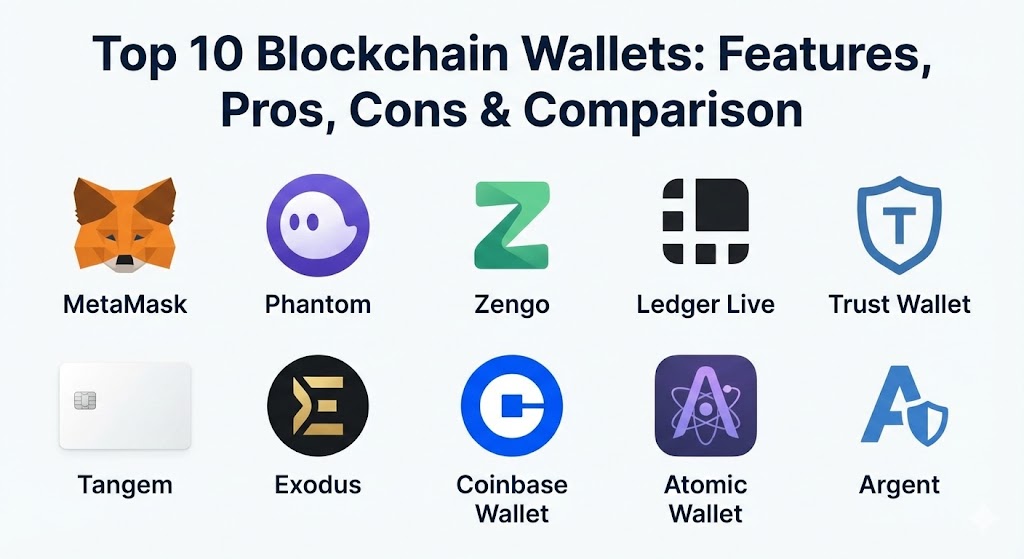
1 — MetaMask
MetaMask remains the most widely used Web3 wallet in 2026. Primarily an Ethereum and EVM-compatible browser extension and mobile app, it serves as the “standard” for dApp (decentralized application) connectivity.
- Key features:
- Native “MetaMask Portfolio” dashboard for cross-chain asset viewing.
- Built-in token swap aggregator that sources liquidity from multiple DEXs.
- Support for nearly all EVM-compatible networks (Polygon, Arbitrum, Optimism, etc.).
- Integrated NFT viewer and management interface.
- “Snaps” feature allowing third-party developers to add new functionalities (like Bitcoin support).
- Direct on-ramping via major payment providers.
- Pros:
- Unrivaled compatibility; almost every dApp in existence supports MetaMask first.
- Highly customizable through the Snaps ecosystem.
- Cons:
- Limited to EVM chains natively (requires Snaps for others).
- Higher swap fees (typically 0.875%) compared to using a DEX directly.
- Security & compliance: Password-protected, 12-24 word seed phrase, and hardware wallet integration. GDPR compliant.
- Support & community: Massive community forums, extensive documentation, and ConsenSys-backed technical support.
2 — Phantom
Originally the “MetaMask of Solana,” Phantom has expanded into a premier multi-chain wallet that supports Solana, Ethereum, Bitcoin, and Polygon with a focus on a smooth, “consumer-grade” user experience.
- Key features:
- Unified multi-chain support for Solana, Bitcoin, and Ethereum.
- Highly intuitive NFT gallery with floor price tracking.
- In-wallet staking for SOL and other native tokens.
- Cross-chain “Bridging” directly within the interface.
- Automated “Burn” feature for spam NFTs to keep the wallet clean.
- Native support for Ledger hardware wallets.
- Pros:
- Arguably the most user-friendly and visually appealing UI in the market.
- Exceptionally fast transaction speeds on the Solana network.
- Cons:
- Still relatively new to the Bitcoin and Ethereum space compared to veterans.
- Some advanced DeFi features are simplified, which may limit “power users.”
- Security & compliance: Self-custodial, biometric login, and hardware integration. SOC 2 compliant protocols.
- Support & community: Very active social media presence and a growing library of educational content.
3 — Zengo
Zengo is a pioneer in “Keyless” security, utilizing Multi-Party Computation (MPC) to eliminate the traditional “seed phrase” vulnerability while remaining fully non-custodial.
- Key features:
- MPC (Multi-Party Computation) technology—no single point of failure.
- 3-Factor Recovery (Email, 3D FaceLock, and cloud backup).
- Integrated “Web3 Firewall” that alerts users of suspicious transactions.
- “Legacy Transfer” feature (inheritance) for long-term planning.
- Native fiat on-and-off ramps.
- Support for 120+ assets including BTC, ETH, and Polygon.
- Pros:
- Eliminates the stress of losing a physical seed phrase.
- High-tier security features are available in the free version.
- Cons:
- Recovery is tied to biometrics, which some privacy purists may dislike.
- Not as many deep “dApp” integrations as MetaMask.
- Security & compliance: 3FA security, MPC architecture, and regular third-party audits.
- Support & community: 24/7 in-app human support (rare for non-custodial wallets) and a large user base.
4 — Ledger Live (Hardware Integration)
Ledger is the industry benchmark for “Cold Storage.” Ledger Live is the companion software that allows users to manage their assets while the private keys remain safely offline in a physical device.
- Key features:
- Secure “Cold Storage” via EAL6+ certified secure element chips.
- Buy, sell, and stake directly through the Ledger Live app.
- Support for 5,500+ coins and tokens across dozens of blockchains.
- “Ledger Recover” option for encrypted seed phrase backup (optional).
- Bluetooth connectivity for mobile use (Nano X / Stax).
- Full NFT support within the software interface.
- Pros:
- The highest level of security for significant long-term holdings.
- Combines “cold” security with the convenience of a “hot” software interface.
- Cons:
- Requires a physical device purchase (ranging from $79 to $279).
- The software interface can occasionally feel slower than native browser wallets.
- Security & compliance: Military-grade hardware, BIP39 seed phrase, and ISO 27001 certified operations.
- Support & community: Extensive knowledge base and professional 24/7 global support.
5 — Trust Wallet
Owned by Binance but operating as an independent non-custodial entity, Trust Wallet is a mobile-first powerhouse supporting over 100 different blockchains.
- Key features:
- Massive multi-chain support (Bitcoin, Ethereum, Solana, Cosmos, and 100+ others).
- Integrated dApp browser for mobile-native DeFi interaction.
- Native staking for multiple PoS (Proof of Stake) assets.
- Direct integration with Binance Pay for easy transfers.
- Built-in DEX for simple token swaps.
- Advanced security features like “Security Scanner” to detect risky tokens.
- Pros:
- Best for mobile users who hold a very diverse portfolio of obscure tokens.
- Fully open-source and audited for transparency.
- Cons:
- No native desktop app (relies on browser extension or mobile).
- The UI can feel cluttered due to the massive amount of supported features.
- Security & compliance: Biometric security, 12-word seed phrase, and regular security audits.
- Support & community: Backed by the massive Binance ecosystem with huge global reach.
6 — Tangem Wallet
Tangem offers a radical departure from traditional hardware wallets by using an NFC-enabled card instead of a screen-based device or a seed phrase, focusing on extreme durability and ease of use.
- Key features:
- Card-based hardware wallet (NFC-enabled) with no battery or charging.
- “No seed phrase” by default (the card is the key).
- Support for 1,000+ assets across multiple chains.
- EAL6+ certified security chip.
- 25-year life span for the hardware.
- Simple mobile app for managing transactions via card tap.
- Pros:
- The easiest hardware wallet for beginners; fits in a standard physical wallet.
- Extremely durable; waterproof and tamper-proof.
- Cons:
- If you lose all your cards and haven’t set up a backup card/phrase, access is lost.
- No screen on the device, meaning you rely entirely on the phone’s screen for transaction info.
- Security & compliance: EAL6+, IP68 rating, and independently audited firmware.
- Support & community: High customer ratings and a very active YouTube educational channel.
7 — Exodus
Exodus is the premier choice for desktop users who value design and simplicity. It is known for its beautiful “black-and-gold” interface and excellent 24/7 customer support.
- Key features:
- Beautifully designed desktop and mobile applications.
- Integration with Trezor hardware wallets for extra security.
- Built-in exchange feature with “one-click” token swaps.
- Portfolio tracking with rich charts and price data.
- 24/7 human customer support.
- Support for 250+ assets across 50+ networks.
- Pros:
- Best-in-class user interface; looks like a premium banking app.
- One of the few non-custodial wallets with a true “Help” desk.
- Cons:
- Not fully open-source, which may deter some transparency advocates.
- Swap fees can be higher than using a native DEX.
- Security & compliance: Hierarchical Deterministic (HD) wallet with local encryption.
- Support & community: Exceptional 24/7 support with response times often under 10 minutes.
8 — Coinbase Wallet
This is a self-custody wallet created by Coinbase. It is separate from the main exchange and allows users to explore the decentralized web while benefiting from Coinbase’s trusted reputation.
- Key features:
- Seamless integration with Coinbase exchange for easy funding.
- Support for Ethereum, Solana, and all EVM chains.
- User-friendly “Human-readable” wallet addresses (e.g., yourname.cb.id).
- Integrated DeFi browser and NFT gallery.
- Secure cloud backup for the seed phrase (optional).
- Native support for Base (Coinbase’s Layer 2 network).
- Pros:
- The safest “entry-level” wallet for those moving from a central exchange to self-custody.
- Extremely well-integrated with the regulated US financial ecosystem.
- Cons:
- Collects some telemetry data, which might bother strict privacy users.
- Not as many “decentralized-first” features as MetaMask or Phantom.
- Security & compliance: Secure Element technology on mobile, SOC 2 Type II, and biometric protection.
- Support & community: Access to Coinbase’s global support network and vast educational resources.
9 — Atomic Wallet
Atomic Wallet is a multi-asset solution that specializes in “Atomic Swaps”—a decentralized way to exchange assets between different blockchains without a third party.
- Key features:
- Atomic Swaps for cross-chain trading without intermediaries.
- Support for 300+ coins and tokens.
- High-yield staking (up to 20%) for various native tokens.
- Local encryption—private keys never leave your device.
- Simple interface for buying crypto with credit/debit cards.
- Desktop and mobile cross-platform support.
- Pros:
- Excellent for “staking-focused” investors who want to earn passive income.
- Private and anonymous; no KYC required for core features.
- Cons:
- Interface feels slightly dated compared to Phantom or Exodus.
- Past security incidents require users to be extra vigilant with updates.
- Security & compliance: AES symmetric encryption, 12-word seed phrase, and local key storage.
- Support & community: Active support team and a dedicated blog for crypto-education.
10 — Argent
Argent is the “smart contract wallet” specialist. It focuses on the Ethereum ecosystem (and Layer 2s like Starknet) to provide bank-like security features without the complexity.
- Key features:
- “Guardians” feature for social recovery (no seed phrase needed).
- Spending limits and “trusted contact” whitelisting.
- Native integration with Layer 2 (Starknet and zkSync) for ultra-low fees.
- One-tap DeFi investment options.
- Human-readable addresses (e.g., name.argent.xyz).
- “Multisig” security for individual users.
- Pros:
- The most secure “hot” wallet for Ethereum users who fear losing their keys.
- Significantly lower gas fees when using its native L2 integrations.
- Cons:
- Strictly focused on Ethereum and its Layer 2s (no Bitcoin or Solana support).
- Requires a small fee to “deploy” the smart contract on Ethereum mainnet.
- Security & compliance: Smart contract-based security, social recovery, and audited protocols.
- Support & community: Strong presence in the Ethereum community and a very active Discord channel.
Comparison Table
| Tool Name | Best For | Platform(s) Supported | Standout Feature | Rating (TrustReview/App Store) |
| MetaMask | dApp Connectivity | Browser, Mobile | Snaps Extensibility | 4.4 / 5 |
| Phantom | Solana & Multi-chain | Browser, Mobile | Best-in-Class UI | 4.7 / 5 |
| Zengo | Keyless Security | Mobile | MPC (No Seed Phrase) | 4.6 / 5 |
| Ledger Live | Long-term Security | Desktop, Mobile | Hardware Cold Storage | 4.8 / 5 |
| Trust Wallet | Diverse Altcoins | Mobile, Extension | Multi-Chain Support (100+) | 4.6 / 5 |
| Tangem | Simple Hardware | NFC Card | No Charging / No Battery | 4.7 / 5 |
| Exodus | Desktop Users | Desktop, Mobile | Design & 24/7 Support | 4.6 / 5 |
| Coinbase Wallet | Beginners | Mobile, Extension | Easy Exchange Transfer | 4.5 / 5 |
| Atomic Wallet | High-Yield Staking | Desktop, Mobile | Cross-Chain Atomic Swaps | 4.2 / 5 |
| Argent | Smart Security | Mobile | Social Guardian Recovery | 4.7 / 5 |
Evaluation & Scoring of Blockchain Wallets
| Category | Weight | Evaluation Criteria |
| Security & Custody | 25% | Key management (MPC/Seed), recovery options, and hardware compatibility. |
| User Experience | 15% | UI design, onboarding speed, and clarity of transaction data. |
| Multi-chain Support | 15% | Breadth of supported networks (BTC, ETH, SOL, L2s) and assets. |
| Web3 & dApp Utility | 10% | Ease of connecting to DEXs, NFT marketplaces, and DAO voting. |
| Performance & Fees | 10% | Swap speeds, transaction fee transparency, and app stability. |
| Support & Community | 10% | Quality of documentation, speed of support, and ecosystem trust. |
| Native DeFi/Earn | 15% | Built-in staking, bridging, and swapping capabilities. |
Which Blockchain Wallet Tool Is Right for You?
Selecting a wallet is a balance between your technical comfort level and the value of the assets you are protecting.
- Solo Users & Beginners: Start with Coinbase Wallet or Phantom. They offer the most familiar, “app-like” experiences and provide safety rails to prevent you from making common mistakes.
- DeFi Power Users: MetaMask is mandatory due to its universal compatibility. For those using Layer 2 networks like Starknet or zkSync, Argent is the superior choice for cost and security.
- Multi-Chain Investors: If you hold “a bit of everything,” Trust Wallet or Atomic Wallet will allow you to see your entire portfolio in one place without switching apps.
- Security Purists & Long-term Holders: You should never store large amounts of crypto in a “hot” wallet. Invest in a Ledger or Tangem card. Use the software for daily interaction, but keep your core savings offline.
- The “Lost Phrase” Fearful: If the idea of losing a 12-word piece of paper terrifies you, choose Zengo (for its MPC recovery) or Argent (for its Social Guardian feature).
Frequently Asked Questions (FAQs)
1. Is it safe to store crypto in a “Hot” wallet? For small amounts used for daily trading, yes. However, since hot wallets are connected to the internet, they are vulnerable to sophisticated phishing and malware. For significant savings, always use a cold wallet.
2. What happens if I lose my phone/hardware device? In a non-custodial wallet, you use your Seed Phrase (the 12-24 words) to restore your account on a new device. In keyless wallets like Zengo, you use your biometric “FaceLock” and email.
3. Can I have the same wallet on multiple apps? Yes. You can “import” your 12-word seed phrase into multiple apps. For example, you can use your same Ethereum account on both MetaMask and Trust Wallet simultaneously.
4. What are “Network Fees” (Gas Fees)? These are fees paid to the blockchain miners/validators to process your transaction. They are not charged by the wallet itself, though some wallets charge a small extra fee for built-in swaps.
5. Why should I avoid keeping my crypto on a central exchange (CEX)? A CEX (like Binance or Kraken) is custodial, meaning they control your money. If the exchange is hacked or goes bankrupt, you could lose your assets. A blockchain wallet puts you in total control.
6. Does a blockchain wallet work like a bank account? Somewhat, but there is no “Forgot Password” button with a bank teller. If you lose your recovery method (Seed Phrase/MPC), no one—not even the wallet developer—can get your money back.
7. Can I store NFTs in my wallet? Most modern wallets like Phantom, MetaMask, and Coinbase Wallet have native NFT galleries where you can view, send, and even list your digital collectibles for sale.
8. What is a “Smart Contract Wallet”? Unlike standard wallets, these are actually small programs on the blockchain. They allow for advanced features like daily spending limits, account freezing, and social recovery without a seed phrase.
9. Can I buy crypto directly in my wallet? Yes, most wallets integrate with “on-ramps” like MoonPay, Sardine, or Banxa, allowing you to buy crypto with a credit card, Apple Pay, or bank transfer directly within the app.
10. How often should I update my wallet software? Always update immediately. Most updates include critical security patches that protect you against new “drainer” scripts and vulnerabilities discovered in the ecosystem.
Conclusion
The “best” blockchain wallet isn’t necessarily the one with the most features; it’s the one that matches your risk profile and usage habits. As we move deeper into the Web3 era, the line between your digital life and your financial assets will continue to blur. Whether you prioritize the “air-gapped” security of a Ledger, the simple NFC tap of a Tangem, or the universal utility of MetaMask, the most important step is simply taking ownership of your keys. In 2026, self-custody isn’t just a technical preference—it’s a fundamental digital right.
Self-custody is the only way to go if you actually want to own your assets, and this guide hits the nail on the head regarding the “not your keys, not your crypto” reality. It’s wild to see the contrast between the old-school seed phrase headache and Zengo’s keyless MPC tech, which finally makes recovery feel like it belongs in 2026. The Tangem NFC card is also a total game-changer for anyone who wants hardware security without carrying around a clunky USB stick that needs charging. While MetaMask is still the king of connectivity, the polished UI of Phantom and the social recovery features in Argent show that we’re finally moving toward wallets that normal people can use without a computer science degree. This is a solid reality check for anyone still leaving their life savings on an exchange.
The shift toward “real-world asset” tokenization and institutional DeFi is making the choice of a blockchain platform more critical than ever, and this guide does a great job of explaining the trade-offs. It’s wild to see the contrast between the absolute decentralization of Ethereum and the high-performance, near-zero cost of Solana for consumer apps. The mention of Hyperledger Fabric’s “private channels” is a standout point; for any B2B environment where data privacy is non-negotiable, that kind of modularity is a massive advantage over public chains. I also appreciated the insight into Polkadot’s “shared security” model, which finally solves the risk of third-party bridges for interoperability. This breakdown is a solid asset for anyone trying to figure out if they should lead with the massive ecosystem of a public chain or the strict regulatory alignment of a permissioned framework like R3 Corda.