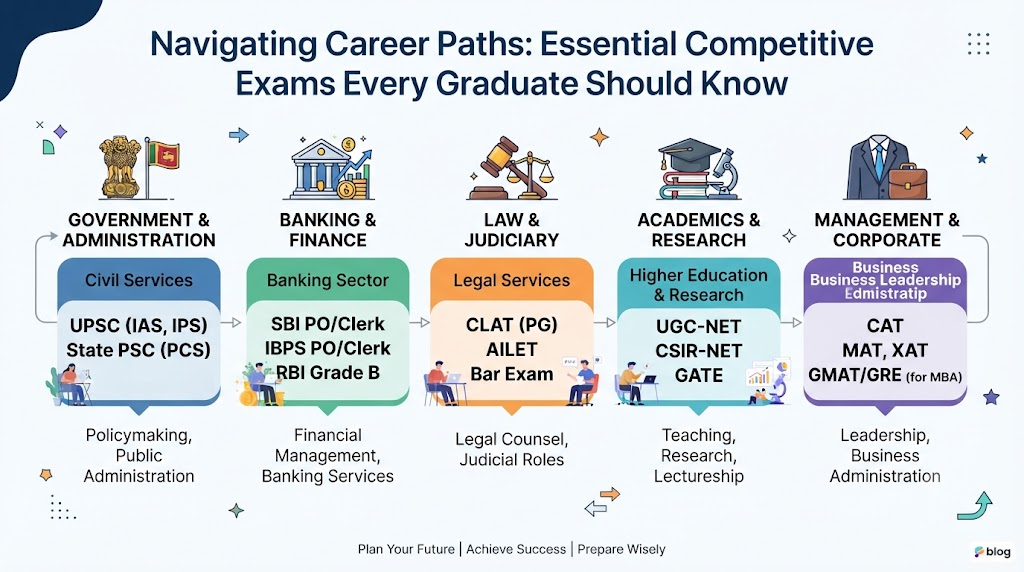
Introduction
Completing graduation is a major milestone in anyone’s life. Suddenly, the structured path of school and college comes to an end, and you find yourself standing at a crossroads. For many young adults, this moment brings a mix of excitement and confusion. You might wonder whether you should start working right away, study further, or try for a government job. Because there are so many paths available, it is completely normal to feel overwhelmed about what to do next. One of the most popular routes chosen by graduates is preparing for competitive exams. These tests can open doors to stable government careers, prestigious civil services, banking roles, higher education, or specialized professional fields. However, with so many options out there, choosing the right exam is far more important than simply following what your friends or peers are doing. Your career goals, personal interests, and educational background should always guide your choice. Understanding the different exam categories can help you make a clearer, more confident decision about your future.
Why Do Students Prepare for Competitive Exams After Graduation?
Graduates choose to appear for competitive exams for several different reasons. Every student has unique career aspirations, and there is no single path that suits everyone.
- Government Job Opportunities: Many graduates look for government roles because they offer job security, fixed working hours, good benefits, and a stable career path.
- Higher Education: Some students want to deepen their knowledge in a specific field by pursuing master’s degrees or specialized professional programs through national-level entrance tests.
- Professional Career Opportunities: Entrance exams for management, law, or technical fields help students build specialized corporate or professional careers.
- Teaching and Research: Graduates who love learning and sharing knowledge often look at exams that allow them to enter academia, lecturing, or scientific research.
- Banking Careers: The banking sector attracts many graduates because of steady job growth, regular recruitment cycles, and diverse roles ranging from clerical positions to officer scales.
- Defence Careers: For those with a sense of adventure, discipline, and a desire to serve the nation, defence exams offer a prestigious path to officer ranks.
- Public Service Roles: Civil services exams attract candidates who want to be directly involved in public administration, policy-making, and national development.
Choosing a path depends entirely on what kind of work excites you and matches your strengths.
Types of Competitive Exams Available After Graduation
Competitive exams for graduates can be broadly divided into several categories depending on the career sector. Understanding these groups makes it easier to narrow down your choices.
- Government Recruitment Exams: Conducted to fill various administrative, clerical, and officer posts in central and state departments.
- Civil Services Exams: Highly competitive tests for top administrative and public service roles.
- Banking Exams: Recruitment tests managed by banking institutions and recruitment boards for roles in public sector banks.
- Railway Exams: Tests conducted for various technical and non-technical positions within the railway network.
- Defence Exams: Officer-entry tests for the army, navy, and air force.
- Teaching and Research Exams: National and state-level tests that check eligibility for lectureship, junior research fellowships, and professorships.
- Higher Education Entrance Exams: Tests for admission into postgraduate programs like MBA, MTech, or specialized master’s courses.
- Professional Entrance Exams: Tests required to enter specialized legal, design, or technical fields.
- State-Level Government Exams: Recruitment tests conducted by individual state public service commissions and boards.
Eligibility rules, exam patterns, and selection stages differ from one exam to another. Always check the official notification before applying for any test.
Government Exams After Graduation
Government recruitment exams are among the most sought-after options for graduates. They offer diverse job roles across various ministries, departments, and public sector undertakings.
Central government jobs and state government jobs provide opportunities ranging from desk-based administrative positions to field-level supervisory roles. Because these exams attract millions of applicants, understanding the eligibility rules, age limits, exam patterns, and required subjects is essential before starting your preparation.
SSC CGL for Graduates
The Staff Selection Commission Combined Graduate Level examination, commonly known as SSC CGL, is one of the most popular graduate-level exams in India.
- What SSC CGL Is: It is a national-level exam conducted to recruit staff and officers for various posts in ministries, departments, and organizations under the central government.
- Who May Consider It: Graduates who have a strong grasp of quantitative aptitude, reasoning, English language, and general awareness often look at this exam.
- Why Graduates Prepare for It: It offers diverse desk and field roles with good pay scales and career growth.
- Types of Job Opportunities: Recruits may work as assistants, auditors, inspectors, or administrative officers in different government offices.
Always check official eligibility rules and understand the syllabus and exam pattern thoroughly before beginning your preparation.
UPSC Civil Services Examination
The Civil Services Examination conducted by the Union Public Service Commission is widely recognized as one of the most prestigious exams in the country.
- What the Exam Is: It is a comprehensive national-level recruitment test for top administrative positions, including the Indian Administrative Service, Indian Police Service, and Indian Foreign Service.
- Why Graduates Consider It: It offers a unique opportunity to shape public policy, manage administrative districts, and contribute directly to national development.
- Long-Term Preparation: This exam requires immense dedication, consistent reading habits, analytical thinking, and a structured study plan over a considerable period.
- Understanding the Syllabus: Candidates must study the detailed syllabus carefully, covering current affairs, history, geography, economy, polity, and optional subjects.
It is a demanding path that requires deep commitment rather than casual preparation.
Banking Exams After Graduation
The banking sector offers structured career growth and regular job openings for graduates from any discipline.
- Probationary Officer Exams: Designed for graduates looking to enter managerial tracks in public sector banks.
- Clerical Recruitment Exams: Focused on customer service, front-office operations, and daily banking tasks.
- Specialist Officer Exams: Targeted at graduates with specific professional degrees such as agriculture, law, IT, or human resources.
Common preparation areas across most banking exams include reasoning ability, quantitative aptitude, English language proficiency, general awareness, and computer knowledge.
IBPS and Other Banking Exams
The Institute of Banking Personnel Selection and other independent banking boards conduct recruitment drives regularly.
- Why Graduates Consider Banking Exams: Fast-paced selection processes, regular annual calendars, and widespread job locations make banking careers attractive.
- Different Recruitment Types: Exams are held at different scales for regional rural banks, public sector banks, and specialized financial institutions.
- Importance of Regular Practice: Because banking exams feature strict sectional time limits, speed and accuracy are crucial for success.
Always verify the latest eligibility criteria and notification details from official banking portals before applying.
Railway Exams for Graduates
Indian Railways is one of the largest employers in the country, offering diverse technical and non-technical career paths for graduates.
- Different Job Categories: Recruitment notifications cover various non-technical popular categories, traffic assistants, station masters, and commercial apprentices.
- General Eligibility Requirements: Age limits and educational qualifications vary depending on the specific post advertised in the official notification.
- Exam Stages: Selection processes often involve computer-based tests, skill tests, and medical examinations where applicable.
Recruitment depends entirely on official notifications and available vacancies released by railway recruitment boards.
State Public Service Commission Exams
State-level public service exams offer an excellent gateway to administrative and executive roles within your home state or other regional administrations.
- State Government Career Opportunities: Successful candidates secure positions such as deputy collectors, block development officers, state tax officers, and municipal administrators.
- State-Specific Recruitment: These exams often include questions related to the history, geography, economy, and culture of the specific state.
- Different Eligibility Rules: Age relaxations and educational requirements can vary significantly from one state commission to another.
Always refer to the official website of the relevant state public service commission for accurate and updated information.
Defence Exams After Graduates
Graduates who wish to serve in the armed forces can enter through various officer-entry schemes.
- Combined Defence Services: Conducted for admission into the Indian Military Academy, Indian Naval Academy, Air Force Academy, and Officers Training Academy.
- Officer Entry Opportunities: Special entries for engineering graduates, NCC certificate holders, and law graduates.
- Physical and Medical Standards: In addition to written tests, candidates must clear strict physical fitness and medical examinations.
Eligibility depends heavily on strict age limits, marital status, nationality, and physical measurements.
Teaching and Research Exams After Graduation
For graduates who want to build a career in education, academia, or scientific research, specific eligibility tests open doors to higher studies and fellowships.
- Eligibility-Based Exams: National-level tests determine eligibility for assistant professorships and junior research fellowships.
- Postgraduate Education: Clearing these exams often requires a master’s degree, making graduation the first stepping stone toward an academic career.
- Research Opportunities: Fellowships provide financial support to scholars pursuing doctoral research in universities and national laboratories.
Check specific eligibility guidelines, as graduation alone may not make you directly eligible for all teaching and research fellowships without a postgraduate qualification.
Higher Education Entrance Exams After Graduation
Many graduates choose to continue their studies to gain specialized knowledge and improve their job prospects.
- Master’s Degree Entrance Exams: National tests for postgraduate programs in arts, science, and commerce disciplines.
- Management Entrance Exams: National and institutional tests for admission into business management programs.
- Engineering-Related Postgraduate Exams: Tests for advanced technical degrees and specialized engineering studies.
Choose your higher education path based on your long-term career goals, personal interests, and previous academic background.
How to Choose the Right Competitive Exam After Graduation
Choosing an exam is a personal decision that requires careful thought. Many graduates make the mistake of picking an exam simply because their friends are preparing for it or because it is currently trending.
- Career Goals: Think about where you want to see yourself in the next five or ten years. Do you want an administrative role, a banking career, or a technical position?
- Graduation Subject: Your graduation background can give you an advantage in certain technical or specialized exams.
- Eligibility and Age Limits: Always confirm that you meet the educational and age criteria before investing time in preparation.
- Exam Pattern and Syllabus: Look at the subjects tested in the exam. Choose a test where your strengths align with the required syllabus.
- Preparation Time: Consider how much daily time you can dedicate to studying. Some exams require multi-year dedication, while others can be cleared with focused months of study.
Check Eligibility Before Starting Preparation
Before purchasing books or joining coaching classes, verify all eligibility requirements for your chosen exam.
- Educational Requirements: Ensure your graduation degree meets the board’s criteria, including minimum percentage requirements or specific stream backgrounds.
- Age Limits: Note the minimum and maximum age boundaries, keeping category-based relaxations in mind if applicable.
- Physical Standards: Certain defence and police exams require specific height, chest measurements, and visual standards.
- Nationality: Most government exams have strict citizenship and residency requirements.
Rules can change over time, so always rely on the latest official notification published by the conducting authority.
Understand the Exam Pattern and Syllabus
Studying without knowing the exam pattern is like traveling without a map. You need to understand how the test is structured.
- Number of Sections: Know which subjects are tested and how much weightage each section carries.
- Marking Scheme: Check whether there is negative marking for incorrect answers.
- Time Limits: Understand how much time you have to complete each section or the entire paper.
- Selection Stages: Find out if the exam involves preliminary tests, main written exams, interviews, or skill tests.
Reviewing the syllabus helps you focus only on relevant topics and prevents you from wasting time on unnecessary study material.
How to Start Preparing for Competitive Exams
Starting your preparation journey requires a calm, organized, and realistic approach.
- Choose the exam carefully based on your interest and eligibility.
- Review the official notification to understand all rules and requirements.
- Download the complete syllabus and print a copy for your study desk.
- Collect reliable study material and standard textbooks recommended by experts.
- Make a realistic daily study plan that fits your daily routine.
- Start with fundamental topics to build a strong conceptual base.
- Practice regularly to improve your calculation speed and reading comprehension.
- Revise important topics weekly to keep your memory sharp.
- Take periodic mock tests to check your preparation level and time management.
How to Make a Study Plan After Graduation
A good study plan is flexible, realistic, and tailored to your personal strengths and weaknesses.
- Assess Available Time: Calculate how many distraction-free hours you can study every day.
- Set Daily Goals: Break large subjects into smaller, manageable daily topics rather than trying to read everything at once.
- Address Difficult Subjects: Give more time to topics you find challenging while maintaining your strong areas.
- Include Revision Blocks: Dedicate specific hours every week to review what you studied earlier.
- Take Regular Breaks: Avoid burnout by resting your mind between study sessions.
Consistency matters far more than studying for ten hours one day and skipping the next three days.
Importance of Previous Year Question Papers
Solving previous year question papers is one of the most effective ways to prepare for any competitive exam.
- Understand Question Trends: Old papers show you which topics are frequently tested by examiners.
- Gauge Difficulty Level: You get a realistic feel of how tough the questions actually are.
- Improve Time Management: Practicing with past papers under timed conditions helps you learn how to pace yourself during the actual exam.
- Identify Knowledge Gaps: Reviewing your mistakes in past papers highlights areas that need more attention.
Do not assume questions will repeat word-for-word, but use past papers as a compass for your preparation direction.
Why Mock Tests Are Important
Mock tests simulate the actual exam environment and provide valuable feedback on your performance.
- Build Exam Stamina: Sitting through a full-length test helps build concentration and mental endurance.
- Manage Exam Pressure: Regular testing reduces anxiety and helps you stay calm when faced with difficult questions.
- Improve Accuracy: Testing helps you minimize silly mistakes and guesswork.
- Analyze Mistakes: The real value of a mock test comes after you finish it. Spend time reviewing every incorrect answer to understand why you went wrong.
Common Mistakes Graduates Make While Choosing an Exam
Many students stumble during their competitive exam journey because of avoidable mistakes.
- Preparing for Too Many Exams at Once: Spreading your focus across completely unrelated exams often leads to poor performance in all of them.
- Ignoring Eligibility Rules: Spending months studying only to realize you do not meet the age or degree requirement is heartbreaking.
- Following Friends Blindly: Choosing an exam because your peer group is preparing for it rarely works out if your interests lie elsewhere.
- Starting Without a Plan: Drifting through study materials without a clear schedule wastes precious time.
- Ignoring Weak Subjects: Avoiding difficult topics guarantees you will struggle with them when they appear in the exam paper.
Recognizing these pitfalls early can save you months of frustration.
Can Graduates Prepare for More Than One Competitive Exam?
Yes, graduates can prepare for multiple exams, but only when certain conditions are met.
If two different exams share a similar syllabus—such as banking exams and certain central government recruitment tests—preparing for both at the same time is practical. The core subjects like quantitative aptitude, reasoning, and English remain largely the same.
However, preparing for completely different exams simultaneously, such as a technical engineering test and a civil services exam, can dilute your focus and slow down your progress. Always evaluate the overlap in subjects and your daily study capacity before trying to juggle multiple exams.
How GURUKULGALAXY.COM Can Help Students Explore Competitive Exams
Navigating the world of competitive exams can feel challenging, but having reliable resources makes the process much simpler. GURUKULGALAXY.COM provides structured support for students looking to understand their options after graduation.
- Exam Information: Clear overviews of various graduate-level tests, their structures, and basic eligibility rules.
- Exam Guides: Step-by-step breakdowns of popular career pathways to help you make informed decisions.
- Important Updates: Timely highlights regarding notification releases, application milestones, and examination schedules.
- Syllabus Highlights: Detailed outlines of core subjects tested in major competitive examinations.
- Preparation Guidance: Practical tips on study planning, time management, and revision strategies.
- Career Exploration: Insights into different professional sectors to help you match your skills with the right career path.
The platform aims to educate students first, helping them explore options clearly without making unrealistic promises or sounding like a sales page.
Why Students Should Stay Updated About Exam Notifications
Exam schedules, application windows, and eligibility criteria can change from year to year. Staying updated ensures you never miss a crucial deadline.
- Application Dates: Know when online registration opens and closes so you can apply without last-minute panic.
- Exam Dates: Keep track of preliminary and main exam dates to plan your revision cycles.
- Admit Card Releases: Download your hall tickets well in advance to avoid technical glitches.
- Result Announcements: Stay informed about scorecards, cut-off marks, and subsequent selection rounds.
Always verify final details directly from official notification PDFs rather than relying solely on secondary sources.
How to Stay Motivated During Exam Preparation
Preparing for competitive exams is a marathon, not a sprint. Maintaining steady motivation over several months requires practical habits.
- Set Small Goals: Celebrate weekly milestones rather than worrying only about the final exam result.
- Track Your Progress: Keep a log of completed topics to visually see how much you have learned.
- Take Regular Breaks: Step away from your books daily to rest, exercise, or spend time with family.
- Avoid Unnecessary Comparison: Everyone learns at a different pace. Focus on your own improvement rather than what others are doing.
- Maintain a Healthy Routine: Proper sleep, balanced nutrition, and physical activity keep your mind sharp and energetic.
Why Choosing the Right Exam Matters
Selecting the right competitive exam shapes the entire trajectory of your professional life. When you choose an exam that aligns with your natural strengths and genuine interests, studying feels less like a burden and more like a purposeful journey.
It saves you precious time, helps you select the correct study materials, and allows you to build a focused preparation routine. Remember that you do not need to follow the crowd. The best choice is always the one that fits your unique background, career ambitions, and personal circumstances.
Frequently Asked Questions
Which are the best competitive exams after graduation?
The best exam depends entirely on your career goals and graduation background. Popular choices include SSC CGL, UPSC Civil Services, banking recruitment tests, railway exams, and state public service commission exams.
Which government exams can graduates prepare for?
Graduates can prepare for central government exams like SSC CGL and UPSC, banking exams conducted by IBPS and SBI, railway recruitment tests, defence officer entries, and state-level administrative exams.
Can final-year students prepare for competitive exams?
Yes, final-year students can use their final months in college to build a strong conceptual foundation, understand exam patterns, and practice basic aptitude questions before graduation is complete.
Which competitive exam is best after graduation?
There is no single best exam for everyone. If you want a stable desk job in central administration, SSC CGL is great. If you prefer banking, SBI and IBPS exams are ideal. Choose based on your personal interest.
How do I choose the right exam after graduation?
Evaluate your graduation subject, career interests, willingness to study long-term, and eligibility rules. Pick an exam whose syllabus matches your strengths.
Can I prepare for banking and government exams at the same time?
Yes, because many banking and central government exams share common subjects like quantitative aptitude, English, and reasoning, preparing for them together is manageable if you organize your study schedule well.
Is SSC CGL suitable for graduates?
Yes, SSC CGL is specifically designed for graduates from any recognized university and offers diverse administrative and officer roles across government departments.
Can graduates prepare for UPSC after completing college?
Yes, many students start preparing for the UPSC Civil Services Examination right after graduation, while others begin their preparation during their final year of college.
What should I check before starting competitive exam preparation?
You should always check your educational eligibility, age limits, the latest official syllabus, the exam pattern, and your own interest in the career path before investing time in preparation.
How can GURUKULGALAXY.COM help students explore competitive exams?
GURUKULGALAXY.COM helps graduates by offering clear exam guides, syllabus highlights, preparation tips, and structured information about various career paths to make informed decisions.
Conclusion
Graduation opens the door to a wide world of career possibilities. Whether you are drawn to government administration, banking, civil services, defence, higher education, or research, competitive exams provide a structured way to reach your goals. Understanding your options, verifying your eligibility, studying the exam pattern, and maintaining a consistent preparation routine are the keys to building a successful career path. Take your time to explore your interests, choose wisely, and work steadily toward your future.