Introduction
In modern enterprise architectures, data pipelines are the lifeblood of business intelligence, machine learning, and operational analytics. Certified DataOps Engineer stands as a premier credential designed to bridge the gap between traditional data engineering, software engineering, and agile operations. This comprehensive guide is built for software engineers, data professionals, platform architects, and engineering leaders who want to make informed career decisions and master production-grade data pipelines. Whether you are scaling analytics infrastructure in India or deploying globally distributed systems, understanding this framework will help you accelerate your technical trajectory and align your skills with enterprise demands. Official training programs and structured learning paths are available directly through the Certified DataOps Engineer Course URL hosted on DataOps School Website. To further expand your enterprise automation and operational capabilities, professionals often explore complementary specializations such as AIOps School.
What is the Certified DataOps Engineer?
Certified DataOps Engineer represents a rigorous, industry-recognized validation of technical competency in building, automating, and monitoring resilient data pipelines. It exists because traditional data management often suffers from silos, slow release cycles, and poor data quality in production environments. The certification emphasizes hands-on, production-focused learning over mere theoretical knowledge, ensuring that practitioners can handle real-world challenges. It aligns perfectly with modern engineering workflows, embracing agile development, continuous integration, and automated testing for data. Enterprise practices demand reproducibility, observability, and security, which form the foundational pillars of this curriculum.
Who Should Pursue Certified DataOps Engineer?
This credential is tailored for data engineers, DevOps practitioners, software developers, and system reliability engineers who handle large-scale data workflows. It benefits beginners looking to enter the data operations space as well as experienced engineers aiming to formalize their automation expertise. Engineering managers and technical leaders also pursue this certification to better understand pipeline orchestration and team governance. The curriculum holds immense global relevance while addressing the rapid digital transformation and cloud adoption trends across India. It empowers professionals to lead data modernization initiatives within their organizations with confidence.
Why Certified DataOps Engineer
Enterprise demand for reliable, real-time data processing has skyrocketed as businesses increasingly rely on data-driven decision-making and artificial intelligence. This certification offers remarkable longevity by focusing on core architectural principles rather than fleeting tool-specific features. Professionals who master these methodologies stay relevant even as the underlying technology stack evolves over time. The return on investment in terms of time and career progression is exceptionally high, opening doors to senior engineering and architecture roles. Organizations actively seek certified practitioners to reduce data downtime and improve the velocity of their analytics delivery.
Certified DataOps Engineer Certification Overview
The program is delivered via the Certified DataOps Engineer Course URL and hosted on DataOps School Website. The certification structure includes progressive levels designed to test both theoretical understanding and practical implementation capabilities. Assessments involve rigorous scenario-based evaluations that mirror real-world production incidents and pipeline design challenges. Ownership and governance of the curriculum reflect current industry best practices, ensuring high standards of technical excellence. Candidates receive clear guidelines on preparation milestones, making the journey structured and achievable for working professionals.
Certified DataOps Engineer Certification Tracks & Levels
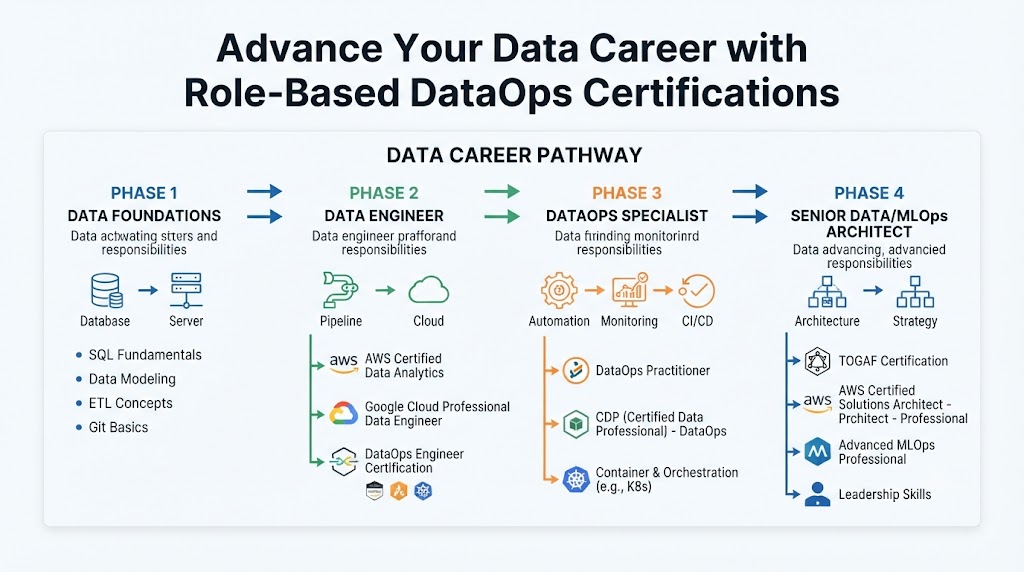
The learning journey is divided into foundation, professional, and advanced tiers to accommodate different experience levels. Specialization tracks branch into areas such as pipeline automation, data observability, governance, and infrastructure orchestration. Foundation levels establish core concepts of agile data management and basic version control for data assets. Professional levels dive deep into continuous integration and continuous deployment pipelines for complex data workflows. Advanced tracks focus on enterprise-wide scalability, multi-cloud architectures, and advanced data reliability engineering principles.
Complete Certified DataOps Engineer Certification Table
| Track | Level | Who it’s for | Prerequisites | Skills Covered | Recommended Order |
|---|---|---|---|---|---|
| Core DataOps | Foundation | Beginners, Junior Engineers | Basic Python, SQL, Linux | Version Control, CI/CD Basics, Scripting | 1 |
| Pipeline Automation | Professional | Data Engineers, DevOps Engineers | Foundation Track, 1 Year Experience | Orchestration, Containerization, Testing | 2 |
| Enterprise Scale | Advanced | Senior Engineers, Architects | Professional Track, 3 Years Experience | Observability, Multi-Cloud, Governance | 3 |
Detailed Guide for Each Certified DataOps Engineer Certification
Certified DataOps Engineer – Foundation Level
What it is
This certification validates fundamental knowledge of data operations principles, basic pipeline version control, and introductory automation concepts.
Who should take it
Junior data engineers, software developers transitioning to data roles, and IT professionals looking to understand agile data workflows.
Skills you’ll gain
- Basic version control using Git for data models and transformation scripts.
- Introduction to continuous integration principles for data validation.
- Fundamental understanding of data pipeline orchestration tools.
- Basic troubleshooting techniques for broken data ingestion scripts.
Real-world projects you should be able to do
- Set up a basic automated data ingestion script with error handling.
- Implement a simple Git-based workflow for SQL transformation files.
- Build a rudimentary unit testing suite for data quality checks.
Preparation plan
- 7–14 days: Focus on foundational terminology, basic Git commands, and introductory data orchestration concepts through self-paced reading.
- 30 days: Dedicate time to building small prototype pipelines, practicing basic scripting, and reviewing fundamental data governance models.
- 60 days: Engage in comprehensive lab exercises, participate in community discussions, and complete full practice assessments before exam day.
Common mistakes
- Relying purely on theoretical memorization without practicing hands-on pipeline deployment.
- Neglecting basic software engineering principles like version control and testing.
Best next certification after this
- Same-track option: Certified DataOps Engineer – Professional Level
- Cross-track option: DevOps Foundation Certification
- Leadership option: Agile Project Management for Technical Leads
Certified DataOps Engineer – Professional Level
What it is
This certification validates advanced proficiency in building, containerizing, and orchestrating complex enterprise-grade data pipelines.
Who should take it
Mid-level data engineers, DevOps practitioners, and backend developers with practical experience in cloud environments.
Skills you’ll gain
- Containerizing data workloads using Docker and orchestration platforms.
- Implementing robust CI/CD pipelines specifically tailored for data assets.
- Designing automated data quality testing and monitoring frameworks.
- Managing state and secrets securely within data infrastructure.
Real-world projects you should be able to do
- Deploy a fully containerized ETL pipeline with automated trigger mechanisms.
- Configure a complete CI/CD workflow that tests and deploys data transformations automatically.
- Implement end-to-end data lineage tracking and automated alert systems.
Preparation plan
- 7–14 days: Review advanced containerization concepts and data pipeline design patterns intensively.
- 30 days: Build multiple end-to-end containerized pipelines, focusing on automated testing and integration workflows.
- 60 days: Simulate production failures, optimize pipeline performance, and complete rigorous mock examinations.
Common mistakes
- Overcomplicating pipeline architectures without establishing baseline monitoring.
- Ignoring security best practices for credential management in CI/CD tools.
Best next certification after this
- Same-track option: Certified DataOps Engineer – Advanced Level
- Cross-track option: Certified SRE Professional
- Leadership option: Engineering Management and Data Governance Leadership
Certified DataOps Engineer – Advanced Level
What it is
This certification validates expert-level mastery in designing resilient, scalable, multi-cloud data operations ecosystems and enterprise governance strategies.
Who should take it
Senior data architects, principal engineers, and technical leads responsible for organizational data reliability and infrastructure.
Skills you’ll gain
- Architecting multi-cloud and hybrid data operations infrastructures.
- Designing advanced enterprise data observability and self-healing pipelines.
- Establishing organization-wide data governance and compliance frameworks.
- Leading cultural and operational transformation toward DataOps adoption.
Real-world projects you should be able to do
- Design a multi-region, highly available data processing platform with automated failover.
- Implement enterprise-wide data observability dashboards with predictive alerting.
- Establish governance policies that automate compliance and data privacy checks.
Preparation plan
- 7–14 days: Study complex case studies on enterprise data architecture and failure recovery strategies.
- 30 days: Design comprehensive multi-cloud migration plans and advanced observability setups in sandbox environments.
- 60 days: Review enterprise security standards, deep-dive into governance frameworks, and execute rigorous scenario-based tests.
Common mistakes
- Focusing solely on tool selection rather than cultural and process integration.
- Failing to account for long-term scalability and maintenance costs in architectural designs.
Best next certification after this
- Same-track option: Principal DataOps Architect Specialization
- Cross-track option: Certified FinOps Professional
- Leadership option: Chief Technology Officer Executive Program
Choose Your Learning Path
DevOps Path
The DevOps path focuses on automating software delivery lifecycles, infrastructure provisioning, and system configuration management. Practitioners learn to bridge the gap between development and operations teams through continuous integration and deployment. Mastery in this domain ensures high availability, rapid deployment cycles, and robust system stability across environments. It serves as a strong technical foundation for advanced operational disciplines.
DevSecOps Path
The DevSecOps path integrates security practices directly into every phase of the software and data development lifecycle. Professionals learn automated vulnerability scanning, secret management, compliance as code, and threat modeling. This approach ensures that security is never an afterthought but a continuous, automated part of pipeline delivery. Organizations rely on these experts to safeguard sensitive workloads against emerging cyber threats.
SRE Path
The Site Reliability Engineering path emphasizes applying software engineering principles to infrastructure and operational problems. Engineers focus on defining service level objectives, error budgets, incident management, and automated toil reduction. This track equips professionals to maintain extreme system reliability and resilience at massive scale. It is essential for mission-critical enterprise applications and data pipelines.
AIOps / MLOps Path
The AIOps / MLOps path addresses the unique operational challenges of deploying, monitoring, and maintaining machine learning models in production. Practitioners learn feature store management, model drift detection, automated retraining pipelines, and inference scaling. This specialization bridges data science and production engineering effectively. It enables enterprises to extract continuous value from their artificial intelligence investments.
DataOps Path
The DataOps path concentrates on standardizing data flow, improving data quality, and accelerating analytics delivery through automation. Engineers master pipeline orchestration, automated testing, version control for data, and real-time observability. This track transforms chaotic data environments into streamlined, reliable digital factories. It is critical for modern data-driven organizations.
FinOps Path
The FinOps path focuses on financial accountability and cloud cost optimization across engineering teams. Practitioners learn to analyze cloud usage data, allocate costs accurately, and implement optimization strategies without sacrificing performance. This discipline empowers organizations to maximize their cloud return on investment. It bridges engineering efficiency with financial governance.
Role → Recommended Certified DataOps Engineer Certifications
| Role | Recommended Certifications |
|---|---|
| DevOps Engineer | Certified DataOps Engineer – Professional Level |
| SRE | Certified DataOps Engineer – Professional Level |
| Platform Engineer | Certified DataOps Engineer – Advanced Level |
| Cloud Engineer | Certified DataOps Engineer – Professional Level |
| Security Engineer | Certified DataOps Engineer – Professional Level |
| Data Engineer | Certified DataOps Engineer – Foundation & Professional Levels |
| FinOps Practitioner | Certified DataOps Engineer – Professional Level |
| Engineering Manager | Certified DataOps Engineer – Foundation Level |
Next Certifications to Take After Certified DataOps Engineer
Same Track Progression
Transitioning from foundational data operations into advanced architectural specializations allows engineers to become recognized domain experts. Deepening expertise in multi-cloud orchestration and enterprise observability unlocks senior advisory roles. This vertical growth ensures continuous alignment with cutting-edge industry standards and complex engineering challenges.
Cross-Track Expansion
Broadening skill sets by exploring complementary operational domains like site reliability or machine learning operations creates well-rounded technical leaders. Understanding adjacent technologies enhances cross-functional collaboration and problem-solving capabilities. This horizontal expansion makes engineers highly versatile assets in rapidly evolving technology landscapes.
Leadership Management Track
Stepping into technical management and executive tracks involves mastering governance, team leadership, and strategic planning. Leaders learn to align technical roadmaps with business objectives while mentoring upcoming engineering talent. This transition leverages hands-on technical experience to drive high-impact organizational transformation.
Training & Certification Support Providers
DevOpsSchool provides comprehensive training programs and expert-led bootcamps designed to prepare professionals for complex enterprise certifications with real-world practicality.
Cotocus offers specialized consulting and rigorous technical education tailored to modern cloud-native architectures and operational excellence.
Scmgalaxy delivers extensive learning resources and community-driven knowledge sharing for software configuration and deployment specialists.
BestDevOps focuses on delivering high-quality, practical training courses covering a wide spectrum of modern engineering methodologies and tools.
devsecopsschool specializes in embedding robust security practices into development and operations pipelines through targeted expert instruction.
sreschool offers dedicated educational pathways aimed at mastering system reliability, incident management, and automated operational resilience.
aiopsschool provides advanced training focusing on artificial intelligence operations, machine learning workflows, and intelligent automation frameworks.
dataopsschool serves as the primary authority for data operations training, offering structured curricula and certification programs for data engineers.
finopsschool delivers expert-guided training on cloud financial management, cost optimization, and operational cost accountability.
Frequently Asked Questions
- How difficult is the Certified DataOps Engineer examination? The examination is designed to be challenging yet achievable for professionals with practical, hands-on pipeline experience. It evaluates real-world problem-solving rather than rote memorization.
- What are the official prerequisites required to attempt the exam? While there are no strict formal prerequisites for the foundation level, candidates benefit greatly from basic proficiency in Python, SQL, and foundational cloud concepts.
- How long does it typically take to prepare for the certification? Preparation generally ranges from thirty to sixty days depending on the candidate’s existing background in software engineering and data workflows.
- What is the return on investment for obtaining this credential? Certified professionals often experience accelerated career growth, enhanced job security, and increased capability to lead high-impact enterprise data projects.
- Can beginners without prior data experience take this certification? Yes, beginners can start with the foundation level, provided they are willing to invest time in learning basic scripting and version control principles.
- Are hands-on labs included in the official training programs? Official training programs include extensive practical lab exercises simulating real-world production environments and pipeline failure scenarios.
- How does this certification impact remote work and global employability? The credential is globally recognized, validating standardized technical competencies that are highly sought after by distributed engineering teams worldwide.
- What kind of ongoing maintenance or renewal is required? Certifications typically require periodic renewal through continuing education units or advanced recertification exams to ensure skills remain current.
- How should candidates sequence their study materials for optimal results? Candidates should follow the recommended track order starting from foundation concepts, moving to professional automation, and concluding with advanced architecture.
- Is coding experience strictly necessary to succeed in data operations? Basic scripting capability, particularly in Python and SQL, is essential for writing data transformation scripts and configuring pipeline orchestration tools.
- How do enterprises benefit from having certified engineers on staff? Organizations experience reduced data downtime, faster analytics delivery, improved data quality, and standardized operational workflows across teams.
- Where can candidates register and find official study guides? Candidates can register and access comprehensive course materials directly through the official course portal hosted on the provider website.
FAQs on Certified DataOps Engineer
- What specific tools are covered in the curriculum? The curriculum focuses on industry-standard orchestration tools, containerization platforms, version control systems, and automated testing frameworks without vendor lock-in.
- How does data operations differ from traditional data engineering? Data operations applies agile development, continuous integration, and automated monitoring principles specifically to data pipelines to ensure continuous reliability.
- Can this certification help in securing remote engineering roles? Employers actively look for verified data operations competencies when hiring remote engineers to ensure autonomous problem-solving capabilities.
- What support is available for candidates during their preparation? Trainees receive access to mentor-led sessions, community forums, hands-on lab environments, and comprehensive practice assessments.
- How are practical skills evaluated during the assessment process? Assessments utilize scenario-based questions and practical lab challenges that mirror actual production incidents and architectural design tasks.
- Are there group training options available for corporate teams? Corporate training packages are available to upskill entire enterprise engineering teams simultaneously with customized schedules.
- How does the certification address data security and compliance? Security best practices, secret management, data lineage tracking, and compliance frameworks are integrated deeply across professional and advanced levels.
- What makes this certification distinct from general cloud certifications? It concentrates specifically on the unique operational lifecycle of data assets, pipelines, and analytics infrastructure rather than general infrastructure.
Final Thoughts: Certified DataOps Engineer Worth It?
Investing time and effort into mastering data operations is a pragmatic choice for engineers looking to future-proof their careers in a data-driven world. The certification provides a clear, structured roadmap to mastering production-grade pipeline automation, observability, and governance. Without relying on hype or marketing fluff, the curriculum delivers tangible skills that translate directly into daily engineering excellence. For professionals committed to elevating their technical authority and driving reliable data delivery, this credential offers undeniable value.