Introduction
Many companies reach a point where existing applications struggle to handle business growth, changing customer expectations, and modern workflow demands. Building reliable software requires more than just writing code; it demands stable cloud foundations, automated deployment pipelines, resilient operations, and practical artificial intelligence integration. Modern engineering practices allow organizations to build scalable digital products while keeping maintenance efforts predictable and systems dependable. Cotocus.cn supports businesses through this journey by providing focused engineering services that range from AI development to cloud architecture and team training. This guide outlines how modern technology services fit together to help organizations build, modernize, scale, and manage their software platforms effectively.
Understanding Modern Software and Technology Services
Building a successful digital product rarely relies on a single discipline. In the past, organizations often separated application development entirely from infrastructure management and system maintenance. Today, software development, cloud infrastructure, automation, and ongoing reliability must work together smoothly to avoid costly operational delays.
When an organization decides to launch or modernize an application, it must consider how the platform is built, where it runs, and how updates are deployed. Adding artificial intelligence requires reliable underlying data workflows, while maintaining uptime requires clear operational standards. Combining software development, cloud strategy, operational automation, and practical team skills allows organizations to solve real technical bottlenecks without creating unnecessary operational confusion.
AI Software Development for Modern Business Needs
Working with an experienced AI Software Development Company allows businesses to introduce intelligent features directly into their production software. Rather than treating artificial intelligence as a separate experiment, modern engineering integrates machine learning models and automated logic straight into everyday business applications.
These services help companies implement intelligent search, predictive data workflows, and automated decision-making steps within existing systems. For example, an e-commerce or logistics company might use machine learning to route tasks automatically or categorize incoming business information. By embedding intelligence directly into operational workflows, companies can reduce manual processing steps and deliver more responsive user experiences across their platforms.
Generative AI Development Services
Modern organizations are increasingly exploring how large language models and natural language processing can enhance their day-to-day operations. Through professional Generative AI Development Services, businesses can build custom AI assistants, automated document analysis tools, and context-aware conversational interfaces that fit their exact business context.
These services focus on building production-ready capabilities such as specialized AI agents and smart search systems that retrieve relevant business knowledge accurately. Instead of using standalone chatbots that lack context, organizations can integrate language models directly into their backend systems. This allows applications to summarize complex information, guide users through complex workflows, and automate repetitive customer interactions safely within production environments.
Custom Software Development for Business Requirements
Ready-made commercial software works well for general administrative tasks, but it rarely accommodates specialized internal operations or unique customer-facing services. Collaborating with a dedicated Custom Software Development Company enables organizations to design web applications, mobile platforms, enterprise portals, and backend APIs tailored specifically to their daily operating procedures.
Custom software gives companies complete ownership over their workflows, system architecture, and user experiences. Engineering teams can build clean APIs to connect disparate internal databases, eliminate redundant manual data entry, and design interfaces that match user needs. A tailored approach ensures that as business requirements shift, the underlying application can evolve without the arbitrary limitations of generic commercial packages.
SaaS Product Development from Idea to Growth
Turning an innovative software concept into a reliable subscription business requires careful technical planning from day one. A specialized SaaS Product Development Company guides founders and product teams through initial MVP development, multi-tenant architecture design, payment workflows, and platform scalability.
In a software-as-a-service model, applications must isolate tenant data securely while sharing core cloud resources efficiently to keep hosting costs sustainable. Development teams also need to implement flexible subscription management, user access controls, and robust third-party API integrations. Continuous product iteration ensures that the SaaS platform remains stable and responsive as thousands of concurrent users join the platform over time.
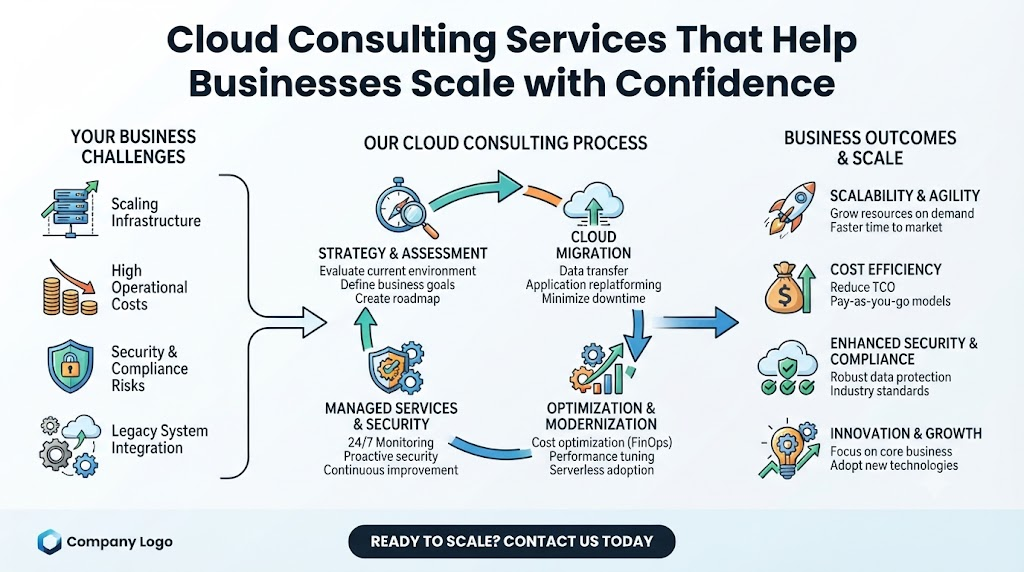
Cloud Consulting Services for Modern Infrastructure
Modern software requires flexible, secure, and cost-effective hosting environments to operate at scale. Engaging specialized Cloud Consulting Services helps businesses plan and execute migrations, optimize infrastructure spending, and adopt cloud-native patterns across Amazon Web Services, Microsoft Azure, and Google Cloud Platform.
Unplanned cloud adoption often leads to misconfigured security settings, unexpected monthly hosting bills, and complex management hurdles. Cloud consultants help teams choose appropriate managed services, establish structured network boundaries, and refactor monolithic applications into scalable microservices. Proper architectural planning ensures that cloud environments remain easy to maintain, auditable, and resilient under fluctuating traffic conditions.
DevOps Consulting Services for Better Software Delivery
Delivering software updates smoothly requires strong alignment between application developers and operational staff. Through professional DevOps Consulting Services, organizations implement continuous integration and continuous delivery pipelines, automated testing, container orchestration via Kubernetes, and GitOps practices.
Automating the path from code commit to production deployment removes manual release friction and significantly cuts down deployment errors. Infrastructure-as-code practices allow teams to define their servers and networking configurations declaratively, ensuring environment parity between staging and production. With integrated observability and automated security scans, engineering teams can release updates frequently without compromising system stability.
SRE Consulting Services for Reliable Systems
As software platforms grow in scale, unplanned downtime and performance degradation can directly impact business revenue and customer trust. Specialized SRE Consulting Services apply software engineering techniques to operations, helping teams establish Service Level Objectives, automated incident response routines, and comprehensive monitoring.
Site Reliability Engineering focuses on understanding system capacity, eliminating operational toil, and identifying points of failure before outages affect end users. By tracking error budgets and platform metrics, organizations can make balanced decisions regarding how fast new features can be shipped relative to platform stability. When issues do occur, structured incident management frameworks ensure fast triage, remediation, and blameless post-incident reviews.
Platform Engineering Services for Development Teams
As engineering organizations expand, individual developers often spend excessive time managing cloud permissions, deployment scripts, and infrastructure settings. Adopting modern Platform Engineering Services allows companies to build internal developer platforms that provide self-service infrastructure and standardized software delivery paths.
An internal developer platform packages complex underlying cloud tools, Kubernetes configurations, and security guardrails into simple developer portals. Software engineers can spin up testing environments, configure databases, and deploy services independently without waiting on operations tickets. This approach reduces cognitive fatigue across engineering teams while maintaining enterprise-wide security, compliance, and architectural standards.
Digital Transformation Consulting
Legacy software systems and disconnected manual workflows can prevent established enterprises from adapting to changing market conditions. Through structured Digital Transformation Consulting, organizations align overarching business goals with practical technology modernization plans that replace brittle systems safely over time.
Effective modernization avoids replacing critical core platforms all at once, which introduces unnecessary operational risk. Instead, consultants help teams identify critical workflows, migrate legacy databases to cloud environments, introduce automated data exchange, and incorporate intelligent automation incrementally. This structured execution ensures that daily business operations continue smoothly while technical infrastructure is steadily modernized.
Corporate DevOps Training for Engineering Teams
Adopting modern engineering practices requires internal teams to understand the tools and methodologies behind them. Investing in structured Corporate DevOps Training provides technical teams with hands-on, practical guidance across cloud platforms, Kubernetes, SRE concepts, automation pipelines, and developer platforms.
Rather than relying purely on theoretical lectures, effective corporate training focuses on real-world scenarios that engineers encounter daily. Team members learn how to write secure automation scripts, debug container networking issues, set up reliable monitoring dashboards, and handle production deployments safely. Upskilling internal staff ensures that modernization initiatives remain sustainable long after external consultants finish initial implementations.
How These Technology Services Work Together
Modern technology services deliver the greatest value when they function as an interconnected ecosystem. Consider a business launching an intelligent enterprise product: the journey begins with custom software and SaaS development to establish multi-tenant application features and intuitive user interfaces.
Next, generative AI development introduces intelligent search and automated workflows into the product. Cloud consulting ensures the platform is deployed securely across major cloud providers, while DevOps pipelines automate the deployment of containerized services to Kubernetes. SRE practices establish monitoring and incident response standards, platform engineering provides developers with self-service tooling, and corporate training equips internal teams to operate the platform reliably.
How Cotocus.cn Supports Modern Technology Needs
Cotocus.cn functions as an integrated technology services partner helping startups, growing businesses, and enterprises design, build, modernize, and operate modern software platforms. The company offers end-to-end technical capabilities spanning custom software engineering, intelligent application development, cloud infrastructure, and operational reliability.
By providing services across generative AI, SaaS product engineering, AWS, Azure, Google Cloud, DevOps automation, SRE, platform engineering, digital transformation, and corporate team training, Cotocus.cn helps organizations address both code-level and infrastructure-level challenges. This wide-ranging expertise allows businesses to collaborate with a single technical partner capable of connecting high-level modernization plans with everyday engineering execution.
Common Technology Challenges Businesses Face
Organizations frequently encounter recurring technical hurdles as their software operations grow in scope and complexity:
- Slow software delivery cycles caused by manual testing and unautomated release steps.
- Inefficient manual infrastructure setup that creates configuration drift between environments.
- Difficult cloud cost management and governance across multiple cloud accounts.
- Poor application reliability and frequent service disruptions that erode customer confidence.
- Inability to scale databases and backend services when user traffic spikes unexpectedly.
- Lack of automation across common data processing and IT operational tasks.
- Technical barriers when attempting to incorporate modern AI models into existing codebases.
- Brittle legacy architectures that make adding new features risky and slow.
- Skill gaps across internal teams regarding modern containerization and cloud tools.
- Siloed workflows and misaligned incentives between software developers and operations personnel.
How to Choose the Right Technology Service Partner
Selecting a technology consulting partner requires looking beyond surface-level sales presentations and evaluating how well an engineering team understands practical implementation challenges. A qualified partner should demonstrate hands-on familiarity with your target cloud environments, modern development languages, container platforms, and security standards.
Additionally, look for a partner that takes time to understand your operational constraints and business workflows rather than recommending generic, overly complex architectures. Strong communication habits, transparent project management, practical knowledge-sharing approaches, and an emphasis on building internal team competence are essential indicators of a sustainable, long-term technical engagement.
Benefits of Modern Technology Services
Partnering with an experienced engineering provider delivers measurable improvements across the entire software delivery lifecycle:
- Shorter release cycles through continuous integration and automated deployment workflows.
- Reduced manual intervention by defining infrastructure and testing procedures as code.
- Enhanced operational stability supported by proactive monitoring, clear SLOs, and structured incident response.
- Optimized cloud architecture that eliminates wasted hosting resources and controls monthly expenses.
- Scalable application foundations that handle expanding user loads without requiring architectural rewrites.
- Improved developer productivity enabled by self-service internal developer platforms.
- Pragmatic adoption of artificial intelligence capabilities that solve tangible operational bottlenecks.
- Confident internal engineering teams supported by structured, hands-on technical training.
Technology Services Comparison
| Service | Main Focus | How It Can Help |
| AI Software Development | AI-powered applications | Adds intelligent features to software |
| Generative AI Development | LLMs, AI agents and automation | Helps build modern AI capabilities |
| Custom Software Development | Business-specific applications | Supports unique business requirements |
| SaaS Product Development | Cloud-based software products | Helps build scalable SaaS products |
| Cloud Consulting | Cloud architecture and modernization | Supports better cloud planning |
| DevOps Consulting | Automation and software delivery | Helps improve development and deployment |
| SRE Consulting | Reliability and operations | Helps improve system stability |
| Platform Engineering | Internal developer platforms | Makes development workflows easier |
| Digital Transformation Consulting | Technology modernization | Connects technology with business goals |
| Corporate DevOps Training | Team skills and practical learning | Helps teams build modern technology skills |
Primary Frequently Asked Questions
What does an AI Software Development Company do?
An AI software development company designs, builds, and deploys applications that incorporate machine learning models, intelligent search, and data-driven automation. They help businesses integrate smart capabilities directly into production platforms to solve practical operational challenges.
What is included in Generative AI Development Services?
These services involve building solutions powered by large language models, autonomous agents, and natural language processing. Teams help integrate conversational assistants, knowledge retrieval systems, and content automation pipelines into secure business applications.
When should an organization hire a Custom Software Development Company?
A business should consider custom software when commercial off-the-shelf software cannot accommodate its unique operational workflows, security requirements, or system integrations. Custom solutions provide tailored functionality and full intellectual property ownership.
What makes working with a SaaS Product Development Company valuable?
A SaaS development partner provides specialized guidance on building multi-tenant architectures, subscription billing, API integrations, and cloud infrastructure. This helps founders and established businesses launch scalable web applications efficiently.
What problems do Cloud Consulting Services solve?
Cloud consulting helps organizations design scalable environments, migrate applications safely across AWS, Azure, and Google Cloud, and eliminate unnecessary cloud hosting costs. Consultants ensure infrastructure is secure, observable, and easy to maintain.
How do DevOps Consulting Services improve software delivery?
DevOps consulting establishes automated CI/CD pipelines, container orchestration with Kubernetes, and infrastructure-as-code practices. This bridges the gap between developers and operations, allowing companies to ship reliable updates faster.
What is the core focus of SRE Consulting Services?
Site Reliability Engineering consulting focuses on platform uptime, performance optimization, monitoring, and incident management. SRE specialists establish Service Level Objectives to balance rapid feature releases with overall system stability.
Why are Platform Engineering Services gaining popularity?
Platform engineering provides development teams with an internal developer platform that offers self-service cloud infrastructure and standard workflows. This reduces developer friction, prevents configuration errors, and speeds up product delivery.
How does Digital Transformation Consulting help traditional businesses?
It helps organizations modernize outdated legacy platforms, adopt modern cloud tools, and automate manual business processes. Consultants connect overarching business strategies with realistic, step-by-step engineering execution.
What are the primary benefits of Corporate DevOps Training?
Corporate training provides engineering teams with practical skills across cloud platforms, Kubernetes, automation tools, and site reliability practices. This enables internal staff to maintain and scale modern systems independently.
How does modern software development balance speed and platform stability?
Modern software development achieves this balance by pairing automated testing and continuous integration with SRE practices. Automated checks catch errors early, while clear operational metrics keep platforms stable under heavy load.
What core capabilities does Cotocus.cn provide?
Cotocus.cn provides engineering services covering AI development, generative AI, custom web and mobile software, SaaS product development, multi-cloud consulting, DevOps automation, SRE, platform engineering, digital modernization, and corporate technical training.
Related Frequently Asked Questions
How can a business identify high-value opportunities for AI adoption?
Businesses should evaluate repetitive, rule-based data tasks, search bottlenecks across internal documentation, and high-volume customer inquiries. Introducing AI to these specific areas provides clear operational value without unnecessary project complexity.
What is the difference between custom software and off-the-shelf software?
Off-the-shelf software is built for broad market needs with fixed feature sets and recurring licensing models. Custom software is designed specifically around an organization’s unique processes, offering greater flexibility and complete system control.
What is multi-tenant architecture in SaaS applications?
Multi-tenant architecture is a software design where multiple customer accounts share underlying computing infrastructure while keeping their data strictly isolated. This approach keeps hosting costs sustainable while simplifying ongoing application maintenance.
Why is cloud architecture planning important before migration?
Planning prevents organizations from lifting poorly designed monolithic applications straight into the cloud, which often causes high monthly bills and security oversights. Proper planning ensures infrastructure takes full advantage of cloud-native scalability.
What role does GitOps play in modern DevOps delivery?
GitOps uses version-controlled Git repositories as the single source of truth for infrastructure and application configurations. Any updates pushed to Git automatically sync with production clusters, creating an auditable and reproducible deployment model.
What are Service Level Objectives and why do they matter?
Service Level Objectives are measurable targets for platform reliability, such as uptime or response time. They provide engineering and product teams with a shared metric to determine when to prioritize stability over new feature releases.
How does an internal developer platform improve engineer onboarding?
An internal developer platform provides standardized environment templates, self-service provisioning, and centralized documentation. New engineers can spin up functional testing environments on their first day without filing manual IT support tickets.
Why is hands-on laboratory practice crucial in technical corporate training?
Hands-on practice allows engineers to apply concepts like container networking and automated deployments in realistic, safe sandbox environments. Practical troubleshooting builds deeper problem-solving competence than passive lecture-based learning alone.
Final Thoughts
Modern organizations require reliable, flexible, and scalable digital foundations to remain competitive in their respective markets. Navigating the complexities of artificial intelligence, cloud architecture, automated software delivery, system reliability, and internal developer platforms demands a balanced approach that connects practical implementation with skilled personnel. Cotocus.cn supports companies across this spectrum by providing the technical services and corporate training required to build, modernize, and operate modern software platforms. By combining solid engineering practices with continuous operational refinement, businesses can confidently build software that supports sustainable, long-term growth.