Introduction
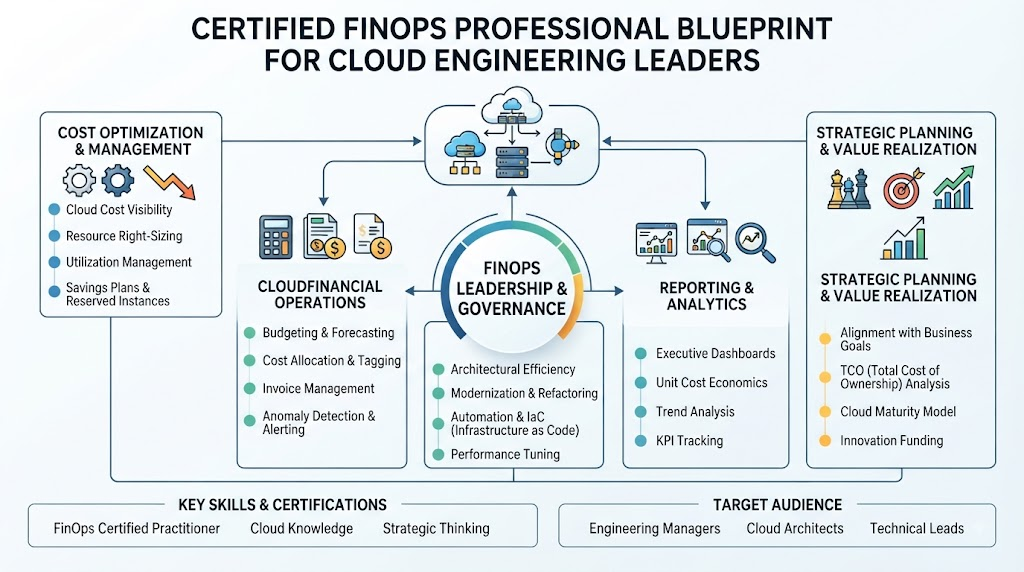
Scaling cloud environments without financial accountability is one of the quickest ways engineering teams burn through capital and lose executive trust. The Certified FinOps Professional program offers a pragmatic, battle-tested framework that turns cloud cost management into a first-class engineering discipline rather than an afterthought. This career blueprint is built for software practitioners, DevOps engineers, systems architects, and engineering leaders who want to master unit economics and build cost-conscious cloud systems. As modern architectures grow in complexity, financial observability must sit right alongside performance and reliability. By leveraging curriculum standards from FinOpsSchool, this guide helps technical teams bridge the gap between technical agility and fiscal responsibility.
What is the Certified FinOps Professional?
The Certified FinOps Professional program validates your hands-on ability to design, implement, and run cloud financial management practices inside real enterprise environments. Rather than treating cost control as a passive spreadsheet exercise, this certification treats cloud financial management as an active engineering practice rooted in telemetry, automation, and architectural discipline.
Modern delivery pipelines demand that engineers take ownership of the resources they spin up. This credential proves that you understand how to translate cloud bills into actionable engineering initiatives, automate waste reduction, optimize resource commitments, and foster cross-functional collaboration between engineering, product, and finance teams.
Who Should Pursue Certified FinOps Professional?
This certification is designed for anyone who builds, maintains, or manages cloud infrastructure and wants to eliminate runaway cloud spending while preserving development velocity. Whether you are troubleshooting container costs or setting organizational cloud strategy, this credential gives you actionable frameworks to succeed.
- Software and Cloud Engineers: Developers and system administrators who want to understand how their architectural decisions and resource allocations impact monthly infrastructure bills.
- DevOps, SRE, and Platform Architects: Practitioners responsible for automating resource scaling, managing Kubernetes cluster efficiency, establishing tagging standards, and eliminating idle resources.
- Engineering Managers and Finance Partners: Technical leaders, directors, and financial analysts who need to implement showback or chargeback models, establish team-level budget metrics, and guide enterprise cloud investments.
Why Certified FinOps Professional
Cloud adoption is expanding rapidly, but unoptimized cloud spending continues to eat into technology budgets across global enterprises. Organizations no longer reward teams solely for building systems that scale; they demand systems that scale economically. Earning this certification signals that you have the skills to run lean, highly efficient cloud operations.
Tool ecosystems, vendor dashboards, and pricing calculators change continuously, but the core fundamentals of cloud financial management remain constant. Mastering resource attribution, commitment planning, and unit cost economics gives you long-term career resilience, establishing you as a trusted technical voice across multi-cloud environments.
Certified FinOps Professional Certification Overview
The Certified FinOps Professional curriculum provides an end-to-end evaluation of an engineer’s technical ability to manage cloud finances across the entire software delivery lifecycle. Candidates are assessed on their understanding of allocation mechanics, anomaly mitigation, rate optimization strategies, and automated infrastructure governance.
Rather than relying purely on multiple-choice theory, the assessment framework tests practical problem-solving capabilities. You are evaluated on how well you dissect multi-cloud invoices, automate resource reclamation, allocate shared container cluster costs, and integrate continuous cost validation checks into standard deployment pipelines.
Certified FinOps Professional Certification Tracks & Levels
The certification framework is structured across distinct tiers designed to support practitioners at different career stages:
- Foundation Level: Introduces the fundamental mechanics of cloud billing data, metadata tagging governance, basic visibility tools, and standard cost allocation concepts.
- Professional Level: Validates an engineer’s technical competence in implementing automated right-sizing, rate optimization, commitment management, and unit cost tracking.
- Advanced / Leadership Level: Focuses on enterprise-wide governance, automated showback and chargeback systems, custom business value modeling, and organizational cultural transformation.
Complete Certified FinOps Professional Certification Table
| Track | Level | Who it’s for | Prerequisites | Skills Covered | Recommended Order |
|---|---|---|---|---|---|
| Cloud Cost Fundamentals | Foundation | Junior Engineers, Cloud Analysts, Finance Associates | Basic Cloud Literacy | Cloud Billing Mechanics, Tagging Policies, Cost Allocation Basics | 1 |
| FinOps Engineering Core | Professional | DevOps, SREs, Systems Engineers, Cloud Practitioners | 1+ Years Cloud Experience | Unit Metrics, Right-Sizing Automation, Commitment Math, Anomaly Remediation | 2 |
| Multi-Cloud Cost Optimization | Professional | Senior Cloud Architects, Principal Engineers | Multi-Cloud Infrastructure | Multi-Cloud Governance, Spot Orchestration, Discount Instrument Blending | 3 |
| Kubernetes & Platform FinOps | Professional | Platform Engineers, Kubernetes Operators | Container Orchestration | Pod Cost Attribution, Cluster Packing, Namespace Chargeback, Node Scaling | 4 |
| Enterprise FinOps Governance | Advanced | Engineering Managers, Technical Directors, FinOps Leads | Enterprise Cloud Strategy | Chargeback Automation, Executive KPI Reporting, Organizational Enablement | 5 |
Detailed Guide for Each Certified FinOps Professional Certification
Certified FinOps Professional – Foundation Tier
What it is
Validates baseline literacy in cloud cost drivers, shared responsibility models for financial management, and standard billing data structures. It ensures you understand how day-to-day provisioning choices directly affect organizational spending.
Who should take it
Ideal for entry-level cloud engineers, system administrators, technical project managers, and finance professionals who want to understand the foundational operational concepts of cloud financial management.
Skills you’ll gain
- Interpreting line-item details in complex public cloud billing exports.
- Designing and implementing standardized resource tagging and labeling hierarchies.
- Configuring baseline cost dashboards, budget thresholds, and spending alerts.
- Mapping infrastructure consumption back to specific teams and functional cost centers.
Real-world projects you should be able to do
- Establish an enterprise tagging schema to bring unallocated resource spend down below 10%.
- Build an operational dashboard tracking daily burn rates across dev, staging, and production environments.
- Configure automated threshold alerts that notify operational teams via chat when daily spend spikes unexpectedly.
Preparation plan
- 7–14 Days: Focus on core cloud billing terminology, standard allocation models, and basic tagging mechanisms.
- 30 Days: Practice reviewing sample billing exports, building basic dashboards, and mapping out team-level cost centers.
- 60 Days: Work directly with live cloud billing reports to identify misallocated resources and configure automated budget warnings.
Common mistakes
- Memorizing terminology without analyzing real, messy billing export files.
- Treating metadata tagging as an optional operational task rather than a strict governance requirement.
- Failing to connect infrastructure provisioning decisions with bottom-line operational costs.
Best next certification after this
- Same-track option: Certified FinOps Professional – Core Engineering Tier
- Cross-track option: Cloud Associate / DevOps Foundation
- Leadership option: Technology Financial Operations Specialist
Certified FinOps Professional – Core Engineering Tier
What it is
Validates intermediate to advanced technical execution in cloud workload optimization, programmatic waste elimination, commitment rate planning, and automated scaling architectures.
Who should take it
DevOps specialists, SREs, cloud engineers, and systems administrators who build, automate, and maintain production workloads and need to optimize compute, network, and storage costs.
Skills you’ll gain
- Implementing automated right-sizing workflows across virtual machines, databases, and serverless compute.
- Modeling and purchasing commitment-based discount instruments including Savings Plans and Reserved Instances.
- Automating lifecycle policies for block storage snapshots, object stores, and unattached disks.
- Configuring real-time anomaly detection rules to catch runaway infrastructure spending before billing cycles close.
Real-world projects you should be able to do
- Write automated remediation scripts that safely detect, snapshot, and decommission orphaned cloud storage volumes.
- Build a balanced 1-year and 3-year commitment discount portfolio covering baseline application demand.
- Configure auto-scaling triggers based on business transaction throughput rather than generic CPU utilization.
Preparation plan
- 7–14 Days: Review rate optimization formulas, commitment break-even analysis, and storage tiering options.
- 30 Days: Build automated cleanup scripts and calculate cost differentials across various architectural configurations.
- 60 Days: Conduct live workload profiling, execute right-sizing actions, and build automated spend anomaly pipelines.
Common mistakes
- Committing to long-term discount instruments before stabilizing workload architectures.
- Downsizing compute instances without evaluating network bandwidth, memory pressure, and IOPS requirements.
- Running cost optimization as a reactive quarterly cleanup rather than a continuous engineering practice.
Best next certification after this
- Same-track option: Certified FinOps Professional – Kubernetes & Platform Tier
- Cross-track option: Site Reliability Engineering Professional
- Leadership option: Cloud Efficiency Lead
Certified FinOps Professional – Kubernetes & Platform Tier
What it is
Validates advanced technical skills in measuring, attributing, and optimizing infrastructure spend inside shared, dynamic, and multi-tenant platforms such as Kubernetes clusters and internal developer platforms.
Who should take it
Platform engineers, Kubernetes cluster administrators, and senior DevOps engineers managing shared computing platforms across multiple development teams.
Skills you’ll gain
- Attributing container compute and memory costs down to namespaces, pods, and application labels.
- Tuning Kubernetes pod requests and limits to maximize cluster packing density and reduce node count.
- Implementing mixed-instance node groups using Spot, On-Demand, and Graviton/ARM architectures.
- Building internal showback and chargeback models for engineering teams sharing cluster capacity.
Real-world projects you should be able to do
- Deploy open-source cost attribution agents across production Kubernetes clusters to identify top spending microservices.
- Implement safe spot instance orchestration with graceful termination handling for asynchronous batch workloads.
- Create a pull-request linting check that blocks deployments with unconfigured or excessively large resource requests.
Preparation plan
- 7–14 Days: Study Kubernetes scheduling logic, resource requests, limits, and cluster autoscaling mechanics.
- 30 Days: Deploy cluster monitoring agents, analyze workload utilization vs. requests, and adjust pod resource definitions.
- 60 Days: Implement multi-tenant cost isolation, spot node provisioning, and automated container right-sizing loops.
Common mistakes
- Configuring arbitrary pod resource requests without analyzing historic container telemetry.
- Neglecting shared cluster overhead, load balancers, and cross-AZ network traffic when calculating pod costs.
- Deploying non-fault-tolerant production workloads on interruptible compute instances without appropriate safeguards.
Best next certification after this
- Same-track option: Certified FinOps Professional – Enterprise Governance Tier
- Cross-track option: Cloud Native Platform Architect
- Leadership option: Director of Platform Infrastructure
Certified FinOps Professional – Enterprise Governance Tier
What it is
Validates executive-level expertise in driving organizational FinOps transformations, architecting automated chargeback systems, establishing compliance guardrails, and tracking business unit economics.
Who should take it
Principal architects, engineering directors, enterprise FinOps leads, and technology executives responsible for company-wide cloud financial governance and strategy.
Skills you’ll gain
- Designing custom unit economic metrics that correlate cloud spending directly to business revenue and user growth.
- Architecting enterprise chargeback and showback engines that cleanly distribute shared infrastructure costs.
- Defining automated organizational guardrails and policy-as-code rules to maintain financial compliance.
- Cultivating an engineering culture where financial accountability is treated as a core performance metric.
Real-world projects you should be able to do
- Architect a comprehensive enterprise chargeback system that distributes networking, shared security, and platform costs.
- Establish and track a core business unit metric like Cost per Active User across all engineering squads.
- Build automated policy-as-code guardrails that prevent non-compliant, unapproved infrastructure deployments globally.
Preparation plan
- 7–14 Days: Review organizational maturity models, shared cost allocation strategies, and unit metric design.
- 30 Days: Model complex enterprise billing structures and draft cross-functional operational workflows.
- 60 Days: Build policy enforcement frameworks, implement unit cost metrics, and launch an organizational FinOps enablement program.
Common mistakes
- Introducing restrictive bureaucratic approvals that slow down engineering velocity and software delivery.
- Focusing purely on reducing raw dollar spend rather than improving efficiency through normalized unit metrics.
- Failing to align engineering managers, product leaders, and finance executives around common KPIs.
Best next certification after this
- Same-track option: Strategic Cloud Economics Fellow
- Cross-track option: Enterprise Cloud Strategy Architect
- Leadership option: Vice President of Infrastructure / Chief Technology Officer
Choose Your Learning Path
DevOps Path
Incorporating financial governance into continuous integration and delivery pipelines ensures that expensive architectural oversights are resolved before reaching production. In this pathway, engineers learn how to embed automated cost estimation tools into pull requests, enforce infrastructure-as-code policies, and build reusable templates with built-in cost guardrails. By shifting financial awareness left into the development cycle, DevOps engineers protect operational velocity while ensuring budget predictability across all deployments.
DevSecOps Path
Security hygiene and financial governance rely on identical operational foundations: complete asset visibility, strict access controls, and rapid elimination of unapproved infrastructure. This path guides engineers through unifying security compliance with cost efficiency, such as uncovering unauthorized compute instances or orphaned, unsecured storage volumes. Combining security and financial practices enables practitioners to build infrastructure that is simultaneously compliant, protected, and financially lean.
SRE Path
Site Reliability Engineers must balance service level objectives and application uptime against infrastructure expenditure. This learning path emphasizes designing resilient architectures without resorting to wasteful over-provisioning or excessive multi-region duplication. You will learn to optimize disaster recovery strategies, fine-tune high-volume telemetry data retention, and maintain strict reliability targets at an optimal infrastructure cost.
AIOps Path
Modern enterprise operations generate massive streams of logs, traces, and metrics that require automated intelligence to process efficiently. This track focuses on using algorithmic models to detect anomalous spending patterns, forecast resource consumption, and remediate capacity bottlenecks in real time. Practitioners learn to manage the cost of running large observability pipelines while automating resource optimization through intelligent operational workflows.
MLOps Path
Machine learning training pipelines and real-time model inference workloads represent some of the most expensive resources in modern computing. This path teaches engineers how to manage, allocate, and optimize high-cost accelerator hardware such as GPUs and TPUs. You will master distributed training orchestration, dynamic batching, spot instance utilization for model training, and scaling down idle inference endpoints during low-traffic windows.
DataOps Path
Enterprise data analytics pipelines frequently create unpredictable costs due to unoptimized queries, massive data transformations, and unmanaged analytical clusters. This pathway helps data engineers optimize query performance, manage data lifecycle policies across storage tiers, and configure automated scaling for data processing engines. By mastering DataOps financial management, teams can deliver continuous analytics without blowing past enterprise budgets.
FinOps Path
The dedicated FinOps track is crafted for specialists whose primary mission is bridging engineering execution with corporate financial strategy. Engineers in this pathway master every phase of the cloud financial lifecycle: visibility, optimization, and continuous cultural governance. This track equips professionals to direct enterprise cloud strategies, implement automated chargeback mechanisms, and clearly articulate the business value of engineering initiatives to executive stakeholders.
Role → Recommended Certified FinOps Professional Certifications
| Role | Recommended Certifications |
|---|---|
| DevOps Engineer | FinOps Engineering Core, Kubernetes & Platform FinOps |
| SRE | FinOps Engineering Core, Multi-Cloud Cost Optimization |
| Platform Engineer | Kubernetes & Platform FinOps, Multi-Cloud Cost Optimization |
| Cloud Engineer | Cloud Cost Fundamentals, FinOps Engineering Core |
| Security Engineer | Cloud Cost Fundamentals, Enterprise FinOps Governance |
| Data Engineer | FinOps Engineering Core, Multi-Cloud Cost Optimization |
| FinOps Practitioner | Cloud Cost Fundamentals, FinOps Engineering Core, Enterprise FinOps Governance |
| Engineering Manager | Cloud Cost Fundamentals, Enterprise FinOps Governance |
Next Certifications to Take After Certified FinOps Professional
Same Track Progression
Deepening your mastery within cloud financial engineering involves tackling advanced enterprise governance, custom cost modeling, and multi-tenant platform architecture. Advancing further in this discipline equips you to architect automated financial governance frameworks, design custom chargeback engines, and establish sophisticated unit economics that tie technical system performance directly to business gross margins.
Cross-Track Expansion
Broadening your technical scope into complementary domains significantly elevates your overall impact as an engineer. Pursuing credentials in Site Reliability Engineering, Cloud Native Platform Architecture, or DevSecOps allows you to design modern distributed systems where cost efficiency, resilience, and security are treated as equal engineering priorities.
Leadership & Management Track
Moving into technical management requires translating engineering achievements into clear business and financial outcomes. Pursuing executive credentials in cloud strategy, technology financial management, or enterprise architecture provides the perspective needed to lead large engineering organizations, direct capital investments, and establish high-performing, cost-conscious engineering cultures.
Training & Certification Support Providers for Certified FinOps Professional
DevOpsSchool
DevOpsSchool delivers structured, hands-on training programs that emphasize real-world automation, cloud governance, and continuous financial engineering. Their practical curriculum features extensive laboratory exercises, scenario-based problem solving, and production-grade tool integrations designed to help working engineers master modern enterprise cloud infrastructure management with high operational confidence.
Cotocus
Cotocus provides enterprise consulting and targeted certification preparation tailored to modern engineering teams. Their structured coaching methodologies focus on closing technical skill gaps, designing continuous optimization frameworks, and helping organizations deploy production-grade cloud architectural patterns that align directly with evolving enterprise performance and cost requirements.
Scmgalaxy
Scmgalaxy provides an established community platform and training ecosystem focused on software configuration management, automated deployment pipelines, and infrastructure governance. Their programs guide technical professionals through the nuances of pipeline management, automated governance models, and comprehensive multi-cloud infrastructure spending analysis.
BestDevOps
BestDevOps provides structured educational guides and practical reference blueprints centered on continuous integration, site reliability engineering, and cloud management. Their course offerings help engineers adopt modern operational workflows, eliminate persistent infrastructure waste, and implement robust, cost-effective deployment patterns across distributed enterprise environments.
devsecopsschool.com
devsecopsschool.com delivers deep technical training focused on integrating automated security practices directly into modern continuous delivery pipelines. Their specialized courses help engineering teams unify compliance, automated vulnerability scanning, and infrastructure governance to create resilient, secure, and financially optimized cloud platforms.
sreschool.com
sreschool.com focuses exclusively on site reliability engineering, covering operational resilience, distributed observability, and system capacity planning. Their training programs teach engineers how to manage production incidents systematically, balance reliability error budgets, and build highly available, cost-sustainable cloud architectures.
aiopsschool.com
aiopsschool.com provides structured instruction on applying machine learning, artificial intelligence, and automated analytics to IT operations. Their curriculum covers automated incident detection, intelligent log telemetry analysis, and predictive infrastructure optimization designed to streamline operational workflows across complex, distributed environments.
dataopsschool.com
dataopsschool.com offers practical technical training focused on designing, deploying, and managing enterprise-scale data pipelines and analytics systems. Their courses emphasize automated data quality testing, distributed processing management, and controlling large-scale data storage and compute expenditures.
finopsschool.com
finopsschool.com delivers specialized education, training frameworks, and certification paths focused exclusively on cloud financial operations and engineering economics. Their curriculum covers full-lifecycle FinOps implementation, rate optimization, container cost allocation, and enterprise-wide financial governance.
Frequently Asked Questions (General)
1. How does a cloud financial certification differ from standard cloud architect exams?
Standard cloud architect exams evaluate your ability to configure and connect cloud services for performance, availability, and security. In contrast, cloud financial certifications validate your ability to measure unit economics, optimize commitment discount instruments, eliminate architectural waste, and implement financial accountability across engineering teams.
2. What level of mathematics or financial accounting knowledge is required?
You do not need an accounting degree or advanced financial background. The mathematical concepts involve straightforward rate calculations, percentage differentials, break-even analyses for commitment discounts, and basic unit cost metric division that any practicing engineer can handle comfortably.
3. What technical background is recommended before attempting this certification?
Candidates should have at least a baseline understanding of public cloud services, basic compute and storage provisioning concepts, familiarity with infrastructure-as-code or command-line interfaces, and an interest in operational efficiency.
4. How long does it usually take a working engineer to prepare?
Most working professionals successfully prepare within 30 to 60 days by dedicating four to six hours per week to reviewing billing concepts, practicing cost allocation, and completing hands-on optimization exercises.
5. Are the skills learned in this program applicable to multi-cloud environments?
Yes. The core principles of resource attribution, tagging governance, rate optimization, right-sizing, and unit economics are vendor-agnostic and apply equally across all major cloud providers and on-premises private clouds.
6. How does earning this credential help engineers stand out during hiring?
As organizations face mounting cloud costs, hiring managers prioritize engineers who build scalable systems without inflating operational budgets. This credential proves you possess the financial discipline that engineering leaders actively look for.
7. Can non-engineering professionals benefit from this certification path?
Yes. Technical project managers, procurement specialists, finance managers, and business operations analysts working closely with cloud teams gain a shared vocabulary and operational framework that improves cross-departmental collaboration.
8. What is the best sequence to follow when earning cloud certifications?
Start by building foundational cloud literacy, advance into core DevOps or SRE certifications, earn your cloud financial management credential, and then progress into specialized platform or enterprise governance tracks.
9. How do you maintain these skills as cloud pricing models change?
While cloud vendors frequently introduce new instance types and pricing tiers, the underlying frameworks of visibility, rate optimization, and automated waste reduction remain stable. Staying active in professional engineering communities ensures your tactical knowledge stays current.
10. How does this training change an engineer’s day-to-day workflow?
Engineers learn to evaluate cost implications during the initial design and coding phases, configuring resources accurately from the start rather than dealing with budget overruns after deployment.
11. Is hands-on laboratory practice necessary to pass the exam?
Yes. Working with real billing datasets, configuring tagging policies, building cost dashboards, and simulating right-sizing workflows are critical for answering practical, scenario-based exam questions.
12. How does this credential assist engineering managers with team leadership?
It provides managers with the metrics and reporting models needed to set team cost KPIs, justify infrastructure investments to executive leadership, and manage shared platform costs equitably.
FAQs on Certified FinOps Professional
1. How does the Certified FinOps Professional exam evaluate practical problem-solving?
The exam uses scenario-based evaluations where candidates must resolve real-world infrastructure challenges, such as diagnosing unexpected billing spikes, defining tagging policies for legacy systems, and evaluating commitment discount trade-offs. This ensures that credential holders can execute solutions in complex production environments.
2. How does this curriculum address cost allocation in multi-tenant Kubernetes clusters?
The program teaches candidates how to measure pod-level resource consumption, tune container requests and limits, and allocate shared cluster overhead across development teams using namespace and label metadata. This transforms container spending from an unallocated platform expense into transparent, accountable team-level metrics.
3. Is software programming experience required to earn this certification?
Deep software engineering experience is not mandatory, but candidates should be comfortable reviewing infrastructure-as-code templates, understanding API-driven provisioning, and analyzing tabular datasets or running basic queries to interpret large billing files effectively.
4. How does the certification teach engineers to manage long-term commitment discounts?
The curriculum covers the mechanics of modeling Savings Plans, Reserved Instances, and committed use discounts. Engineers learn how to balance steady-state baseline usage against variable workloads to achieve maximum discount coverage while avoiding over-commitment risks.
5. How does this certification help teams implement policy-as-code for cost governance?
Candidates learn how to integrate automated guardrails directly into CI/CD pipelines and infrastructure templates. This enables organizations to block unapproved instance types, enforce mandatory metadata tagging, and prevent costly configuration errors before code merges to production.
6. What is unit economics, and why does the curriculum place such heavy emphasis on it?
Unit economics measures cloud spend relative to a core business metric, such as cost per active user or cost per transaction. The curriculum emphasizes this approach because it allows engineering teams to prove whether spending increases represent healthy business growth or operational waste.
7. How does earning this credential improve collaboration between engineering and finance teams?
Engineering and finance often speak completely different operational languages. This certification provides technical teams with the financial literacy to explain infrastructure investments clearly, while providing finance teams with technical context on cloud scaling dynamics.
8. Why is the Certified FinOps Professional credential becoming an industry standard?
Unmanaged cloud expenditures directly impact corporate profitability. Enterprises across every sector need certified professionals who can build scalable platforms, eliminate infrastructure waste, and establish lasting financial accountability across distributed engineering teams.
Final Thoughts: Is Certified FinOps Professional Worth It?
Engineering excellence is about delivering reliable, scalable software that drives real business value within realistic economic constraints. An architecture that achieves high uptime but burns through budget uncontrollably represents an incomplete technical solution. Modern engineering demands that cost visibility and efficiency be treated as foundational architecture requirements alongside security and resilience.
Pursuing the Certified FinOps Professional credential gives you the structured mindset and technical tools to take control of your cloud infrastructure spend. It transforms cost management from a reactive operational headache into a proactive engineering advantage. If you want to expand your technical influence, communicate effectively with business leadership, and build sustainable cloud platforms, earning this certification is a worthwhile investment in your engineering career.