Introduction
PII Detection and Redaction tools are specialized software solutions designed to automatically identify sensitive identifiers within vast datasets and then “mask” or remove them. Detection typically involves using pattern matching (Regular Expressions), keyword analysis, and advanced Machine Learning (ML) to spot PII in structured databases, unstructured documents, emails, and even images (via OCR). Redaction, on the other hand, is the process of permanently deleting or obscuring that information—replacing it with placeholders, hashes, or black bars—to ensure it cannot be recovered.
These tools are critical for modern enterprises because they bridge the gap between data utility and data privacy. Key real-world use cases include sanitizing datasets for AI model training, protecting customer privacy in call center transcripts, and ensuring compliance during legal “discovery” phases where thousands of documents must be shared without leaking sensitive secrets. When choosing a tool, users should evaluate the “Precision vs. Recall” of the detection engine, the speed of processing at scale, the breadth of supported file formats, and the level of automation in the remediation workflow.
Best for: Security engineers, Data Privacy Officers (DPOs), compliance teams, and legal departments in highly regulated sectors such as finance, healthcare, and government. Large enterprises with hybrid-cloud infrastructures also benefit significantly from the centralized visibility these tools provide.
Not ideal for: Small businesses with minimal digital footprints or those whose data is entirely confined to a single, secure SaaS platform that provides its own native privacy controls. It may also be overkill for projects where data is already pseudonymized at the point of collection.
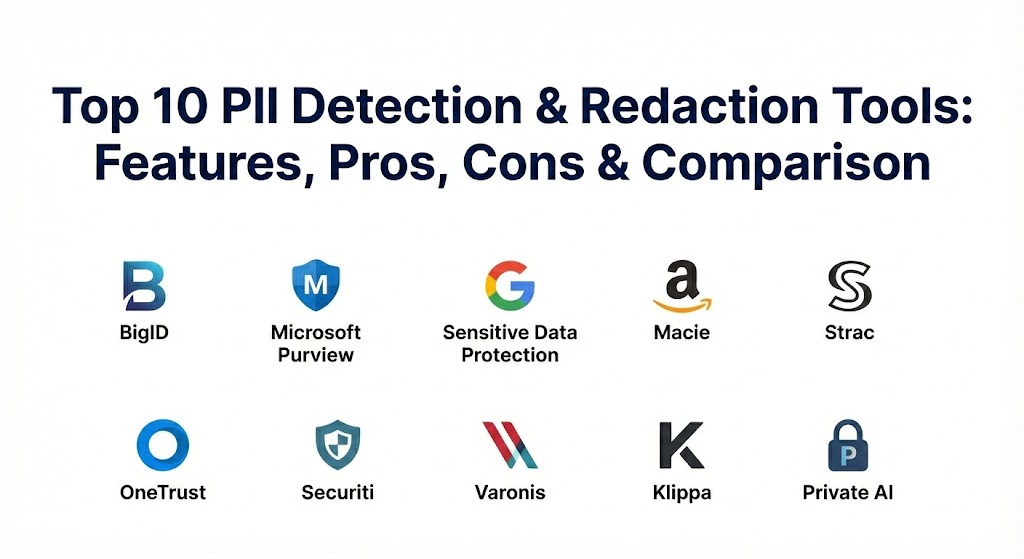
Top 10 PII Detection & Redaction Tools
1 — BigID
BigID is a powerhouse in the data intelligence space, focusing on deep data discovery and PII governance. It goes beyond simple scanning by using identity-centric “correlation” to link fragmented PII back to specific individuals.
- Key features:
- Correlation-based discovery that identifies “shadow” PII.
- Automated data mapping and inventorying across all environments.
- Privacy-by-design workflows for Data Subject Access Requests (DSARs).
- Native redaction and masking for both structured and unstructured data.
- Integration with major data catalogs and governance platforms.
- Risk scoring based on the sensitivity and location of the data.
- Pros:
- Unrivaled at finding “dark data” that other pattern-matching tools miss.
- Extremely strong compliance reporting specifically built for legal audits.
- Cons:
- The platform is highly complex and usually requires a dedicated administrator.
- Pricing is at the high end of the market, targeted at large enterprises.
- Security & compliance: SOC 2 Type II, ISO 27001, GDPR, HIPAA, and CCPA compliant.
- Support & community: High-tier enterprise support, professional training certifications, and an extensive documentation portal.
2 — Microsoft Purview
For organizations operating within the Microsoft ecosystem, Purview (formerly Azure Purview and Microsoft 365 Compliance) is the native solution for detecting and redacting PII across the entire Microsoft 365 and Azure stack.
- Key features:
- Over 200 built-in “Sensitive Information Types” (SITs) for global PII.
- Automatic labeling and encryption based on PII detection.
- Integrated redaction for Teams chats, SharePoint files, and emails.
- Discovery support for non-Microsoft data via specialized connectors.
- Unified compliance manager dashboard with “Compliance Score.”
- Data lifecycle management to automatically delete or archive PII.
- Pros:
- Seamless integration; if you use Office 365, it is already “there.”
- Superior at managing PII within communication channels like Teams.
- Cons:
- Feature sets are fragmented across different license tiers (E3 vs. E5).
- Performance can be slower when scanning large on-premises data sources.
- Security & compliance: FIPS 140-2, FedRAMP, HIPAA, SOC 2, and GDPR.
- Support & community: Backed by the global Microsoft support network and a massive community of IT professionals.
3 — Google Cloud Sensitive Data Protection
Formerly known as Cloud DLP, this Google Cloud service is a high-performance API that allows for the real-time discovery, classification, and de-identification of sensitive data.
- Key features:
- Powerful API for redacting PII in text, images, and structured tables.
- Built-in support for 150+ infoTypes (SSN, credit cards, global IDs).
- De-identification techniques including masking, bucketing, and tokenization.
- Native integration with BigQuery, Cloud Storage, and Datastore.
- Capability to inspect images for PII via integrated OCR.
- Streaming redaction for real-time application logs and chat flows.
- Pros:
- The API is incredibly fast and developer-friendly for building custom apps.
- Offers the most sophisticated “masking” options, like format-preserving encryption.
- Cons:
- Consumption-based pricing can lead to “bill shock” if scanning petabytes of data.
- Lacks a dedicated “human-in-the-loop” review UI for manual redaction.
- Security & compliance: ISO 27001, SOC 3, HIPAA, and GDPR compliant.
- Support & community: Extensive developer documentation and support through Google Cloud’s standard channels.
4 — Amazon Macie
Amazon Macie is the AWS-native data security service that uses machine learning and pattern matching to discover and protect sensitive PII stored in Amazon S3.
- Key features:
- Continuous automated discovery of PII across S3 buckets.
- Visual dashboards showing public vs. private bucket exposure.
- Managed data identifiers for common PII types across various countries.
- Integration with AWS EventBridge for automated remediation (e.g., closing public access).
- Capability to perform targeted “sensitive data discovery jobs.”
- Low-cost, scalable architecture designed for high-volume storage.
- Pros:
- Very affordable for users who need PII visibility specifically for S3 storage.
- Simple “one-click” deployment within the AWS Management Console.
- Cons:
- Strictly limited to the AWS environment; cannot scan local servers or other clouds.
- Detection accuracy can sometimes suffer with highly specialized, non-standard PII.
- Security & compliance: FedRAMP, HIPAA, SOC 1/2/3, and PCI DSS.
- Support & community: Supported by the vast AWS technical community and AWS Premium Support plans.
5 — Strac
Strac is a modern, “DLP-as-a-service” platform that specializes in real-time PII detection and redaction for SaaS tools (like Slack and Zendesk) and LLM/GenAI prompts.
- Key features:
- Real-time redaction for Slack messages, emails, and support tickets.
- AI-based detection that recognizes PII in context, reducing false positives.
- No-code integration with SaaS apps via secure API gateways.
- Anonymization for ChatGPT and other LLM prompts to prevent data leakage.
- Self-service portal for developers to integrate redaction into custom apps.
- Audit logs showing what was redacted and who attempted to view it.
- Pros:
- The best choice for securing “shadow IT” and modern collaboration tools.
- Extremely fast setup; often takes minutes to connect to a SaaS environment.
- Cons:
- Newer to the market compared to giants like IBM or Microsoft.
- Less focus on deep scanning of legacy on-premises databases.
- Security & compliance: SOC 2 Type II, HIPAA, and PCI compliant.
- Support & community: Highly responsive startup-style support with direct access to engineers.
6 — OneTrust Data Discovery
OneTrust is a leader in the broader GRC (Governance, Risk, and Compliance) space. Its discovery tool is designed to feed directly into its privacy management workflows.
- Key features:
- Integrated data mapping that links PII to “legal basis” and retention policies.
- Support for 500+ pre-built connectors to cloud and on-prem systems.
- Automated privacy impact assessments (PIAs) triggered by PII discovery.
- Collaborative workflows for legal and security teams.
- Regulatory research portal integrated directly into the dashboard.
- Visual “lineage” showing how PII moves through the organization.
- Pros:
- Best for organizations that want discovery to be part of a total privacy program.
- Unmatched regulatory intelligence built into the platform.
- Cons:
- Can feel “bloated” if you only need PII detection and not a full GRC suite.
- Interface is quite complex due to the sheer number of modules.
- Security & compliance: ISO 27001, SOC 2, GDPR, HIPAA, and APEC Cross-Border Privacy.
- Support & community: Massive user community and a professional “OneTrust University” for training.
7 — Securiti
Securiti provides a “Data Command Center” that unifies data security, privacy, and governance. It is particularly strong at managing PII in complex, hybrid-cloud “Data Lakes.”
- Key features:
- AI-powered “Sensitive Data Intelligence” for structured and unstructured data.
- Unified policy engine to enforce PII masking across different clouds.
- Automated consent management linked to PII records.
- Real-time monitoring for PII “sprawl” and unauthorized access.
- Support for multi-cloud DSPM (Data Security Posture Management).
- Integrated redaction for documents and images.
- Pros:
- Excellent visibility into “Who” is accessing “What” PII across the entire cloud.
- Very modern, clean interface that simplifies complex governance tasks.
- Cons:
- Implementation can be complex for very old, legacy on-prem systems.
- Higher pricing tiers for advanced automation features.
- Security & compliance: SOC 2 Type II, HIPAA, GDPR, and ISO 27001.
- Support & community: Strong professional services and comprehensive documentation.
8 — Varonis
Varonis is a veteran in data security, specializing in unstructured data (files and emails). It focuses on the “blast radius” of PII—who can access it and whether they are actually using it.
- Key features:
- Automated PII classification for file shares, SharePoint, and OneDrive.
- Behavioral analytics that detect if someone is downloading excessive PII.
- “Least Privilege” automation that removes unnecessary access to PII.
- Real-time alerts for PII exposure (e.g., sensitive files shared with “Everyone”).
- Comprehensive audit trail of every file touch.
- Integration with DLP tools to enforce redaction policies.
- Pros:
- The undisputed leader for securing unstructured “dark” data in file systems.
- Exceptional at reducing risk by automatically locking down over-exposed PII.
- Cons:
- Traditionally requires on-prem infrastructure for management (though SaaS is now available).
- Primarily focused on access and discovery rather than “active” redaction within the file.
- Security & compliance: FIPS 140-2, GDPR, HIPAA, and SOC 2.
- Support & community: World-class support and a very active technical blog and user group.
9 — Klippa DocHorizon
Klippa focuses specifically on the “document” side of PII. It is an Intelligent Document Processing (IDP) platform that excels at redacting PII from scanned PDFs, invoices, and IDs.
- Key features:
- AI-powered OCR that recognizes PII in 100+ languages.
- High-volume batch redaction for digital transformation projects.
- Specific detectors for IDs, signatures, and medical codes.
- Web-based interface for manual “Human-in-the-loop” review.
- Capability to anonymize faces and license plates in images.
- Developer-friendly SDK and API for mobile/web integration.
- Pros:
- Faster and more accurate for “scanned document” redaction than general cloud tools.
- Excellent for European companies due to its focus on diverse document types.
- Cons:
- Not designed for scanning databases or cloud “buckets” like S3.
- Lacks broader data governance or access management features.
- Security & compliance: GDPR compliant, ISO 27001, and data is never stored on their servers.
- Support & community: Direct support from a dedicated team of document-AI experts.
10 — Private AI
Private AI is a specialized solution that offers high-accuracy, privacy-preserving PII detection and anonymization for text, audio, and video.
- Key features:
- Support for 50+ languages with high-precision NER (Named Entity Recognition).
- On-device/On-prem deployment to ensure data never leaves your environment.
- Synthetic data replacement (replacing PII with realistic but fake data).
- Redaction for audio transcripts and video overlays.
- Specialized models for medical (PHI) and financial data.
- Lightweight Docker-based architecture for easy scaling.
- Pros:
- The go-to for developers who need “privacy-first” redaction without cloud dependency.
- Exceptional at handling conversational PII (slang, typos, context).
- Cons:
- Requires some engineering effort to integrate the Docker containers into your pipeline.
- Lacks the “all-in-one” governance dashboards of BigID or OneTrust.
- Security & compliance: HIPAA, GDPR, and SOC 2. Supports “Zero Knowledge” architectures.
- Support & community: Highly technical support and detailed API documentation.
Comparison Table
| Tool Name | Best For | Platform(s) Supported | Standout Feature | Rating (Gartner/G2) |
| BigID | Enterprise Discovery | Cloud, On-Prem, SaaS | Correlation Intelligence | 4.6 / 5 |
| Microsoft Purview | M365 Ecosystem | Azure, M365 | Native Teams Redaction | 4.4 / 5 |
| Google SDP | Developers / API | GCP, API-based | Format-Preserving Encryption | 4.5 / 5 |
| Amazon Macie | AWS Security | AWS S3 Only | “One-Click” S3 Discovery | 4.3 / 5 |
| Strac | SaaS & GenAI | Slack, Zendesk, SaaS | Real-time Chat Redaction | 4.8 / 5 |
| OneTrust | Legal & GRC Teams | Cloud, SaaS | Regulatory Intelligence | 4.5 / 5 |
| Securiti | Multi-Cloud Governance | Multi-Cloud, Hybrid | Data Command Center | 4.7 / 5 |
| Varonis | Unstructured Data | Windows, SharePoint | Access/Blast Radius Control | 4.7 / 5 |
| Klippa | Document Redaction | Web, API, Mobile | Scanned ID/Invoice AI | 4.6 / 5 |
| Private AI | Privacy-First / LLMs | On-Prem, Docker | Synthetic Data Replacement | 4.8 / 5 |
Evaluation & Scoring of PII Detection & Redaction Tools
| Category | Weight | Evaluation Criteria |
| Core Features | 25% | Detection accuracy (Recall), redaction variety (Masking/Hashing), and file support. |
| Ease of Use | 15% | Dashboard clarity, manual review workflow, and “no-code” potential. |
| Integrations | 15% | API depth, native cloud connectors, and MLOps ecosystem support. |
| Security & Compliance | 10% | Encryption levels, certifications (SOC2/HIPAA), and on-prem deployment. |
| Performance | 10% | Throughput speed for petabyte-scale data and low-latency API response. |
| Support & Community | 10% | Documentation quality, speed of support response, and training resources. |
| Price / Value | 15% | Cost-per-scan or seat vs. efficiency gains and risk reduction. |
Which PII Detection & Redaction Tool Is Right for You?
Selecting the right tool depends heavily on your data’s “home” and your primary use case.
- Solo Users & Researchers: For small-scale projects or academic research, the open-source Microsoft Presidio (not on this list but excellent) or a limited tier of Private AI is perfect for local data sanitization.
- Small to Medium Businesses (SMBs): If you rely heavily on Slack, Gmail, or Zendesk, Strac is the most cost-effective way to prevent PII leakage without needing a full security team.
- Mid-Market Companies: Organizations with mixed cloud/on-prem footprints should look at Securiti or Varonis. They offer a great balance of automation and high-level risk visibility without the extreme price of Tier-1 enterprise tools.
- Enterprise & Regulated Sectors: BigID and OneTrust are the gold standards for large legal and compliance teams. They provide the “defensible audit trail” that regulators demand during a formal inquiry.
- Cloud-First Developers: If you are building your own AI applications, use Google Cloud Sensitive Data Protection or Private AI via API. These allow you to embed redaction directly into your data pipelines seamlessly.
Frequently Asked Questions (FAQs)
1. What is the difference between “Anonymization” and “Pseudonymization”? Anonymization is a permanent process where data is stripped of all identifiers so it can never be relinked. Pseudonymization replaces identifiers with fake ones (pseudonyms), allowing for relinking only if you have a secure key.
2. Can these tools redact PII from images and handwritten notes? Yes. Tools like Klippa and Google SDP use advanced OCR (Optical Character Recognition) to “read” text inside images and scanned documents and apply redaction masks over the sensitive areas.
3. Do these tools store my sensitive data on their servers? Most modern enterprise tools (like Strac, Private AI, and Klippa) are designed with privacy in mind. They process data in memory or within your private cloud and do not store a copy of the sensitive information.
4. How do these tools handle false positives? False positives (non-PII marked as PII) are common. Mature tools use “Contextual Awareness”—for example, they check if a 9-digit number is preceded by the word “SSN” before flagging it, significantly reducing noise.
5. Is redacting a PDF as simple as putting a black box over the text? No. Simply drawing a black box in a standard editor doesn’t remove the metadata underneath. Specialized redaction tools “burn” the black bars into the pixels and scrub the underlying text from the file’s XML.
6. Can PII detection be used for real-time chat monitoring? Yes, platforms like Strac and Microsoft Purview can intercept messages in Slack or Teams, detect PII, and redact it before it is ever permanently stored in the chat history.
7. Why is PII redaction important for Generative AI (LLMs)? If employees paste customer data or internal secrets into ChatGPT, that data could potentially be used for future model training. Redaction tools act as a “firewall” to strip PII before the prompt reaches the AI.
8. What is “Format-Preserving Encryption” (FPE)? FPE is a masking technique that replaces a credit card number with another 16-digit number. This allows database structures and applications to keep working without crashing, even though the data is fake.
9. Do I need these tools if I already have a firewall and encryption? Yes. Firewalls prevent outsiders from getting in, and encryption protects data from being read if stolen. However, PII redaction is about “internal” privacy—ensuring that your own employees and data scientists only see what they need to see.
10. Are there open-source alternatives for PII detection? Yes, Microsoft Presidio and Stanford CoreNLP are popular open-source frameworks. They are excellent for developers but lack the management dashboards and native cloud connectors of commercial platforms.
Conclusion
The “Best” PII detection and redaction tool is ultimately the one that integrates most naturally into your existing data flow. As data privacy laws continue to tighten in 2026, the cost of “doing nothing” far outweighs the investment in these platforms. Whether you choose the deep correlation of BigID, the cloud-native speed of Google, or the real-time SaaS protection of Strac, the goal remains the same: transforming your data from a ticking time bomb of liability into a safe, useful asset.