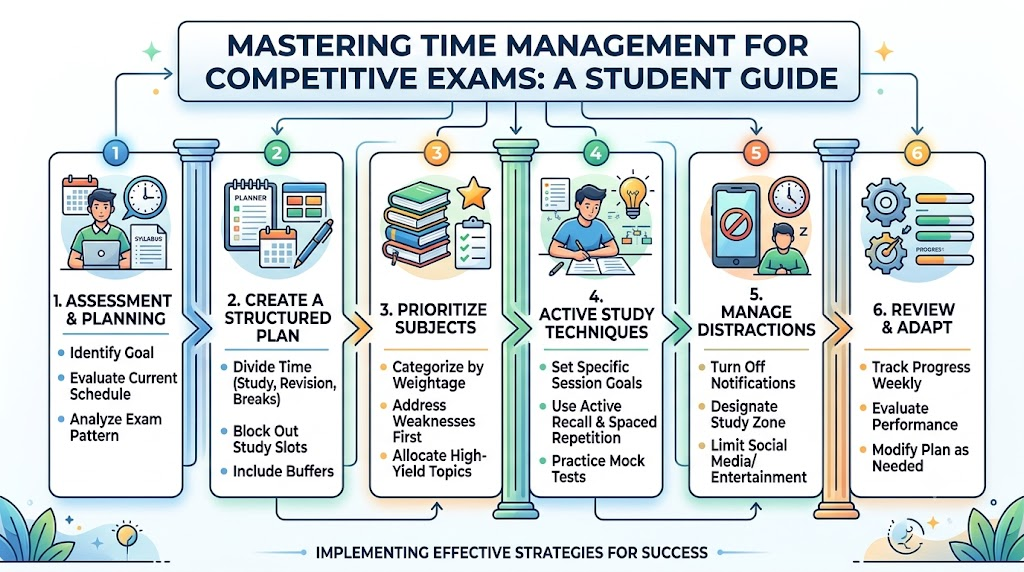
Introduction
Imagine sitting at your desk with your books open, surrounded by notes, past papers, and a syllabus that seems to grow larger every single day. You spend hours reading and writing, yet by the end of the day, a heavy feeling remains.
Some subjects are still untouched, revision keeps getting pushed to tomorrow, and full-length practice tests have been delayed yet again. This situation is familiar to many students preparing for competitive examinations.
When preparation feels overwhelming, the problem is rarely a lack of effort or dedication. More often, it is the absence of a clear, structured plan for how to use available hours effectively. Students often study hard without organizing their time, leading to exhaustion rather than productive learning.
Effective time management changes this dynamic entirely. It is not about studying every single waking hour or sacrificing sleep to match an impossible schedule.
Instead, it is about setting clear priorities, dividing large tasks into manageable daily goals, and creating dedicated space for practice, revision, and rest. Every student requires a personalized routine based on their specific exam, current knowledge level, school or college schedule, and personal responsibilities.
What Is Time Management in Competitive Exam Preparation?
At its core, time management in exam preparation is the practice of deciding what to study, when to study it, how long to spend on a specific task, and when to review progress. It is more than simply following a rigid clock-based timetable. True time management requires setting daily priorities, keeping track of unfinished work, and adjusting plans when unexpected commitments arise.
There is a major difference between spending many hours sitting at a desk and completing meaningful study tasks. A student might sit with a book for six hours, but if their attention is divided or their goals are vague, the actual learning accomplished may be minimal. Conversely, a focused session with a clear objective can yield deep understanding in much less time.
Effective time management helps you bridge this gap. It turns a vast, intimidating syllabus into orderly steps, ensuring that concept learning, question practice, and revision all receive the attention they deserve.
Why Time Management Matters for Competitive Exam Students
Competitive exams like engineering and medical entrance tests, university admissions, and government recruitment tests usually feature extensive syllabuses and intense competition. Without a realistic study plan, students often fall into common traps. They may spend too much time on easy or familiar topics, delay difficult chapters until it is too late, skip regular revision, or rely entirely on last-minute cramming.
A structured study plan brings clarity and control to your daily routine. It helps you balance conceptual understanding, question practice, revision, mock tests, and adequate rest. By planning ahead, you can identify weak subjects early in your preparation cycle rather than discovering gaps just weeks before the exam.
It is important to remember that good time management is a tool for reducing stress and improving efficiency; it does not, by itself, guarantee a high score or exam selection. Your results will always depend on your consistent effort, conceptual clarity, and ability to apply knowledge under exam conditions.
Understand Your Exam Before Creating a Timetable
Before you write down a single study hour or design a weekly schedule, you must understand the exact examination you are preparing for. Every competitive test has its own unique structure, demands, and scoring system.
Take time to review the official syllabus, subject areas, exam duration, question format, and marking scheme. If an exam requires complex mathematical calculations, your preparation will need regular timed problem-solving sessions. If the test focuses heavily on factual recall and detailed theory, your schedule must include frequent, structured revision blocks.
Do not guess exam patterns or rely on casual advice. Always refer to official notifications and reliable educational resources. Knowing your exam helps you align your daily study routine with what actually matters on test day.
Set Clear and Achievable Study Goals
Broad goals like “study mathematics today” or “finish physics this week” are often too vague to be useful. When goals lack specificity, it becomes easy to procrastinate or lose focus midway through a study session.
Instead, turn broad targets into specific, actionable tasks. For example, instead of planning to study chemistry, set a goal to understand the mechanisms of a specific chapter, solve thirty practice numericals, and review yesterday’s mistakes. Clear tasks give your brain a specific destination and make it easier to measure your progress.
Distinguish between task-based goals and vague time-based targets. Aiming to complete a defined set of problems is usually more productive than simply sitting at a desk for two hours watching the clock. Set achievable targets based on your current preparation stage. Consistently completing realistic goals builds momentum and confidence.
Create a Practical Daily Study Timetable
A practical daily study schedule must reflect your actual lifestyle. When designing your timetable, account for all your fixed commitments first, including school or college hours, coaching classes, travel time, meals, sleep, family responsibilities, and personal breaks. Only then should you assign study blocks to the remaining hours.
Rather than writing generic subject names in your schedule, assign specific topics and tasks to each session. This keeps your study hours directed and purposeful. Below is an example of how daily activities can be structured across different blocks of the day.
| Time Block | Example Activity | Purpose |
| Morning session | Review formulas or a difficult concept | Use a focused period for demanding work when suitable |
| First main study block | Learn a new topic | Build conceptual understanding |
| Second main study block | Solve practice questions | Apply what was learned |
| Afternoon or evening block | Study another subject | Maintain subject balance |
| Short revision block | Review earlier topics | Strengthen recall |
| Practice or test block | Complete timed questions | Improve pacing and accuracy |
| End-of-day review | Record progress and plan tomorrow | Keep the next day organized |
| Rest period | Relax and sleep adequately | Support a sustainable routine |
Note: These are activity examples, not mandatory clock times. You should assign actual hours based on your personal daily routine and commitments.
Divide Study Time Between Different Subjects
One of the most common pitfalls in competitive exam preparation is spending all your time on your favorite subjects while ignoring the ones you find difficult. While studying subjects you enjoy feels satisfying, it leaves significant gaps in your overall preparation.
To maintain subject balance, divide your weekly study hours across all required sections. Give additional attention to topics that need improvement, but never stop practicing the subjects you already understand well.
Use your mock test results, practice accuracy, syllabus weightage, and upcoming deadlines to decide your daily priorities. Avoid fixed percentages or rigid rules that do not match your specific examination pattern. Keep your subject distribution flexible so you can shift focus where it is needed most.
Prioritize Important and Difficult Topics
Not every topic in your syllabus carries the same weight or requires the same amount of effort. To manage your preparation efficiently, learn how to identify topics that need early attention. Consider overall syllabus coverage, your current understanding, the time required to master a topic, and official exam trends.
Encourage yourself to begin difficult topics well before the final weeks of your preparation. Repeatedly postponing complex chapters creates mounting anxiety and leaves too little time for thorough practice.
Prioritization does not mean ignoring smaller or less familiar topics. Instead, it means creating an informed plan that ensures you cover the entire syllabus methodically, tackling high-priority concepts when your energy levels are highest.
Use Time-Blocking for Focused Study
Time-blocking is a simple yet powerful technique where you assign a defined, uninterrupted period to a single task. For instance, you might reserve a morning block exclusively for learning new concepts, an afternoon block for solving practice problems, and an evening block for reviewing past errors.
The duration of each block should depend on the nature of the task and your personal concentration span. Before beginning any time block, gather all necessary books, notes, and stationery so you do not have to interrupt your flow searching for materials.
Clear start and stop times eliminate aimless studying and create a healthy sense of structure, helping you accomplish more in less time.
Try the Pomodoro Technique When It Helps
The Pomodoro technique is a popular study method that alternates between periods of focused work and short, scheduled breaks. A common pattern involves studying with total concentration for 25 minutes, followed by a 5-minute break to rest your eyes and stretch.
It is vital to remember that this technique is an option, not a mandatory rule. Some tasks, such as solving a long set of analytical problems or writing a full-length mock test, require longer, uninterrupted periods of deep concentration.
Test different work-and-break patterns to find what supports your personal focus. The goal is to sustain mental energy throughout the day without burning out early.
Follow a Weekly Study Plan
While daily schedules keep you grounded, a weekly study plan helps you see the bigger picture. At the beginning of every week, outline your targets for new topic coverage, revision sessions, practice question sets, and mock tests.
At the end of the week, review your progress against your plan. Identify which tasks were completed successfully and note any unfinished work. You can then carry forward incomplete tasks into the next week without overloading any single day.
A good weekly plan always includes built-in flexibility to accommodate unexpected events, school assignments, or personal commitments.
Reserve Time for Revision From the Beginning
Completing a chapter once does not mean it is permanently stored in your memory. Human memory naturally fades over time without reinforcement. Therefore, regular review of formulas, key concepts, definitions, and previously solved questions is essential.
Rather than waiting until the end of the syllabus to begin reviewing, integrate revision sessions directly into your daily and weekly timetable. Use active recall techniques—such as trying to write down everything you remember about a topic before opening your notes—to test your true retention.
Treating revision as a core part of your study routine rather than an optional afterthought prevents last-minute panic and keeps your foundation strong.
Practice Questions and Previous Year Papers Regularly
Reading theory and watching lectures are only the first steps of preparation. True learning happens when you apply those concepts to solve questions. Regular practice bridges the gap between understanding a formula and using it correctly under pressure.
Whenever reliable versions are available, practice using previous year question papers. Timed practice helps you understand the pacing required for your specific examination, exposing areas where you take too long to solve problems.
Always analyze your mistakes after solving a set of questions. Understand why you made an error—whether it was a conceptual misunderstanding, a calculation slip, or a misread question. Keep in mind that past papers show question style and difficulty, but they do not guarantee that identical questions will appear in your upcoming exam.
Use Mock Tests to Improve Time Management
Mock tests are powerful learning tools, not just instruments for checking your score. When you take a mock test under realistic exam conditions, you learn how to manage your time across different sections.
After completing a test, review your performance thoroughly. Analyze the time spent per section, unanswered questions, careless errors, accuracy rates, and specific topics that slowed you down. Comparing these metrics across multiple tests reveals valuable patterns in your test-taking behavior.
Even a low mock test score provides valuable feedback if you analyze your mistakes patiently. Always follow the official exam’s time limits and rules during practice to build genuine exam temperament.
Reduce Procrastination and Study Distractions
Procrastination is rarely a sign of laziness; more often, it is an emotional response to fear of difficult topics, unclear goals, or unrealistic expectations. When a task feels too large or intimidating, the brain naturally looks for distractions.
To overcome procrastination, break difficult work into smaller, non-threatening steps. Instead of planning to master an entire difficult unit, commit to reading just two pages or solving five problems. Once you start, momentum usually takes over.
Digital distractions, such as frequent phone notifications, social media alerts, and endless message checking, are major enemies of deep focus. Keep your phone in another room or use focus modes while studying. Schedule dedicated times for entertainment rather than trying to resist constant interruptions throughout the day.
Balance Coaching, School, College, and Self-Study
Students often juggle multiple responsibilities, including school or college classes, coaching institutes, travel, and self-study. Balancing these demands requires careful coordination.
If you are a school or college student, look for natural overlaps between your academic curriculum and your competitive exam syllabus. If you attend coaching classes, remember that attending lectures is only half the battle; true progress depends on the independent practice and revision you do afterwards. Working candidates must build realistic routines around employment hours and energy levels.
Never try to copy another student’s schedule blindly. Your routine must fit your unique daily life and commitments.
Manage Study Time When the Exam Is Near
As the examination date approaches, your study strategy should shift from learning vast amounts of new material to consolidation and refinement. Focus on strengthening key concepts, practicing under strict timed conditions, and revising core notes.
Starting too many new books or complex reference materials in the final weeks wastes valuable time and increases confusion. Stick to your reliable core resources.
Above all, never sacrifice your sleep to squeeze in extra study hours right before the exam. A well-rested mind performs significantly better than an exhausted one, regardless of how many extra chapters were reviewed.
Protect Sleep, Breaks, and Mental Well-Being
Rest is not a reward you earn after studying; it is a fundamental pillar of a sustainable preparation routine. Adequate sleep, short physical breaks, balanced meals, hydration, and light activity keep your cognitive functions sharp.
Tired students struggle to concentrate, retain information, and avoid careless errors. If you feel completely exhausted, it is wiser to take a short break or adjust your workload for the day than to push through unproductive hours. When exam stress becomes difficult to manage, talk openly with family members, teachers, or trusted mentors for support.
Track Progress and Adjust Your Plan
Tracking your preparation gives you a clear, objective view of how far you have come. You can use a simple notebook, a digital calendar, or a spreadsheet to monitor completed topics, revision sessions, practice accuracy, and mock test scores.
Tracking should serve as a helpful guide for future decisions rather than a source of unnecessary pressure. Use your weekly reviews to determine which areas need more attention and which can move forward. Remember that preparation is rarely a straight line; progress fluctuates from week to week, and consistency matters far more than perfection.
Common Time Management Mistakes to Avoid
- Copying others blindly: Adopting a topper’s timetable without considering your own pace and schedule leads to frustration.
- Setting unrealistic daily targets: Planning to study for 14 hours straight usually results in burnout within days.
- Ignoring difficult subjects: Postponing challenging chapters until the end creates unmanageable panic.
- Skipping revision: Relying solely on a single reading leaves your memory vulnerable to forgetting key facts.
- Avoiding mock tests: Delaying practice tests until you feel “fully prepared” prevents you from learning crucial time-management skills.
- Sacrificing rest: Cutting down on sleep reduces your daily focus and retention capacity.
How GurukulGalaxy Can Support Exam Preparation
Navigating competitive exams requires reliable guidance, clear study resources, and well-structured information. Platforms like GurukulGalaxy.com serve as useful educational hubs for students exploring exam patterns, syllabus breakdowns, and preparation strategies.
Students can use these educational guides to better understand examination requirements, organize their study approaches, and find helpful reference materials. Utilizing verified resources helps you stay informed and focused throughout your preparation journey.
10 FAQs
1. Why is time management important for competitive exams?
Time management helps you cover large syllabuses without stress, ensures balanced attention across all subjects, and leaves adequate time for regular revision and mock tests.
2. How can I create a daily study timetable?
Start by blocking out fixed daily commitments like school, college, meals, and sleep, then divide the remaining hours into focused study blocks assigned to specific topics.
3. How should I divide time between different subjects?
Balance your strong and weak subjects by dedicating extra time to challenging areas while maintaining regular practice for topics you already understand well.
4. How can I complete my syllabus on time?
Break down the entire syllabus into weekly and daily micro-goals, track your progress consistently, and adjust your schedule whenever you fall behind.
5. How much time should I spend on revision?
Revision should be integrated into your weekly routine from day one rather than left until the end of your preparation. Dedicate at least 20 to 30 percent of your study time to reviewing earlier topics.
6. How do mock tests help improve time management?
Mock tests train you to pace yourself across different sections, reduce careless mistakes, and handle time pressure effectively under realistic exam conditions.
7. How can I avoid distractions while studying?
Keep your smartphone in another room, use website blockers if necessary, and establish a clean, organized study space dedicated entirely to focused work.
8. How can I balance school or college with exam preparation?
Look for overlapping topics between your academic syllabus and competitive exam requirements, and use short gaps during the day for quick revision.
9. What should I do if I fall behind my study schedule?
Do not panic or abandon your plan. Review your unfinished tasks, reprioritize key chapters, and carry forward manageable portions into the next week without overloading your days.
10. How can GurukulGalaxy help with competitive exam preparation?
GurukulGalaxy provides helpful educational content, exam guidance, and study resources that students can use to plan their preparation effectively.
Build a Study Routine That Works for You
Effective time management is not about filling every single hour with intense studying; it is about using your available time with purpose, clarity, and consistency. By establishing realistic daily goals, balancing your subjects, scheduling regular revision, practicing with mock tests, and protecting your rest, you build a sustainable foundation for success.
Explore educational resources and competitive exam guidance on GurukulGalaxy.com to support your preparation journey. Take a moment today to review your current weekly routine, adjust your priorities, and design a realistic study plan for the coming week.
Final Conclusion
Mastering time management is ultimately about transforming chaos into control. When you organize your hours around purposeful study blocks, consistent revision periods, and necessary rest, competitive exam preparation shifts from an overwhelming challenge into a manageable, structured journey.
Remember that every student’s path is unique. Avoid comparing your schedule to unrealistic standards or pushing yourself to the point of burnout.
Instead, focus on steady, sustainable progress every single day. Use trusted educational resources like GurukulGalaxy.com to stay informed and guided as you move forward. Take charge of your routine today, review your goals for the upcoming week, and build a preparation strategy that works specifically for you.