Introduction
AIOps Platforms represent the next evolution of IT management. At its core, AIOps is the practice of using big data, analytics, and machine learning to automate and enhance IT operations. These platforms ingest massive volumes of data from various sources—logs, metrics, traces, and events—and use sophisticated algorithms to identify patterns that a human eye would likely miss.
Why It Is Important
In a world where five minutes of downtime can cost a Fortune 500 company millions, reactive troubleshooting is a liability. AIOps is critical because it provides noise reduction, filtering out thousands of redundant alerts to highlight the single root cause. It enables predictive maintenance, allowing teams to address a failing database or a saturated network link before it causes a full-scale outage. Essentially, it transforms IT teams from “firefighters” into “architects of uptime.”
Key Real-World Use Cases
- Automated Root Cause Analysis (RCA): Identifying the exact code change or infrastructure failure that triggered an incident.
- Anomaly Detection: Spotting unusual behavior in traffic patterns that might indicate a security breach or a looming system failure.
- Alert Correlation: Grouping hundreds of related alerts from different tools into a single, manageable incident.
- Capacity Optimization: Predicting future resource needs based on historical growth trends.
Evaluation Criteria
When choosing an AIOps platform, you must look for data ingestion breadth (can it talk to all your tools?), algorithm transparency (is the AI a “black box” or can you see the logic?), and remediation capabilities (can it actually trigger a script to fix the issue?).
Best for: Large-scale enterprises, Managed Service Providers (MSPs), and high-growth DevOps teams managing complex, hybrid-cloud environments. It is ideal for SREs and IT Ops leaders who need to scale operations without exponentially increasing headcount.
Not ideal for: Small businesses with simple, static infrastructures or single-server setups where the cost and complexity of training an AI model outweigh the manual effort of monitoring.
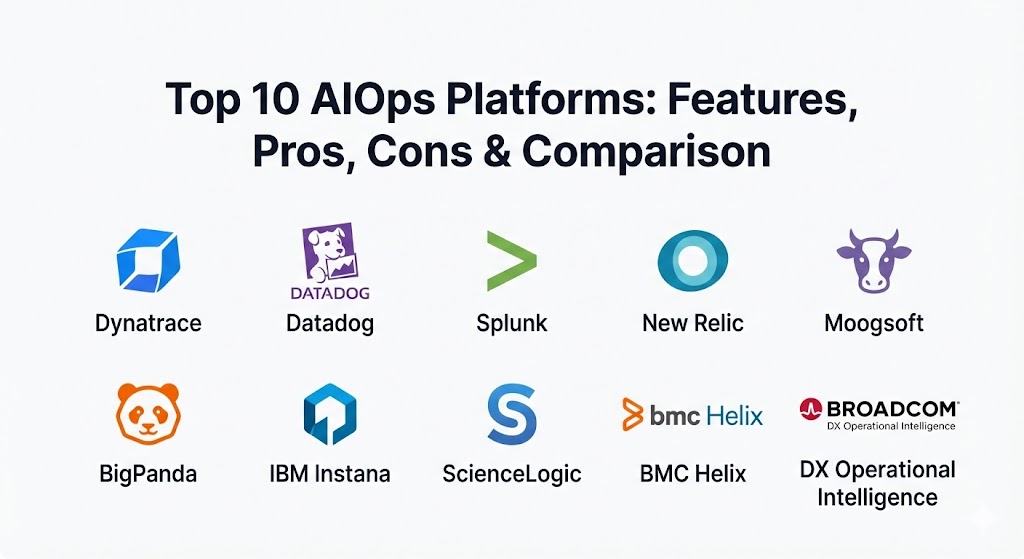
Top 10 AIOps Platforms
1 — Dynatrace
Dynatrace is a pioneer in the space, known for its “Davis” AI engine. It provides a full-stack observability platform that is designed to be highly automated, making it a favorite for organizations running large-scale Kubernetes and microservices environments.
- Key Features:
- Davis AI Engine: A deterministic AI that provides precise root-cause answers rather than just “guesses.”
- OneAgent Technology: Automatically discovers and monitors all components of the stack with a single installation.
- Smartscape Topology: Maps out the entire environment in real-time, showing how every component is connected.
- Cloud Automation: Integrated CI/CD quality gates that use AI to block buggy code from reaching production.
- Digital Experience Monitoring (DEM): Correlates backend performance with actual user behavior and satisfaction.
- PurePath Monitoring: Captures end-to-end distributed traces across every tier of the application.
- Pros:
- The automation is second to none; the tool practically maps your environment for you.
- The ” Davis” AI significantly reduces the time spent in war rooms during major incidents.
- Cons:
- It is one of the more expensive options on the market.
- The sheer depth of the platform can create a steep learning curve for junior administrators.
- Security & Compliance: SOC 2 Type II, HIPAA, GDPR, ISO 27001, and FedRAMP authorized. Includes robust SSO and audit logging.
- Support & Community: World-class documentation, a dedicated “Dynatrace University,” 24/7 premium support, and a highly active global user forum.
2 — Datadog
Datadog has rapidly evolved from a simple monitoring tool into a comprehensive AIOps and observability platform. Its “Watchdog” AI is designed to be accessible, providing proactive insights across the entire infrastructure.
- Key Features:
- Watchdog AI: Automatically detects anomalies and outliers across metrics and traces without manual setup.
- Unified Tagging: Allows teams to correlate data across different silos (logs, metrics, APM) using common metadata.
- Log Management: Ingests and processes logs at scale, using AI to categorize and find patterns in log data.
- Service Map: Provides a visual representation of how services interact and where bottlenecks are occurring.
- Incident Management: A built-in workflow to manage outages, integrated directly with Slack and PagerDuty.
- Pros:
- Extremely easy to set up and get value from almost immediately.
- Highly agile; they release new features and integrations faster than almost any competitor.
- Cons:
- Pricing can be unpredictable because it is billed per host, per log, and per trace.
- The “Watchdog” AI, while helpful, can sometimes feel less “deterministic” than Dynatrace’s Davis engine.
- Security & Compliance: SOC 2, HIPAA, GDPR, and ISO 27001 compliant. Offers powerful role-based access control (RBAC).
- Support & Community: Extensive technical documentation, a strong presence at industry conferences, and a very responsive support team.
3 — Splunk IT Service Intelligence (ITSI)
Splunk is the “big data” king of IT. Its ITSI platform leverages the massive amount of log data already in Splunk to provide deep AIOps capabilities, making it ideal for organizations that want to turn their data into business value.
- Key Features:
- Event Analytics: Uses machine learning to cluster massive amounts of events into high-level actionable items.
- Predictive Analytics: Can predict a potential service degradation up to 30 minutes before it happens.
- Service Health Scores: Aggregates various metrics into a single “health score” for business services.
- Glass Tables: Highly customizable executive dashboards that show real-time business and IT performance.
- Adaptive Thresholding: Automatically adjusts alert thresholds based on historical seasonal patterns.
- Pros:
- Unmatched capability for searching and analyzing massive datasets.
- Extremely flexible; if the data exists in Splunk, you can build an AI model around it.
- Cons:
- Managing Splunk at scale requires significant expertise and engineering resources.
- The cost of data ingestion can become astronomical for high-volume environments.
- Security & Compliance: FedRAMP, SOC 2 Type II, HIPAA, PCI DSS, and ISO 27001.
- Support & Community: One of the largest communities in the tech world (“Splunk Answers”) and high-tier enterprise support.
4 — New Relic AI
New Relic has consolidated its various tools into the “New Relic One” platform, which features a robust AI engine designed to reduce alert fatigue and provide instant root cause analysis for developers.
- Key Features:
- Applied Intelligence: Automatically detects anomalies and groups related alerts to reduce noise by up to 80%.
- Looker Integration: Deep visualization capabilities to slice and dice performance data.
- Errors Inbox: A centralized location for developers to track and resolve every error across the stack.
- Full-Stack Observability: Connects application performance directly to the underlying infrastructure and end-user data.
- Pros:
- The “per-user” pricing model is more predictable for some teams than the “per-host” model.
- Very developer-friendly, with a focus on fixing code issues quickly.
- Cons:
- The transition to the “New Relic One” interface was rocky for some long-term users.
- Some AI features require a higher level of data ingestion to be truly effective.
- Security & Compliance: SOC 2, GDPR, and HIPAA compliant. High-standard data encryption and SSO.
- Support & Community: New Relic University provides excellent training; support is tiered based on the subscription level.
5 — Moogsoft
Moogsoft is a “pure-play” AIOps platform, meaning its primary focus has always been AI-driven operations. It is specifically designed to sit on top of your existing monitoring tools and act as the “brain” that correlates their data.
- Key Features:
- Patented Algorithms: Uses noise reduction algorithms that don’t require manual training or “rules.”
- Situation Manager: Groups related alerts into a “Situation,” providing a timeline of how an incident evolved.
- Collaborative Team Room: A built-in virtual room for SREs to collaborate on active incidents.
- Integration Hub: Connects seamlessly with hundreds of tools like ServiceNow, Jira, and Slack.
- Pros:
- One of the best in the industry at reducing alert noise in very noisy environments.
- Agnostic approach; it doesn’t care which monitoring tools you use, it just makes them better.
- Cons:
- As a standalone tool, it’s an “extra” layer to manage and pay for.
- Does not provide its own monitoring agents (it relies on other data sources).
- Security & Compliance: SOC 2 Type II, GDPR, and ISO 27001 compliant.
- Support & Community: Known for very high-touch customer success and personalized onboarding.
6 — BigPanda
BigPanda is an Event Correlation and Automation platform that focuses on helping IT Ops teams manage the “Event Life Cycle.” It is particularly strong for organizations dealing with massive alert storms from fragmented tools.
- Key Features:
- Open Box AI: Transparent AI logic that allows you to see why the system grouped specific alerts.
- Root Cause Analysis: Correlates changes (like CI/CD deploys) with incidents to find the “who” and “what.”
- Unified Analytics: Provides long-term reports on team performance and system reliability.
- Automated Remediation: Integrates with tools like Ansible and SaltStack to automate fixes.
- Pros:
- The transparency of the AI (“Open Box”) builds trust with skeptical engineering teams.
- Excellent for consolidating data from many different legacy and modern monitoring tools.
- Cons:
- Requires a fair amount of configuration to get the correlation logic “just right.”
- Focused strictly on event management; not a full APM or infrastructure monitoring tool.
- Security & Compliance: SOC 2 Type II, GDPR, and HIPAA compliant.
- Support & Community: Strong professional services and dedicated account management for enterprise clients.
7 — IBM Instana
Instana, now part of IBM, is a fully automated Enterprise Observability platform. It is built specifically for the challenges of cloud-native, microservices-heavy applications that change constantly.
- Key Features:
- Dynamic Graph: A real-time model of your entire application that updates every second.
- Automated Full-Stack Monitoring: Zero-configuration monitoring for over 200 technologies.
- Contextual RCA: When an alert triggers, Instana provides the full context of the failure, including traces and logs.
- Pipeline Feedback: Tells developers exactly how a recent deployment affected performance.
- Pros:
- One-second data granularity is among the highest in the industry.
- The automatic discovery is incredibly fast and accurate.
- Cons:
- The interface can feel very “busy” because of the amount of real-time data being shown.
- Less focus on legacy mainframes/infrastructure compared to IBM’s other tools.
- Security & Compliance: ISO 27001, SOC 2, GDPR, and HIPAA.
- Support & Community: Backed by IBM’s global support infrastructure and a growing community of cloud-native experts.
8 — ScienceLogic SL1
ScienceLogic’s SL1 platform is a leader in the AIOps space for hybrid cloud environments. It focuses on “contextualizing” data to help teams understand how infrastructure issues impact business services.
- Key Features:
- Data Lake Integration: Ingests data from any source to create a “canonical” view of the environment.
- Behavioral Correlation: Uses machine learning to find relationships between disparate data points.
- Automated Workflows: Out-of-the-box workflows for incident management and troubleshooting.
- Hybrid Cloud Visibility: Equal focus on on-premise hardware and public cloud services.
- Pros:
- Excellent for companies in the middle of a multi-year migration to the cloud.
- Very strong at monitoring networking hardware and storage arrays.
- Cons:
- The platform can feel quite complex and “enterprise-heavy.”
- The UI is functional but lacks the modern “slickness” of tools like Datadog or Instana.
- Security & Compliance: ISO 27001, SOC 2, GDPR, and FedRAMP (JAB) authorized.
- Support & Community: High-quality training programs and specialized support for service providers.
9 — BMC Helix Operations Management
BMC has reinvented its operations suite for the AIOps era. The Helix platform combines IT Service Management (ITSM) with AIOps, creating a “service-aware” monitoring environment.
- Key Features:
- Service-Centric AIOps: Understands how a server failure impacts specific business processes (like payroll).
- Probable Cause Analysis: Uses AI to rank potential causes of an incident by probability.
- Integrated ITSM: Seamless flow from an AI-detected incident to a ServiceNow or BMC Helix ticket.
- Multi-Cloud Discovery: Automatically finds and maps resources across AWS, Azure, and GCP.
- Pros:
- The best choice for organizations that are already deeply invested in the BMC ecosystem.
- Strong focus on compliance and governance in highly regulated industries.
- Cons:
- Can be slower to implement than lightweight SaaS-only competitors.
- The pricing structure is traditional enterprise-style (complex and high).
- Security & Compliance: FedRAMP, SOC 2, HIPAA, and ISO 27001.
- Support & Community: Extensive global support network and professional services.
10 — Broadcom DX Operational Intelligence
Part of the Broadcom (formerly CA Technologies) portfolio, DX Operational Intelligence is built for the largest, most complex global networks and infrastructures.
- Key Features:
- Full-Stack Analytics: Correlates data from mobile to mainframe.
- Capacity Analytics: Uses ML to predict when you will run out of storage or compute resources.
- Network Flow Analysis: Deep AI insights into network traffic patterns and bottlenecks.
- Service Experience Insights: Measures the end-user impact of infrastructure performance.
- Pros:
- Incredible scale; it can handle millions of metrics per second across global sites.
- Deep expertise in network and mainframe monitoring that most SaaS tools lack.
- Cons:
- Not suitable for small or mid-sized teams; it is a “heavyweight” tool.
- Can be difficult to navigate for those not used to Broadcom/CA interfaces.
- Security & Compliance: High-level enterprise certifications including SOC 2, ISO, and GDPR.
- Support & Community: High-tier enterprise support and extensive professional training certifications.
Comparison Table
| Tool Name | Best For | Platform(s) Supported | Standout Feature | Rating (Gartner / TrueReviewnow) |
| Dynatrace | Enterprise Observability | SaaS / Managed | Davis Deterministic AI | 4.7 / 5 |
| Datadog | Agile DevOps Teams | SaaS | Speed of Feature Release | 4.5 / 5 |
| Splunk ITSI | Big Data Analytics | SaaS / On-Prem | Predictive Service Health | 4.3 / 5 |
| New Relic | Developer-Centric Ops | SaaS | Per-User Pricing Model | 4.4 / 5 |
| Moogsoft | Noise Reduction | SaaS | Agnostic Correlation | 4.2 / 5 |
| BigPanda | Event Management | SaaS | “Open Box” (Transparent) AI | 4.5 / 5 |
| IBM Instana | Microservices/K8s | SaaS / Self-Host | 1-Second Granularity | 4.6 / 5 |
| ScienceLogic | Hybrid Cloud | SaaS / On-Prem | Contextual Device Mapping | 4.1 / 5 |
| BMC Helix | ITSM Integration | SaaS | Service-Aware AIOps | 4.0 / 5 |
| Broadcom DX | Mainframe & Network | SaaS / On-Prem | Scale (Mobile to Mainframe) | 4.2 / 5 |
Evaluation & Scoring of AIOps Platforms
Choosing an AIOps platform requires a structured approach. Below is the rubric used by many industry analysts to evaluate these tools.
| Criteria | Weight | Evaluation Logic |
| Core Features | 25% | Anomaly detection, root cause analysis, and correlation logic. |
| Ease of Use | 15% | Time-to-value, UI design, and automated discovery capabilities. |
| Integrations | 15% | Ecosystem of out-of-the-box connectors for cloud and legacy tools. |
| Security & Compliance | 10% | Certifications (SOC 2, HIPAA) and data encryption protocols. |
| Performance | 10% | Ability to handle high-cardinality data and real-time processing. |
| Support & Community | 10% | Availability of documentation, forums, and 24/7 technical support. |
| Price / Value | 15% | Transparency of the billing model and overall ROI. |
Which AIOps Platform Is Right for You?
Solo Users vs SMB vs Mid-Market vs Enterprise
- Solo Users/Small Teams: Most likely don’t need a full AIOps suite. However, if you must, Datadog’s entry-level tiers are the most approachable.
- SMBs: New Relic and Datadog are the strongest contenders because of their lower barrier to entry and SaaS-first nature.
- Mid-Market: Moogsoft or BigPanda can be great “add-on” tools if you already have a monitoring stack that is producing too much noise.
- Enterprise: Dynatrace, Splunk, and IBM Instana are the power players that can handle the complexity of global infrastructure.
Budget-Conscious vs Premium Solutions
If budget is the primary concern, Instatus (for status pages) or Better Stack (for basic uptime/logs) might be better alternatives. If you are committed to AIOps, New Relic’s per-user model can often work out cheaper than host-based billing. Dynatrace and Splunk are premium solutions for those who view uptime as their primary revenue driver.
Feature Depth vs Ease of Use
- Maximum Depth: Splunk ITSI and Dynatrace. These tools can see everything, but they require dedicated engineers to maintain.
- Maximum Ease: Instana and Datadog. These tools prioritize “auto-discovery” and minimal manual configuration.
Integration and Scalability Needs
If you have a lot of legacy gear (mainframes, old Cisco switches), ScienceLogic or Broadcom are superior to the modern SaaS tools. If you are 100% in the cloud with Kubernetes, Instana or Dynatrace should be your top choices.
Frequently Asked Questions (FAQs)
1. What is the difference between Observability and AIOps?
Observability is the ability to understand the internal state of a system from the data it produces (logs, metrics, traces). AIOps is the layer of intelligence that analyzes that data to automate tasks and provide insights.
2. Does AIOps replace IT staff?
No. It replaces the “grunt work”—manually sifting through alerts and correlating logs. It allows IT staff to focus on higher-value tasks like architecture, security, and performance optimization.
3. Is AIOps a “Black Box”?
Historically, yes, but modern tools like BigPanda and Dynatrace focus on “Explainable AI.” They show you the logic used to reach a conclusion so your engineers can verify it.
4. How long does it take to “train” an AIOps tool?
Some tools (like Instana) are ready in minutes. Others (like Splunk ITSI) may take weeks of data ingestion to build accurate baseline models for your specific environment.
5. Can AIOps fix problems automatically?
Yes, this is called “Closed-Loop Remediation.” When the AI identifies a root cause, it can trigger a webhook to a tool like Ansible or ServiceNow to restart a service or clear a disk.
6. Do I need to be in the cloud to use AIOps?
No. Many platforms (ScienceLogic, BMC, Broadcom) are specifically designed for hybrid environments that include on-premise data centers and legacy hardware.
7. What is “Alert Fatigue”?
Alert fatigue happens when IT teams are overwhelmed by thousands of minor or redundant alerts, leading them to ignore or miss the truly critical ones. AIOps solves this via noise reduction.
8. Is AIOps expensive?
It can be. However, the ROI is usually measured in the reduction of “Mean Time to Repair” (MTTR) and the avoidance of costly outages.
9. What data does an AIOps platform need?
The “Big Three” of data sources are Metrics (numeric data), Logs (textual records), and Traces (the path of a request). Most also ingest “Events” from other software.
10. What is the most common mistake when implementing AIOps?
The “Garbage In, Garbage Out” problem. If your underlying data is poor or your systems aren’t properly instrumented, even the best AI won’t be able to provide helpful insights.
Conclusion
The transition to AIOps is no longer optional for large-scale digital businesses—it is a survival strategy. The “best” tool ultimately depends on your starting point. If you are a cloud-native shop that wants total automation, Dynatrace and Instana are hard to beat. If you are a data-heavy organization already using Splunk, extending into ITSI is a natural move.
What matters most is choosing a platform that your team actually trusts. The goal is to move away from guesswork and toward data-driven certainty. As AI continues to evolve, these platforms will only become more autonomous, eventually leading us toward the vision of a “Self-Healing” data center.