Introduction
An Account-Based Marketing (ABM) platform is a specialized suite of software tools designed to help B2B organizations identify, track, and engage specific high-value accounts throughout the entire buying journey. Unlike traditional inbound marketing, which focuses on individual leads, ABM flips the funnel. It starts by identifying the “best-fit” companies—your Ideal Customer Profile (ICP)—and then orchestrates personalized campaigns across advertising, email, web, and sales outreach to win over the entire buying committee at those accounts.
The importance of ABM platforms has surged as buying committees have grown larger and more anonymous. Today, a typical enterprise purchase involves 6 to 10 stakeholders. ABM tools provide the “glue” that aligns sales and marketing, ensuring both teams are working from the same list of target accounts and responding to the same real-time intent signals.
When evaluating these tools, users should look for four key “pillars”:
- Account Intelligence: The ability to identify anonymous website visitors and provide deep firmographic and technographic data.
- Intent Data: Surfacing “dark funnel” activity (e.g., when a target company is researching your category on third-party sites).
- Orchestration: The power to trigger multi-channel campaigns automatically based on account behavior.
- Attribution: Clear reporting that shows how marketing touches influenced pipeline and revenue, rather than just clicks.
Best for: B2B companies with high average contract values (ACVs), complex sales cycles, and a defined list of target accounts. It is ideal for mid-market and enterprise firms in SaaS, manufacturing, and professional services where sales and marketing alignment is a top priority.
Not ideal for: B2C companies, e-commerce businesses, or B2B firms with very small deal sizes and high-volume, transactional sales. If your strategy relies on capturing individual users rather than entire organizations, a standard Marketing Automation Platform (MAP) or CRM is likely a better investment.
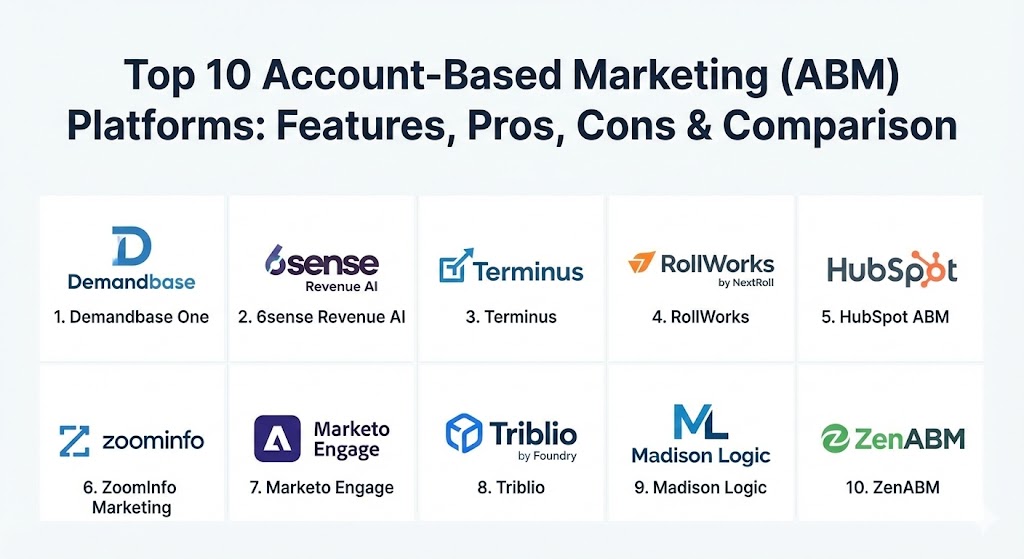
Top 10 Account-Based Marketing (ABM) Platforms
1 — Demandbase One
Demandbase is widely considered the pioneer of the ABM category. Their “Account-Based Experience” (ABX) philosophy moves beyond just marketing to include sales and customer success, providing a truly unified Go-To-Market (GTM) platform.
- Key features:
- Proprietary B2B data cloud with over 20 years of historical intent signals.
- AI-driven account identification and predictive scoring for “in-market” accounts.
- Native DSP for high-precision account-based advertising.
- Website personalization that changes content based on the visitor’s company.
- Sales Intelligence module that pushes “next best action” alerts to reps.
- Advanced journey mapping to visualize how accounts move through the funnel.
- Pros:
- The most comprehensive “all-in-one” solution for large enterprises.
- Unmatched data depth, particularly for global firmographics and complex hierarchies.
- Cons:
- Significant price tag that can be prohibitive for smaller teams.
- The platform is incredibly feature-rich, which leads to a steep learning curve.
- Security & compliance: SOC 2 Type II, GDPR, CCPA, ISO 27001, and SSO integration.
- Support & community: Dedicated Strategic CSMs for enterprise clients; robust certification programs via Demandbase Academy.
2 — 6sense Revenue AI
6sense is the leader in predictive intelligence. Their platform is built around the concept of the “Dark Funnel”—the 90% of the buyer’s journey that happens anonymously on third-party sites before they ever fill out a form on yours.
- Key features:
- Industry-leading predictive modeling to forecast when an account is ready to buy.
- Anonymous visitor deanonymization at the account and department level.
- Multi-channel orchestration across display ads, LinkedIn, and email.
- 6sense Sales Intelligence (Sales Copilot) for real-time seller alerts.
- Dynamic segments that update automatically based on intent signals.
- External intent data integration (Bombora and proprietary signals).
- Pros:
- Exceptional at identifying “hidden” demand before your competitors do.
- Strongest AI engine for account prioritization and timing.
- Cons:
- Setup requires high-quality CRM data to be effective.
- Reporting can occasionally feel like a “black box” regarding how scores are calculated.
- Security & compliance: SOC 2, HIPAA (available), GDPR, and standard enterprise encryption.
- Support & community: High-touch onboarding; “6sense Community” for peer-to-peer networking and strategy sharing.
3 — Terminus
Terminus focused early on “account-based advertising” but has since evolved into a full-scale orchestration platform. It is a favorite for teams that want to dominate the “air cover” phase of ABM with multi-channel brand presence.
- Key features:
- Multi-channel ad orchestration (LinkedIn, Display, Video, Audio).
- Terminus Chat Experiences (conversational marketing tied to account lists).
- Email signature marketing for consistent branding across sales outreach.
- Account Hub for unified sales and marketing visibility.
- Measurement Studio for attribution and campaign ROI tracking.
- Pros:
- The best tool for coordinating ads with sales-led conversational chat.
- Very intuitive user interface that is easier to navigate than Demandbase or 6sense.
- Cons:
- Lacks the deep native intent data found in 6sense.
- Ad reporting can be less granular than platform-native tools (like LinkedIn).
- Security & compliance: SOC 2 Type 2, GDPR, CCPA, and SSO support.
- Support & community: Award-winning customer success team; “Terminus University” for user training.
4 — RollWorks (by NextRoll)
RollWorks is the go-to platform for mid-market companies and SMBs. It offers a more accessible entry point into ABM, specifically for teams that live inside HubSpot or Salesforce and need a powerful ad-engine to scale.
- Key features:
- Automated “Playbooks” for ad-retargeting and account warming.
- Machine-learning-based ICP modeling to find lookalike accounts.
- Bidirectional sync with HubSpot and Salesforce.
- Account-based advertising across social, display, and web.
- Contact discovery and validation tools.
- Pros:
- Extremely easy to set up and integrate with existing CRMs.
- Predictable, tiered pricing that is more affordable for growing teams.
- Cons:
- Lacks the deep website personalization features of high-end enterprise tools.
- Analytics are strong but may not satisfy the needs of a massive RevOps department.
- Security & compliance: GDPR, CCPA, and standard data encryption protocols.
- Support & community: Robust help center and responsive email/chat support for all tiers.
5 — HubSpot (ABM Features)
While technically a CRM platform, HubSpot’s native ABM features have become so robust that many SMBs no longer need a separate third-party platform. It is the best choice for teams that want their ABM strategy to live directly inside their primary marketing hub.
- Key features:
- Native “Target Account” home for sales/marketing coordination.
- Company scoring based on engagement and fit.
- ABM-specific workflow triggers (e.g., “If account is Tier 1, notify AE”).
- Standardized ABM reporting dashboards (Target Account Overview).
- Integration with LinkedIn Sales Navigator and Ads for account targeting.
- Pros:
- Zero integration required if you already use HubSpot.
- “Single source of truth” for all marketing and sales data.
- Cons:
- Lacks proprietary 3rd-party intent data (requires a separate subscription like Bombora).
- Ad orchestration is less sophisticated than dedicated ABM platforms.
- Security & compliance: SOC 2, HIPAA (with enterprise), GDPR, and ISO 27001.
- Support & community: Legendary support and the massive HubSpot Community/User Groups.
6 — ZoomInfo Marketing
ZoomInfo has transformed from a mere contact database into a full-scale ABM platform. It leverages its massive data spine to power account identification, targeting, and sales activation.
- Key features:
- World-class contact and company data accuracy.
- ZoomInfo Intent (real-time signals of accounts researching topics).
- Website Visitor Intelligence (deanonymizing traffic).
- Automated “Workflows” that trigger sales outreach or ads based on intent signals.
- Cross-channel advertising and email marketing modules.
- Pros:
- You never have to worry about data quality or contact coverage.
- The “all-in-one” nature of data + orchestration is highly efficient.
- Cons:
- Can be very expensive as you add more records and modules.
- The UI can feel cluttered due to the sheer amount of data available.
- Security & compliance: SOC 2, GDPR, CCPA, and rigorous data privacy audits.
- Support & community: Enterprise-grade support; dedicated onboarding managers for large contracts.
7 — Adobe Marketo Engage
Adobe Marketo is a staple of the enterprise marketing stack. Its ABM module allows marketers to treat accounts with the same level of sophistication usually reserved for lead-based nurture programs.
- Key features:
- Native account-based segmentation and scoring.
- Advanced lead-to-account (L2A) matching.
- Account-based web personalization through Adobe Experience Manager.
- Deep integration with Adobe’s broader creative and data clouds.
- Advanced revenue attribution and modeling.
- Pros:
- Incredible power for complex, branching nurture campaigns.
- Scales to meet the needs of the world’s largest corporations.
- Cons:
- Interface is notoriously complex and “old school.”
- Often requires a dedicated Marketo certified expert to manage.
- Security & compliance: ISO 27001, SOC 2, GDPR, and HIPAA compliance.
- Support & community: Large global network of consultants and the “Marketo Nation” community.
8 — Triblio (by Foundry)
Triblio specializes in orchestrating the “whole account” journey. It is particularly strong for teams that want to focus on website personalization and middle-of-the-funnel conversion.
- Key features:
- Combined Account Identification, Advertising, and Personalization.
- “Orchestration Canvas” for building multi-step account journeys.
- Sales activation tools that provide “Daily Intent Alerts” to reps.
- Contextual account-based advertising.
- Pros:
- Very strong website personalization capabilities compared to mid-market rivals.
- Provides a clear view of how different channels (Ads vs Web) work together.
- Cons:
- The user interface is functional but not as modern as 6sense or CData Arc.
- Reporting can take time to customize to specific business needs.
- Security & compliance: SOC 2, GDPR, and enterprise encryption.
- Support & community: Highly praised for their hands-on customer success approach.
9 — Madison Logic
Madison Logic is a specialist in the enterprise space, focusing heavily on content syndication and multi-channel account engagement. It is often used as a performance layer on top of a core CRM.
- Key features:
- ML Insights: Proprietary intent signals combined with 3rd party data.
- ABM content syndication at scale.
- Multi-channel advertising (LinkedIn, Display, and Video).
- Deep integrations with Salesforce, HubSpot, and Marketo.
- Pros:
- Excellent for generating “intent-driven” leads through content.
- Global reach for large multinational campaigns.
- Cons:
- Focused more on the “top of funnel” and content compared to full-suite platforms.
- Pricing can be complex based on lead and syndication volume.
- Security & compliance: GDPR, CCPA, and standard enterprise security protocols.
- Support & community: Professional managed services available for global execution.
10 — ZenABM
ZenABM is the newest entrant on this list, catering to teams that want a “LinkedIn-first” ABM strategy. It is designed for agility and rapid deployment rather than enterprise-wide orchestration.
- Key features:
- Plug-and-play LinkedIn Ads integration and tracking.
- Simplified account scoring and pipeline attribution.
- Automated CRM sync for engaged accounts.
- Lightweight analytics dashboard for quick insights.
- Pros:
- The most affordable and easiest to implement on this list.
- Perfect for teams whose primary ABM channel is LinkedIn.
- Cons:
- Lacks the multi-channel depth (Direct Mail, Web Personalization) of giants.
- Not suitable for companies with thousands of target accounts.
- Security & compliance: GDPR, CCPA, and standard cloud security.
- Support & community: Primarily email and chat-based; extensive self-service documentation.
Comparison Table
| Tool Name | Best For | Platform(s) Supported | Standout Feature | Rating (Gartner) |
| Demandbase One | Enterprise All-in-One | Cloud, CRM Native | Proprietary B2B Data Cloud | 4.6 / 5 |
| 6sense Revenue AI | Predictive Intelligence | Cloud, CRM Native | “Dark Funnel” Intent Data | 4.7 / 5 |
| Terminus | Multi-channel Ads + Chat | Cloud, CRM Native | Integrated Email Signatures | 4.4 / 5 |
| RollWorks | Mid-market Scale | HubSpot, Salesforce | Automated Playbooks | 4.3 / 5 |
| HubSpot ABM | CRM-Native Teams | HubSpot Only | Zero Integration Required | 4.5 / 5 |
| ZoomInfo | Data-First Teams | Cloud, CRM Native | Unmatched Contact Data | 4.5 / 5 |
| Marketo Engage | Enterprise Nurturing | Adobe Ecosystem | Complex Journey Branching | 4.2 / 5 |
| Triblio | Web Personalization | Cloud, CRM Native | Orchestration Canvas | 4.4 / 5 |
| Madison Logic | Content Syndication | Cloud, Multi-CRM | Global Lead Acceleration | 4.3 / 5 |
| ZenABM | LinkedIn-first SMBs | LinkedIn, CRM | Rapid Deployment | N/A |
Evaluation & Scoring of ABM Platforms
To help you decide, we have evaluated the market leaders using a weighted scoring rubric based on current industry standards.
| Category | Weight | Evaluation Criteria |
| Core Features | 25% | Intent data, account identification, orchestration, and personalization. |
| Ease of Use | 15% | Intuitiveness of UI, setup speed, and team adoption rates. |
| Integrations | 15% | Depth of bidirectional sync with CRM and Sales engagement tools. |
| Security | 10% | Compliance certifications (SOC2, GDPR) and data privacy controls. |
| Performance | 10% | Accuracy of data, platform uptime, and reporting speed. |
| Support | 10% | Training resources, CSM availability, and community engagement. |
| Price / Value | 15% | ROI potential vs total cost of ownership (TCO). |
Which ABM Platform Is Right for You?
Selecting an ABM tool is less about finding the “top” rated product and more about finding the one that matches your current marketing maturity and budget.
- Solo Users & Very Small Teams: If you are a team of one or two, stay native. Use HubSpot’s built-in ABM features or a lightweight tool like ZenABM. Adding a complex platform like 6sense without a dedicated ops person will only lead to frustration.
- Budget-Conscious SMBs: Look at RollWorks. It provides “enterprise-lite” features like account-based advertising and intent signals at a fraction of the cost of the big two.
- Mid-Market Growth Teams: If your strategy revolves around “air cover” and keeping your brand in front of buyers, Terminus or Triblio offer the best balance of feature depth and ease of use.
- Enterprise Powerhouses: If you have 500+ target accounts and a dedicated RevOps team, you need Demandbase or 6sense. These tools provide the level of granular data and automated orchestration required to manage complex, global buying committees.
- Data-Obsessed Teams: If your biggest pain point is inaccurate contact data for your SDRs, ZoomInfo Marketing is the logical choice. It ensures that when an account shows intent, your team has the right phone numbers and emails to act immediately.
Frequently Asked Questions (FAQs)
1. What is the difference between ABM and Lead Generation?
Lead Generation focuses on quantity—getting individuals to fill out forms. ABM focuses on quality—identifying specific companies that fit your ICP and engaging multiple stakeholders within that organization.
2. Do I need a CRM to use an ABM platform?
Yes. ABM platforms are not meant to replace your CRM (Salesforce, HubSpot, etc.); they sit on top of it, enriching the account data and triggering actions based on what happens in your sales pipeline.
3. What is “Intent Data”?
Intent data is information collected about a company’s online behavior (searches, article reads, website visits) that suggests they are actively researching a solution. It helps you time your outreach perfectly.
4. How much do ABM platforms cost?
Pricing is almost always custom. SMB solutions can start around $10k–$20k per year, while enterprise platforms like Demandbase often start at $50k+ and can reach six figures.
5. Can ABM work for small businesses?
Yes, but it must be simplified. Focus on a small list of 20–50 accounts and use native CRM features rather than buying a massive orchestration suite.
6. What is “Lead-to-Account” (L2A) matching?
It is the process of automatically associating an individual lead (e.g., john@acme.com) with the correct company account (Acme Corp) in your CRM so you can see the total engagement level of that company.
7. How do I measure ABM success?
Look at “Account Engagement” (how many stakeholders are active), “Pipeline Velocity” (how fast accounts move through stages), and “Win Rate” for target accounts vs. non-target accounts.
8. Do ABM platforms help with sales outreach?
Yes. Most provide “Sales Intelligence” dashboards or Slack/email alerts that tell reps exactly which accounts are on the website and what they are looking at.
9. Is website personalization necessary for ABM?
It is not “necessary,” but it is highly effective. Greeting a Tier 1 account with a homepage that addresses their specific industry pain points significantly increases conversion rates.
10. What is the “Dark Funnel”?
It refers to the research buyers do on sites you don’t own—like G2, industry blogs, or social media. ABM platforms use 3rd-party intent data to “see” into this dark funnel.
Conclusion
Choosing an ABM platform in 2026 is no longer just a marketing decision; it is a fundamental choice about how your entire revenue team operates. The “best” tool isn’t the one with the most features—it’s the one your sales team will actually use and your marketing team can actually manage. Whether you choose a predictive powerhouse like 6sense or a CRM-native approach with HubSpot, the key is to start with a clear Ideal Customer Profile and a commitment to alignment.