Introduction
Legal research platforms are centralized digital repositories of legal information—including case law, statutes, regulations, court dockets, and secondary sources—accessible through advanced search and analytical tools. These platforms are essential because they ensure that a legal professional’s advice is based on “good law,” meaning it is current and hasn’t been overturned or superseded. In a 2026 environment, where the volume of new judicial opinions and regulatory changes is higher than ever, these tools are the only way to maintain a competitive edge.
Real-world use cases include identifying precedents to support a motion, verifying the validity of a citation using a “citator” (like Shepard’s or KeyCite), and performing litigation analytics to understand a judge’s past rulings on similar motions. When evaluating these tools, users must look for content depth, search precision, AI-driven insights, and mobile accessibility. The integration of Large Language Models (LLMs) has also made “hallucination management”—the ability of the tool to ground its AI responses in actual, verifiable citations—a top priority for 2026 buyers.
Best for: Small-to-midsize law firms, large enterprise legal departments, solo practitioners, and academic institutions. Roles ranging from paralegals and junior associates to senior partners and judges benefit most from these tools, particularly in litigation-heavy or highly regulated industries like healthcare, finance, and intellectual property.
Not ideal for: General consumers looking for simple legal advice or very small businesses with one-off legal questions. These users may find the subscription costs and complexity of enterprise-grade platforms unnecessary, finding better value in “self-help” legal sites or free resources like Google Scholar.
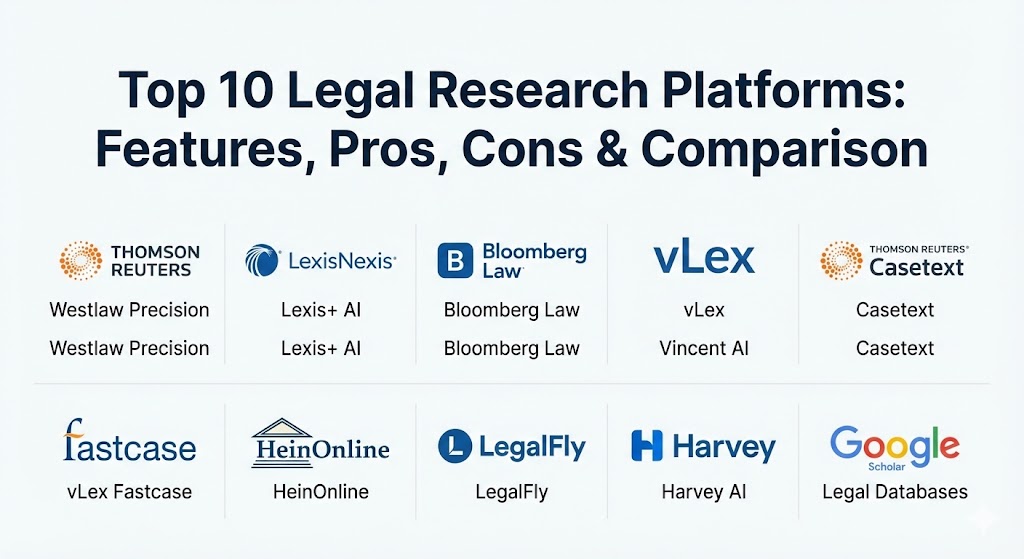
Top 10 Legal Research Platforms
1 — Westlaw Precision (Thomson Reuters)
Westlaw Precision remains the gold standard in the industry, particularly favored for its proprietary Key Number System and attorney-edited content. In 2026, it features deeply integrated generative AI that goes beyond simple keyword matching.
- Key features:
- KeyCite Citator: The industry-leading tool for verifying if a case is still good law.
- Precision Research: Advanced filters that allow users to search by specific legal issues, motion types, and outcomes.
- AI-Assisted Research: A conversational interface that provides cited answers to complex legal questions.
- Key Number System: A century-old, human-curated taxonomy that makes finding related cases effortless.
- Integrated Practical Law: Access to thousands of checklists, templates, and “how-to” guides.
- Brief Analysis: AI tool that reviews your draft and suggests missing authorities.
- Pros:
- Unmatched accuracy thanks to a combination of AI and human editorial review.
- The most comprehensive database of primary and secondary law available.
- Cons:
- Significantly higher price point than competitors.
- Complex interface that requires significant training to master.
- Security & compliance: SOC 2, GDPR, ISO 27001, and HIPAA compliant. Includes multi-factor authentication (MFA) and granular access controls.
- Support & community: 24/7 access to specialized reference attorneys; extensive university-style training modules.
2 — Lexis+ AI (LexisNexis)
Lexis+ is the primary rival to Westlaw, known for its expansive news and public records data alongside traditional legal research. Its 2026 iteration, Lexis+ AI, focuses on the speed and “conversational” nature of legal inquiry.
- Key features:
- Shepard’s Citations: The original, highly respected citator for legal authority verification.
- Lexis+ AI Assistant: Capabilities for legal drafting, summarization, and document upload analysis.
- Litigation Analytics: Detailed data on judges, courts, and opposing counsel.
- Context Insights: Analytics for expert witnesses and their past testimonies.
- News & Business Data: Integration with over 40,000 news sources and business directories.
- Legal News Hub: Real-time updates on high-profile litigation and regulatory shifts.
- Pros:
- Superior integration of news and public records for due diligence and investigative work.
- The AI assistant is remarkably fast at summarizing long, complex judicial opinions.
- Cons:
- Some users find the search logic (Boolean) less forgiving than Westlaw’s natural language.
- Pricing transparency can be an issue for small firms.
- Security & compliance: ISO 27001, SOC 2 Type II, and GDPR. Data is encrypted at rest and in transit.
- Support & community: Robust online help center, dedicated account managers for firms, and a massive global user community.
3 — Bloomberg Law
Bloomberg Law is unique for its “all-in” pricing model, which provides access to all features—including dockets, news, and AI—for one flat fee. It is the platform of choice for corporate and transactional lawyers.
- Key features:
- Integrated Dockets: Unified access to federal and state court dockets without extra per-page fees.
- Transactional Intelligence: AI-powered tools for reviewing and comparing contract clauses.
- Practical Guidance: Step-by-step workflows for corporate, tax, and employment law.
- Bloomberg News: Real-time financial and legal news integration.
- Chart Builders: Tools to create visual comparisons of laws across different jurisdictions.
- Health & Compliance Centers: Specialized portals for niche regulatory practices.
- Pros:
- Predictable pricing; no “surprise” costs for downloading dockets or searching news.
- Exceptional for business context and financial data integration.
- Cons:
- The database of secondary sources (treatises) is smaller than Westlaw or Lexis.
- Interface is heavily text-based and can feel cluttered to new users.
- Security & compliance: SOC 2, ISO 27001, and HIPAA. Complies with major global data privacy standards.
- Support & community: Help desk staffed by legal professionals; active webinars and “how-to” sessions for corporate counsel.
4 — vLex (including Vincent AI)
vLex has made waves by building a truly global legal database. With the 2024 launch of Vincent AI, it has become a leader in international and comparative legal research, covering over 100 countries.
- Key features:
- Vincent AI: An assistant that can analyze a document and suggest relevant cases from multiple jurisdictions.
- Global Coverage: Access to law from the UK, Spain, Latin America, the US, and more.
- Case Visualization: Interactive maps showing how cases are cited over time.
- Personalized Newsfeed: Daily alerts tailored to the user’s specific practice area and jurisdiction.
- vLex Cloud: A feature that allows firms to upload their own documents and search them alongside primary law.
- Multi-language Search: Search in one language and find relevant law in another.
- Pros:
- Best-in-class for firms with cross-border practices or international clients.
- Vincent AI is highly effective at “gap analysis”—finding what your opponent missed.
- Cons:
- US-specific content, while growing, is not as deep as the big three (Westlaw/Lexis/Bloomberg).
- Can be overkill for purely local, domestic practitioners.
- Security & compliance: GDPR, ISO 27001, and SOC 2. High focus on EU-level data residency.
- Support & community: Extensive documentation in multiple languages; active presence in international legal tech forums.
5 — Casetext (now a Thomson Reuters company)
Casetext revolutionized the industry with its AI assistant, CoCounsel. Since its acquisition by Thomson Reuters, it has maintained its identity as a fast, agile tool for litigation preparation and document review.
- Key features:
- CoCounsel AI: A powerful “legal AI” that can review thousands of documents for specific terms or themes.
- CARA A.I.: The original tool that finds cases by simply dragging and dropping a brief.
- Deposition Preparation: AI-driven outlines based on case facts.
- Parallel Search: Uses neural networks to find cases that share the same legal concept, even if keywords don’t match.
- Summary Tools: Rapid summaries of filings, transcripts, and judicial opinions.
- Integrated Westlaw Content: Gradually gaining access to Westlaw’s deeper editorial data.
- Pros:
- Incredible time-saver for document-heavy litigation and discovery.
- Very modern, clean, and intuitive user interface.
- Cons:
- Pricing has shifted since the acquisition, becoming less “budget-friendly” for solo users.
- Focus is primarily on litigation; less comprehensive for transactional law.
- Security & compliance: SOC 2, HIPAA, and GDPR. Leverages the robust Thomson Reuters security infrastructure.
- Support & community: Highly responsive chat support and a very modern set of video tutorials.
6 — Fastcase (vLex Fastcase)
Fastcase, now part of the vLex family, is widely known as the “democratized” legal research tool. It is often provided for free through state bar associations, making it the most accessible paid platform.
- Key features:
- Full National Database: Comprehensive access to federal and state case law and statutes.
- Interactive Timeline: A visual map showing the “most cited” cases in a search result.
- Forecite: An AI tool that finds important cases your keyword search might have missed.
- Clio Integration: Seamlessly syncs research time and documents with the Clio practice management system.
- Mobile App: One of the best-rated mobile legal research apps on the market.
- Cloud Sync: Allows users to save research on a desktop and access it on a tablet instantly.
- Pros:
- Unbeatable value; many lawyers already have access through their bar dues.
- Simple, clean search interface that doesn’t overwhelm the user.
- Cons:
- Secondary source library (treatises) is limited compared to Westlaw.
- The citator (CheckCite) is not as historically deep as Shepard’s.
- Security & compliance: SOC 2 and GDPR. Data is stored in secure, redundant data centers.
- Support & community: Strong bar association support networks; friendly and accessible customer service.
7 — HeinOnline
HeinOnline is the “researcher’s researcher.” It is the premier source for historical documents, law reviews, and academic journals, offering them in their original PDF format.
- Key features:
- Image-based PDF Access: See the document exactly as it appeared in print.
- Law Journal Library: Access to over 3,000 law and law-related periodicals.
- U.S. Congressional Documents: Deep archive of legislative history and hearings.
- World Constitutions Illustrated: A massive database of historical and current global constitutions.
- Fastcase Integration: Links academic research directly to primary law.
- ScholarCheck: A tool to see how often a specific article or case has been cited.
- Pros:
- Essential for academic, constitutional, or legislative history research.
- Allows for “page-accurate” citations, which are required for many court filings.
- Cons:
- The search interface feels somewhat archaic compared to modern AI tools.
- Not designed for daily litigation or case tracking.
- Security & compliance: SOC 2 and GDPR. Reliable for academic and government environments.
- Support & community: Strong academic library community; excellent wiki and user guides.
8 — LegalFly
LegalFly is one of the newer “AI-native” platforms emerging as a leader in 2026. It is designed as a secure workspace where research, drafting, and compliance monitoring happen in a single flow.
- Key features:
- AI-Native Workspace: Research is integrated directly into the drafting environment.
- Anonymization Engine: Automatically redacts sensitive data before processing in the AI.
- Multi-Jurisdictional Search: Capable of finding on-point law across various regulatory frameworks.
- Contract Review: Automated “redlining” and risk assessment based on legal research.
- Compliance Tracker: Live updates on changes in law that affect specific company policies.
- Pros:
- Built for privacy from the ground up; very high trust factor for enterprise use.
- Significant efficiency gains for transactional and compliance teams.
- Cons:
- Lacks the 100-year history of case law databases found in Lexis or Westlaw.
- Brand is still establishing its reputation in the traditional legal market.
- Security & compliance: ISO 27001, SOC 2, and EU AI Act compliant.
- Support & community: Dedicated customer success teams; focuses on high-touch enterprise onboarding.
9 — Harvey AI
Harvey is an enterprise-grade AI assistant built on advanced LLMs and trained specifically on legal data. It is currently being adopted by some of the world’s largest law firms to automate high-level analytical tasks.
- Key features:
- Conversational Legal Research: Can answer complex legal hypotheticals with citations.
- Custom Model Training: Firms can train the AI on their own internal knowledge and past work product.
- Deep Summarization: Turns hundreds of pages of discovery into a 5-page memo.
- Language Flexibility: Strong performance in non-English jurisdictions.
- Drafting Assistant: Generates first drafts of briefs, motions, and contracts.
- Pros:
- The “state of the art” in legal generative AI.
- Dramatic reduction in time spent on low-level associate tasks.
- Cons:
- Primarily available only to large firms and enterprises currently.
- Users must be extremely vigilant for AI “hallucinations” (though improving).
- Security & compliance: SOC 2, GDPR, and rigorous data encryption. No data is used to train public models.
- Support & community: High-end enterprise support with dedicated engineers and legal experts.
10 — Google Scholar (Legal Databases)
While not a “paid” platform, Google Scholar’s legal database is a staple for solo attorneys and students. It provides free, searchable access to state and federal case law.
- Key features:
- Free Primary Law: Access to cases from all 50 states and the federal government.
- Intuitive Search: The familiar Google search bar applied to law.
- Citation Search: Find cases that cite a particular opinion.
- Personal Library: Save cases for future reference.
- Alerts: Get notified when new cases matching your keywords are published.
- Pros:
- Completely free; no subscription or registration required.
- The fastest way to pull up a known case by name or citation.
- Cons:
- No citator (KeyCite/Shepard’s) to tell you if a case is still “good.”
- Minimal secondary sources, news, or analytical tools.
- Security & compliance: Standard Google security; not suitable for storing confidential client data.
- Support & community: Community-driven help forums; no dedicated customer support.
Comparison Table
| Tool Name | Best For | Platform(s) Supported | Standout Feature | Rating (Gartner Peer) |
| Westlaw Precision | Elite Litigation | Web, iOS, Android | KeyCite & Key Numbers | 4.8 / 5 |
| Lexis+ AI | Investigations & News | Web, iOS, Android | Shepard’s Citations | 4.7 / 5 |
| Bloomberg Law | Corporate & Dockets | Web, iOS | Unmetered Docket Access | 4.6 / 5 |
| vLex / Vincent AI | International Law | Web, iOS, Android | Multi-Country Search | 4.5 / 5 |
| Casetext | Lit Prep & Doc Review | Web | CoCounsel AI Assistant | 4.7 / 5 |
| Fastcase | Budget-Conscious / SMB | Web, iOS, Android | Bar Association Access | 4.4 / 5 |
| HeinOnline | Academic / Historical | Web | Original PDF Archive | 4.3 / 5 |
| LegalFly | Enterprise Compliance | Web (Cloud-Native) | Privacy Redaction AI | 4.6 / 5 |
| Harvey AI | Large Firm Automation | Web, API | Custom Firm Training | 4.7 / 5 |
| Google Scholar | Free Initial Research | Web, Mobile Web | $0 Cost / Accessibility | N/A |
Evaluation & Scoring of Legal Research Platforms
Every firm has different priorities. The following rubric provides a weighted look at how these platforms are evaluated in 2026.
| Category | Weight | Evaluation Criteria |
| Core Features | 25% | Database depth, citator accuracy (Shepard’s/KeyCite), and jurisdictional coverage. |
| Ease of Use | 15% | Search intuition, UI clarity, and mobile accessibility. |
| Integrations | 15% | Syncing with practice management (Clio), MS Word, and document storage. |
| Security | 10% | SOC 2/GDPR compliance, AI data privacy, and encryption. |
| Performance | 10% | Search speed and the accuracy of AI “hallucination” prevention. |
| Support | 10% | Access to reference attorneys, 24/7 help, and community forums. |
| Price / Value | 15% | Transparency of billing and ROI relative to time saved. |
Which Legal Research Platform Is Right for You?
The 2026 legal market is highly segmented. Your choice should be driven by your practice area and your tolerance for technology.
- Solo Practitioners & Small Firms (SMBs): If you are cost-conscious, start with Fastcase through your state bar. For a slightly more modern, AI-forward experience, Casetext is a solid middle ground. If you only need to look up a case every few months, Google Scholar is your best friend.
- Mid-Market Firms: You need a balance of power and price. Lexis+ or Bloomberg Law are often excellent choices here, as they provide robust analytics and business data that can help you win clients from larger firms.
- Large Enterprise & Global Firms: You essentially need a “full stack.” Westlaw Precision is usually a requirement for its depth, but many elite firms are layering on Harvey AI or LegalFly to automate the high-volume tasks that associates used to perform.
- Niche & Academic Research: If you are a law professor, a policy researcher, or a constitutional lawyer, HeinOnline is indispensable. If your practice involves international trade or immigration, vLex is the clear winner for its global database.
- Security & Compliance Needs: In 2026, the EU AI Act has changed the game. If you work for a highly regulated multinational, tools like LegalFly that focus on anonymization and compliance monitoring should be at the top of your list.
Frequently Asked Questions (FAQs)
1. What is a “citator” and why is it so important?
A citator (like Shepard’s or KeyCite) tracks the history of a case to see if it has been overruled, criticized, or affirmed. Using a case that has been overturned is one of the most common causes of legal malpractice.
2. Can I trust the AI in these platforms?
In 2026, the answer is “yes, but verify.” Leading tools now use “Retrieval-Augmented Generation” (RAG), which forces the AI to base its answers on specific, cited documents in the database rather than its general training data.
3. Are there free legal research tools?
Yes, Google Scholar, FindLaw, and Justia are excellent free resources. However, they lack citators and editorial analysis, meaning you must be much more careful about verifying your results manually.
4. How much do these platforms typically cost?
Pricing is highly variable. Solo plans can start around $50–$100/month (Fastcase/Casetext), while enterprise plans for large firms can cost tens of thousands of dollars per year.
5. Do I need to be a lawyer to subscribe?
Most platforms are designed for professionals, but they are generally available to anyone willing to pay. However, some advanced features like “Reference Attorney” support are only useful to those with legal training.
6. Can these tools predict how a judge will rule?
Platforms like Lexis+ and Bloomberg Law offer “Litigation Analytics,” which analyze a judge’s past decisions on specific motions. While they can’t predict the future, they provide a statistical “success rate” that is invaluable for strategy.
7. Is Westlaw better than Lexis?
This is the “Coke vs. Pepsi” of the legal world. Westlaw is often seen as having better editorial content (Key Numbers), while Lexis is praised for its news, public records, and aggressive AI development.
8. What is the “Key Number System”?
Created by Westlaw, it is a massive classification system that assigns a unique number to every legal concept. This allows you to find every case on “unreasonable search and seizure” even if the cases don’t use those exact words.
9. Can I use these platforms on my phone?
Most major platforms have mobile apps or optimized web versions. Fastcase and Westlaw have particularly well-regarded mobile experiences for research on the go.
10. How do these tools integrate with my current workflow?
Most modern platforms have plugins for Microsoft Word, allowing you to check citations or search for precedents without ever leaving your document.
Conclusion
The evolution of legal research platforms represents a shift from “information retrieval” to “legal intelligence.” In 2026, a lawyer’s value is no longer found in their ability to find the law, but in their ability to interpret and apply it. While the “big three” (Westlaw, Lexis, and Bloomberg) continue to dominate for their depth, the rise of specialized AI tools like Harvey and vLex offers exciting new ways for smaller firms to punch above their weight. Ultimately, the best tool is the one that aligns with your specific practice areas while ensuring your research is accurate, efficient, and above all, ethical.