Introduction
Android App Builders are specialized software-as-a-service (SaaS) platforms that allow users to create, design, and deploy applications for the Android operating system without writing extensive lines of code. These platforms utilize visual interfaces—often drag-and-drop—to assemble components, manage databases, and define user workflows. They range from “no-code” tools intended for absolute beginners to “low-code” platforms designed for developers who want to accelerate the building process.
The importance of these tools lies in the democratization of technology. By lowering the barrier to entry, these builders allow a restaurant owner to create a loyalty app or a logistics manager to build a custom tracking tool without a six-figure development budget. Key real-world use cases include e-commerce storefronts, internal employee portals, event management apps, and Minimum Viable Products (MVPs) for startups. When evaluating these tools, users should look for UI customization depth, offline functionality, integration capabilities (APIs), and the scalability of the underlying architecture.
Best for: Small to medium-sized businesses (SMBs), non-technical founders, marketing agencies, and internal IT teams looking for rapid prototyping. It is particularly effective for content-driven apps, simple e-commerce, and workflow automation.
Not ideal for: High-fidelity 3D gaming (e.g., AAA titles), apps requiring highly specialized hardware-level driver integrations, or complex social networks that require massive, custom-architected backend logic from day one.
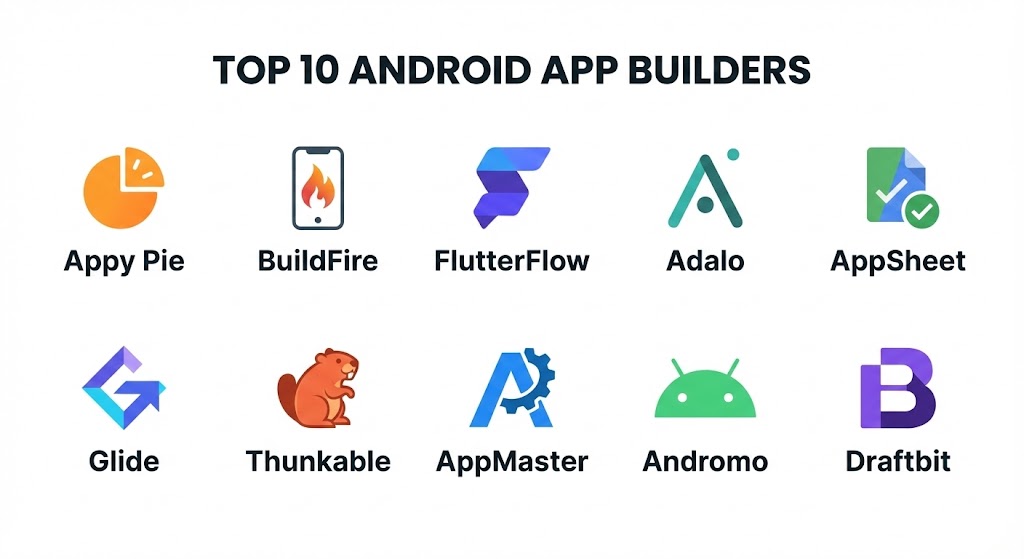
Top 10 Android App Builders Tools
1 — Appy Pie
Appy Pie is a global leader in the no-code space, famous for its “democratized” approach to app development. It is designed to be so simple that anyone, regardless of their technical background, can build a functional Android app in minutes.
- Key features:
- Drag-and-Drop Interface: A highly intuitive visual builder that requires zero coding knowledge.
- Offline Capabilities: Allows apps to provide content even when the user has no internet connection.
- App Analytics: Built-in tools to track user behavior, installs, and engagement metrics.
- Push Notifications: Easy-to-configure alerts to keep users coming back to the app.
- App Store Submission: Assistance with the complex process of getting an app live on the Google Play Store.
- Social Media Integration: One-click sharing and login features for popular social platforms.
- 200+ Built-in Features: Pre-made modules for food ordering, taxi booking, and real estate.
- Pros:
- Unrivaled speed to market; you can literally have a draft app ready in an hour.
- Very affordable entry-level pricing compared to hiring a developer.
- Cons:
- Limited design flexibility for users who want a truly unique “bespoke” look.
- Advanced logic can be difficult to implement without hitting the platform’s limits.
- Security & compliance: GDPR compliant, SSL encryption, and standard 2FA for account security.
- Support & community: 24/7 live chat support, an extensive library of video tutorials, and a massive global user base.
2 — BuildFire
BuildFire is a premium app builder targeted at businesses that need professional-grade applications with deep functionality and high-end design. It strikes a balance between ease of use and professional power.
- Key features:
- Plugin Architecture: Allows developers to build custom features using the BuildFire SDK.
- Highly Customizable UI: More design freedom than most standard no-code builders.
- Marketplace of Features: A wide array of pre-built plugins for loyalty programs, Shopify sync, and more.
- White-Labeling: Remove all BuildFire branding to present a completely custom product to your users.
- Real-time Preview: See exactly how changes will look on an actual Android device instantly.
- Deep Analytics Integration: Connects seamlessly with specialized tools like Segment or Mixpanel.
- Pros:
- Extremely scalable; many “BuildFire” apps have hundreds of thousands of users.
- The plugin system means you aren’t “locked in” to only the features they provide.
- Cons:
- Significantly more expensive than basic builders like Appy Pie.
- The learning curve is slightly steeper due to the depth of options available.
- Security & compliance: SOC 2 Type II compliant, GDPR, and CCPA compliant. Offers advanced SSO for enterprise clients.
- Support & community: Dedicated account managers for higher tiers, professional onboarding, and a robust developer portal.
3 — FlutterFlow
FlutterFlow is a low-code builder that allows you to build native Android apps visually while generating real Flutter (Dart) code in the background. It is the gold standard for those who want no-code speed with high-code quality.
- Key features:
- Native Code Export: You can download the actual Dart code and continue developing in VS Code if you wish.
- Firebase Integration: Native, deep connection for databases, authentication, and file storage.
- Custom Widgets: Write your own code snippets and drop them into the visual builder.
- API Support: Connect to any external backend or service with a standard REST API.
- Push Notifications & Payments: Built-in support for Stripe, Braintree, and RevenueCat.
- Animations: High-end visual transitions and micro-interactions that feel “premium.”
- Pros:
- The apps built here are truly “native” and perform significantly better than “web-wrap” apps.
- Zero vendor lock-in; since you can export the code, the app belongs to you.
- Cons:
- Requires a basic understanding of logic (if/then) and data structures.
- Design freedom is so high that it can be easy for a beginner to make mistakes.
- Security & compliance: Inherits the security of Google Firebase; GDPR compliant and supports advanced encryption.
- Support & community: Very active Discord community, “FlutterFlow University” tutorials, and a rapidly growing marketplace.
4 — Adalo
Adalo focuses on the visual “experience.” It is designed for founders who want to build apps that look beautiful and function like popular startups (like Tinder or Airbnb) without writing code.
- Key features:
- Visual Database: A simple, spreadsheet-like interface to manage your app’s data.
- Dynamic Actions: Create complex user flows by linking screens based on user input.
- Component Marketplace: Buy and sell custom-made UI elements created by other designers.
- Multi-Platform Publishing: Build once and publish to Android, iOS, and the Web.
- Zapier Integration: Connect your app to over 5,000 other web services.
- Native Prototyping: Build a fully functional prototype that feels like a real app for investor pitches.
- Pros:
- One of the best tools for creating a unique, branded user interface.
- The “Database” logic is very easy to understand for non-technical people.
- Cons:
- Performance can sometimes lag on older Android devices with very large datasets.
- Complex math and logic calculations can be limited within the native builder.
- Security & compliance: GDPR compliant; offers standard data encryption at rest.
- Support & community: A very friendly community forum and a “Hire an Expert” program for those who get stuck.
5 — AppSheet (by Google)
AppSheet is Google’s answer to the enterprise app demand. It is a data-driven platform that turns spreadsheets (like Google Sheets or Excel) into functional Android applications automatically.
- Key features:
- Spreadsheet-to-App: Simply connect a sheet, and AppSheet builds the first draft of the app for you.
- AI & Automation: Includes “AppSheet Automation” to trigger emails, SMS, or data updates.
- Machine Learning: Native support for OCR (Optical Character Recognition) and predictive models.
- Offline Sync: Robust offline features for field workers in remote areas.
- Governance Tools: Centralized management for IT departments to control app access.
- Barcode & NFC: Deep integration with mobile hardware for inventory management.
- Pros:
- The fastest way to build “Utility” apps for business operations.
- Extremely stable and secure, backed by Google’s infrastructure.
- Cons:
- The UI is functional but very “standard”—not suitable for a creative consumer app.
- Customization of the layout is quite restricted compared to Adalo or FlutterFlow.
- Security & compliance: HIPAA, GDPR, SOC 2, and ISO compliant. Enterprise-grade SSO and audit logs.
- Support & community: Professional documentation, Google Cloud support, and an active developer community.
6 — Glide
Glide is similar to AppSheet but focuses on being “beautiful by default.” It allows you to build powerful Android apps from your data in minutes, with a focus on modern, clean design.
- Key features:
- Glide Tables: A built-in database that is faster and more powerful than standard spreadsheets.
- Adaptive Layouts: Your app automatically adjusts for different screen sizes and devices.
- Action Editor: A visual “flowchart” style builder for app logic.
- Pre-made Templates: Hundreds of templates for directories, inventory, and HR portals.
- Computed Columns: Perform complex calculations and data manipulations within the app.
- Pros:
- You can build an app that looks like it cost $50,000 in less than a day.
- Very low maintenance; Glide handles all the hosting and infrastructure.
- Cons:
- Can become expensive if your app requires a high number of “updates” or “users.”
- Limited ability to add completely custom code for unique requirements.
- Security & compliance: GDPR and SOC 2 Type II compliant. Offers private app options for internal use.
- Support & community: Excellent “Glide University” video courses and a very helpful community forum.
7 — Thunkable
Thunkable is a “blocks-based” builder that allows for extremely complex logic. It is perfect for those who want the power of code but want to see it visually.
- Key features:
- Visual Blocks: Use “Scratch-like” blocks to build the logic of your app.
- Native Device Access: Easy access to Bluetooth, Accelerometer, and Location services.
- Cross-Platform Builder: One logic set works for both Android and iOS.
- Animation Support: Integrated with Lottie animations for high-end visual effects.
- API & Database: Connect to Airtable, Google Sheets, or any external API.
- Pros:
- Probably the most “powerful” no-code logic builder on the market.
- Great for educational purposes and for those who want to learn “how code works” visually.
- Cons:
- The UI builder is not as modern or “drag-and-drop” friendly as Adalo.
- It can get messy when building very large, complex applications with many screens.
- Security & compliance: GDPR compliant; standard SSL and data protection protocols.
- Support & community: Strong educational community and very detailed documentation.
8 — AppMaster
AppMaster is a “No-Code” platform that generates real source code (in the Go language). It is unique because it focuses heavily on the Backend and site architecture.
- Key features:
- Backend Builder: Build a real, scalable backend with a visual data modeler.
- Source Code Generation: Every time you hit “Publish,” it writes real code for you.
- BP Designer: A visual business process designer for complex backend logic.
- Native Android UI: Build the front-end visually using a “server-driven” approach.
- Auto-generated Documentation: Automatically creates Swagger (OpenAPI) documentation for your app.
- Pros:
- The closest you can get to “Real Development” without writing code.
- Extremely high performance because the generated code is compiled, not interpreted.
- Cons:
- The learning curve is steep; you need to understand how databases and backends work.
- Pricing is geared toward professional developers and enterprises.
- Security & compliance: GDPR, SOC 2, and HIPAA compliant. Allows for on-premises hosting.
- Support & community: Professional technical support and a detailed knowledge base.
9 — Andromo
Andromo is a specialized Android app builder that focuses on Monetization. It is ideal for hobbyists and entrepreneurs who want to build apps to make money via ads or content.
- Key features:
- Activity-based Builder: Choose from pre-made “Activities” (Photo gallery, YouTube feed, PDF reader).
- Ad Network Integration: Native support for AdMob, Facebook Audience Network, and more.
- Content Focused: Perfect for news apps, wallpaper apps, and niche guides.
- Native Android Performance: The apps are compiled into native Android code.
- Multilingual Support: Easily target global audiences with multiple languages.
- Pros:
- Very easy to understand for those who want a “passive income” app.
- Extremely affordable; one of the cheapest ways to get an app on the Play Store.
- Cons:
- Not suitable for complex business tools or custom startups.
- Design options are limited to specific “styles” provided by the platform.
- Security & compliance: GDPR compliant; standard app security features.
- Support & community: Good knowledge base and email-based customer support.
10 — Draftbit
Draftbit is a visual builder for React Native. It is designed for developers and designers who want to build high-performance, professional Android apps visually.
- Key features:
- React Native Source Code: Unlike many others, you can see and export the underlying React Native code.
- Custom Code Components: Drop in your own React Native snippets seamlessly.
- Live Preview: Use the “Expo” app to see your app live on your phone as you build.
- Deep Integration: Connect to any backend (Xano, Supabase, Airtable).
- Component Library: A high-quality set of pre-built UI components that follow Android design standards.
- Pros:
- Professional-grade output that is ready for the “big stage.”
- Excellent for teams where a designer builds the UI and a developer adds the logic.
- Cons:
- Not for absolute beginners; you need to know how React Native components work.
- Requires a third-party backend (you have to build the database elsewhere).
- Security & compliance: GDPR compliant; security depends largely on your chosen backend.
- Support & community: Very active “Office Hours” and a high-quality community forum.
Comparison Table
| Tool Name | Best For | Platform(s) Supported | Standout Feature | Rating (G2 / Gartner) |
| Appy Pie | Beginners / Speed | Android, iOS, Web | 200+ Pre-built Modules | 4.7 / 5 |
| BuildFire | Professional SMBs | Android, iOS | Plugin SDK for Devs | 4.6 / 5 |
| FlutterFlow | Startups / Low-code | Android, iOS, Web | Native Dart Code Export | 4.8 / 5 |
| Adalo | Visual Design | Android, iOS, Web | Visual Database Modeler | 4.5 / 5 |
| AppSheet | Utility / Business | Android, iOS, Web | Spreadsheet-to-App AI | 4.3 / 5 |
| Glide | Simple Business Apps | Android, iOS, Web | Beautiful UI by Default | 4.7 / 5 |
| Thunkable | Complex Logic | Android, iOS, Web | Visual Logic Blocks | 4.4 / 5 |
| AppMaster | Scalable Backends | Android, iOS, Web | Go Source Code Generation | 4.6 / 5 |
| Andromo | Monetization | Android Only (Primary) | Ad Network Focus | 4.2 / 5 |
| Draftbit | React Native Devs | Android, iOS | Full Source Code Access | 4.5 / 5 |
Evaluation & Scoring of Android App Builders
To help you determine which tool fits your project, we have scored the general category based on a weighted rubric reflecting professional standards in 2026.
| Criteria | Weight | Evaluation Rationale |
| Core Features | 25% | Presence of push notifications, offline mode, and hardware access (GPS/Camera). |
| Ease of Use | 15% | Intuitiveness of the drag-and-drop builder and the onboarding experience. |
| Integrations | 15% | Ability to connect to external APIs, Zapier, and third-party databases. |
| Security & Compliance | 10% | Adherence to GDPR, encryption standards, and enterprise SSO support. |
| Performance | 10% | App load speed, frame rates, and handling of large datasets. |
| Support & Community | 10% | Availability of documentation, video tutorials, and active forums. |
| Price / Value | 15% | ROI for a small business vs. the cost of a professional developer. |
Which Android App Builders Tool Is Right for You?
Solo Users vs SMB vs Mid-market vs Enterprise
If you are a solo user looking to build a hobby app or a simple side project, Appy Pie or Andromo are the most frictionless paths. For an SMB looking to launch a customer-facing brand, Glide or Adalo offer the best design-to-effort ratio. Mid-market companies requiring specialized tools for their sales or HR teams will find AppSheet or FlutterFlow more appropriate. Enterprises requiring strict governance, high scalability, and custom source code should look exclusively at AppMaster or BuildFire.
Budget-conscious vs Premium Solutions
For those on a tight budget, Andromo and Glide (on free/low tiers) provide incredible value. If you are looking for a Premium solution where quality and support are the only priorities, BuildFire and AppMaster are worth the investment, as they effectively act as a replacement for a full engineering team.
Feature Depth vs Ease of Use
If you need Feature Depth (e.g., custom AI filters, complex math, or specific Bluetooth interactions), FlutterFlow and Thunkable are the only no-code tools that won’t leave you hitting a “wall.” If you prioritize Ease of Use and want the tool to do the heavy lifting for you, Appy Pie and AppSheet are the simplest to master.
Integration and Scalability Needs
If your app needs to talk to a complex existing IT system, the API-first approach of AppMaster and Draftbit is essential. For those planning to scale to millions of users, the source-code-generating platforms (AppMaster/FlutterFlow) ensure that your app’s performance won’t degrade as your database grows.
Frequently Asked Questions (FAQs)
1. Can I really build an Android app with zero coding?
Yes. Modern “No-Code” platforms like Appy Pie and Adalo have completely abstracted the coding layer. You move visual elements, and the platform writes the code in the background.
2. How do I get my app on the Google Play Store?
Most app builders provide an “APK” or “AAB” file that you upload to the Google Play Console. Some services (like Appy Pie or BuildFire) offer a “white-glove” service where they handle the submission for you.
3. Do these apps work on all Android versions?
Generally, yes. Professional app builders ensure their code is compatible with most modern versions of Android (typically Android 8.0 and above).
4. What is the difference between No-Code and Low-Code?
No-Code is 100% visual. Low-Code allows for visual building but gives you the option to write custom code for advanced features. FlutterFlow is a classic “Low-Code” example.
5. Is my data secure in an app builder?
Yes, provided you choose a reputable platform. Look for “SOC 2” or “GDPR” compliance. Most builders use secure cloud storage (like AWS or Google Cloud) to keep your data safe.
6. Can I switch to a different app builder later?
It is very difficult. Most builders are “walled gardens.” However, tools like FlutterFlow and AppMaster allow you to export your source code, which protects you from vendor lock-in.
7. How much does an app builder cost?
Basic plans start around $15–$30 per month. Professional or enterprise plans can range from $150 to $500+ per month.
8. Can I make money from my app?
Yes. Most builders allow you to integrate ads (AdMob), subscriptions (Stripe), or direct product sales.
9. Will my app look like everyone else’s?
Only if you use a generic template. If you use a tool like Adalo or FlutterFlow, you can customize every pixel to ensure your brand looks unique.
10. What happens if I stop paying the monthly subscription?
In most cases, your app will stop working or be “frozen.” If you use a tool that allows code export (like AppMaster), you can host it yourself and it will continue to work.
Conclusion
The year 2026 marks the point where the “App Idea” is no longer held captive by the “Developer Shortage.” Whether you choose the design-first approach of Adalo, the data-driven speed of AppSheet, or the professional power of FlutterFlow, the tools now exist to turn any vision into a digital reality.
The “best” Android app builder is ultimately the one that aligns with your specific technical comfort and long-term goals. Don’t let the fear of technology hold you back—pick a tool from this list, start a free trial, and build the future of your business today.