Introduction
Pharmacovigilance software is a specialized category of health-IT solutions designed to collect, manage, analyze, and report data regarding Adverse Events (AEs) and any other drug-related problems. These tools act as a centralized repository for safety data originating from clinical trials, spontaneous reports from healthcare providers, and even social media. By automating the intake and processing of these reports, PV software ensures that pharmaceutical companies can identify “signals”—early warnings of previously unknown side effects—before they become public health crises.
The importance of these tools is rooted in both patient safety and regulatory necessity. Regulatory bodies like the FDA (USA) and the EMA (Europe) mandate that life sciences companies report serious adverse events within strict timeframes, often as short as 15 days. Key real-world use cases include MedDRA coding (standardizing medical terminology), E2B(R3) electronic reporting, and automated signal detection using machine learning. When evaluating these tools, users should prioritize regulatory compliance history, ease of integration with Clinical Data Management Systems (CDMS), and the level of automation provided for case intake to reduce human error.
Best for: Pharmaceutical companies of all sizes, Contract Research Organizations (CROs), and regulatory agencies. It is essential for safety officers, medical reviewers, and compliance managers who need to maintain a “permanent state of audit-readiness.”
Not ideal for: Retail pharmacies, individual medical practices, or small health-tech startups that do not manufacture or sponsor clinical trials for drugs or medical devices.
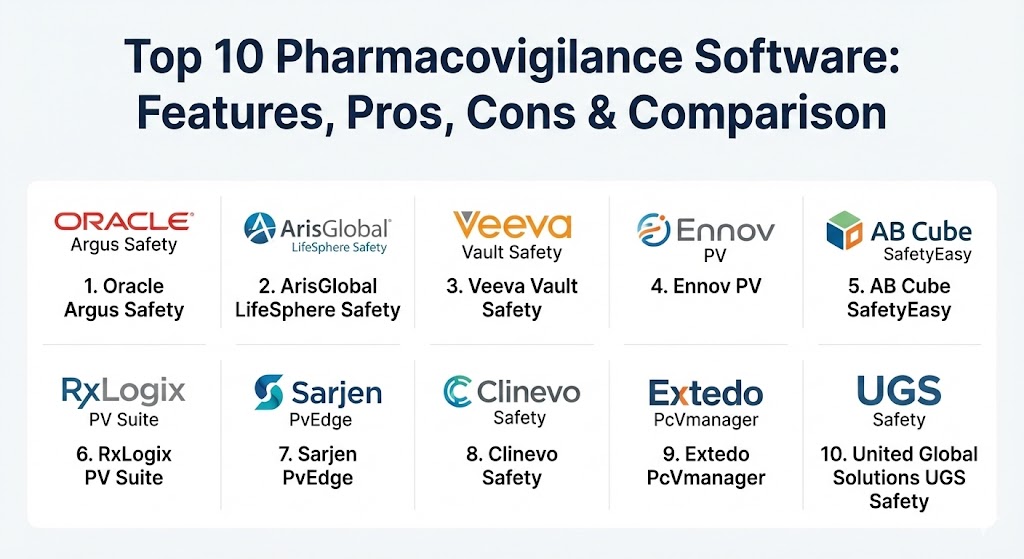
Top 10 Pharmacovigilance Software Tools
1 — Oracle Argus Safety
Oracle Argus is widely considered the “gold standard” in the pharmacovigilance industry. It is a comprehensive, highly scalable database solution used by nearly all the world’s top 20 pharmaceutical companies to manage their global safety operations.
- Key features:
- Global, centralized case processing for clinical and post-marketing data.
- Native support for E2B(R3) electronic reporting to global authorities.
- Integrated “Argus Mart” for advanced data warehousing and analytics.
- Automated periodic reporting (PSUR, DSUR, PBRER).
- Comprehensive MedDRA and WHODrug coding integration.
- Multi-tenancy support for CROs managing multiple sponsors.
- Pros:
- Proven track record with regulatory inspectors worldwide; it is the “safe” choice for compliance.
- Exceptional scalability, capable of handling millions of cases per year.
- Cons:
- Extremely high total cost of ownership (TCO) including licensing and implementation.
- The user interface can feel dated and requires intensive training for new users.
- Security & compliance: SOC 1/2, HIPAA, GDPR, 21 CFR Part 11, and FIPS 140-2.
- Support & community: Extensive global support network, massive user community, and certified third-party consultants available worldwide.
2 — ArisGlobal LifeSphere Safety
LifeSphere Safety is a modern, AI-driven platform that focuses on “cognitive automation.” It is designed to reduce the manual effort involved in case processing by using machine learning to intake and code adverse event data.
- Key features:
- LifeSphere Intake: Uses OCR and NLP to automate data entry from paper or digital forms.
- AI-powered auto-narrative generation for case reports.
- Real-time signal detection and risk management modules.
- Cloud-native architecture with seamless, automatic updates.
- Pre-configured workflows based on industry best practices.
- Advanced interactive dashboards for safety data visualization.
- Pros:
- Significantly reduces the time spent on data entry, allowing safety officers to focus on medical review.
- Modern, “web-first” user interface that is much more intuitive than legacy systems.
- Cons:
- AI features require a period of “training” and validation to reach peak accuracy.
- Integration with older, legacy clinical systems can be complex.
- Security & compliance: ISO 27001, SOC 2 Type II, HIPAA, and GDPR.
- Support & community: High-quality documentation and a growing customer base focused on digital transformation.
3 — Veeva Vault Safety
Veeva has disrupted the life sciences industry with its “Vault” platform. Vault Safety is a modern, cloud-native solution that unifies safety data with clinical, quality, and regulatory data on a single platform.
- Key features:
- Unified platform: Move data seamlessly from clinical trials (Vault CDMS) to Safety.
- Real-time visibility into case processing status across global teams.
- Automated E2B generation and gateway submissions.
- Native mobile support for case intake and reviewing.
- Simplified configuration that doesn’t require complex coding.
- Automated MedDRA and WHODrug version updates.
- Pros:
- Eliminates “data silos” between the safety department and clinical teams.
- The most modern and easy-to-navigate user interface in the industry.
- Cons:
- Best used as part of the full Veeva ecosystem; less efficient as a standalone tool.
- The premium pricing reflects its position as a high-end SaaS leader.
- Security & compliance: SOC 2, HIPAA, GDPR, and 21 CFR Part 11 compliant.
- Support & community: Strong “Customer Success” model with frequent, non-disruptive software updates.
4 — Ennov PV
Ennov PV is a highly integrated, mid-market favorite particularly popular in Europe. It offers a unified platform for pharmacovigilance, regulatory affairs, and quality management.
- Key features:
- Integrated Signal Detection using advanced statistical algorithms.
- Support for human, veterinary, and medical device safety reporting.
- Native E2B(R3) gateway for direct submission to EMA/FDA.
- Automated workflow management with visual tracking.
- Comprehensive audit trails and electronic signature support.
- Localized for multiple languages and regional regulatory requirements.
- Pros:
- Much faster implementation times compared to Oracle or ArisGlobal.
- Highly flexible; easy to customize workflows without vendor intervention.
- Cons:
- Smaller user community and third-party consultant pool in North America.
- Less advanced AI/ML capabilities compared to LifeSphere.
- Security & compliance: GDPR, 21 CFR Part 11, and ISO 9001.
- Support & community: Excellent localized support in Europe; high documentation quality.
5 — AB Cube SafetyEasy
SafetyEasy is a purely SaaS-based pharmacovigilance solution designed to be “ready-to-use” out of the box. It is a top choice for small-to-mid-sized pharma companies and CROs.
- Key features:
- Fully managed SaaS environment with no IT infrastructure required.
- Multi-standard support (E2B R2 and R3).
- Integrated MedDRA browser and automatic coding suggestions.
- Global regulatory submission tracking.
- Portal for partners and affiliates to report cases directly.
- Dedicated module for medical device vigilance (EVMPD).
- Pros:
- Extremely cost-effective for companies that only process a few hundred cases a year.
- Very low barrier to entry; can be up and running in weeks rather than months.
- Cons:
- Limited customization options for very complex, unique workflows.
- May struggle with the high-concurrency needs of massive global organizations.
- Security & compliance: SOC 2, HIPAA, and GDPR compliant.
- Support & community: Responsive customer support and a simplified onboarding process.
6 — RxLogix (PV Suite)
RxLogix isn’t just a database; it is a suite of advanced “surveillance” tools that often sit on top of systems like Argus to provide superior signal detection and data mining.
- Key features:
- PV Signal: Industry-leading signal detection and management.
- PV Reports: High-speed, self-service reporting for non-technical users.
- PV Analytics: Advanced data mining using AI and statistical modeling.
- Native integration with Oracle Argus and ArisGlobal.
- Automated literature monitoring and social media screening.
- Real-time tracking of safety signals from identification to resolution.
- Pros:
- Widely considered the best-in-class tool for signal detection and analytics.
- Empowers medical reviewers to find patterns that standard databases miss.
- Cons:
- Not a standalone “case processing” system; usually requires another database.
- High cost as it is often an “add-on” to an already expensive system.
- Security & compliance: SOC 2, HIPAA, and GDPR.
- Support & community: Deep domain expertise; consultants are often ex-industry safety experts.
7 — Sarjen PvEdge
PvEdge is an end-to-end pharmacovigilance solution that is particularly popular in emerging markets like India and Southeast Asia due to its balance of features and affordability.
- Key features:
- Integrated Literature Monitoring module.
- Support for E2B(R3) and XML-based electronic submissions.
- Automated reconciliation between clinical and safety databases.
- Dashboard for tracking submission deadlines and compliance metrics.
- Native MedDRA coding with auto-suggest features.
- Built-in signal detection using Disproportionality Analysis.
- Pros:
- Very competitive pricing for the features provided.
- Good at handling the specific regulatory nuances of emerging markets.
- Cons:
- The user interface is functional but lacks the polish of Veeva or ArisGlobal.
- Limited presence and support infrastructure in Western Europe and the US.
- Security & compliance: 21 CFR Part 11 and GDPR compliant.
- Support & community: Strong technical support team with quick turnaround times.
8 — Clinevo Safety
Clinevo offers a modern, cloud-based, “all-in-one” safety system that focuses on simplicity and reducing the TCO for small pharma and biotech firms.
- Key features:
- AI-based automated data entry (Clinevo AI).
- Integrated AS2 gateway for direct regulatory submissions.
- End-to-end case management from intake to archiving.
- Real-time collaboration tools for global safety teams.
- Automatic versioning of MedDRA and WHODrug.
- Low-code environment for workflow customization.
- Pros:
- One of the most affordable modern cloud options.
- Very lightweight; runs smoothly on standard web browsers with no plugins.
- Cons:
- Still a growing company; the user community is smaller than the big three.
- Fewer advanced enterprise integrations compared to Oracle or Veeva.
- Security & compliance: ISO 27001, HIPAA, and GDPR.
- Support & community: Personalized customer service and a fast onboarding process.
9 — Extedo (PcVmanager)
Extedo is a leader in regulatory information management (RIM), and their pharmacovigilance module, PcVmanager, is built with a heavy focus on submission compliance.
- Key features:
- Seamless integration with Extedo’s eCTD (electronic Common Technical Document) tools.
- Global submission management for over 100 countries.
- Automated generation of aggregated reports (PSUR, PBRER).
- Management of product characteristics (XEVMPD).
- Robust document management for safety narratives.
- Highly structured audit and compliance tracking.
- Pros:
- Ideal for companies that already use Extedo for their regulatory filings.
- Exceptional at managing the “submission” phase of the safety lifecycle.
- Cons:
- Case processing features are less specialized than Argus or ArisGlobal.
- Can feel overly “document-centric” rather than “data-centric.”
- Security & compliance: ISO 9001, GDPR, and 21 CFR Part 11.
- Support & community: Strong European presence; well-regarded training programs.
10 — United Global Solutions (UGS Safety)
UGS Safety provides a modular pharmacovigilance platform that allows companies to start small and add modules (like signal detection) as they grow.
- Key features:
- Modular architecture (Case Management, Signal Detection, Reporting).
- Web-based case entry for affiliates and health professionals.
- Integrated medical dictionary management.
- Automated duplicate case detection.
- Flexible workflow engine with email notifications.
- Support for E2B(R3) and regional XML formats.
- Pros:
- Highly flexible pricing based on the specific modules you need.
- Strong “human” support; they act more as a partner than a vendor.
- Cons:
- Lacks the cutting-edge “cognitive AI” seen in high-end rivals.
- Analytics dashboards are less interactive than competitors like Veeva.
- Security & compliance: GDPR and 21 CFR Part 11 compliant.
- Support & community: Direct access to developers and technical leads for troubleshooting.
Comparison Table
| Tool Name | Best For | Platform(s) Supported | Standout Feature | Rating (Gartner Peer Insights) |
| Oracle Argus | Global Enterprises | On-Prem / Cloud | Regulatory Reliability | 4.6 / 5 |
| LifeSphere Safety | AI Automation | Cloud-Native | Cognitive Data Intake | 4.5 / 5 |
| Veeva Vault Safety | Unified Ecosystems | Cloud-Native | Cross-Platform Integration | 4.7 / 5 |
| Ennov PV | Mid-Market Europe | On-Prem / Cloud | Multi-Domain (Vet/Device) | 4.4 / 5 |
| SafetyEasy | SMBs / CROs | SaaS | Speed of Deployment | 4.3 / 5 |
| RxLogix | Signal Detection | Add-on / Cloud | Advanced Data Mining | 4.8 / 5 |
| Sarjen PvEdge | Emerging Markets | On-Prem / Cloud | Cost-to-Feature Ratio | 4.2 / 5 |
| Clinevo Safety | Small BioTech | SaaS | Modern UI / AI Intake | 4.5 / 5 |
| Extedo | Regulatory Focus | On-Prem / Cloud | RIM Integration | 4.1 / 5 |
| UGS Safety | Modular Growth | Web-Based | Flexible Module Selection | 4.0 / 5 |
Evaluation & Scoring of Pharmacovigilance Software
When ranking these tools, we utilize a weighted rubric that reflects the priorities of modern drug safety departments. Compliance is the “entry fee,” but ease of use and automation are the true differentiators.
| Category | Weight | Scoring Criteria |
| Core Features | 25% | E2B(R3) support, MedDRA integration, signal detection, and aggregate reporting. |
| Ease of Use | 15% | UI/UX design, mobile accessibility, and the learning curve for new safety officers. |
| Integrations | 15% | Ability to connect with CDMS, EDC, RIM, and external regulatory gateways. |
| Security & Compliance | 10% | 21 CFR Part 11, GDPR, audit trails, and history with regulatory inspections. |
| Performance | 10% | Database speed, high-concurrency handling, and uptime reliability. |
| Support & Community | 10% | Availability of consultants, training resources, and responsive technical support. |
| Price / Value | 15% | Total cost of ownership relative to efficiency gains and risk reduction. |
Which Pharmacovigilance Software Tool Is Right for You?
The “perfect” PV system depends largely on your current pipeline and your 5-year growth strategy.
- Solo Consultants & Very Small SMBs: If you are managing fewer than 50 cases a year, a full-scale Argus implementation is financial suicide. Look at AB Cube SafetyEasy or Clinevo. These SaaS models allow you to pay for what you use without heavy IT overhead.
- Growing Mid-Market Pharma: If you are expanding into multiple regions (US and EU), you need robust compliance. Ennov PV or LifeSphere Safety offer the best balance of automation and regulatory depth.
- Large Global Enterprises: You cannot afford a compliance failure. Oracle Argus Safety remains the industry standard for a reason—it is virtually “audit-proof.” However, if your company is already heavily invested in the Veeva ecosystem for clinical trials, Veeva Vault Safety is a compelling alternative that can save thousands of man-hours through data unification.
- CROs (Contract Research Organizations): You need multi-tenancy. Oracle Argus and ArisGlobal have the most mature multi-tenant architectures, allowing you to isolate different sponsors’ data within a single instance.
- Signal Detection Specialists: If your primary database is solid but you are struggling with medical insights, don’t switch your database. Instead, add RxLogix on top of your existing system to supercharge your data mining capabilities.
Frequently Asked Questions (FAQs)
1. What is E2B(R3) and why does my software need it?
E2B(R3) is the international standard for the electronic transmission of Individual Case Safety Reports (ICSRs). Most major regulatory bodies (FDA, EMA, PMDA) now require reports to be in this specific XML format. All modern PV software must support this.
2. Can PV software automate MedDRA coding?
Yes. Modern tools use “Auto-encoders” that suggest the correct MedDRA Lower Level Term (LLT) based on the reporter’s verbatim text. AI-driven tools like LifeSphere and Clinevo can achieve very high accuracy in this.
3. Is it better to have an On-Premise or Cloud solution?
In 2026, the industry has shifted heavily toward the Cloud (SaaS). It reduces IT maintenance, ensures you are always on the latest regulatory version, and provides better security for remote safety teams.
4. How long does a typical implementation take?
A simple SaaS implementation can take 4–8 weeks. A global enterprise migration (e.g., Argus or LifeSphere) can take 6–18 months depending on data migration complexity and validation requirements.
5. What is “Signal Detection” in PV software?
It is the process of looking for patterns in the data that suggest a new safety risk. For example, if a tool notices a disproportionate number of “headache” reports for a drug compared to others in its class, it flags a “signal.”
6. Does the software handle veterinary or device safety?
Not all of them do. If you handle multiple product types, you should look for tools like Ennov or ArisGlobal, which have dedicated modules for animal health and medical device vigilance.
7. How much does pharmacovigilance software cost?
Small SaaS solutions can start at $10,000–$20,000 per year. Large enterprise systems can cost hundreds of thousands in licensing, plus millions in implementation and validation costs.
8. What is “Validation” in the context of PV software?
Validation is the formal process of proving that the software works exactly as intended in your specific environment. It is a mandatory requirement under 21 CFR Part 11 to ensure data integrity.
9. Can I migrate my data from an old system to a new one?
Yes, but it is the most difficult part of the process. Most vendors provide mapping tools to migrate legacy data into the new E2B-compliant format, but it requires careful quality control.
10. Do I need a separate gateway for submissions?
Some tools (like Veeva and GoAnywhere) have built-in AS2 gateways. Others require a third-party gateway (like Axway) to “talk” to the regulatory authorities’ servers.
Conclusion
Selecting a Pharmacovigilance software is one of the most significant decisions a life sciences company will make. It is not just an IT purchase; it is a risk-mitigation strategy. While Oracle Argus continues to lead the enterprise market through sheer reliability, the rise of AI-driven platforms like ArisGlobal LifeSphere and unified ecosystems like Veeva Vault Safety are setting new benchmarks for efficiency. Ultimately, the “best” tool is the one that allows your safety team to stop worrying about data entry and start focusing on what truly matters: patient safety.
