Introduction
The Certified DevOps Professional (CDP) represents a gold standard for engineers aiming to master the intersection of software development and IT operations. This guide targets software engineers, systems administrators, and technical leads who need to navigate the complexities of modern delivery pipelines and cloud architectures. As the industry shifts toward platform engineering and automated governance, understanding the core tenets of CDP ensures you remain competitive in an evolving market. This comprehensive overview helps you evaluate the curriculum, assess its difficulty, and determine how this specific credential accelerates your journey toward senior engineering or architectural roles.
What is the Certified DevOps Professional (CDP)?
The Certified DevOps Professional (CDP) is a practitioner-focused program designed to validate a candidate’s ability to implement and manage DevOps workflows in production environments. Unlike theoretical courses, it focuses heavily on the integration of various open-source and enterprise tools to create a cohesive automation ecosystem. It addresses the practical challenges of continuous integration, continuous delivery, and infrastructure as code, ensuring that participants can handle real-world scaling issues. By aligning with modern enterprise practices, the CDP provides a framework for reducing lead time to production and improving the overall stability of software systems.
Who Should Pursue Certified DevOps Professional (CDP)?
This certification is ideal for working professionals who are already familiar with basic Linux commands and cloud environments but want to formalize their expertise. DevOps engineers, Site Reliability Engineers (SREs), and Cloud Architects will find the curriculum directly applicable to their daily tasks of managing environments and deploying code. It also serves as an excellent pivot point for traditional QA engineers or System Administrators looking to transition into modern automation roles. In the Indian market and globally, engineering managers also pursue this credential to better understand the technical capabilities of their teams and lead digital transformation initiatives effectively.
Why Certified DevOps Professional (CDP) is Valuable in 2026 and Beyond
As organizations continue to migrate to microservices and serverless architectures, the demand for professionals who can orchestrate these complex systems remains at an all-time high. The Certified DevOps Professional (CDP) offers longevity because it teaches principles of automation and collaboration that transcend specific tool versions or cloud providers. Professionals who hold this certification demonstrate a commitment to operational excellence and a deep understanding of the feedback loops required for high-performing teams. This investment in your skills provides a strong return by making you a versatile asset capable of adapting to whatever technical shifts occur in the coming decade.
Certified DevOps Professional (CDP) Certification Overview
The program is delivered via the Certified DevOps Professional (CDP) and hosted on DevOpsSchool. It features a structured assessment approach that combines objective testing with practical, project-based evaluations to ensure a well-rounded understanding of the domain. Ownership of the curriculum lies with industry experts who update the content regularly to reflect the latest shifts in containerization, security, and monitoring technologies. This structure allows professionals to gain a recognized credential that carries weight during technical interviews and internal promotion cycles.
Certified DevOps Professional (CDP) Certification Tracks & Levels
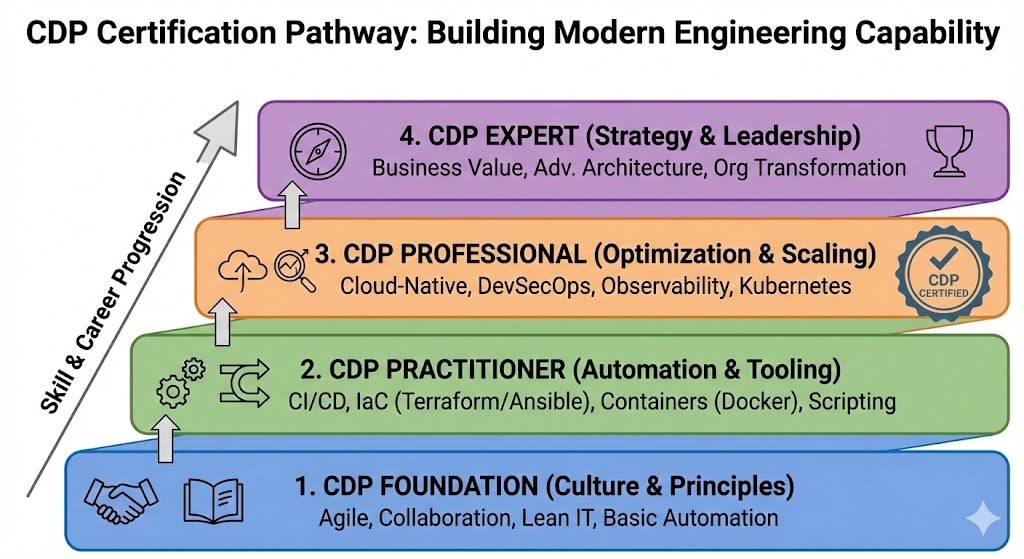
The certification is organized into foundation, professional, and advanced levels to accommodate different stages of a career. The foundation level introduces the core philosophy and basic toolchain, while the professional level dives deep into advanced CI/CD and orchestration strategies. For those looking to specialize further, the program offers tracks in specialized areas like SRE, FinOps, or DevSecOps, allowing for a tailored learning experience. This tiered approach ensures that as your responsibilities grow, you have a clear roadmap for continuing your education and maintaining your status as a subject matter expert.
Complete Certified DevOps Professional (CDP) Certification Table
| Track | Level | Who it’s for | Prerequisites | Skills Covered | Recommended Order | Official Link |
| Core DevOps | Foundation | Beginners/Associates | Basic IT knowledge | Linux, Git, CI/CD | 1st | Link |
| Core DevOps | Professional | Mid-level Engineers | 2+ years experience | Docker, K8s, Terraform | 2nd | Link |
| Specialization | Expert | Senior SREs/Architects | Professional level | Observability, Scaling | 3rd | Link |
| Security | DevSecOps | Security Engineers | Core DevOps | Vault, SonarQube, SCA | Optional | Link |
| Finance | FinOps | Managers/Leads | Cloud experience | Cost Optimization | Optional | Link |
Detailed Guide for Each Certified DevOps Professional (CDP) Certification
Certified DevOps Professional (CDP) – Foundation Level
What it is
This certification validates a fundamental understanding of the DevOps lifecycle, including the cultural shifts and basic automation tools required to bridge the gap between development and operations.
Who should take it
It is suitable for junior engineers, project managers, or recent graduates who want to build a strong theoretical and practical baseline in modern software delivery.
Skills you’ll gain
- Proficiency in version control using Git.
- Understanding of Continuous Integration principles.
- Basic knowledge of Linux administration and shell scripting.
- Awareness of cloud infrastructure basics.
Real-world projects you should be able to do
- Set up a basic automated build pipeline for a simple application.
- Manage source code repositories with proper branching strategies.
- Deploy a static website to a cloud storage bucket.
Preparation plan
- 7–14 days: Review core DevOps terminology and Git commands.
- 30 days: Complete a hands-on lab environment setup and run basic CI jobs.
- 60 days: Engage in a full mock project involving a multi-stage build process.
Common mistakes
- Focusing too much on tools rather than the underlying process.
- Neglecting the importance of Linux command-line proficiency.
Best next certification after this
- Same-track option: Certified DevOps Professional (CDP) Professional Level.
- Cross-track option: Cloud Associate Certification.
- Leadership option: Agile Project Management.
Certified DevOps Professional (CDP) – Professional Level
What it is
The Professional Level validates advanced competency in containerization, orchestration, and infrastructure as code, focusing on building resilient and scalable production environments.
Who should take it
This is designed for experienced DevOps engineers and SREs who are responsible for maintaining complex microservices architectures and automated deployment systems.
Skills you’ll gain
- Advanced Kubernetes orchestration and cluster management.
- Infrastructure as Code (IaC) using tools like Terraform or Ansible.
- Implementing monitoring and logging stacks for production visibility.
- Mastering blue-green and canary deployment strategies.
Real-world projects you should be able to do
- Provision a multi-region cloud infrastructure using automated scripts.
- Containerize a complex multi-tier application and deploy it to a cluster.
- Build an automated rollback mechanism triggered by failed health checks.
Preparation plan
- 7–14 days: Deep dive into Docker internals and Kubernetes manifests.
- 30 days: Build a complete end-to-end pipeline including security scanning.
- 60 days: Conduct disaster recovery drills and performance tuning exercises.
Common mistakes
- Hardcoding configurations instead of using secret management tools.
- Over-complicating the CI/CD pipeline beyond the team’s ability to maintain it.
Best next certification after this
- Same-track option: Certified DevOps Professional (CDP) Expert Level.
- Cross-track option: Certified DevSecOps Professional.
- Leadership option: Principal Engineer or Engineering Manager.
Choose Your Learning Path
DevOps Path
The traditional DevOps path focuses on the end-to-end delivery of software with high velocity and quality. It requires a deep understanding of the software development lifecycle and the ability to automate everything from testing to deployment. Professionals on this path often become the glue between teams, ensuring that releases are frequent and reliable. This path is perfect for those who enjoy building and optimizing complex systems.
DevSecOps Path
The DevSecOps path integrates security checks directly into the automated pipeline, moving security to the left of the development process. You will learn how to automate vulnerability scanning, manage secrets, and ensure compliance without slowing down the release cycle. This is a critical path as enterprises face increasing regulatory pressure and security threats. It suits engineers who have a passion for cybersecurity and automated governance.
SRE Path
The Site Reliability Engineering (SRE) path applies software engineering mindsets to system administration problems. You will focus on reliability, scalability, and service-level objectives (SLOs) to ensure that large-scale systems remain performant under load. This path involves significant work with observability tools and incident management protocols. It is ideal for those who prefer working on the operational stability and performance of systems.
AIOps / MLOps Path
This path addresses the unique challenges of deploying and managing machine learning models and artificial intelligence systems. You will learn how to automate data pipelines, manage model versioning, and monitor the performance of models in production. As AI becomes integrated into every product, this specialized knowledge is becoming highly sought after. It is perfect for engineers who want to bridge the gap between data science and operations.
DataOps Path
DataOps focuses on improving the quality and cycle time of data analytics by applying DevOps principles to data management. You will learn how to build automated data pipelines that are resilient to changes in data volume and structure. This path ensures that data is available, accurate, and secure for business intelligence needs. It is best suited for data engineers who want to bring automation and reliability to data workflows.
FinOps Path
The FinOps path centers on the financial management of cloud resources, ensuring that organizations get the most value for every dollar spent. You will learn how to monitor cloud costs, optimize resource allocation, and foster a culture of financial accountability within engineering teams. As cloud bills grow, the ability to manage these costs effectively is a vital business skill. This path is excellent for senior leads and managers focused on operational efficiency.
Role → Recommended Certified DevOps Professional (CDP) Certifications
| Role | Recommended Certifications |
| DevOps Engineer | CDP Professional, Kubernetes Certification |
| SRE | CDP Professional, Observability Specialist |
| Platform Engineer | CDP Professional, IaC Specialist |
| Cloud Engineer | CDP Foundation, Cloud Architect |
| Security Engineer | CDP Professional, DevSecOps Specialist |
| Data Engineer | CDP Foundation, DataOps Specialist |
| FinOps Practitioner | CDP Foundation, Cloud Financial Management |
| Engineering Manager | CDP Foundation, Leadership for DevOps |
Next Certifications to Take After Certified DevOps Professional (CDP)
Same Track Progression
Once you have mastered the professional level of the CDP, the natural next step is to seek expert-level certifications or specialized cloud provider credentials. Deepening your knowledge in specific areas like advanced container orchestration or service mesh management will solidify your position as a technical authority. This progression signals to employers that you are capable of designing architecture, not just maintaining it. Continuous learning in this track ensures you remain at the cutting edge of infrastructure technology.
Cross-Track Expansion
Broadening your skills into areas like DevSecOps or MLOps allows you to become a T-shaped professional with deep expertise in one area and broad knowledge in others. Expanding your horizons helps you solve cross-functional problems and makes you a better collaborator in diverse engineering teams. By understanding how security or data science intersects with DevOps, you can build more integrated and efficient systems. This approach is highly effective for those aiming for staff engineer or consultant roles.
Leadership & Management Track
For those interested in the human side of technology, moving toward leadership involve certifications in Agile, Lean, or Engineering Management. Understanding how to scale culture, manage technical debt, and lead digital transformations is essential for moving into director or VP of Engineering positions. This track focuses on the strategic implementation of DevOps to achieve business goals rather than just technical milestones. It is the best route for engineers who want to influence the direction of an entire organization.
Training & Certification Support Providers for Certified DevOps Professional (CDP)
DevOpsSchool
DevOpsSchool provides comprehensive training programs that are deeply rooted in practical, hands-on learning for the CDP program. They offer instructor-led sessions and a vast library of resources to help professionals master the entire toolchain. Their curriculum is designed by industry veterans to ensure alignment with current market demands.
Cotocus
Cotocus focuses on delivering high-quality technical education with a focus on enterprise-grade DevOps implementations. They provide specialized environments for candidates to practice real-world scenarios, making the transition from learning to doing much smoother. Their support is tailored toward working professionals seeking to upgrade their skills quickly.
Scmgalaxy
Scmgalaxy is a well-known community and training hub that offers extensive documentation and tutorials for DevOps practitioners. They provide a wealth of free and paid resources that cover everything from basic version control to advanced orchestration. Their focus is on building a strong community of learners who share knowledge and best practices.
BestDevOps
BestDevOps offers targeted certification preparation and consulting services for teams and individuals aiming for the CDP. They emphasize the ROI of training, ensuring that the skills gained lead to immediate improvements in delivery speed and system stability. Their trainers are active practitioners who bring current industry insights to the classroom.
devsecopsschool.com
This provider specializes in the security aspect of the DevOps lifecycle, offering deep dives into automated security testing and compliance. They help professionals integrate security into every stage of the pipeline, which is a key component of the CDP specialization tracks. Their courses are essential for anyone looking to focus on modern security engineering.
sreschool.com
Sreschool.com focuses exclusively on reliability engineering and operational excellence, providing the tools needed for the SRE specialization. They cover topics like error budgets, incident response, and performance monitoring in great detail. This is the go-to resource for engineers who prioritize system uptime and scalability.
aiopsschool.com
Aiopsschool.com provides the specialized training required for the AIOps and MLOps tracks of the CDP. They bridge the gap between artificial intelligence and traditional operations, teaching how to manage the lifecycle of machine learning models. Their curriculum is cutting-edge and designed for the next wave of automation.
dataopsschool.com
Dataopsschool.com offers training programs focused on applying DevOps principles to data engineering and analytics workflows. They teach how to build reliable data pipelines and manage data at scale, ensuring quality and consistency. Their courses are vital for data professionals moving toward an automated, agile data environment.
finopsschool.com
Finopsschool.com focuses on the financial management and optimization of cloud infrastructure, a key skill for senior DevOps leaders. They provide the frameworks and tools needed to track cloud spending and improve cost efficiency across the organization. Their training is essential for aligning technical operations with business budgets.
Frequently Asked Questions
- How difficult is the Certified DevOps Professional (CDP) exam?The difficulty level is moderate to high, primarily because it requires both theoretical knowledge and practical application. It is not a simple multiple-choice test; you must demonstrate that you can actually configure tools and build pipelines. Professionals with at least two years of hands-on experience generally find it manageable if they prepare specifically for the assessment criteria.
- What are the prerequisites for the CDP certification?For the foundation level, there are no strict prerequisites other than a basic understanding of IT and software development. However, for the professional level, it is highly recommended to have at least two years of experience in a DevOps or system administration role. Familiarity with Linux, Git, and at least one cloud platform will significantly help your chances of success.
- How long does it take to prepare for the CDP?The preparation time varies based on your existing experience. A seasoned engineer might only need 30 days of focused study to bridge gaps in their knowledge. A beginner should expect to spend 60 to 90 days to fully grasp the concepts and complete the necessary hands-on labs. Consistency in practice is more important than the total number of hours spent.
- Is the CDP certification recognized globally?Yes, the Certified DevOps Professional (CDP) is recognized by enterprises and startups worldwide as a validation of DevOps competency. It is particularly popular in India, the US, and Europe, where the demand for skilled DevOps engineers is consistently high. Many multinational corporations list it as a preferred credential in their job descriptions for engineering roles.
- What is the return on investment (ROI) for this certification?The ROI is typically quite high, as certified professionals often command higher salaries and have access to better job opportunities. Beyond the financial aspect, the skills gained allow you to work more efficiently and solve complex problems faster, which leads to higher job satisfaction. Many professionals see a significant career boost within six months of obtaining the certification.
- Can I take the CDP exam online?Yes, the program is designed to be accessible to a global audience, and the assessments are typically conducted online. This allows you to schedule your exam at a time that fits your work schedule and take it from the comfort of your home or office. Ensure you have a stable internet connection and a quiet environment for the duration of the assessment.
- How does CDP compare to cloud-specific certifications like AWS or Azure?While cloud-specific certifications focus on the tools of a single provider, the CDP focuses on the broader DevOps methodology and vendor-neutral tools like Jenkins, Docker, and Kubernetes. It complements cloud certifications by teaching you how to integrate various services into a cohesive, automated workflow. Having both a CDP and a cloud certification makes you a highly versatile engineer.
- Is there a recertification requirement for CDP?DevOps is a rapidly changing field, so there is usually a requirement to renew your certification every two to three years. This ensures that your skills remain current with the latest industry standards and tool versions. Recertification often involves passing an updated exam or demonstrating continued professional development in the field.
- Does the CDP course include hands-on labs?Yes, practical learning is a core component of the CDP program. You will be expected to complete various labs that simulate real-world scenarios, such as setting up a CI/CD pipeline or troubleshooting a Kubernetes cluster. These labs are essential for building the muscle memory needed to perform these tasks in a professional environment.
- What kind of support is available during the training?Most authorized training providers offer mentorship, community forums, and technical support to help you through the curriculum. You can often interact with instructors and fellow students to clarify doubts and share experiences. This support network is invaluable for overcoming technical hurdles during your preparation.
- Are there any discounts available for the CDP exam?Training providers occasionally offer discounts for early registration, group bookings, or during special promotional periods. It is worth checking the official website and those of authorized partners for any current offers. Some organizations also provide corporate training packages that include exam vouchers for their employees.
- Can this certification help me transition from QA to DevOps?Absolutely. Many QA engineers use the CDP as a bridge to move into more technical, automation-focused roles. The curriculum covers the essential skills needed for this transition, such as scripting, CI/CD, and infrastructure management. It provides a structured path for broadening your skill set and increasing your value to the organization.
FAQs on Certified DevOps Professional (CDP)
- What specific tools are covered in the CDP curriculum?The curriculum covers a wide array of industry-standard tools, including Git for version control, Jenkins for continuous integration, Docker for containerization, and Kubernetes for orchestration. It also includes infrastructure as code tools like Terraform and Ansible, along with monitoring solutions like Prometheus and Grafana. This toolset ensures you can handle the entire DevOps lifecycle.
- Does the CDP focus more on development or operations?The CDP is designed to be a balanced certification that addresses the needs of both development and operations. It teaches developers how to think about deployment and monitoring, and it teaches operations engineers how to use software engineering practices for infrastructure. The goal is to create a professional who can navigate both worlds seamlessly.
- Are there different versions of the CDP for different clouds?The core CDP is vendor-neutral, focusing on tools and practices that can be applied to any cloud environment. However, the hands-on labs may use a specific cloud provider as a backdrop for the exercises. The principles you learn are universally applicable across AWS, Azure, Google Cloud, and even on-premises data centers.
- How are the practical assessments in the CDP structured?Practical assessments usually involve a set of tasks that you must complete in a live lab environment within a specific timeframe. You might be asked to fix a broken pipeline, deploy a specific application configuration, or secure a cluster. Your performance is evaluated based on the final state of the environment and the efficiency of your solution.
- Is the CDP suitable for project managers?Yes, the foundation level is particularly beneficial for project managers who want to understand the technical workflows of their teams. It helps them set realistic expectations, identify bottlenecks in the delivery process, and communicate more effectively with engineers. Understanding the “how” behind DevOps leads to better project outcomes and team morale.
- Can I skip the foundation level and go straight to professional?If you can demonstrate significant professional experience in the field, some providers may allow you to enroll directly in the professional level. However, it is often recommended to review the foundation material to ensure there are no gaps in your knowledge of core DevOps philosophy. Each level builds on the previous one to create a complete understanding.
- What is the format of the CDP certification exam?The exam typically consists of a combination of multiple-choice questions that test your knowledge of concepts and hands-on tasks that test your practical skills. This hybrid approach ensures that you not only know the theory but can also perform the work. The total duration and number of questions vary depending on the level of the certification.
- How does the CDP help with career progression in India?In the Indian tech market, DevOps is one of the fastest-growing sectors with a massive demand for skilled talent. Holding a CDP certification makes your profile stand out to recruiters at top IT service companies and product startups alike. It serves as a verified mark of quality that can lead to faster promotions and opportunities to work on high-impact projects.
Final Thoughts: Is Certified DevOps Professional (CDP) Worth It?
If you are looking for a way to formalize your experience and gain a comprehensive understanding of the modern delivery ecosystem, the Certified DevOps Professional (CDP) is a solid investment. It moves beyond the hype of individual tools and focuses on the integrated workflows that actually drive value in an enterprise. As a mentor, I have seen many engineers use this credential to move from reactive firefighting roles to proactive, strategic engineering positions. The effort required to earn this certification pays off in the form of a more resilient career and a deeper confidence in your technical abilities. It is not just about the certificate; it is about the journey of becoming a more capable, well-rounded professional in a world that demands continuous improvement.