Introduction
A Yard Management System (YMS) is a software solution designed to oversee the movement of trucks, trailers, and containers in the yard of a manufacturing facility, warehouse, or distribution center. It acts as the bridge between transportation and warehouse operations, providing real-time visibility into trailer locations, automating gate processes, and optimizing spotter (shunter) movements.+1
The importance of a YMS lies in its ability to eliminate “dwell time”—the costly periods where drivers wait for a dock or trailers sit idle. By streamlining these transitions, companies can significantly reduce detention fees, improve labor productivity, and ensure that high-priority inventory moves into the warehouse first. Key real-world use cases include managing “drop-and-hook” programs, tracking refrigerated trailer temperatures (reefer monitoring), and automating gate check-ins to reduce congestion. When evaluating tools, users should look for Real-Time Location System (RTLS) integration, ease of mobile use for yard jockeys, and robust integration capabilities with existing WMS and TMS platforms.+2
Best for: Large-scale distribution centers, retail giants, automotive manufacturers, and third-party logistics (3PL) providers handling high daily trailer volumes. It is essential for operations where manual yard checks are no longer feasible due to scale or speed requirements.
Not ideal for: Small businesses with only one or two dock doors and minimal trailer turnover. For these organizations, simple scheduling tools or even basic manual logs are often sufficient and more cost-effective.
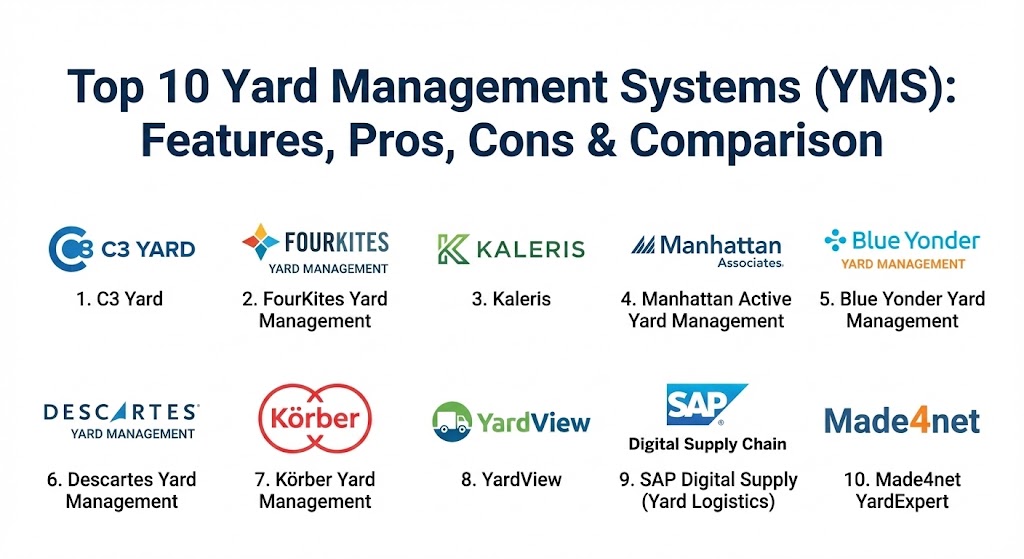
Top 10 Yard Management Systems (YMS) Tools
1 — C3 Yard
C3 Yard is a web-based, best-of-breed YMS designed to manage complex yard operations. It focuses on high-level automation and providing a “site-centric” view of logistics.
- Key features:
- Automated gate management with self-service driver kiosks.
- Real-time trailer tracking and inventory management.
- Intelligent task assignment for yard drivers (shunters).
- Comprehensive dock management and appointment scheduling.
- Multi-site visibility for regional or global yard oversight.
- Advanced reporting and KPI tracking (e.g., trailer aging, dwell time).
- Pros:
- Highly configurable to fit specific business rules and unique yard layouts.
- Excellent visibility into “at-risk” shipments or expiring reefer loads.
- Cons:
- Can be overly complex for simpler operations that don’t need deep automation.
- Implementation requires significant time for data mapping and rule configuration.
- Security & compliance: SOC 2 Type II, SSO integration, role-based access control, and GDPR compliance.
- Support & community: Dedicated account managers, 24/7 global support, and extensive online training modules.
2 — FourKites Yard Management
FourKites, a leader in real-time supply chain visibility, offers a cloud-native YMS that integrates yard data with over-the-road tracking to provide end-to-end visibility.
- Key features:
- Unified visibility connecting in-transit data with yard status.
- AI-driven predictive ETAs for arriving shipments.
- Automated spotter tasking based on warehouse priority.
- Mobile app for yard drivers and security guards.
- Temperature and fuel monitoring for refrigerated trailers.
- Digital gate logs to eliminate paper-based processes.
- Pros:
- Unmatched end-to-end visibility when paired with the broader FourKites platform.
- User interface is modern, intuitive, and requires minimal training.
- Cons:
- Best value is realized only if you are already using FourKites for freight tracking.
- Some advanced automation features are still evolving compared to legacy YMS.
- Security & compliance: SOC 2, ISO 27001, and HIPAA-compliant data handling.
- Support & community: Robust customer success program and a large community of global logistics users.
3 — Kaleris (formerly PINC)
Kaleris is a top-tier provider of yard management and supply chain execution. Their YMS is famous for utilizing drone technology and RTLS to automate yard counts.
- Key features:
- Real-Time Location System (RTLS) using GPS, RFID, or Optical sensors.
- Automated yard “re-counts” using autonomous drones.
- Cloud-based “Enterprise View” for managing hundreds of yards.
- Advanced shuttle and spotter management with optimized routing.
- Integration with carrier portals for self-service scheduling.
- Pros:
- The gold standard for real-time asset location accuracy.
- Dramatically reduces the labor required for manual yard audits.
- Cons:
- The hardware components (RFID/Drones) make this a higher-cost investment.
- Deployment can be hardware-intensive and requires site-specific setup.
- Security & compliance: SOC 2, encrypted data transmission, and ISO standards compliance.
- Support & community: Expert-led implementation teams and a comprehensive technical support desk.
4 — Manhattan Active Yard Management
As part of the Manhattan Active Supply Chain suite, this YMS is built on a cloud-native microservices architecture, designed to work seamlessly with Manhattan’s market-leading WMS.
- Key features:
- Native integration with Manhattan WMS for warehouse-to-yard synchronization.
- Mobile task management for yard jockeys with real-time updates.
- Automated dock door scheduling based on labor availability.
- Dynamic trailer prioritization for “just-in-time” manufacturing.
- Global view of assets across all nodes in the supply chain.
- Pros:
- No-version-loss architecture means you are always on the latest software version.
- Deepest integration available for companies already running Manhattan WMS.
- Cons:
- Primarily aimed at large enterprises; price point reflects its high-end nature.
- Less “agnostic” than other tools; works best within the Manhattan ecosystem.
- Security & compliance: SOC 1/2/3, PCI DSS, and global data privacy standards.
- Support & community: Massive global support network and annual user conferences.
5 — Blue Yonder Yard Management
Blue Yonder (formerly JDA) provides an enterprise-grade YMS that focuses on optimizing the synchronized flow of labor, equipment, and inventory.
- Key features:
- Constraint-based scheduling for dock and yard resources.
- Visibility into trailer contents and shelf-life requirements.
- Automated alerting for detention and demurrage risks.
- Comprehensive gate management with integrated security protocols.
- Support for complex multi-facility yard environments.
- Pros:
- Exceptional at handling high-volume, complex retail and grocery operations.
- Strong “what-if” scenario planning for peak season preparation.
- Cons:
- User interface can feel “legacy” compared to newer cloud-native startups.
- Requires a high level of technical expertise to maintain and optimize.
- Security & compliance: ISO 27001, SOC 2, and rigorous internal audit controls.
- Support & community: Extensive partner ecosystem and 24/7 enterprise-level support.
6 — Descartes Yard Management
Descartes offers a modular YMS that is designed to be easy to deploy and scale, focusing on improving the visibility and security of assets in the yard.
- Key features:
- Real-time tracking using passive and active RFID or GPS.
- Touch-screen kiosks for driver self-check-in.
- Integrated “Yard Check” mobile audits for high-accuracy inventory.
- Automated alerts for unauthorized trailer movements.
- Seamless data flow between TMS and the yard.
- Pros:
- Modular approach allows you to buy only the features you need.
- Very strong focus on security and preventing theft or loss in the yard.
- Cons:
- UI is functional but lacks some of the advanced data visualizations of competitors.
- Integration with non-Descartes WMS systems can require custom work.
- Security & compliance: GDPR, SOC 2, and FISMA compliance for government-related logistics.
- Support & community: Global help desk and localized support in North America and Europe.
7 — Körber Yard Management (formerly HighJump)
Körber’s YMS is highly regarded for its flexibility. It is designed for businesses that need a system that can be modified to fit their specific physical yard constraints.
- Key features:
- Highly extensible workflow engine to mirror unique yard processes.
- Real-time tasking and voice-directed yard operations.
- Integration with IoT sensors for reefer and asset monitoring.
- Multi-level site mapping for complex, non-linear yard layouts.
- Comprehensive audit trails for every trailer movement.
- Pros:
- If you have a “weird” yard process, Körber is the easiest to customize.
- Strong global presence with support for multiple languages and currencies.
- Cons:
- “With great power comes great responsibility”—customization can lead to complexity.
- Upgrades can be more difficult if the system has been heavily modified.
- Security & compliance: SOC 2, ISO 27001, and HIPAA-ready configurations.
- Support & community: Large user group network and extensive training via Körber University.
8 — YardView
YardView is a purpose-built YMS that focuses on simplicity, speed of deployment, and ease of use for the actual people working in the yard.
- Key features:
- Intuitive “drag-and-drop” yard map interface.
- Rapid deployment (can be live in days, not months).
- Automated detention tracking and carrier notifications.
- Text-to-driver communications for gate and dock assignments.
- Web-based carrier portal for real-time trailer status.
- Pros:
- One of the most user-friendly systems on the market.
- Very cost-effective for mid-market companies or single-site operations.
- Cons:
- Lacks some of the AI-driven “predictive” features of FourKites or Manhattan.
- Scalability for massive global enterprises may be more limited.
- Security & compliance: Standard data encryption, SSO, and secure cloud hosting.
- Support & community: Known for high-touch, personalized customer support and rapid response times.
9 — SAP Digital Supply Chain (Yard Logistics)
For organizations running SAP S/4HANA, SAP Yard Logistics provides a native extension to manage the yard as part of the broader “Digital Supply Chain.”
- Key features:
- Fully integrated with SAP EWM (Extended Warehouse Management) and TM.
- Support for rail, container, and truck yard management.
- 3D visualization of the yard for real-time asset monitoring.
- Automated gate integration with IoT and weighbridge connectivity.
- Built-in compliance for hazardous materials and specialized handling.
- Pros:
- Eliminates data silos for SAP-centric organizations.
- Unmatched depth in handling multi-modal yards (rail + truck).
- Cons:
- High cost of entry and requires SAP expertise to implement.
- Overkill for companies not already heavily invested in the SAP ecosystem.
- Security & compliance: Meets all SAP global security, privacy, and audit standards.
- Support & community: Global SAP support infrastructure and massive community of experts.
10 — Made4net YardExpert
Made4net provides a robust, mid-market focused YMS that is part of their broader SCExpert suite. It focuses on affordability and agility.
- Key features:
- Integrated appointment scheduling and gate control.
- Mobile interface for shunters with optimized “next-task” logic.
- Real-time visibility of empty vs. loaded trailers.
- Automated emails to carriers when detention thresholds are met.
- Easy integration via web services (APIs).
- Pros:
- Exceptional value for the feature set provided.
- Fast implementation and lower total cost of ownership (TCO).
- Cons:
- Fewer “advanced” hardware integrations (drones/RTLS) than Kaleris.
- Reporting capabilities are solid but less customizable than Manhattan or SAP.
- Security & compliance: SOC 2 Type II, SSO, and secure API protocols.
- Support & community: Strong North American support and a growing global partner network.
Comparison Table
| Tool Name | Best For | Platform(s) Supported | Standout Feature | Rating (Gartner/TrueReview) |
| C3 Yard | High Automation | Cloud / SaaS | Site-Centric View | 4.6 / 5 |
| FourKites Yard | End-to-End Visibility | Cloud-Native | Predictive ETAs | 4.7 / 5 |
| Kaleris | RTLS & Asset Tracking | Hybrid / SaaS | Drone Yard Audits | 4.5 / 5 |
| Manhattan Active | Large Enterprise | Cloud / SaaS | Microservices Architecture | 4.8 / 5 |
| Blue Yonder | Complex Retail | Cloud / On-Prem | Constraint Scheduling | 4.4 / 5 |
| Descartes | Security & Modular | Cloud / SaaS | Passive RFID Support | 4.3 / 5 |
| Körber YMS | Custom Workflows | Cloud / On-Prem | Extensible Logic | 4.5 / 5 |
| YardView | Ease of Use / SMB | Cloud / SaaS | Drag-and-Drop Map | 4.6 / 5 |
| SAP Yard Logistics | SAP Ecosystem | S/4HANA / Cloud | Rail & Container Support | 4.5 / 5 |
| Made4net | Mid-Market Value | Cloud / On-Prem | Agile Implementation | 4.4 / 5 |
Evaluation & Scoring of Yard Management Systems (YMS)
| Category | Weight | Evaluation Criteria |
| Core Features | 25% | Gate management, spotter tasking, dock scheduling, and asset tracking. |
| Ease of Use | 15% | Intuitiveness for yard jockeys and gate guards; mobile responsiveness. |
| Integrations | 15% | How well it talks to WMS, TMS, ERP, and ELD/GPS hardware. |
| Security & Compliance | 10% | Data privacy, SOC 2 compliance, and audit logs. |
| Performance | 10% | Real-time update speed and system reliability during peak hours. |
| Support & Community | 10% | Documentation, training, and 24/7 technical support availability. |
| Price / Value | 15% | ROI based on detention fee savings and labor efficiency. |
Which Yard Management System (YMS) Tool Is Right for You?
- Solo Users vs SMBs: If you manage a single facility with moderate volume, focus on YardView or Made4net. They offer the best “bang for your buck” without overwhelming your team with features they won’t use.
- Mid-Market to Large Enterprise: If visibility is your primary pain point, FourKites is a game-changer. If you need extreme precision in asset location, Kaleris is the leader.
- Ecosystem-First Companies: If your company is already an “SAP House” or a “Manhattan Shop,” it is almost always better to stick with their native YMS extensions to ensure data integrity and lower integration costs.
- Budget-Conscious Teams: Look for modular systems like Descartes, where you can start with digital gate logs and add RFID or dock scheduling later as budget allows.
- Security-Focused Operations: For facilities handling high-value goods (electronics, pharma), prioritize C3 Yard or Descartes for their advanced security alerts and tamper-tracking capabilities.
Frequently Asked Questions (FAQs)
1. What is the main difference between YMS and WMS? A WMS manages everything inside the four walls of the warehouse. A YMS manages everything outside the doors but within the property fence, such as trailer parking, gate flow, and spotter tasks.
2. Can a YMS reduce detention fees? Yes. By automating alerts when a trailer is approaching its detention time limit and prioritizing those trailers for unloading, a YMS directly reduces the fees paid to carriers.
3. Do I need RFID tags for every trailer? Not necessarily. While RFID/GPS provides the highest accuracy, many YMS tools (like YardView) can work effectively using manual “drag-and-drop” updates or simple mobile app confirmations.
4. How does a YMS improve safety? A YMS reduces the need for “yard walks” where employees walk among moving trucks. It also ensures that yard jockeys are given optimized, safe routes and that trailers are properly checked before movement.
5. Is YMS software usually cloud-based? The industry has shifted heavily toward the cloud. Cloud-based YMS allows carriers to access portals, enables multi-site management, and reduces the IT burden on the local facility.
6. What is “Reefer Monitoring” in a YMS? This is the ability to track the temperature and fuel levels of refrigerated trailers. The YMS can alert staff if a temperature goes out of range, preventing cargo spoilage.+1
7. How long does implementation typically take? Simple cloud systems can be live in 2–4 weeks. Complex enterprise implementations involving drones, RFID, and deep SAP/Manhattan integration can take 4–9 months.
8. Does YMS integrate with ELDs? Many modern systems (like FourKites) integrate with Electronic Logging Devices (ELDs) to provide accurate arrival times before the truck even hits the gate.
9. Can a YMS manage rail cars? Specialized enterprise systems like SAP Yard Logistics and Kaleris have specific modules designed for rail-bound cargo and yard switching.
10. What is a “Yard Jockey” or “Spotter”? These are specialized drivers and vehicles used specifically to move trailers around the yard. A YMS optimizes their work by sending the next task directly to a tablet in their cab.
Conclusion
A Yard Management System is no longer a luxury; it is the final piece of the digital supply chain puzzle. By turning the “black hole” of the yard into a transparent, automated hub, businesses can unlock significant cost savings and operational speed. Whether you need the drone-powered precision of Kaleris, the end-to-end visibility of FourKites, or the agile simplicity of YardView, the right choice depends on your volume, your existing tech stack, and your budget. Start with the “why”—identify your biggest yard bottleneck—and the “which” will become much clearer.