Introduction
Wind Farm Monitoring Software (WFMS) is a suite of digital solutions designed to track, analyze, and optimize the performance of wind turbines and their associated infrastructure. These tools integrate data from Supervisory Control and Data Acquisition (SCADA) systems, Internet of Things (IoT) sensors, and even autonomous drones to provide a “live” view of asset health. By leveraging Artificial Intelligence (AI) and machine learning, this software can predict mechanical failures before they happen, allowing for proactive maintenance rather than reactive repairs.
The importance of these tools is rooted in the high stakes of downtime. A single turbine offline can cost thousands of dollars in lost revenue every day. Beyond revenue, these tools ensure safety by reducing the need for technicians to perform hazardous manual inspections on-site. Real-world use cases include detecting micro-cracks in rotor blades via high-resolution imagery, monitoring gearbox vibration levels to prevent catastrophic failure, and analyzing power curves to ensure each turbine is producing energy at its theoretical maximum. When evaluating these tools, users should look for cross-platform compatibility, the depth of AI-driven predictive analytics, and the ability to integrate with legacy SCADA systems.
Best for: Wind farm owners, independent power producers (IPPs), utility companies, and Operations & Maintenance (O&M) service providers. It is particularly beneficial for organizations managing large-scale or remote portfolios (especially offshore) where manual inspection is prohibitively expensive.
Not ideal for: Small-scale residential wind enthusiasts or individual turbine owners where the cost of the software license would outweigh the marginal gains in efficiency. It is also not a replacement for physical repair teams, but rather a guide for them.
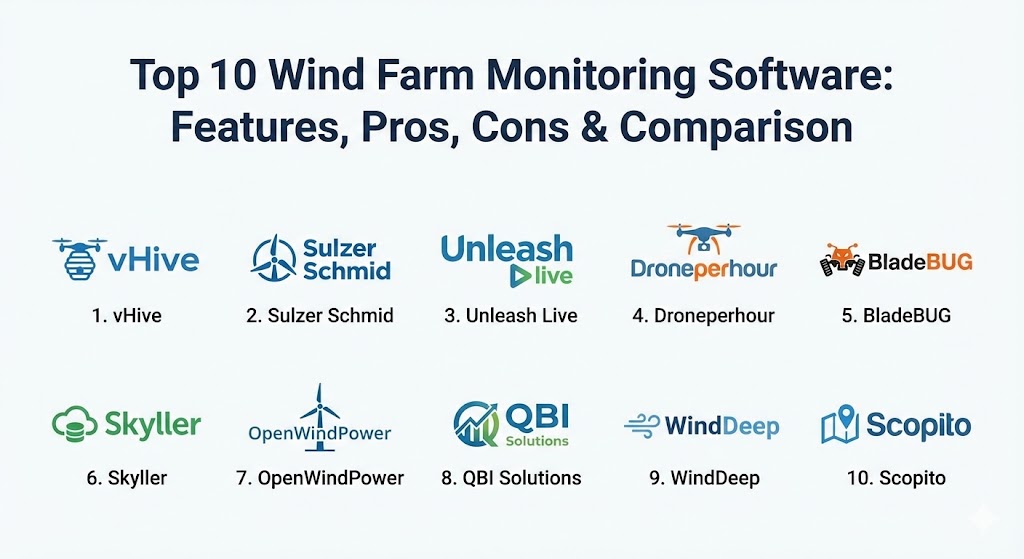
Top 10 Wind Farm Monitoring Software Tools
1 — vHive
vHive is a leading software platform that specializes in digital twin technology and autonomous drone inspections for wind turbines. It provides an end-to-end solution from automated data capture to AI-based analysis.
- Key features:
- Autonomous drone flight orchestration for standardized data capture.
- Creation of high-fidelity “digital twins” of wind turbines.
- AI-driven defect detection for blades, nacelles, and towers.
- Cloud-based collaboration portal for global O&M teams.
- Historical comparison tools to track defect progression over years.
- Integration with existing asset management workflows.
- Pros:
- Eliminates human error in data capture through fully automated drone missions.
- The digital twin interface is highly intuitive for visual asset management.
- Cons:
- Requires specific drone hardware for the best automated experience.
- Initial setup and 3D modeling can be time-intensive for very large fleets.
- Security & compliance: SOC 2 Type II, GDPR compliant, SSO integration, and encrypted data storage at rest and in transit.
- Support & community: Offers comprehensive onboarding, 24/7 technical support, and an extensive online training academy for drone operators.
2 — Sulzer Schmid 3DX Blade Platform
The 3DX Blade Platform is a highly specialized solution focused almost exclusively on the health of rotor blades. It is known for its high-resolution imagery and rigorous damage classification standards.
- Key features:
- Ultra-high-resolution visual and thermal blade inspection.
- Automated flight paths ensuring 100% blade surface coverage.
- Expert-backed damage classification based on industry severity standards.
- Detailed repair planning and tracking modules.
- Web-based dashboard for multi-site blade health comparison.
- Pros:
- Recognized as one of the most field-proven solutions for blade-specific health.
- Excellent reporting that is often used for insurance and warranty claims.
- Cons:
- Very narrow focus; lacks broader SCADA or gearbox monitoring features.
- Higher price point due to the specialized nature of the analysis.
- Security & compliance: ISO 27001, GDPR, and robust user access controls.
- Support & community: Strong global presence with field service partners and dedicated technical account managers.
3 — Unleash Live
Unleash Live is an AI-powered video and image analytics platform that provides real-time monitoring for a wide range of industrial assets, including wind farms.
- Key features:
- Real-time AI analytics on live video streams (drones or fixed cameras).
- “A-Eye” visual inspection for detecting structural anomalies.
- Integration with IoT sensor data for a holistic view of health.
- Collaborative digital workspaces for remote teams.
- Automated reporting and alerting based on customizable thresholds.
- Pros:
- Not limited to wind; can manage an entire renewable portfolio (solar, hydro, wind).
- Exceptional at real-time remote monitoring and collaboration.
- Cons:
- The platform is highly generalized, which may require more customization for wind-specific needs.
- Heavy bandwidth requirements for high-quality live streaming from remote sites.
- Security & compliance: SOC 2, HIPAA (for relevant data), GDPR, and AES-256 encryption.
- Support & community: Fast response times and a robust developer API for custom integrations.
4 — Droneperhour
Droneperhour offers an accessible, fast-turnaround inspection software designed for operators who want a simple way to transition from manual to digital inspections.
- Key features:
- Rapid data upload and processing for quick inspection reports.
- Mobile-first workflow for field technicians.
- Automated AI defect identification for common turbine issues.
- Transparent, per-inspection pricing model.
- Support for standard off-the-shelf commercial drones.
- Pros:
- Highly cost-effective for smaller operators or trial projects.
- Very low learning curve; teams can be up and running in days.
- Cons:
- Lacks the deep “digital twin” or predictive modeling of more expensive tools.
- Limited support for complex offshore environment challenges.
- Security & compliance: GDPR compliant and secure cloud storage.
- Support & community: Email-based support with a focus on quick troubleshooting and user guides.
5 — BladeBUG
BladeBUG takes a unique approach to monitoring by using robotic crawlers that physically walk along the turbine blades to perform non-destructive testing (NDT).
- Key features:
- Robotic blade crawler for close-contact structural assessment.
- Ultrasonic and tactile sensors for subsurface defect detection.
- High-definition cameras for “close-up” visual inspection.
- Software dashboard for analyzing robotic telemetry and sensor data.
- Ability to perform minor repairs/cleanings via the robotic arm.
- Pros:
- Finds internal structural issues that drones and cameras cannot see.
- Significantly safer than rope-access technicians for deep structural work.
- Cons:
- Slower inspection speed compared to aerial drones.
- Robotic hardware is specialized and requires specific operator training.
- Security & compliance: Varies / N/A (Focused on hardware-software telemetry security).
- Support & community: High-touch engineering support and direct partnership models for large-scale O&M.
6 — Skyller
Skyller is a comprehensive asset management platform that integrates drone data with business intelligence to streamline maintenance workflows across large wind fleets.
- Key features:
- Centralized asset registry for all wind farm components.
- Automated work order generation based on inspection findings.
- “Skyller AI” for automated image processing and defect tagging.
- Financial impact modeling of maintenance delays.
- Seamless integration with popular ERP and CMMS systems.
- Pros:
- Excellent at bridging the gap between “finding a problem” and “fixing it” through workflow automation.
- Strong focus on the business ROI of wind farm operations.
- Cons:
- Advanced features can feel complex for teams only looking for simple photo storage.
- Dashboard performance can lag when managing thousands of assets simultaneously.
- Security & compliance: SOC 2 Type I, ISO 27001, and GDPR.
- Support & community: Professional onboarding services and a dedicated customer success team.
7 — OpenWindPower
OpenWindPower (often integrated with Bentley Systems) focuses on the structural and foundation health of wind turbines, especially for the offshore and floating wind sectors.
- Key features:
- Advanced structural modeling of towers and foundations.
- Fatigue and stress analysis based on wave and wind loads.
- Simulation of environmental impacts on asset longevity.
- Integration with hydrodynamic modeling for offshore sites.
- Lifecycle assessment tools for repowering or decommissioning.
- Pros:
- The industry standard for offshore foundation and structural health.
- Essential for life-extension projects for older wind farms.
- Cons:
- High degree of technical complexity; requires structural engineering knowledge.
- Not designed for visual blade inspection or SCADA performance monitoring.
- Security & compliance: ISO 27001, SOC 2, and rigorous data integrity protocols.
- Support & community: Extensive engineering documentation, webinars, and specialized user groups.
8 — QBI Solutions
QBI Solutions provides a robust asset management platform that focuses on the financial and technical performance of renewable energy portfolios.
- Key features:
- Performance benchmarking across different wind turbine OEMs.
- Automated financial reporting and investor dashboards.
- Technical KPI tracking (Availability, Yield, Downtime analysis).
- Document management for contracts, land leases, and permits.
- Integration with multiple SCADA systems for unified reporting.
- Pros:
- Exceptional for asset managers who need to report to investors and stakeholders.
- Provides a unified “commercial” view of the wind farm’s health.
- Cons:
- Lacks the deep “visual” AI for defect detection found in drone-centric tools.
- May require custom data connectors for less common SCADA brands.
- Security & compliance: SOC 2, GDPR, and multi-factor authentication (MFA).
- Support & community: High-quality client support with a focus on data accuracy and financial reporting.
9 — WindDeep
WindDeep is an analytics-heavy platform that leverages machine learning to provide real-time performance optimization and fault prediction.
- Key features:
- Real-time power curve analysis and deviation alerts.
- Machine learning models for early gearbox and bearing failure detection.
- Automated daily/weekly performance reports for O&M teams.
- Weather-adjusted performance benchmarking.
- User-friendly mobile app for real-time turbine status updates.
- Pros:
- Highly effective at finding “hidden” performance losses that aren’t visible to the eye.
- The mobile interface is excellent for on-the-go monitoring.
- Cons:
- Requires high-frequency data from the turbine’s SCADA system to be effective.
- The AI models require a “learning period” of historical data to reach peak accuracy.
- Security & compliance: ISO 27001 and encrypted data transmission.
- Support & community: Strong technical support with a background in wind energy engineering.
10 — Scopito
Scopito is a versatile data management platform that excels at organizing, analyzing, and sharing large volumes of geospatial inspection data.
- Key features:
- High-performance visual data viewer for thousands of inspection photos.
- Custom tagging and classification system for various asset types.
- Public sharing links for providing data to third-party repair contractors.
- Integrated map view for geographical asset management.
- Lightweight AI modules for preliminary defect detection.
- Pros:
- One of the best interfaces for managing “big data” from drone inspections.
- Very flexible; can be used for wind, solar, and power line inspections.
- Cons:
- Not a standalone monitoring tool; it relies on other sources for data capture.
- Lacks the deep structural engineering or financial modeling of specialized rivals.
- Security & compliance: GDPR compliant and secure cloud infrastructure.
- Support & community: Responsive support and a straightforward, well-documented API.
Comparison Table
| Tool Name | Best For | Platform(s) Supported | Standout Feature | Rating (Gartner/TrueReview) |
| vHive | Large-scale AI/Digital Twin | Cloud, Drone-based | Fully Automated Capture | 4.8 / 5 |
| Sulzer Schmid | Blade Health Specialist | Cloud, Web | Damage Severity Logic | 4.7 / 5 |
| Unleash Live | Live Video/Remote Collab | SaaS, Cloud | Real-time AI on Live Feed | 4.5 / 5 |
| Droneperhour | Budget/Simple Inspections | Web, Mobile | Per-Inspection Pricing | 4.3 / 5 |
| BladeBUG | Subsurface/Robotic NDT | Hardware/Software | Robotic Crawler Tech | N/A |
| Skyller | Workflow/Maintenance Mgmt | Cloud, ERP-integrated | Asset-to-Work Order Automation | 4.6 / 5 |
| OpenWindPower | Offshore Foundations | Desktop, Cloud | Hydrodynamic Modeling | 4.7 / 5 |
| QBI Solutions | Commercial/Financial Mgmt | SaaS, Web | Investor Reporting | 4.5 / 5 |
| WindDeep | Performance Optimization | Mobile, SaaS | AI Power Curve Analysis | 4.4 / 5 |
| Scopito | Data Org & Sharing | Web, Cloud | Geospatial Data Viewer | 4.5 / 5 |
Evaluation & Scoring of Wind Farm Monitoring Software
Choosing the right software involves weighing technical depth against operational simplicity. The following rubric highlights the key priorities for enterprise-level selection.
| Category | Weight | Evaluation Criteria |
| Core Features | 25% | AI defect detection, SCADA integration, and digital twin capability. |
| Automation | 15% | Ease of data capture (autonomous drones/robots) and automated reporting. |
| Ease of Use | 15% | Dashboard clarity, mobile access, and workflow intuitiveness. |
| Security | 10% | SOC 2/ISO compliance, data encryption, and user access management. |
| Reliability | 10% | System uptime and accuracy of the AI-driven predictive models. |
| Integrations | 10% | Ability to connect with SAP, Oracle, and various OEM SCADA systems. |
| Price / Value | 15% | Total cost vs. the reduction in downtime and manual inspection costs. |
Which Wind Farm Monitoring Software Tool Is Right for You?
The right choice depends on where you sit in the wind farm lifecycle and the specific pain points you are trying to solve.
- Solo Users & Small Operators: If you manage a handful of turbines, a heavy enterprise tool will be overkill. Look for Droneperhour or Scopito. These provide the visibility you need without the massive annual license fees.
- Independent Power Producers (IPPs): If your goal is to maximize the ROI of a mid-sized portfolio, WindDeep or vHive offer the best balance of performance analytics and visual health monitoring.
- Offshore Giants: For companies managing massive offshore arrays, structural integrity is as important as blade health. OpenWindPower is essential for the foundations, while vHive handles the above-water automated drone capture.
- O&M Service Providers: If you are a third-party maintenance company, you need tools that make your job easier. Skyller is excellent for turning inspection data into billable work orders, and Sulzer Schmid provides the expert-level reports your clients will demand.
- Financial & Asset Managers: If your primary job is reporting to a board of directors or investors, QBI Solutions is the clear winner for its focus on financial health and portfolio-wide benchmarking.
Frequently Asked Questions (FAQs)
1. Does the software include the drones/robots needed for inspection? Usually, no. Most tools like vHive or Scopito provide the software platform but are “hardware-agnostic” or support specific commercial drones (like DJI or Skydio). Specialized companies like BladeBUG provide their own robotic hardware.
2. Can these tools monitor different brands of turbines at once? Yes. Modern monitoring tools are designed to be “multi-OEM,” meaning they can pull data from Vestas, GE, Siemens Gamesa, and others into a single unified dashboard.
3. How does AI actually “detect” a defect? The AI models are trained on millions of images of healthy and damaged turbines. When you upload your photos, the software compares them to its database to flag cracks, lightning strikes, or leading-edge erosion automatically.
4. Is internet access required at the wind farm site? For real-time SCADA monitoring, yes. However, for visual drone inspections, data is often captured offline and then uploaded to the cloud once the technician returns to a location with internet.
5. How much does wind farm monitoring software cost? Pricing is typically based on the number of turbines or the volume of data. It can range from $500 per inspection to $100,000+ per year for global enterprise licenses.
6. Can these tools predict when a gearbox will fail? Yes, tools like WindDeep use vibration and thermal data to identify microscopic changes in gear health, often predicting a failure months before it actually happens.
7. Is this software secure from hackers? Top-tier tools prioritize cybersecurity, especially since they connect to critical infrastructure. Look for SOC 2 Type II or ISO 27001 certifications to ensure data integrity.
8. Does this software replace the need for manual inspections? It significantly reduces them (up to 90%), but it doesn’t eliminate them. You still need technicians for the actual repairs, but the software tells them exactly where to go and what tools to bring.
9. Can it help with insurance claims? Yes. Standardized, time-stamped, and expert-verified reports from tools like Sulzer Schmid are often required by insurance companies to prove the state of an asset before and after a storm or fault.
10. What is a “Digital Twin” in wind energy? A digital twin is a 3D virtual replica of your physical turbine. It allows you to “walk” around the turbine virtually, see historical repair data in 3D space, and simulate how different stresses will impact the structure.
Conclusion
The wind industry has moved past the era of manual checklists and binoculars. In 2026, the competitive edge belongs to the operators who can harness the massive amounts of data their turbines produce. Choosing a Wind Farm Monitoring Software is about finding the right balance between “seeing” (visual drone inspections) and “sensing” (SCADA and AI analytics). Whether you prioritize blade health, structural foundation, or financial yield, the tools listed above represent the gold standard of modern asset management. Remember, the most expensive software is the one your team finds too complicated to use—start with your operational goals and choose the tool that fits your team’s workflow.