Introduction
Trade compliance software is a specialized category of enterprise technology designed to automate and manage the regulatory requirements of international trade. These tools serve as a digital safeguard, ensuring that every shipment adheres to the laws of both the exporting and importing countries. By centralizing data and automating screening processes, these solutions allow businesses to identify restricted parties, calculate total landed costs, and manage customs documentation with surgical precision.
The importance of trade compliance software in 2026 cannot be overstated. With the introduction of stricter environmental regulations (like the EU Deforestation Regulation) and rapid-fire changes in tariff policies, organizations must be agile. Real-world use cases include real-time “stop-ship” triggers for sanctioned entities, automated tariff classification using AI, and the management of complex “Rules of Origin” to qualify for duty-free status. When evaluating these tools, users should look for depth in regulatory content, ease of ERP integration, robust audit trails, and the ability to scale across multiple jurisdictions.
Best for: Multinational corporations, high-volume exporters/importers, customs brokers, and logistics service providers. It is essential for compliance officers, supply chain managers, and legal teams in industries like aerospace, defense, electronics, and pharmaceuticals.
Not ideal for: Small local retailers with no international footprint or businesses that source and sell exclusively within a single trade bloc (like the EU) where cross-border regulatory requirements are minimal and can be handled by basic accounting software.
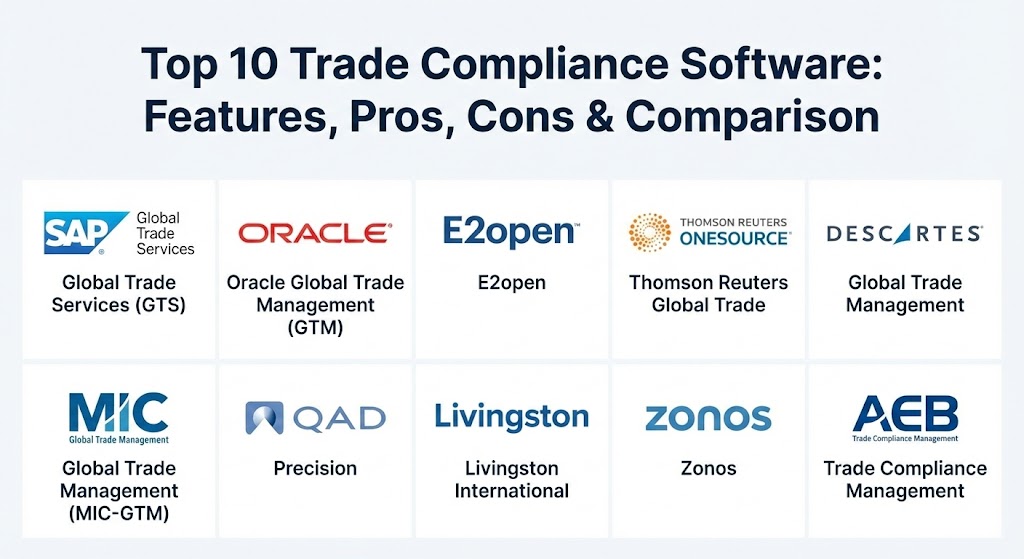
Top 10 Trade Compliance Software Tools
1 — SAP Global Trade Services (GTS)
SAP GTS is widely considered the gold standard for large-scale enterprises already running on the SAP ecosystem. It provides a comprehensive, highly integrated platform for managing all aspects of global trade, from sanctioned party screening to complex customs management.
- Key features:
- Native integration with SAP S/4HANA for seamless transaction monitoring.
- Automated Sanctioned Party List (SPL) screening against global databases.
- Advanced Export Control and license management functionality.
- Electronic communication with customs authorities in over 25 countries.
- Integrated Trade Preference Management for duty savings.
- Comprehensive audit trails and compliance reporting dashboards.
- Pros:
- Unmatched scalability for organizations with millions of monthly transactions.
- Deep, native integration eliminates data silos between sales and compliance.
- Cons:
- Extremely high implementation cost and complexity.
- Requires specialized SAP consultants for initial setup and maintenance.
- Security & compliance: SOC 1/2, ISO 27001, GDPR, and FIPS 140-2 compliant.
- Support & community: Extensive global support network, SAP Community forums, and a massive ecosystem of certified implementation partners.
2 — Oracle Global Trade Management (GTM) Cloud
Oracle GTM Cloud is a modern, cloud-native solution that offers a unified platform for trade compliance and global logistics. It is designed to provide real-time visibility and control over international trade operations.
- Key features:
- Global Trade Intelligence for advanced data visualization and analytics.
- Automated restricted party screening with “fuzzy logic” matching.
- Integrated product classification and landing cost calculations.
- High-availability architecture designed for 24/7 global operations.
- User-definable compliance rules and flexible workflow automation.
- Built-in support for multiple languages, currencies, and time zones.
- Pros:
- Faster deployment cycles compared to traditional on-premise solutions.
- Excellent predictive analytics for identifying potential supply chain risks.
- Cons:
- The user interface can feel complex for occasional or non-technical users.
- Integration with non-Oracle ERP systems can be more challenging.
- Security & compliance: SOC 1/2, HIPAA (where applicable), GDPR, and ISO 27001.
- Support & community: Robust Oracle Cloud Support, dedicated customer success managers, and the Oracle University training platform.
3 — E2open (including Amber Road & BluJay)
E2open has consolidated several industry-leading tools (like Amber Road and BluJay) to create a massive, network-centric trade management platform. It focuses on end-to-end supply chain visibility and compliance orchestration.
- Key features:
- Access to one of the world’s largest trade content databases (Global Knowledge).
- Integrated E-Commerce compliance for cross-border B2C sales.
- Automated qualification for over 100 Global Trade Agreements.
- Supplier collaboration portal for collecting origin and compliance data.
- Multi-mode transportation management integrated with compliance checks.
- AI-driven classification engine for Harmonized Tariff Schedules.
- Pros:
- Unrivaled breadth of regulatory content spanning nearly every country.
- Excellent for companies needing to manage high-volume, small-parcel global trade.
- Cons:
- Transitioning between the different acquired modules can occasionally feel disjointed.
- Higher pricing tiers make it less accessible for mid-market companies.
- Security & compliance: SOC 2 Type II, ISO 27001, and GDPR compliant.
- Support & community: Dedicated account management and a robust online portal for documentation and training.
4 — Thomson Reuters ONESOURCE Global Trade
ONESOURCE is a leader in the intersection of tax and trade compliance. It is designed for companies that need to manage the financial implications of trade—such as duties, taxes, and transfer pricing—alongside regulatory requirements.
- Key features:
- Automated duty and tax calculation for over 180 countries.
- Integrated Import/Export documentation automation.
- Advanced Free Trade Agreement (FTA) management tools.
- Real-time regulatory updates delivered directly to the platform.
- Integration with top-tier ERPs like Workday, Oracle, and SAP.
- Transfer pricing and valuation compliance modules.
- Pros:
- Best-in-class accuracy for duty and tax calculations.
- Backed by Thomson Reuters’ massive team of global trade and tax researchers.
- Cons:
- Strongest in financial/tax compliance; slightly less focus on physical logistics.
- Implementation can be time-consuming due to the depth of data required.
- Security & compliance: SOC 2, GDPR, ISO 27001, and robust encryption protocols.
- Support & community: Comprehensive technical support and world-class regulatory webinars and training sessions.
5 — Descartes Global Trade Management
Descartes offers a modular, cloud-based platform that is particularly strong in the logistics and transport sectors. It is built around a vast database of trade records and regulatory information.
- Key features:
- Denied Party Screening (DPS) with integrated “Adjudication” workflows.
- Customs Info database with over 5 billion trade records.
- Automated classification tools for HS and ECCN codes.
- Export compliance and license management for dual-use goods.
- Integrated ocean and air carrier connectivity for filing.
- Visual compliance tools for quick risk assessments.
- Pros:
- Extremely fast time-to-value for screening-only requirements.
- The database is arguably the most comprehensive in the industry for researchers.
- Cons:
- The UI can feel a bit dated compared to modern “App-style” cloud platforms.
- Advanced automation requires significant custom configuration.
- Security & compliance: SOC 2, HIPAA, GDPR, and ISO 27001.
- Support & community: Extensive online knowledge base and responsive technical support teams.
6 — MIC Global Trade Management (MIC-GTM)
MIC is a specialized provider focused on customs filing and multiregional compliance. It is the preferred choice for companies with heavy manufacturing operations in Europe and North America.
- Key features:
- Direct electronic customs filing for over 55 countries on a single platform.
- Advanced Inventory Management for Bonded Warehouses and FTZs.
- Automated Special Customs Procedures (e.g., IPR/OPR).
- Integrated Export Control and Sanction List Screening.
- Origin Calculation and Supplier Solicitation modules.
- Detailed audit logs that are specifically designed for customs audits.
- Pros:
- Unmatched depth in European customs regulations and local requirements.
- High level of “direct-to-customs” connectivity without third-party brokers.
- Cons:
- Smaller market presence in Asia-Pacific compared to SAP or Oracle.
- The learning curve for the administrative back-end is relatively steep.
- Security & compliance: ISO 27001, SOC 2, and GDPR compliant.
- Support & community: Direct phone support in multiple languages (English, German, French).
7 — QAD Precision
QAD Precision (formerly Precision Software) is a leader in global trade management and multi-carrier transportation. It is unique in how it blends high-speed parcel shipping with enterprise-grade trade compliance.
- Key features:
- Desktop Shipping integrated with real-time compliance checks.
- Automated export documentation and shipping label generation.
- Restricted party screening for both B2B and B2C transactions.
- Trade agreement qualification and certificate management.
- Import management with automated entry summary filing.
- High-integrity audit trails with no record deletion allowed.
- Pros:
- Best choice for manufacturers who ship a high volume of small parcels globally.
- Excellent integrity of audit data, making it very popular with legal teams.
- Cons:
- Integration with non-QAD ERPs can require more effort than expected.
- Less focus on heavy bulk or ocean-only logistics.
- Security & compliance: SOC 2, ISO 27001, and GDPR compliant.
- Support & community: Reliable enterprise support with a strong reputation for customer retention.
8 — Livingston International (TradeSphere)
Livingston is unique because it combines high-end MFT software with professional trade consulting services. TradeSphere is their technology platform, designed for companies that want a hybrid of software and expert guidance.
- Key features:
- Integrated “Expert-on-Demand” support for complex compliance questions.
- Automated Export/Import transaction processing.
- Restricted Party Screening with manual review services.
- Product classification services managed by trade experts.
- Trade agreement management and document storage.
- Real-time regulatory dashboards for executive visibility.
- Pros:
- Ideal for companies that lack a large in-house compliance department.
- Combines software automation with human “sanity checks” for high-risk items.
- Cons:
- More expensive than “software-only” solutions due to the service component.
- Less “self-service” than cloud-native competitors.
- Security & compliance: SOC 2, CJIS (select modules), and HIPAA compliant.
- Support & community: High-touch customer service with North American leadership in trade training.
9 — Zonos
Zonos is a modern, developer-first solution that focuses heavily on the “Landed Cost” aspect of trade compliance. It is the leading choice for global E-commerce brands.
- Key features:
- Industry-leading Landed Cost API (Duty, Tax, and Fees).
- Automated HS code classification using machine learning.
- Integrated “Hello” widget for showing duties to shoppers in real-time.
- Restricted party screening for E-commerce checkouts.
- Managed service for IOSS and international tax registration.
- Native plugins for Shopify, BigCommerce, and Magento.
- Pros:
- The most modern and easy-to-integrate API for E-commerce developers.
- Dramatically improves the customer experience by eliminating “surprise” fees.
- Cons:
- Not designed for heavy industrial exports or dual-use goods management.
- Narrower compliance scope compared to enterprise GTM suites.
- Security & compliance: SOC 2, PCI DSS, and GDPR compliant.
- Support & community: Excellent developer documentation and a very responsive support team.
10 — AEB SE (Trade Compliance Management)
AEB is a German-based powerhouse that provides a modular, highly secure cloud platform for international trade and logistics. It is particularly strong in the European market but has a growing global footprint.
- Key features:
- Integrated Risk Assessment with digital questionnaires.
- Automated Embargo Checks and Restricted Party Screening.
- Advanced License Management for controlled/military goods.
- Multi-ERP connectivity (SAP, Microsoft Dynamics, Oracle).
- Automated Customs Filing for various European countries.
- Collaborative workflows for internal and external stakeholders.
- Pros:
- Highly modular; you can start small and add compliance modules as you grow.
- Very strong focus on data privacy and security, adhering to strict German standards.
- Cons:
- Regulatory content for some non-EU/non-US regions can be less detailed.
- The administrative interface has a slight learning curve.
- Security & compliance: ISO 27001, SOC 2, and BSI-certified data centers.
- Support & community: High-quality training academy and a strong presence in the European logistics community.
Comparison Table
| Tool Name | Best For | Platform(s) Supported | Standout Feature | Rating (Gartner Peer Insights) |
| SAP GTS | SAP Enterprises | SAP (S/4HANA, Cloud) | Deep ERP Integration | 4.7 / 5 |
| Oracle GTM | Cloud-First / Analytics | Cloud, SaaS | Predictive Intelligence | 4.6 / 5 |
| E2open | B2B & Supply Chain | Cloud, SaaS | Global Knowledge DB | 4.5 / 5 |
| ONESOURCE | Tax & Duty Accuracy | Cloud, On-Prem | Tax-Trade Convergence | 4.4 / 5 |
| Descartes | Logistics / DPS | SaaS, Cloud | 5B+ Trade Records | 4.5 / 5 |
| MIC-GTM | Direct Customs Filing | Cloud, Hybrid | 55+ Countries Direct | 4.4 / 5 |
| QAD Precision | Parcel / Manufacturing | Cloud, On-Prem | Multi-Carrier Compliance | 4.3 / 5 |
| Livingston | Expert-Led Hybrid | Cloud, SaaS | Expert Advisors on Demand | 4.4 / 5 |
| Zonos | E-commerce / Landed Cost | API, SaaS | Landed Cost API | 4.8 / 5 |
| AEB SE | Modular / European Trade | Cloud, SaaS | Risk Questionnaire Engine | 4.6 / 5 |
Evaluation & Scoring of Trade Compliance Software
To choose the right solution, organizations must weigh the relative importance of these seven key categories.
| Category | Weight | Evaluation Logic |
| Core Features | 25% | Depth of HS classification, SPL screening, and FTA management. |
| Ease of Use | 15% | Intuitiveness for both compliance officers and logistics staff. |
| Integrations | 15% | Connectivity with ERP (SAP, Oracle), WMS, and TMS systems. |
| Security & Compliance | 10% | Depth of audit logs and adherence to data privacy (GDPR/ISO). |
| Performance | 10% | Latency of real-time screening and uptime for 24/7 global operations. |
| Support & Community | 10% | Availability of regulatory experts and updated training modules. |
| Price / Value | 15% | ROI from duty savings and avoidance of regulatory fines. |
Which Trade Compliance Software Tool Is Right for You?
The “perfect” trade compliance tool depends heavily on your transaction volume, the complexity of your products, and your existing IT stack.
- Solo Users & Tiny Startups: You likely do not need a full enterprise GTM system. Using free government screening tools and simple tariff lookup sites is usually sufficient until your international volume grows.
- Small to Medium Businesses (SMBs): If you are primarily an E-commerce brand, Zonos is the clear winner for its ease of integration. For general shipping and compliance, SolarWinds Serv-U (from our previous blog) or a modular solution like AEB SE provides a good balance of cost and features.
- Mid-Market Companies: If you have a growing international presence but a small compliance team, Livingston offers the best of both worlds with its “Expert-on-Demand” model. If you are shipping many parcels, QAD Precision is worth a look.
- Large Multi-National Enterprises: Your choice is usually dictated by your ERP. SAP GTS and Oracle GTM are the heavyweights. If your focus is primarily on maximizing duty savings and tax efficiency, Thomson Reuters ONESOURCE is the logical choice.
- Logistics & Customs Brokers: You need deep database access and direct filing. Descartes or MIC-GTM are the industry standards for those moving freight for others.
Frequently Asked Questions (FAQs)
1. What is Trade Compliance Software? It is technology that automates the checks required to move goods across borders, including identifying restricted parties, determining correct tariff codes, and ensuring all required documents are filed.
2. What is Sanctioned Party List (SPL) screening? It is the process of checking your customers, suppliers, and partners against global lists of entities prohibited from trade by governments (like the US OFAC list).
3. Can these tools help me save money on duties? Yes. By using FTA (Free Trade Agreement) management modules, these tools identify when your products qualify for lower or zero duty rates under agreements like USMCA or CPTPP.
4. What is a “Landed Cost”? The total price of a product once it has arrived at a buyer’s door, including the original price, shipping, insurance, customs duties, and taxes.
5. How often are the regulatory lists updated? Top-tier providers like E2open or Thomson Reuters update their databases daily (or even hourly) as governments issue new sanctions or tariff changes.
6. Do I need an ERP to use these tools? While many are standalone, they are most effective when integrated with an ERP (like SAP or Oracle) so they can automatically “hold” a sales order if a compliance issue is found.
7. What is an HS Code? The Harmonized System (HS) code is a standardized numerical method of classifying traded products, used by customs authorities around the world to identify products and apply duties.
8. Is cloud-based trade compliance software secure? Yes. In fact, most modern trade software is cloud-native (SaaS) to ensure that security patches and regulatory updates are applied instantly across the entire user base.
9. How long does implementation take? For an API-based tool like Zonos, it can take days. For a full enterprise rollout like SAP GTS, it can take 6 to 12 months.
10. What happens if I don’t use trade compliance software? The risk is “manual error.” This can lead to shipments being seized at the border, heavy fines from customs agencies, or even criminal charges for trading with sanctioned regimes.
Conclusion
The era of “casual” international trade is over. In 2026, the regulatory environment is too complex and the penalties too severe to rely on guesswork or manual processes. Choosing the right Trade Compliance Software is no longer just an IT decision—it is a strategic necessity for business continuity. Whether you prioritize deep ERP integration, high-speed parcel shipping, or E-commerce landed cost accuracy, the right tool will not only protect your company from fines but also turn your compliance department into a driver of supply chain efficiency and duty savings.