Introduction
A Tenant Experience Platform is a digital ecosystem—usually anchored by a mobile app—that centralizes building services, communication, and amenities into a single interface. These platforms act as a “remote control” for a building, allowing occupants to unlock doors, book meeting rooms, order food, and engage with their community from their smartphones. For landlords and property managers, these tools provide invaluable data on how spaces are being used, which amenities are actually driving value, and where operational efficiencies can be found.
The importance of TEPs lies in their ability to drive tenant retention and increase Net Operating Income (NOI). In a market where tenants can easily move to a more modern space, the “stickiness” provided by a seamless digital experience is a significant competitive advantage. Key real-world use cases include touchless access control, automated maintenance ticketing, and the creation of “digital communities” through event RSVP systems and local retail marketplaces. When evaluating these tools, users should look for hardware-agnostic integrations, robust data privacy standards, and the ability to scale across a global portfolio.
Best for: Commercial real estate (CRE) owners, asset managers of Grade-A office buildings, multifamily residential operators, and workplace experience teams in large corporate enterprises. These tools are essential for those managing high-end properties where “lifestyle” and “seamlessness” are core parts of the value proposition.
Not ideal for: Small-scale DIY landlords with only a few units or industrial warehouse owners where tenant interaction is minimal and amenity-driven engagement is unnecessary. In these cases, traditional property management software or simple communication tools are often more cost-effective.
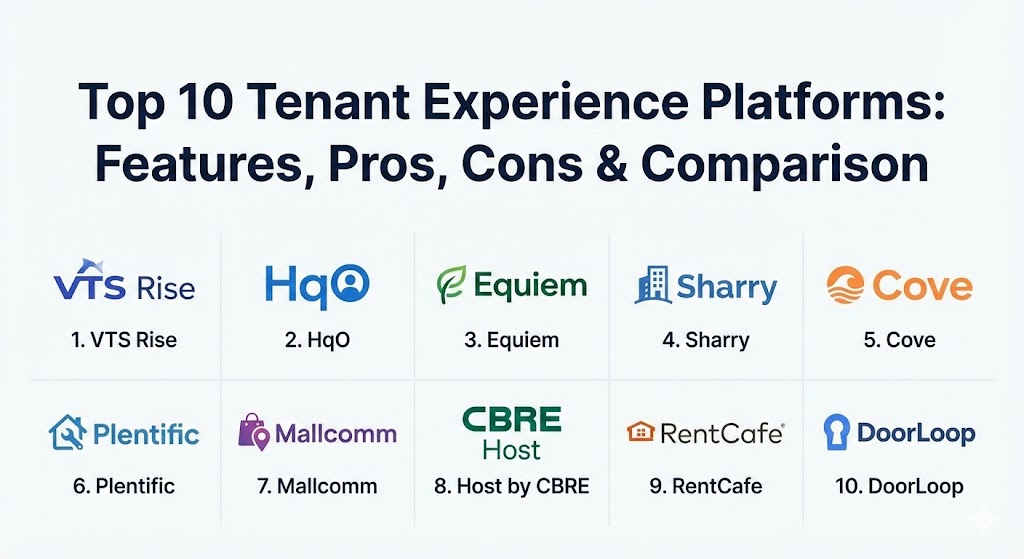
Top 10 Tenant Experience Platforms
1 — VTS Rise
VTS Rise is a premium, high-end tenant experience platform that was born from the acquisition of Rise Buildings by VTS. It is designed primarily for the elite commercial office market but has successfully expanded into the luxury residential space.
- Key features:
- Integrated property access control for doors, elevators, and turnstiles.
- Real-time building sensors for occupancy and air quality monitoring.
- Advanced visitor management with QR-code based invites.
- A comprehensive “Workplace Management” suite for hybrid desk booking.
- Deep integration with VTS Lease and VTS Activate for a complete asset lifecycle view.
- Customizable branding for a bespoke building app experience.
- Pros:
- Offers some of the most sophisticated hardware integrations (HVAC, lighting, locks) in the industry.
- The data reporting is extremely granular, helping landlords justify capital expenditures on amenities.
- Cons:
- Can be significantly more expensive than “engagement-only” apps.
- The sheer number of features can lead to a longer implementation period.
- Security & compliance: SOC 2 Type II, GDPR compliant, SSO integration, and enterprise-grade encryption for all data in transit and at rest.
- Support & community: High-touch enterprise support with dedicated implementation managers; robust documentation and a global user community through the VTS network.
2 — HqO
HqO is a leading “experience-first” platform that focuses on creating a “digital layer” for the physical office. It prides itself on being a partner in the “Human-to-Building” connection, leveraging data to drive tenant satisfaction.
- Key features:
- “HqOS” operating system that unifies all building technology.
- Extensive marketplace of partner integrations (retail, wellness, transport).
- Powerful sentiment analysis tools to measure tenant “happiness” in real-time.
- Digital keys and seamless mobile-first parking management.
- Automated “experience” programming (events, polls, and content).
- Dynamic indoor wayfinding for massive corporate campuses.
- Pros:
- The analytics dashboard is arguably the most insightful for measuring “soft” metrics like engagement.
- Very strong at building a sense of community through partnerships with local businesses.
- Cons:
- Some users find the interface slightly crowded due to the high volume of third-party “perks.”
- Requires a proactive community manager on the landlord side to get the most out of the engagement features.
- Security & compliance: ISO 27001, SOC 2, and GDPR compliant. Detailed audit logs are standard.
- Support & community: Offers “HqO Academy” for training; excellent customer success teams and high availability for global enterprise clients.
3 — Equiem
Equiem is a veteran in the space, originally launching in Australia and now serving a global market. It is known for its “community-first” approach, focusing heavily on content, commerce, and communication.
- Key features:
- Highly developed e-commerce engine for building-based retail and services.
- Curated content feed for building news and local interest stories.
- Flexible amenity booking for gyms, rooftop terraces, and meeting rooms.
- Comprehensive tenant feedback and survey tools.
- Integrated help desk for maintenance and janitorial requests.
- Mobile and web versions for accessibility across all device types.
- Pros:
- Exceptional for older buildings that want to modernize their “vibe” without replacing hardware.
- The e-commerce functionality is more mature than many newer competitors.
- Cons:
- Not as strong in “deep” hardware/IoT control as VTS Rise or Sharry.
- The aesthetic of the app is professional but less “flashy” than some modern rivals.
- Security & compliance: SOC 2, HIPAA (for relevant medical office use), and GDPR.
- Support & community: Renowned for their “concierge-style” onboarding and 24/7 technical support for large portfolios.
4 — Sharry
Sharry is a European-born platform that has gained massive traction in the US due to its focus on “Smart Workplace” technology. It excels in design and the integration of smart building systems.
- Key features:
- Industry-leading smart parking management with license plate recognition.
- Mobile-first access control using HID or Gallagher technology.
- Integrated visitor management system with automated check-in kiosks.
- Dynamic building information and “smart” signage control.
- “Employee App” for corporate tenants to manage their hybrid office space.
- High-level aesthetic design that aligns with modern luxury architecture.
- Pros:
- The user interface is beautiful and works incredibly smoothly.
- Excellent for international companies needing multi-language and multi-currency support.
- Cons:
- The “engagement” features (like newsfeeds) are not as deep as HqO or Equiem.
- Implementation often requires significant coordination with local hardware vendors.
- Security & compliance: GDPR, ISO 27001, and SOC 2. Supports advanced SSO and multi-factor authentication.
- Support & community: Rapidly growing support network; known for being very agile in developing custom features for enterprise clients.
5 — Cove
Cove offers a “simplified” approach to tenant experience, aiming to be the most user-friendly and fastest-to-deploy tool on the market. It is particularly popular with mid-market owners who want results without the enterprise complexity.
- Key features:
- “One-tap” amenity booking and maintenance requests.
- Integrated digital keys and visitor management.
- Communication hub for building-wide announcements and direct messaging.
- Simple “Workplace” module for desk and room reservations.
- Clean, intuitive dashboards for property managers to track tasks.
- Native integration with property management systems like Yardi and MRI.
- Pros:
- Extremely fast launch times; a building can go “live” in weeks rather than months.
- High adoption rates among tenants due to the simplicity of the interface.
- Cons:
- Lacks some of the ultra-deep data analytics found in “big-data” platforms like VTS.
- Fewer integrations with high-end building automation systems (BMS).
- Security & compliance: SOC 2 Type II, GDPR, and data encryption at rest.
- Support & community: Very responsive support team; excellent documentation for self-service setup.
6 — Plentific
Plentific takes a unique angle by focusing heavily on the operational and maintenance side of the tenant experience. It is the best choice for landlords who want to improve the “un-fun” part of living or working in a building.
- Key features:
- Integrated marketplace of over 20,000 vetted contractors.
- End-to-end work order management with real-time tenant updates.
- Compliance and safety tracking for large portfolios.
- Automated quoting and invoicing for building repairs.
- Tenant portal for reporting issues with photo uploads and live tracking.
- Predictive maintenance insights based on historical data.
- Pros:
- Significant cost savings on maintenance by leveraging their competitive contractor marketplace.
- Dramatically reduces the time it takes to resolve tenant complaints.
- Cons:
- Focuses less on “amenity booking” or “community engagement” than other platforms.
- More of an “Operations Platform” than a “Lifestyle Platform.”
- Security & compliance: GDPR, Cyber Essentials Plus, and SOC 2 compliant.
- Support & community: Strong focus on the UK and European markets; excellent onboarding for large property management firms.
7 — Mallcomm
Mallcomm is the world’s leading platform specifically designed for the unique needs of retail destinations, shopping centers, and mixed-use environments.
- Key features:
- Sales data collection and turnover reporting from retail tenants.
- Real-time security alerts and incident reporting for mall staff and shops.
- Integrated “job board” for retailers to hire locally.
- Digital “B2B” communication between mall management and store managers.
- Consumer-facing features for loyalty programs and mall wayfinding.
- Logistics and delivery management for busy loading bays.
- Pros:
- The only platform that truly understands the operational complexity of a shopping mall.
- Improves safety by giving every store employee a direct “panic” line to security.
- Cons:
- Not suitable for standard office buildings or residential towers.
- The UI is built for “information density” rather than “lifestyle luxury.”
- Security & compliance: ISO 27001, GDPR, and high-level data encryption for sensitive sales data.
- Support & community: Specialized support teams with deep retail real estate expertise.
8 — Host by CBRE
Host is the “workplace experience” platform from the global real estate giant CBRE. It leverages CBRE’s massive knowledge base to provide a hospitality-driven experience for corporate tenants.
- Key features:
- Concierge services (ordering food, booking dry cleaning) directly through the app.
- Advanced “Wayfinding” to help employees navigate massive corporate headquarters.
- Integrated meeting room management with hardware status indicators.
- Feedback loops that connect directly to CBRE’s facility management teams.
- “Employee Wellness” modules with tips and local fitness integrations.
- Global portfolio visibility for multi-national corporations.
- Pros:
- Backed by the world’s largest real estate services firm, ensuring long-term stability.
- Excellent at turning a workplace into a “talent recruitment” tool for corporate occupiers.
- Cons:
- Often bundled with CBRE management contracts, making it less accessible for independent owners.
- Can feel “corporate” compared to the boutique feel of HqO or Sharry.
- Security & compliance: World-class security standards, SOC 2, ISO 27001, and HIPAA compliance.
- Support & community: Enterprise-level support with a global reach; access to CBRE’s research and insights.
9 — RentCafe (by Yardi)
RentCafe is the gold standard for the residential and multifamily market. While it started as a leasing portal, it has evolved into a comprehensive tenant experience tool for apartment living.
- Key features:
- Robust rent payment and financial history tracking.
- Seamless lease renewal and electronic signature workflows.
- Integrated “Resident Social” for community message boards.
- Maintenance request tracking with status notifications.
- “Concierge” module for package tracking and visitor management.
- Built-in utility billing and insurance verification.
- Pros:
- If you already use Yardi for accounting, the integration is flawless.
- Highly familiar to tenants; many renters have used RentCafe in previous buildings.
- Cons:
- Lacks the “cool” lifestyle amenities (like order-ahead coffee) of CRE-focused apps.
- The interface is more functional/transactional than inspirational.
- Security & compliance: SOC 1/2, PCI DSS for payments, HIPAA, and GDPR.
- Support & community: Massive user base and extensive Yardi training resources.
10 — DoorLoop
DoorLoop is a fast-growing platform that caters specifically to mid-market commercial and residential managers. It is designed to be the “easiest” all-in-one tool for those who want property management and tenant experience in one box.
- Key features:
- Fully integrated accounting and rent collection.
- Dedicated tenant portal for payments, requests, and documents.
- Automated communication via email, text, and in-app notifications.
- Maintenance management with a dedicated vendor portal.
- Lead-to-lease automation for vacant units.
- Customizable reports for property owners.
- Pros:
- Perfect for managers who want to avoid having separate “accounting” and “experience” apps.
- Extremely modern and easy-to-use interface.
- Cons:
- Doesn’t offer deep “smart building” hardware integrations (like door locks) natively.
- Lacks the community/lifestyle depth of HqO or Equiem.
- Security & compliance: SOC 2, bank-level encryption, and secure cloud hosting.
- Support & community: Highly rated customer service with 24/7 availability and a very helpful “university” learning center.
Comparison Table
| Tool Name | Best For | Platform(s) Supported | Standout Feature | Rating (Gartner Peer Insights) |
| VTS Rise | Luxury Office / CRE | iOS, Android, Web | Deep Hardware / BMS Integration | 4.6 / 5 |
| HqO | Data-Driven Portfolios | iOS, Android, Web | Amenity Usage Analytics | 4.7 / 5 |
| Equiem | Community Engagement | iOS, Android, Web | Mature E-commerce Engine | 4.5 / 5 |
| Sharry | Smart Parking / Design | iOS, Android, Web | Premium UI & Smart Parking | 4.6 / 5 |
| Cove | Mid-Market Simplicity | iOS, Android, Web | Speed of Implementation | 4.4 / 5 |
| Plentific | Maintenance Efficiency | iOS, Android, Web | Vetted Contractor Marketplace | 4.3 / 5 |
| Mallcomm | Retail / Shopping Malls | iOS, Android, Web | Retailer Sales Reporting | 4.5 / 5 |
| Host by CBRE | Corporate HQ | iOS, Android, Web | Advanced Workplace Wayfinding | 4.2 / 5 |
| RentCafe | Multifamily / Apartments | iOS, Android, Web | Native Yardi Integration | 4.8 / 5 |
| DoorLoop | SMB / All-in-One | iOS, Android, Web | Unified Accounting & Experience | 4.7 / 5 |
Evaluation & Scoring of Tenant Experience Platforms
To help you decide, we have evaluated the general market of TEPs based on the following weighted rubric.
| Category | Weight | Evaluation Criteria |
| Core Features | 25% | Amenity booking, access control, visitor management, and communication. |
| Ease of Use | 15% | Intuitiveness for both the property manager and the end-tenant. |
| Integrations | 15% | Compatibility with PMS (Yardi/MRI), hardware (HID/Gallagher), and SaaS tools. |
| Security & Compliance | 10% | Data privacy standards (GDPR/SOC 2) and hardware security. |
| Performance | 10% | App speed, offline access for digital keys, and real-time alerts. |
| Support | 10% | Implementation quality, documentation, and customer success focus. |
| Price / Value | 15% | Total cost vs. the impact on retention and asset value. |
Which Tenant Experience Platform Tool Is Right for You?
Selecting the right tool depends on your asset class and your technical maturity.
- Solo Landlords & Small SMBs: If you manage fewer than 50 units, a full TEP is likely unnecessary. DoorLoop is the best bridge, as it provides a professional tenant portal within a standard management software.
- Mid-Market & Suburban Office: If you want to modernize quickly without a massive IT project, Cove is your best bet. It provides the “big building” feel at a smaller-scale price point.
- Grade-A Commercial Portfolios: For multi-city, high-end offices, VTS Rise and HqO are the clear leaders. They provide the deep data and “luxury” integrations that global corporate tenants (like Google or JP Morgan) expect.
- Retail & Mixed-Use: If your asset includes a high volume of shops, Mallcomm is the only logical choice due to its specialized B2B retail features.
- Residential Operators: For multifamily housing, stick with the leaders that integrate with your accounting. RentCafe (for Yardi) or Entrata are the industry standards for high-volume residential management.
Frequently Asked Questions (FAQs)
1. What is the difference between a Tenant Experience Platform and Property Management Software?
Property Management Software (PMS) is for the “back office” (accounting, leases, taxes). A Tenant Experience Platform (TEP) is for the “front office”—it’s the interface the tenant uses to interact with the building daily.
2. Will tenants actually use the app?
Adoption varies, but tools with “Utility Value” (like digital keys to unlock doors or parking management) see much higher adoption rates than apps that only offer “Engagement” (like news and content).
3. Do these platforms require new hardware in the building?
Not necessarily. Many can integrate with existing access control or HVAC systems. However, to get features like “mobile unlocking,” you may need to upgrade some readers or sensors.
4. How long does it take to get a building “live”?
“Engagement-only” platforms can launch in 2-4 weeks. Complex “Integrated” platforms that connect to elevators and building systems can take 3-6 months.
5. Is the data collected by these apps private?
Yes, reputable platforms are SOC 2 and GDPR compliant. They generally do not track your location outside the building; they focus on how you use the building’s specific services.
6. Can these apps help me save energy?
Yes. By integrating with the Building Management System (BMS), these apps can show occupancy data, allowing you to dim lights or adjust HVAC in empty zones of the building.
7. Can I white-label the app?
Most premium platforms (like VTS Rise, HqO, and Sharry) allow you to name the app after your building (e.g., “The SkyTower App”) rather than using the software vendor’s brand.
8. Do these tools replace my building staff?
No. They automate the repetitive tasks (like printing visitor badges or booking rooms), allowing your staff to focus on higher-value hospitality and proactive maintenance.
9. How do these tools improve retention?
By making the daily experience frictionless. If a tenant can unlock their door, pay rent, and order lunch in 30 seconds, they are statistically less likely to move to a building that requires physical keys and manual checks.
10. What is a “Digital Twin” in this context?
Some advanced TEPs offer a “Digital Twin”—a virtual 3D map of the building that lets managers visualize everything from pipe leaks to underutilized meeting rooms in real-time.
Conclusion
The era of the “dumb building” is over. In 2026, a property is only as valuable as the experience it provides. Whether you choose a heavyweight like VTS Rise for its hardware depth or a modern “all-in-one” like DoorLoop, the goal is the same: to create a frictionless, data-rich environment that tenants love. The “best” tool isn’t the one with the most features, but the one that your tenants actually enjoy using every morning when they walk through the front door.