Introduction
Supply Chain Management (SCM) Suites are comprehensive software platforms designed to oversee and optimize the flow of goods, data, and finances as they move from supplier to manufacturer to wholesaler to retailer and, finally, to the consumer. Unlike point solutions that handle only one aspect of the chain—like a standalone warehouse manager—an SCM suite offers end-to-end visibility and orchestration.
The importance of these suites has skyrocketed due to increased market volatility, geopolitical shifts, and the rise of “just-in-case” inventory strategies. Real-world use cases include using AI to predict demand spikes before they happen, automating procurement when stock reaches a critical threshold, and optimizing delivery routes in real-time to reduce carbon footprints. When evaluating an SCM suite, organizations should look for advanced AI/ML capabilities, real-time IoT integration, a “digital twin” of their supply chain for scenario testing, and deep compatibility with existing Enterprise Resource Planning (ERP) systems.
Best for: Medium to large-scale enterprises with complex, multi-national operations, high-volume manufacturers, and retailers managing omni-channel fulfillment. It is essential for COOs and Supply Chain Directors who need a unified view of their entire ecosystem to make data-driven decisions.
Not ideal for: Micro-businesses or simple service-based companies that do not manage physical inventory. Smaller retailers with a single sales channel may find the cost and complexity of a full SCM suite outweighs the benefits, often being better served by basic inventory modules within a small-business ERP.
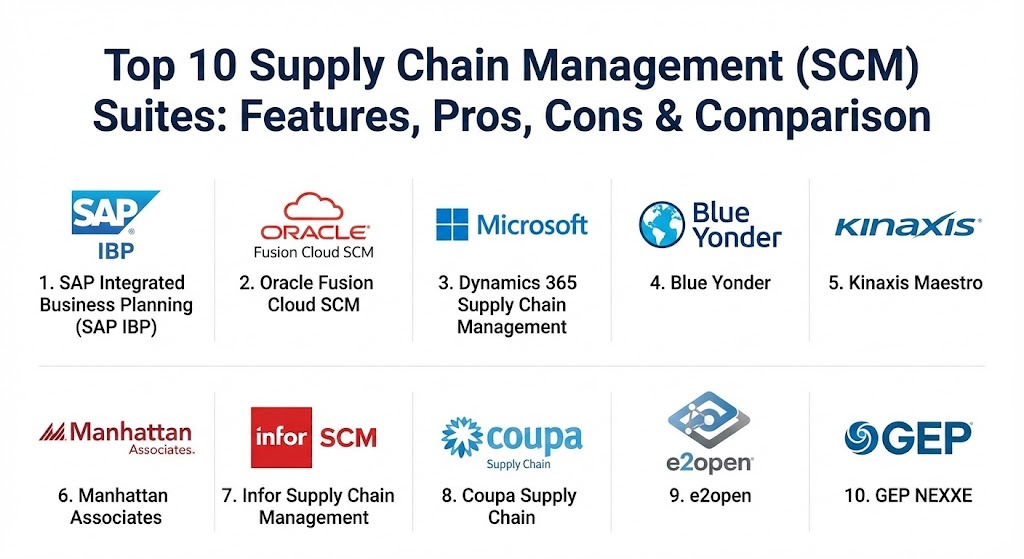
Top 10 Supply Chain Management (SCM) Suites
1 — SAP Integrated Business Planning (SAP IBP)
SAP IBP is a cloud-based solution that sits at the forefront of the industry, specifically designed to handle the massive data requirements of global enterprises. It focuses on the planning phase, offering real-time responses to supply chain changes.
- Key features:
- Demand sensing and predictive forecasting using the Joule AI assistant.
- Integrated Sales and Operations Planning (S&OP) to align finance and operations.
- Multi-echelon inventory optimization (MEIO) for global stock balancing.
- Real-time supply and response planning with “what-if” scenario analysis.
- Native integration with SAP S/4HANA for seamless data flow.
- Advanced analytics and supply chain control tower visibility.
- Pros:
- Unmatched scalability for the world’s largest and most complex supply chains.
- Deep integration with the broader SAP ecosystem, reducing data silos.
- Cons:
- Significant implementation cost and time compared to lighter alternatives.
- Steeper learning curve requiring specialized training for power users.
- Security & compliance: SOC 1/2, GDPR, HIPAA, ISO 27001, and FedRAMP authorized.
- Support & community: Extensive global partner network, robust documentation, and a massive user community with annual conferences.
2 — Oracle Fusion Cloud SCM
Oracle Cloud SCM is a complete, modular suite that covers everything from product lifecycle management to logistics. It is frequently cited as a “Leader” in Gartner Magic Quadrants for its ability to execute end-to-end vision.
- Key features:
- AI-driven demand management that incorporates external signals like weather and social trends.
- Oracle Manufacturing Cloud for smart factory orchestration.
- Integrated Logistics Management (TMS and WMS) within the same suite.
- Global Trade Management for automated compliance and customs.
- Blockchain-ready for transparent, secure tracking of high-value goods.
- Advanced Procurement for strategic sourcing and supplier relationship management.
- Pros:
- Very high degree of automation through embedded AI and “Intelligent Planning Advisor.”
- The unified data model across SCM, Finance, and HR provides incredible business insights.
- Cons:
- Migration from legacy on-premises Oracle systems can be a complex undertaking.
- Occasional UI inconsistencies between older and newer modules.
- Security & compliance: SOC 2, ISO 27001, HIPAA, GDPR, and DOD SRG Level 4/5.
- Support & community: Oracle Cloud Customer Connect offers a vibrant community and direct access to product managers.
3 — Microsoft Dynamics 365 Supply Chain Management
Leveraging the power of the Azure cloud and a familiar Microsoft interface, Dynamics 365 SCM focuses on building resilience through visibility and agility, particularly in the manufacturing and distribution sectors.
- Key features:
- Copilot (Generative AI) for natural language queries and automated insights.
- Asset Management to maximize equipment uptime and lifecycle.
- Master Planning for demand-driven material requirements (DDMRP).
- Integrated Warehouse (WMS) and Transportation (TMS) modules.
- Mixed Reality (HoloLens) integration for warehouse and factory floor training.
- IoT Intelligence for real-time equipment and inventory monitoring.
- Pros:
- Excellent value for money for organizations already invested in the Microsoft 365 stack.
- Highly customizable through the Power Platform (Power Automate, Power BI).
- Cons:
- May require third-party add-ons for highly specialized global trade compliance.
- Rapid update cycles can occasionally cause issues with custom extensions.
- Security & compliance: FIPS 140-2, HIPAA, GDPR, SOC 1/2/3, and ISO 27001.
- Support & community: Strong partner-led support model; extensive learning resources on Microsoft Learn.
4 — Blue Yonder (formerly JDA)
Blue Yonder is a powerhouse in the retail and logistics space. It is renowned for its “Luminate” platform, which uses a digital twin foundation to predict problems before they manifest.
- Key features:
- Luminate Planning for AI-based forecasting and replenishment.
- Digital Twin architecture for real-time supply chain simulation.
- Advanced Warehouse Labor Management to optimize workforce productivity.
- Dynamic pricing optimization based on inventory levels and market demand.
- Multi-enterprise collaboration for sharing data with suppliers and partners.
- ESG (Environmental, Social, and Governance) tracking for sustainable sourcing.
- Pros:
- Best-in-class for retail-specific workflows like markdown optimization.
- Strong “predictive” capabilities that go beyond simple “reactive” monitoring.
- Cons:
- Can feel overly complex for companies with straightforward manufacturing needs.
- The transition from legacy JDA products to the cloud-native platform is still ongoing for some users.
- Security & compliance: SOC 2, GDPR, ISO 27001, and industry-standard encryption.
- Support & community: Professional services are top-tier, though enterprise-level support comes at a premium.
5 — Kinaxis Maestro (formerly RapidResponse)
Kinaxis specializes in “concurrent planning,” where changes in any part of the supply chain instantly ripple across the entire network, allowing for immediate decision-making.
- Key features:
- Maestro Platform for unified, real-time concurrent planning.
- Exception-based management—only deal with the problems the AI can’t solve.
- Rapid scenario modeling (modeling “what-if” in seconds).
- Integrated demand, supply, and inventory planning.
- Sales & Operations Planning (S&OP) and Integrated Business Planning (IBP).
- Supply Chain Control Tower for global visibility.
- Pros:
- The fastest tool for scenario simulation; ideal for highly volatile industries like high-tech.
- Excellent at breaking down silos between planning and execution teams.
- Cons:
- Less focused on the “physical” execution (WMS/TMS) than suites like Manhattan or Oracle.
- Requires high-quality data inputs to reach its full predictive potential.
- Security & compliance: ISO 27001, SOC 2, GDPR, and HIPAA.
- Support & community: Highly rated customer success teams and a dedicated “Kinaxis Knowledge Network.”
6 — Manhattan Associates (Manhattan Active SCM)
Manhattan Associates is the gold standard for supply chain execution, specifically warehouse and transportation management. Their “Active” suite is cloud-native and designed to never need upgrading.
- Key features:
- Manhattan Active Warehouse Management (WMS) with industry-leading pick/pack/ship.
- Unified Transportation Management (TMS) for global freight optimization.
- Omnichannel Commerce for seamless buy-online-pickup-in-store (BOPIS) flows.
- Manhattan Active Inventory for demand-driven replenishment.
- Labor Management and slotting optimization for distribution centers.
- Native integration with robotics and automation systems.
- Pros:
- Unrivaled depth in warehouse and distribution operations.
- The “Active” version stays evergreen with continuous updates, eliminating painful version upgrades.
- Cons:
- Primarily focused on execution; planning features are robust but may not match SAP or Kinaxis.
- Premium pricing reflects its status as a top-tier specialist tool.
- Security & compliance: SOC 1/2, PCI DSS, GDPR, and ISO 27001.
- Support & community: Excellent implementation support; strong presence in the retail and consumer goods sectors.
7 — Infor Supply Chain Management
Infor’s SCM solution is built for specific industries, particularly manufacturing, healthcare, and fashion. It provides a unique “Nexus” network that connects thousands of suppliers globally.
- Key features:
- Infor Nexus for multi-enterprise collaboration and global trade.
- Industry-specific CloudSuites with pre-configured SCM workflows.
- Integrated Business Planning (IBP) for financial and operational alignment.
- Supply Chain Visibility for tracking goods at the unit level globally.
- AI-driven “Coleman” for predictive insights and task automation.
- Advanced Warehouse and Transport Management modules.
- Pros:
- Outstanding industry-specific functionality right out of the box.
- The Nexus network is one of the world’s largest B2B platforms for supplier collaboration.
- Cons:
- The modular nature can sometimes lead to a fragmented user experience.
- Customization can be complex due to the industry-hardened core.
- Security & compliance: SOC 1/2/3, ISO 27001, GDPR, and HIPAA.
- Support & community: Solid documentation; Infor Concierge provides a centralized support portal.
8 — Coupa Supply Chain (including Llamasoft)
Coupa, traditionally a leader in Business Spend Management (BSM), significantly boosted its SCM credentials by acquiring Llamasoft. It now offers world-class supply chain design and planning.
- Key features:
- Supply Chain Design and Modeling for network optimization.
- Integrated Business Planning (IBP) focusing on cost and risk.
- Strategic Sourcing and Procurement within the same BSM platform.
- Risk management and sustainability scoring for suppliers.
- App-based interface for easy adoption by non-IT staff.
- Direct link between supply chain decisions and financial spend.
- Pros:
- The best tool for supply chain design—determining where to build warehouses or source materials.
- Excellent for CFOs who want to see exactly how supply chain changes affect the bottom line.
- Cons:
- Less emphasis on granular, day-to-day warehouse or manufacturing execution.
- Integration between the legacy Llamasoft planning tools and the Coupa platform is still evolving.
- Security & compliance: SOC 1/2, ISO 27001, PCI DSS, GDPR, and HIPAA.
- Support & community: Strong focus on “Customer Success” and a very large B2B network.
9 — e2open
e2open is built on the concept of a “Connected Supply Chain.” It acts as a massive cloud network that brings together data from suppliers, carriers, and retailers to provide a single version of the truth.
- Key features:
- Multi-enterprise network for real-time collaboration with external partners.
- Global Trade Management for navigating complex customs and tariffs.
- Demand Sensing that uses downstream data to improve forecast accuracy.
- Logistics and Transportation management for all modes of transport.
- Supplier Management and risk monitoring.
- Channel Shaping to optimize retail sales through better inventory placement.
- Pros:
- Exceptional for global companies that rely heavily on a complex network of third-party partners.
- Very strong trade compliance and “cross-border” capabilities.
- Cons:
- The interface can feel more utilitarian and less “modern” than Dynamics or CData.
- High volume of data from the network can be overwhelming without proper filter configurations.
- Security & compliance: SOC 2, GDPR, ISO 27001, and NIST standards.
- Support & community: Strong global presence; extensive experience in electronics and automotive sectors.
10 — GEP NEXXE
GEP NEXXE is a next-generation, cloud-native SCM platform that is AI-first. It is part of GEP’s unified procurement and supply chain software suite.
- Key features:
- GEP Qi—an “Agentic AI” platform for autonomous supply chain management.
- Unified platform for both procurement (GEP SMART) and SCM (NEXXE).
- Real-time visibility and control tower across all tiers of the supply chain.
- Advanced Inventory and Warehouse management.
- Sustainability and ESG tracking built directly into the sourcing workflows.
- Mobile-first design for “anywhere” management.
- Pros:
- One of the most modern, AI-integrated platforms available today.
- Having procurement and supply chain in a single code base is a massive efficiency boost.
- Cons:
- Newer to the market than legacy giants, meaning a smaller partner ecosystem for implementation.
- Primarily geared toward large “Global 2000” style organizations.
- Security & compliance: ISO 27001, SOC 1/2, GDPR, and HIPAA.
- Support & community: Personalized customer service and deep expertise in strategic sourcing.
Comparison Table
| Tool Name | Best For | Platform(s) Supported | Standout Feature | Rating (Gartner/Peer) |
| SAP IBP | Multi-national Planning | Cloud (Azure/AWS/GCP) | Joule AI & ERP Integration | 4.7 / 5 |
| Oracle Fusion | End-to-End Automation | Cloud (OCI) | Unified Data Model | 4.8 / 5 |
| D365 SCM | Microsoft Ecosystem | Cloud (Azure) | Copilot & Mixed Reality | 4.4 / 5 |
| Blue Yonder | Retail & CPG | Cloud-Native | Digital Twin Architecture | 4.6 / 5 |
| Kinaxis Maestro | Volatile Industries | Cloud-Native | Concurrent Planning | 4.4 / 5 |
| Manhattan Active | High-Volume Execution | Cloud-Native | Evergreen WMS/TMS | 4.8 / 5 |
| Infor SCM | Industry-Specific Needs | Cloud / Hybrid | Nexus Supplier Network | 4.5 / 5 |
| Coupa | Spend-Led Supply Chain | SaaS | Supply Chain Design | 4.4 / 5 |
| e2open | Global Trade / Networks | Cloud-Native | Multi-Enterprise Network | 4.3 / 5 |
| GEP NEXXE | AI-Native Procurement | Cloud-Native | GEP Qi Agentic AI | 4.6 / 5 |
Evaluation & Scoring of Supply Chain Management Suites
Choosing an SCM suite is a long-term strategic decision. We evaluate these tools based on a weighted scoring rubric that prioritizes the needs of the modern, resilient enterprise.
| Category | Weight | Key Considerations |
| Core Features | 25% | Depth in planning, execution, and visibility; support for global trade. |
| Ease of Use | 15% | Modern UI, AI assistants, and mobile accessibility for the workforce. |
| Integrations | 15% | Ability to connect with ERPs, IoT devices, and external partner systems. |
| Security & Compliance | 10% | Data residency, encryption, and support for global trade regulations. |
| Performance | 10% | Scalability for millions of SKUs and real-time data processing speeds. |
| Support & Community | 10% | Quality of implementation partners and size of the user network. |
| Price / Value | 15% | Total cost of ownership vs. the ROI from inventory and logistics savings. |
Which SCM Tool Is Right for You?
The “right” tool is the one that best matches your organization’s digital maturity and strategic goals.
Solo Users vs SMB vs Mid-Market vs Enterprise
- Solo/SMB: Focus on basic inventory within your accounting or ERP software (like NetSuite or Acumatica). A full suite like SAP IBP will be prohibitively expensive and complex.
- Mid-Market: Microsoft Dynamics 365 or Infor are strong contenders here, offering enterprise features without the overwhelming scale of the global giants.
- Enterprise: SAP, Oracle, and Blue Yonder are designed for this tier, handling the petabytes of data generated by global operations.
Budget-Conscious vs Premium Solutions
- Budget-Conscious: Dynamics 365 offers a lower entry point if you already use Microsoft. JSCAPE or Serv-U (from our file transfer list) can handle small parts of the chain, but for a suite, GEP often offers competitive, modern pricing.
- Premium: Manhattan Associates and IBM Aspera (for data movement) represent the top end of the market where performance justifies the high cost.
Feature Depth vs Ease of Use
If your primary pain point is warehouse chaos, go with Manhattan. If your pain point is uncertain demand, Kinaxis is your best bet. For those who want the easiest AI assistant, SAP (with Joule) and Microsoft (with Copilot) are currently leading the pack in 2026.
Frequently Asked Questions (FAQs)
1. Does SCM software replace an ERP? No. An ERP (Enterprise Resource Planning) is the “system of record” for finance and HR. The SCM suite is the “system of intelligence and execution” for the physical movement of goods. They are designed to work together.
2. How long does a typical implementation take? For an enterprise suite, expect 6 to 18 months. Smaller, cloud-native modules can be rolled out in 3 to 6 months depending on the cleaniness of your data.
3. What is the role of AI in SCM suites in 2026? AI is no longer a “feature”—it is the core. It is used for “demand sensing” (predicting what customers will buy), “autonomous procurement,” and “predictive maintenance” of factory equipment.
4. Can these tools help with sustainability (ESG)? Yes. Modern suites like Blue Yonder and GEP track the carbon footprint of shipping routes and the environmental compliance of suppliers, helping companies meet “Net Zero” targets.
5. Are SCM suites secure from cyberattacks? Leading vendors use military-grade encryption and multi-factor authentication. However, the biggest risk is “third-party risk” from smaller suppliers, which is why tools like e2open include supplier security monitoring.
6. What is a “Digital Twin” in a supply chain? It is a virtual replica of your entire physical supply chain. You can run “stress tests” on this twin (like “what if the Suez Canal closes again?”) to see the impact without risking your real-world operations.
7. Is cloud deployment better than on-premises? In 2026, the industry has almost entirely shifted to the cloud. The cloud allows for real-time collaboration with external partners and provides the massive computing power needed for AI.
8. Can SCM suites manage service-based parts of a business? Some, like IFS and Microsoft Dynamics, are excellent at managing “service supply chains”—ensuring technicians have the right spare parts for repairs in the field.
9. Why is “visibility” so important? You cannot manage what you cannot see. Visibility allows you to track a single shipping container’s location, temperature, and customs status in real-time, preventing costly “dark spots.”
10. What is the biggest mistake companies make when choosing an SCM suite? Choosing based on a checklist of features rather than industry fit. A retail-focused company buying a heavy manufacturing-focused SCM will struggle with “square peg, round hole” implementation issues.
Conclusion
Navigating the supply chain landscape of 2026 requires more than just good logistics—it requires digital intelligence. Whether you choose the massive scale of SAP, the warehouse precision of Manhattan, or the AI-forward approach of GEP NEXXE, the goal remains the same: transforming your supply chain from a cost center into a competitive advantage. The best tool is the one that allows your team to stop “putting out fires” and start looking ahead.