Introduction
Subscription Creator Platforms are all-in-one digital environments that enable creators—ranging from writers and podcasters to educators and videographers—to monetize their audience through recurring membership fees. Unlike social media sites that thrive on “reach,” these platforms focus on “depth,” providing tools for exclusive content delivery, community building, and automated billing. By converting casual followers into paying subscribers, creators gain the financial freedom to produce work that resonates with their core audience rather than what pleases a trending algorithm.
The importance of these tools lies in audience ownership. On traditional platforms, you “rent” your audience; if the platform changes its rules or shuts down, you lose your livelihood. MFT platforms (in this context, Membership and Funnel Tools) ensure you own your email list, your data, and your revenue stream. When choosing a platform, evaluation criteria should include fee structures (revenue share vs. flat monthly fee), ease of use for both the creator and the fan, native content hosting capabilities, and the robustness of community engagement tools.
Best for: Independent journalists, niche educators, digital artists, podcasters, and community leaders who have an existing (even if small) audience and want to build a sustainable, predictable income stream.
Not ideal for: Creators who are strictly focused on “going viral” or those who do not yet have a baseline audience to convert. It is also not a substitute for discoverability platforms like TikTok or YouTube; these tools are for deep monetization, not broad discovery.
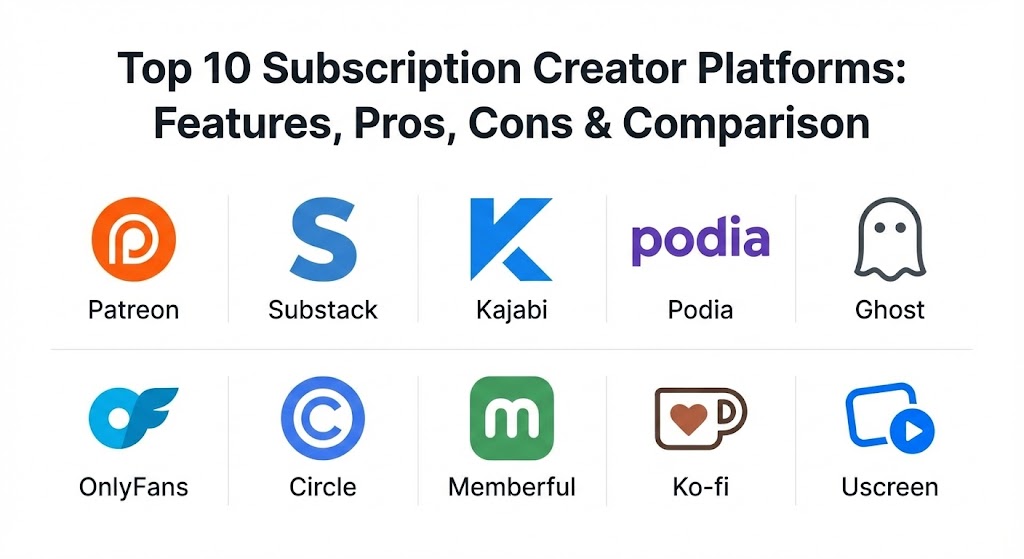
Top 10 Subscription Creator Platforms
1 — Patreon
Patreon is the industry pioneer that popularized the “fan-funding” model. It remains the most recognized name for creators across nearly every artistic medium, offering a centralized hub where fans (patrons) can support ongoing work through tiered membership levels.
- Key features:
- Tiered membership levels with customizable rewards and access.
- Native video hosting and ad-free podcast RSS feeds.
- Integrated “Patreon Shop” for selling individual digital products.
- Community tab with member-only posts, polls, and comments.
- Detailed insights into patron growth, churn, and revenue trends.
- Seamless integration with Discord for private community chat.
- Merch-for-membership automated fulfillment services.
- Pros:
- High brand recognition makes fans more comfortable entering credit card details.
- The mobile app provides a smooth experience for patrons to consume content on the go.
- Cons:
- Revenue share model (up to 12%) can become very expensive as you scale.
- Limited customization of the “look and feel” of the creator page.
- Security & compliance: PCI DSS Level 1 compliant, GDPR and CCPA readiness, and secure payout handling via Stripe and PayPal.
- Support & community: Extensive “Patreon Academy” for creator education, 24/7 email support, and a massive community of peer creators.
2 — Substack
Substack revolutionized the newsletter industry by making it incredibly simple for writers to start a paid publication. It has since expanded to support podcasts and video, but its core remains the written word.
- Key features:
- High-deliverability email newsletter engine.
- “Substack Notes” for social discovery within the platform.
- Built-in podcasting with private, subscriber-only feeds.
- Flexible subscription models (monthly, yearly, or “founding member”).
- Simple, distraction-free Markdown editor.
- Group subscriptions for businesses and educational institutions.
- Recommendation engine that helps creators grow through cross-promotion.
- Pros:
- Zero upfront cost; you only pay a fee when you start making money.
- Focuses heavily on “discoverability,” which is rare for subscription platforms.
- Cons:
- The 10% platform fee is high compared to self-hosted alternatives like Ghost.
- Very rigid design—every Substack publication looks essentially the same.
- Security & compliance: End-to-end encryption for account data, GDPR compliant, and secure payments via Stripe.
- Support & community: Robust help center and “Office Hours” where the Substack team interacts with writers.
3 — Kajabi
Kajabi is the “heavy hitter” of the group, designed for creators who run a full-scale digital business. It is an all-in-one suite that handles everything from website building and email marketing to course hosting and funnels.
- Key features:
- Comprehensive online course builder with quizzes and assessments.
- Sophisticated email marketing automation and sales funnels.
- Built-in CRM for managing leads and subscriber data.
- Native mobile app that allows members to access content anywhere.
- Podcast hosting and membership site templates.
- Landing page builder with high-converting “pipelines.”
- AI-powered “Creator Studio” for generating content ideas and copy.
- Pros:
- No transaction fees (you keep 100% of your revenue minus credit card fees).
- Replaces 5–10 other software tools, simplifying your technical stack.
- Cons:
- High monthly starting price makes it inaccessible for hobbyists.
- The platform is so broad that it has a steep learning curve.
- Security & compliance: SSL encryption, PCI DSS compliance, GDPR support, and secure AWS hosting infrastructure.
- Support & community: 24/7 live chat support, “Kajabi University,” and one of the most active “mastermind” communities in the industry.
4 — Podia
Podia positions itself as the user-friendly alternative to Kajabi. It is designed for creators who want an all-in-one platform for selling memberships, courses, and digital downloads without the overwhelming complexity.
- Key features:
- Unified dashboard for courses, webinars, and digital downloads.
- Easy-to-build membership sites with tiered access.
- Built-in email marketing and messaging tools.
- Custom website builder with a focus on simplicity.
- Affiliate marketing tools to help you grow your sales team.
- “No-code” checkout process optimized for mobile.
- Native video hosting (no need for Vimeo or YouTube).
- Pros:
- Exceptional customer support—often cited as the best in the industry.
- Moving your content from another platform is free and handled by their team.
- Cons:
- Lacks some of the advanced automation and logic found in Kajabi.
- Limited design flexibility for the website builder.
- Security & compliance: Fully PCI-compliant, GDPR support, and secure data storage.
- Support & community: High-touch customer support and an active “Podia Creator Community.”
5 — Ghost
Ghost is an open-source alternative to Substack. It is a modern, professional publishing platform that gives creators 100% control over their data, their design, and their branding.
- Key features:
- Powerful, world-class editor optimized for large-scale publishing.
- Built-in membership and subscription tiers with zero fees.
- Best-in-class SEO tools integrated directly into the core.
- Hundreds of custom themes and the ability to build your own.
- “Ghost Pro” for managed hosting or “Self-Hosted” for total control.
- Advanced analytics for tracking subscriber engagement and churn.
- Developer-friendly API for complex integrations.
- Pros:
- Zero platform fees; you only pay for hosting, meaning more money stays in your pocket as you grow.
- Extremely fast, modern, and aesthetically pleasing interface.
- Cons:
- Requires more technical setup than “turnkey” solutions like Patreon.
- No built-in discovery; you are entirely responsible for your own marketing.
- Security & compliance: FIPS 140-2 compliance for self-hosters, GDPR readiness, and secure SSO support.
- Support & community: Strong documentation and a dedicated developer community.
6 — OnlyFans
While often associated with adult content, OnlyFans has expanded into fitness, cooking, and lifestyle. It is a direct-to-fan platform that prioritizes messaging and pay-per-view interactions over long-form blogging.
- Key features:
- Subscription-based access to a personal feed.
- Pay-per-view (PPV) messaging for exclusive “locked” content.
- Tipping system for posts and live streams.
- Integrated live streaming with “fan interaction” tools.
- Vault for managing and reusing media assets.
- Referral program for creators.
- “Lists” for segmenting and targeting specific fans.
- Pros:
- Incredibly high earning potential through direct messaging and tips.
- Very low barrier to entry for mobile-first content creators.
- Cons:
- Platform reputation can be a barrier for certain brand-conscious creators.
- The 20% platform fee is the highest in the industry.
- Security & compliance: Secure identity verification, SSL encryption, and 3D Secure payment processing.
- Support & community: Fast payout system and a massive, globally active user base.
7 — Circle
Circle is a community-first platform. It’s designed for creators who want to build a “private social network” or a modern forum rather than just a one-way content feed.
- Key features:
- Discussion spaces organized by topics, tiers, or interests.
- “Live Rooms” for hosting workshops, Q&As, and community events.
- Integrated “Courses” feature for structured learning.
- Weekly “Digest” emails to keep members engaged.
- Single Sign-On (SSO) to integrate with your existing website.
- Robust mobile app for community engagement on the move.
- Member directory and private messaging.
- Pros:
- Creates a high sense of “belonging,” which significantly reduces subscriber churn.
- Excellent for “co-creation” where members interact with each other.
- Cons:
- Not primarily a publishing tool; the blogging features are secondary to the forum.
- Can feel “noisy” if not moderated properly.
- Security & compliance: SOC 2 Type II, GDPR, and PCI-compliant payments via Stripe.
- Support & community: “Circle Experts” network and a very high-quality internal community for creators.
8 — Memberful
Memberful is a “membership layer” rather than a full platform. It is designed to plug into your existing website (usually WordPress) to add subscription functionality without changing your workflow.
- Key features:
- Seamless integration with WordPress via a dedicated plugin.
- Private podcasting with easy RSS feed generation.
- Customizable checkout overlays that keep fans on your site.
- Tiered access and group/team subscription support.
- Integration with tools like Mailchimp, Discord, and Zapier.
- Automated email notifications for renewals and failed payments.
- Simple dashboard for managing members and subscriptions.
- Pros:
- You maintain total ownership of your brand and your website.
- Extremely reliable and “invisible” to the end-user.
- Cons:
- Requires you to already have a website (and the knowledge to manage it).
- No native content hosting—you must host your videos/files elsewhere.
- Security & compliance: PCI-compliant checkout, GDPR readiness, and secure data handling.
- Support & community: High-quality technical documentation and responsive email support.
9 — Ko-fi
Ko-fi is a social-first donation and membership platform. It’s perfect for creators who want a “low-pressure” way for fans to support them, starting with small one-time tips (like “buying a coffee”).
- Key features:
- Zero platform fees on one-time donations.
- Membership tiers with monthly recurring support.
- Digital storefront for selling files and physical goods.
- “Commissions” feature for custom art or service requests.
- Goal-tracking widgets to encourage community contributions.
- Integration with YouTube, Twitch, and Discord.
- Simple “Ko-fi Page” that acts as a social link-in-bio.
- Pros:
- The most “friendly” and least corporate-feeling platform for artists.
- Instant payouts—donations go directly to your PayPal/Stripe immediately.
- Cons:
- Lacks advanced marketing tools like email automation or funnels.
- The community and blogging tools are relatively basic.
- Security & compliance: Secure OAuth logins, SSL encryption, and direct-to-creator payment security.
- Support & community: Very active social media presence and a helpful creator blog.
10 — Uscreen
Uscreen is the “Netflix for Creators.” It is specifically designed for high-end video creators who want to launch their own branded streaming service and mobile apps.
- Key features:
- Video-on-demand (VOD) library with a professional interface.
- Ability to launch native apps for iOS, Android, Roku, and Apple TV.
- Live streaming with real-time chat and monetization.
- Advanced analytics on video watch time and viewer behavior.
- “Gift this subscription” and marketing coupon codes.
- Landing page builder specifically for video memberships.
- Built-in community features beneath video content.
- Pros:
- Provides the most professional viewing experience for high-ticket video content.
- Complete control over the “Netflix-style” branding.
- Cons:
- Very high cost (monthly fee + per-subscriber fee).
- Not suitable for writers or podcasters who don’t prioritize video.
- Security & compliance: Multi-DRM (Digital Rights Management) protection, SSL, and PCI compliance.
- Support & community: 1-on-1 onboarding for enterprise clients and a dedicated “Video Business School.”
Comparison Table
| Tool Name | Best For | Platform(s) Supported | Standout Feature | Rating (Gartner/TrueReview) |
| Patreon | Artists / Podcasters | Web, iOS, Android | Brand Recognition | 4.5 / 5 |
| Substack | Writers / Newsletters | Web, iOS, Android | Discovery Network | 4.6 / 5 |
| Kajabi | Business Owners | Web, iOS, Android | All-in-One CRM/Funnels | 4.4 / 5 |
| Podia | Beginner All-in-One | Web | Customer Support | 4.7 / 5 |
| Ghost | Pro Publishers | Web, Desktop | Zero Platform Fees | 4.8 / 5 |
| OnlyFans | Personal Brands | Web, Mobile Web | Direct PPV Messaging | 4.1 / 5 |
| Circle | Community Leaders | Web, iOS, Android | Live Community Rooms | 4.6 / 5 |
| Memberful | WordPress Users | WordPress, Web | Seamless “Invisible” Layer | 4.5 / 5 |
| Ko-fi | Visual Artists | Web | Instant Payouts | 4.7 / 5 |
| Uscreen | Video Creators | Web, Mobile, TV Apps | Branded OTT Apps | 4.8 / 5 |
Evaluation & Scoring of Subscription Creator Platforms
To choose the right platform, evaluate your needs against this weighted rubric. Not every creator needs every feature, but high-growth businesses should pay close attention to the “Integrations” and “Price/Value” scores.
| Category | Weight | Evaluation Criteria |
| Core Features | 25% | Tiered memberships, content gating, and payment reliability. |
| Ease of Use | 15% | Speed of setup for the creator and friction-less checkout for fans. |
| Integrations | 15% | Compatibility with email lists, CRMs, and community tools like Discord. |
| Security & Compliance | 10% | Handling of tax (VAT/GST), GDPR compliance, and PCI security. |
| Performance | 10% | Uptime, video streaming quality, and email deliverability rates. |
| Support | 10% | Availability of live help, documentation, and education. |
| Price / Value | 15% | Assessing revenue share % vs. flat fees as your income scales. |
Which Subscription Creator Platform Tool Is Right for You?
Selecting the right tool depends on your current stage and your long-term goals.
- Solo Users vs. SMBs: If you are a solo creator starting out, Patreon or Substack are excellent because they have no upfront costs. As you grow into a Small-to-Medium Business (SMB) with multiple products, Kajabi or Podia become better choices to consolidate your tools.
- Budget-Conscious vs. Premium: If every dollar counts, Ko-fi (low fees) or Ghost (flat fee) are your best friends. If you have a high-margin business and want the best features regardless of cost, Uscreen or Kajabi are the premium winners.
- Feature Depth vs. Ease of Use: Substack is incredibly easy but has zero customization. Ghost offers infinite depth but requires a bit of a “learning curve” to design.
- Scalability Needs: Be wary of revenue-share models (Patreon/Substack). At $1,000/month, a 10% fee is $100. At $50,000/month, that same fee is $5,000. For high-earners, switching to a flat-fee platform like Ghost or Memberful can save tens of thousands of dollars.
- Security and Compliance: If you have global subscribers, ensure the platform handles VAT/Sales Tax automatically (like Memberful or Substack). If you handle this manually, you might face significant legal headaches.
Frequently Asked Questions (FAQs)
1. Do I need a website to start a subscription business?
No. Platforms like Patreon, Substack, and Kajabi provide a hosted page that acts as your website. However, using Memberful or Ghost allows you to use your own domain, which is better for long-term branding.
2. How do these platforms handle taxes, especially in the EU (VAT)?
This varies greatly. Substack and Patreon handle most tax collection and remittance for you. Others, like Ghost (self-hosted), require you to integrate with a tool like Stripe Tax to manage compliance yourself.
3. Can I move my subscribers from one platform to another?
Generally, yes—but with a catch. You can usually export your email list, but you cannot always export your active credit card subscriptions. Moving platforms often requires asking your fans to re-subscribe.
4. What is the typical platform fee?
It ranges from 0% (Ghost, Kajabi) to 20% (OnlyFans). Most “entry-level” platforms like Substack and Patreon take between 8% and 12% of your total revenue.
5. Is managed video hosting included?
In platforms like Uscreen, Patreon, and Kajabi, video hosting is built-in. For others like Memberful, you will need to host videos on YouTube (unlisted) or Vimeo and embed them.
6. Which platform is best for “discoverability”?
Substack is the current leader here thanks to its “Recommendations” feature and “Substack Notes,” which actively pushes your content to other users on the platform.
7. Can I sell one-time products alongside subscriptions?
Yes, most modern platforms (Podia, Patreon, Ko-fi) now allow you to have a “Shop” area where you can sell individual digital or physical items to non-members.
8. What is “Dunning Management”?
This is a critical feature that automatically retries failed credit card payments and sends emails to subscribers to update their info. Without it, you can lose 10-15% of your revenue to “passive churn.”
9. Do I own my content on these platforms?
On professional platforms like those listed above, you retain 100% ownership of your IP. However, always read the terms of service to ensure the platform doesn’t claim a “license” to use your content for promotion.
10. What is the biggest mistake new creators make?
Picking a platform based on “low fees” rather than “audience ownership.” If you don’t have access to your subscribers’ email addresses, you don’t actually own your business.
Conclusion
The “best” platform is the one that removes the friction between your creativity and your bank account. If you are a writer, Substack or Ghost are the clear choices. If you are an educator, Kajabi or Podia will serve you best. If you are an artist with a loyal fanbase, Patreon or Ko-fi are your home. Remember: your platform is just the plumbing. What matters most is the value you provide to your community and the consistency with which you deliver it.