Introduction
Sourcing & RFX platforms are specialized software solutions designed to automate and manage the entire “upstream” procurement cycle. “RFX” is a catch-all term that includes Request for Information (RFI), Request for Proposal (RFP), and Request for Quotation (RFQ). These tools provide a centralized hub where procurement teams can draft requirements, invite suppliers to bid, evaluate responses through weighted scoring, and ultimately award contracts based on total value rather than just the lowest price.
The importance of these platforms has skyrocketed as global supply chains become more volatile. By digitizing the sourcing process, companies can rapidly discover new vendors, benchmark market prices in real-time, and maintain a “paper trail” for audit purposes. Key real-world use cases include automating “tail spend” (low-value, high-frequency purchases), managing complex direct material tenders in manufacturing, and conducting sustainability-focused evaluations to meet ESG (Environmental, Social, and Governance) goals. When evaluating these tools, users should look for intuitive supplier portals, robust automation (including AI-driven insights), seamless ERP integration, and the ability to handle complex mathematical optimization for large-scale awards.
Best for: Procurement departments in mid-to-large enterprises, supply chain managers in manufacturing, and public sector organizations that require high levels of transparency and structured evaluation. It is also essential for any company managing a high volume of supplier interactions across multiple categories.
Not ideal for: Very small businesses with a limited supplier base or companies that only make infrequent, simple purchases. For these users, basic project management tools or standard email communication may suffice without the overhead of a dedicated platform.
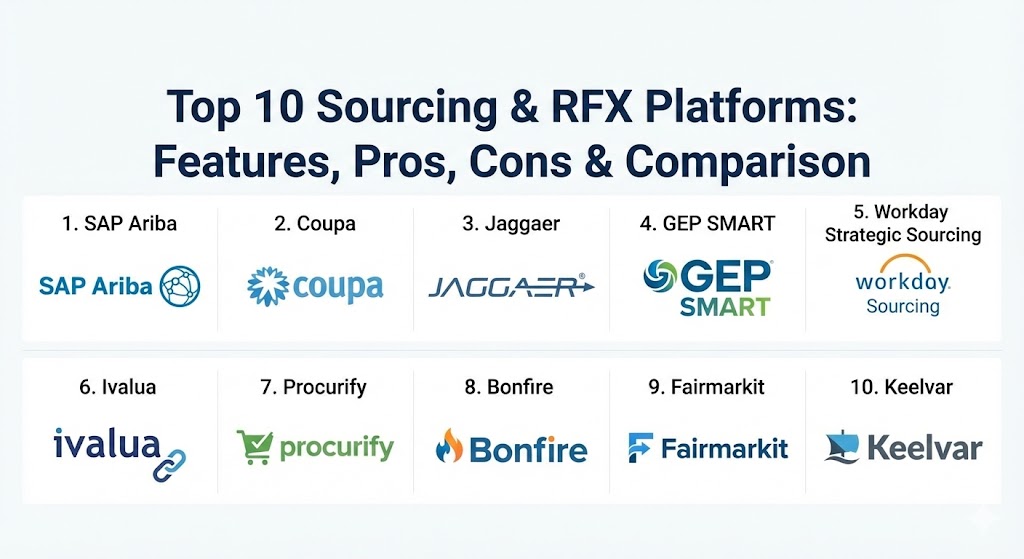
Top 10 Sourcing & RFX Platforms
1 — SAP Ariba Sourcing
SAP Ariba Sourcing is the market leader for enterprise-grade strategic sourcing. Part of the broader SAP Business Network, it connects buyers with millions of suppliers globally, offering an end-to-end solution from spend analysis to contract execution.
- Key features:
- Access to the SAP Business Network (millions of pre-vetted suppliers).
- Advanced RFX creation with multi-round bidding and reverse auctions.
- Automated supplier discovery and qualification workflows.
- Integration with SAP S/4HANA and other major ERP systems.
- Sophisticated scoring and evaluation tools with stakeholder collaboration.
- Real-time market intelligence and benchmark data.
- Integrated “Guided Sourcing” for a more modern, simplified user experience.
- Pros:
- Unmatched global supplier reach, making it easier to find alternative vendors quickly.
- Deeply robust for complex, multi-stage global sourcing events.
- Cons:
- Implementation is notoriously complex and often requires specialized consultants.
- The legacy user interface can feel heavy and less intuitive than modern competitors.
- Security & compliance: SOC 1/2/3, ISO 27001 certified, GDPR compliant, and FIPS 140-2 support for government sectors.
- Support & community: World-class enterprise support with a massive global community and extensive documentation via the SAP Help Portal.
2 — Coupa Sourcing
Coupa Sourcing is built on a “Business Spend Management” (BSM) philosophy that prioritizes user adoption and community-powered intelligence. It is widely praised for its modern, easy-to-use interface that encourages high compliance.
- Key features:
- Community Intelligence: Anonymized spend data from across Coupa’s network for benchmarking.
- Advanced Sourcing Optimization for complex categories like logistics.
- Integrated risk management and supplier diversity tracking.
- No-code template builders for rapid RFX launch.
- Real-time collaboration tools for internal stakeholders and suppliers.
- Seamless transition from sourcing award to contract and purchase order.
- Pros:
- Exceptionally high user adoption rates due to the intuitive “Amazon-like” UI.
- Community data provides unique insights into market trends and supplier reliability.
- Cons:
- Customizing deep reporting can be more challenging than in other platforms.
- Customer support responsiveness can vary depending on the tier of service.
- Security & compliance: ISO 27001, SOC 2 Type II, GDPR, and HIPAA compliant.
- Support & community: Active Coupa Community forums and “Coupa University” for comprehensive user training.
3 — Jaggaer One Sourcing
Jaggaer (formerly SciQuest) is a powerhouse in the sourcing space, particularly known for its strength in direct materials and complex manufacturing requirements. It offers a modular platform that caters to specific industry needs.
- Key features:
- Advanced Sourcing Optimizer (ASO) for massive, multi-variable tenders.
- Deep direct material support including Bill of Materials (BOM) integration.
- AI-powered recommendations for award scenarios.
- Global supplier lifecycle management and performance tracking.
- ESG and sustainability-focused scoring models.
- Multi-currency and multi-language support for global operations.
- Pros:
- The “gold standard” for complex optimization—handling thousands of line items with ease.
- Strong vertical expertise in higher education, government, and manufacturing.
- Cons:
- The platform can feel “over-engineered” for teams only doing simple indirect sourcing.
- Initial configuration takes significant effort to align with custom business logic.
- Security & compliance: ISO 27001, 27017, 27018, SOC 2, and GDPR compliant.
- Support & community: Professional services are top-tier; includes an extensive customer success network.
4 — GEP SMART
GEP SMART is a unified, cloud-native source-to-pay platform that leverages artificial intelligence to provide a seamless experience. It is designed to be a single codebase solution, ensuring data consistency across the entire procurement lifecycle.
- Key features:
- AI-driven spend analysis that feeds directly into sourcing projects.
- Mobile-native apps for participating in sourcing events on the go.
- Robotic Process Automation (RPA) for repetitive administrative tasks.
- Collaborative document co-authoring for RFPs.
- Advanced cost modeling and “should-cost” analysis.
- Highly configurable dashboards for executive-level visibility.
- Pros:
- A truly unified suite; no “bolted-on” modules, leading to superior data flow.
- The Quantum AI update provides cutting-edge predictive insights for buyers.
- Cons:
- High upfront cost makes it less accessible for mid-market companies.
- Some users report occasional system reliability concerns during peak update periods.
- Security & compliance: Built on Microsoft Azure with ISO 27001, SOC 2, and FISMA compliance.
- Support & community: Known for “white-glove” implementation service and deep domain expertise.
5 — Workday Strategic Sourcing (formerly Scout RFP)
Acquired by Workday, this tool remains one of the fastest-growing sourcing platforms due to its sheer simplicity. It focuses on reducing the cycle time of RFPs and improving stakeholder engagement.
- Key features:
- “Click-to-launch” platform for rapid RFX and reverse auctions.
- Visual pipeline management for tracking all active sourcing projects.
- Simplified supplier portal that requires zero training for vendors.
- Side-by-side bid comparison grids with automated scoring.
- Centralized document repository with version control.
- Seamless integration into the broader Workday ERP/HCM ecosystem.
- Pros:
- Remarkable speed to value; teams can often be up and running in days.
- Stakeholders actually enjoy using it, which solves the “rogue spend” problem.
- Cons:
- Lacks the deep mathematical optimization found in Jaggaer or Keelvar.
- Best used within a Workday environment; standalone value is slightly lower.
- Security & compliance: SOC 1/2, ISO 27001, GDPR, and HIPAA compliant.
- Support & community: Benefit from Workday’s massive enterprise support infrastructure and user groups.
6 — Ivalua Sourcing
Ivalua is celebrated for its extreme configurability. It is a “no-code/low-code” platform that allows organizations to build highly specific sourcing workflows without needing a team of developers.
- Key features:
- Support for all spend categories: Direct, Indirect, Services, and Capex.
- Deep supplier risk and performance management modules.
- Collaboration hub for innovation with key strategic partners.
- Highly flexible RFX templates for niche industry requirements.
- Integrated Contract Lifecycle Management (CLM).
- Multi-tier supply chain visibility.
- Pros:
- The most flexible platform on this list; if you have a unique process, Ivalua can mirror it.
- High customer satisfaction and retention rates due to its adaptability.
- Cons:
- Steep learning curve for administrators who need to master the configuration tools.
- Implementations can be long and require a clear project scope to avoid “feature creep.”
- Security & compliance: ISO 27001, SOC 2 Type II, and GDPR compliant.
- Support & community: Strong partner ecosystem for implementation and 24/7 global support.
7 — Procurify
Procurify is a mid-market favorite that focuses on proactive spend management. While it handles the full procure-to-pay cycle, its sourcing and RFQ features are designed for speed and internal control.
- Key features:
- Simple, mobile-friendly RFQ creation and supplier response tracking.
- Real-time budget tracking to see the impact of a purchase before it’s awarded.
- Automated approval workflows with mobile notifications.
- Centralized supplier database with performance notes.
- Punch-out catalog integration for easy requisitioning.
- Tight integration with QuickBooks, NetSuite, and Sage.
- Pros:
- The best option for mid-sized companies that need control without complexity.
- Implementation is incredibly fast, often taking weeks rather than months.
- Cons:
- Not suitable for high-complexity strategic sourcing (e.g., global logistics tenders).
- Lacks advanced reverse auction capabilities.
- Security & compliance: SOC 2 Type II certified and GDPR compliant.
- Support & community: Excellent customer success teams and a very helpful online knowledge base.
8 — Bonfire Strategic Sourcing
Bonfire (now part of Euna Solutions) is the leader in public sector and evaluation-heavy sourcing. It is built specifically for committees that need to score complex qualitative bids.
- Key features:
- Advanced evaluation tools for consensus-based scoring.
- Role-based permissions for internal stakeholders and evaluators.
- Compliance-first design with a full, unalterable audit trail.
- Automated bid tallying and side-by-side qualitative comparisons.
- Integrated project management for procurement teams.
- Public-facing portals for transparent bidding.
- Pros:
- Unrivaled for qualitative RFP scoring—makes “committee work” significantly faster.
- Strongest documentation and audit features for the public sector.
- Cons:
- Less focus on price-driven “reverse auctions” compared to others.
- UI can feel a bit more “functional” than “sleek.”
- Security & compliance: SOC 2 certified, GDPR compliant, and built for government standards.
- Support & community: Frequently praised for its “real-person” support and specialized training for public buyers.
9 — Fairmarkit
Fairmarkit is a pioneer in “Autonomous Sourcing.” It uses machine learning to automate the most tedious parts of procurement, specifically focusing on “tail spend” and high-volume tactical purchases.
- Key features:
- AI-driven supplier recommendations based on historical data and market signals.
- Automated RFQ generation and distribution to a wide vendor pool.
- “Smart” bid evaluation that highlights the best value automatically.
- Bi-directional integration with ERPs like SAP Ariba and Coupa.
- Drastic reduction in cycle times for non-strategic spend.
- Pros:
- Huge ROI for companies struggling to manage thousands of small, manual requests.
- The autonomous engine actually learns from your team’s past preferences.
- Cons:
- Focused strictly on the sourcing part of the cycle; needs an ERP to “finish” the job.
- Not designed for high-touch, long-term strategic partnership negotiations.
- Security & compliance: SOC 2 Type II and ISO 27001 certified.
- Support & community: Very customer-centric culture with a focus on rapid deployment.
10 — Keelvar Sourcing Optimizer
Keelvar is the specialist’s choice for complex category sourcing. It is essentially an advanced mathematical brain that layers on top of traditional sourcing platforms to solve high-stakes award puzzles.
- Key features:
- World-class optimization engine for logistics, packaging, and high-SKU events.
- AI Sourcing Agents that handle routine tactical sourcing end-to-end.
- “What-if” scenario analysis (e.g., “What if we prioritize green energy vendors?”).
- Traffic-light feedback for suppliers during the bidding process.
- High-speed data validation for bid sheets with thousands of rows.
- Pros:
- Allows procurement teams to manage events that would be impossible in Excel.
- Significant cost avoidance through advanced competitive bidding mechanics.
- Cons:
- High learning curve for the optimization logic.
- Overkill for indirect spend like office supplies or professional services.
- Security & compliance: SOC 2 Type II and GDPR compliant.
- Support & community: Expert-level support for architecture and complex event design.
Comparison Table
| Tool Name | Best For | Platform(s) Supported | Standout Feature | Rating (Gartner Peer Insights) |
| SAP Ariba | Global Enterprises | SaaS / Cloud | Massive Supplier Network | 4.3 / 5 |
| Coupa | User Adoption & ROI | SaaS / Mobile | Community Intelligence | 4.6 / 5 |
| Jaggaer One | Direct Manufacturing | SaaS / Cloud | Optimization Engine | 4.4 / 5 |
| GEP SMART | Unified S2P Suite | SaaS / Mobile | Single-Codebase UI | 4.5 / 5 |
| Workday Sourcing | Fast Implementation | SaaS / Mobile | Simplicity & Speed | 4.6 / 5 |
| Ivalua | Extreme Flexibility | Cloud / No-Code | Total Process Customization | 4.7 / 5 |
| Procurify | Mid-Market Control | SaaS / Mobile | Real-time Budget Visibility | 4.5 / 5 |
| Bonfire | Evaluation-Heavy RFPs | SaaS | Qualitative Scoring | 4.6 / 5 |
| Fairmarkit | Autonomous Sourcing | SaaS / API | AI-Driven Tail Spend | 4.4 / 5 |
| Keelvar | Complex Logistics | SaaS | Advanced Scenario Modeling | 4.7 / 5 |
Evaluation & Scoring of Sourcing & RFX Platforms
To help you weigh your options, we’ve evaluated these platforms using a standard weighted rubric.
| Category | Weight | Evaluation Criteria |
| Core Features | 25% | RFX creation, e-auctions, scoring models, and supplier discovery. |
| Ease of Use | 15% | Intuitiveness for both the internal team and the external supplier base. |
| Integrations | 15% | Ability to sync with SAP, Oracle, NetSuite, and third-party risk data. |
| Security | 10% | Encryption, SSO, SOC 2 compliance, and audit trail reliability. |
| Performance | 10% | System uptime and handling of large-scale, high-concurrency events. |
| Support | 10% | Quality of documentation and responsiveness of technical support. |
| Price / Value | 15% | ROI potential and licensing transparency relative to features. |
Which Sourcing & RFX Platform Is Right for You?
Selecting a platform is a balance between your current technical maturity and your future strategic goals.
- Solo Users vs SMB: If you are a small team, avoid the “heavy” enterprise tools. Procurify or Workday Strategic Sourcing offer the best blend of control and speed without requiring an IT army to maintain.
- Mid-Market Growth: If you are scaling and need better visibility into spend, Coupa or GEP SMART are excellent because they allow you to start with sourcing and expand into a full procure-to-pay suite later.
- Enterprise Giants: For global organizations with billions in spend, SAP Ariba or Ivalua are the standard. These tools have the depth to handle complex legal and tax requirements across hundreds of regions.
- Specialized Use Cases: If you are a logistics manager or work in heavy manufacturing, do not settle for a general tool. Jaggaer or Keelvar are non-negotiable for their ability to handle thousands of line items and complex bidding constraints.
- Budget-Conscious vs Premium: If ROI is the primary driver, Fairmarkit is unique because it pays for itself almost immediately by automating the “messy” parts of your tail spend.
Frequently Asked Questions (FAQs)
1. What is the difference between an RFI, RFP, and RFQ?
An RFI (Information) is for gathering vendor capabilities. An RFP (Proposal) is for complex projects where you need a detailed solution. An RFQ (Quotation) is for price-focused buying of standardized goods.
2. How long does a typical implementation take?
For mid-market tools like Procurify, 4–6 weeks. For enterprise suites like SAP Ariba or Ivalua, expect 6–12 months depending on the level of ERP integration.
3. Will my suppliers be charged to use these platforms?
Most modern platforms are free for suppliers. However, legacy networks like the Ariba Network may charge suppliers transaction fees based on their volume of business.
4. Can these tools help with ESG and sustainability tracking?
Yes. Most top platforms now integrate with data providers like EcoVadis or include native surveys to track supplier carbon footprints, diversity status, and labor practices.
5. Do I still need Excel for sourcing?
While many platforms allow you to upload/download Excel bid sheets, the goal is to move the evaluation and scoring into the platform to maintain a single source of truth.
6. What is a “Reverse Auction”?
It is a sourcing event where suppliers bid against each other in real-time, driving the price down. It is highly effective for commodities but should be used cautiously for service-based contracts.
7. How do these platforms handle “Tail Spend”?
Tools like Fairmarkit use AI to find three quotes for small purchases that are usually too time-consuming for humans to source, ensuring competition even on low-dollar items.
8. Are these platforms secure for sensitive government data?
Yes, platforms like Bonfire and SAP Ariba offer FedRAMP or specialized government-cloud environments that meet high-security data residency requirements.
9. Can I integrate my current ERP with a standalone sourcing tool?
Yes. Most use standardized APIs to sync “Award” data back to the ERP as a Contract or Purchase Order.
10. What is the biggest mistake when choosing a platform?
Choosing based on features rather than user adoption. If the tool is too hard for your team or suppliers to use, they will go back to using email, and you will lose all visibility.
Conclusion
The best Sourcing & RFX platform is the one that your team will actually use. While the mathematical optimization of a tool like Keelvar or the global reach of SAP Ariba is impressive, the true value of these platforms lies in their ability to transform procurement from a reactive, administrative function into a proactive, strategic powerhouse. By centralizing data and automating routine tasks, you free your team to focus on what matters most: building resilient, ethical, and cost-effective supply chains.