Introduction
A Smart Meter Data Management System (MDMS) is a centralized software platform designed to ingest, validate, store, and analyze the massive volumes of data generated by Advanced Metering Infrastructure (AMI). It acts as the critical “middleman” between the meter network and a utility’s back-office systems, such as the Customer Information System (CIS), Billing, and Outage Management Systems (OMS). By performing high-speed Validation, Estimation, and Editing (VEE), the MDMS ensures that only “bill-quality” data reaches the financial systems.+2
The importance of an MDMS cannot be overstated; it is the engine that enables modern utility functions like time-of-use (TOU) pricing, demand response programs, and real-time leak or theft detection. Without a robust MDMS, utilities face “data drowning,” where the sheer volume of 15-minute or hourly interval data becomes an operational liability rather than an asset. Key evaluation criteria for these tools include scalability (handling millions of meters), interoperability (vendor-neutrality), and the depth of their analytics engine for predictive maintenance and grid health.
Best for: Electricity, gas, and water utility providers ranging from municipal cooperatives to massive multi-national investor-owned utilities (IOUs). It is essential for IT directors, grid operations managers, and billing departments focused on grid modernization.
Not ideal for: Individual consumers, small sub-metering setups for single buildings, or non-utility businesses that do not need to integrate high-frequency meter data with complex billing or grid management systems.
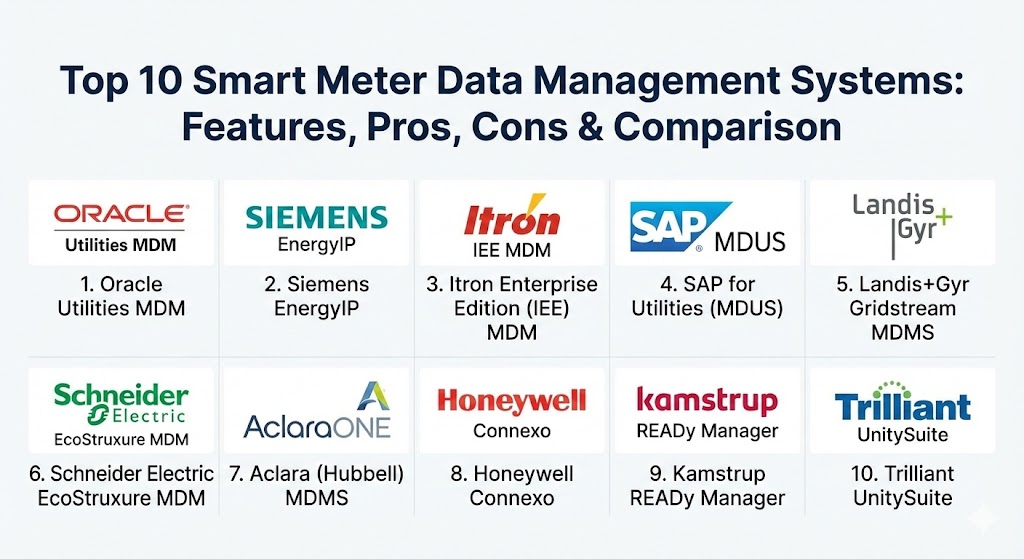
Top 10 Smart Meter Data Management Systems
1 — Oracle Utilities Meter Data Management (MDM)
Oracle Utilities MDM is an industry-leading, enterprise-grade solution designed to handle the most complex data requirements of the world’s largest utilities. It provides a robust foundation for meter-to-cash operations across all commodities.
- Key features:
- Advanced VEE (Validation, Estimation, and Editing) engine with pre-built rules.
- Integrated Service Order Management for automating remote connects/disconnects.
- Information Lifecycle Management (ILM) for cost-effective data archiving.
- Native integration with Oracle Utilities CIS and third-party billing systems.
- Multi-commodity support (Electric, Gas, Water) within a single instance.
- Scalable cloud-native or on-premises deployment options.
- Pros:
- Unmatched scalability for utilities with tens of millions of meters.
- Highly configurable business rules that reduce the need for custom coding.
- Cons:
- High total cost of ownership (TCO) compared to mid-market alternatives.
- Significant implementation complexity requiring specialized Oracle expertise.
- Security & compliance: NERC CIP compliant, SOC 2, HIPAA, and robust AES-256 encryption.
- Support & community: Extensive global support network, a large community of certified implementation partners, and comprehensive University-style training.
2 — Siemens EnergyIP
Siemens EnergyIP is a highly modular MDMS known for its “smart city” focus and its ability to act as an application platform for use cases far beyond simple billing.
- Key features:
- Modular “App Store” approach for adding analytics, theft detection, and prepayment.
- EnergyIP Mosaic® user interface designed specifically for operator efficiency.
- Real-time grid event correlation for proactive outage management.
- Interoperable design that supports virtually any AMI vendor (vendor-neutral).
- Advanced support for prosumers and decentralized energy resources (DERs).
- Integrated “Revenue Protection” module to identify non-technical losses.
- Pros:
- Excellent for utilities looking to innovate with smart city and IoT integrations.
- The user interface is widely considered one of the most intuitive in the industry.
- Cons:
- Modular pricing can make budgeting difficult as more features are added.
- Requires a robust internal IT team to fully leverage the modular capabilities.
- Security & compliance: ISO 27001 certified, GDPR compliant, and adheres to strict utility-grade data privacy standards.
- Support & community: Strong professional services-led onboarding and a dedicated global user group.
3 — Itron Enterprise Edition (IEE) MDM
Itron’s IEE MDM is a time-tested, vendor-neutral platform used by over 100 utilities globally. It focuses on providing a “single version of the truth” for meter data across disparate networks.
- Key features:
- High-volume interval data ingestion from multiple head-end systems (HES).
- “IEE Essentials” option for a lightweight, faster deployment for smaller utilities.
- Automated batch jobs for periodically checking and validating meter reads.
- Deep support for C&I (Commercial & Industrial) complex billing.
- Native cloud architecture optimized for Microsoft Azure.
- Open-architecture system that avoids vendor lock-in.
- Pros:
- Exceptional reliability and stability, even when traversing massive datasets.
- Strongest “vendor-neutral” reputation; works seamlessly with non-Itron hardware.
- Cons:
- The standard user interface can feel slightly dated compared to Siemens or Oracle.
- Customization of the main dashboard is somewhat limited in the core version.
- Security & compliance: SOC 2, FIPS 140-2, and rigorous auditing/versioning of all meter data.
- Support & community: Very active “Itron Community” and a long history of successful global deployments.
4 — SAP for Utilities (MDUS)
For organizations already running on SAP S/4HANA, the Meter Data Unification and Synchronization (MDUS) component offers the tightest possible integration between meter data and finance.
- Key features:
- Real-time synchronization between meter data and SAP IS-U (Industry Solution for Utilities).
- Standardized data models that eliminate the need for complex integration layers.
- Native support for both prepaid and postpaid billing models within SAP.
- Automated financial reporting based on actual, validated consumption data.
- Data validation workflows directly integrated into the billing cycle.
- Time-of-use and dynamic tariff support for the energy transition.
- Pros:
- Provides the most seamless “meter-to-cash” flow for existing SAP users.
- Reduces the complexity of managing a separate, stand-alone MDMS.
- Cons:
- Primarily only viable for utilities that are already “all-in” on the SAP ecosystem.
- Can be less flexible for non-billing use cases (like grid engineering) than specialty MDMS tools.
- Security & compliance: Fully compliant with GDPR, SOC 2, and integrated with SAP GRC (Governance, Risk, and Compliance).
- Support & community: Backed by SAP’s massive global support infrastructure and thousands of specialized consultants.
5 — Landis+Gyr Gridstream MDMS
Gridstream MDMS is a unified system designed to consolidate metering and consumption data from any source into a single centralized repository.
- Key features:
- Standards-based interfaces (CIM/MultiSpeak) for enterprise interoperability.
- Load mapping and non-billing data storage (voltage, amperage) for grid visibility.
- Powerful analytic engines capable of processing hundreds of millions of reads.
- Virtual and net metering capabilities for complex prosumer setups.
- Automated remediation of events related to the VEE process.
- Integrated network connectivity model for the smart grid infrastructure.
- Pros:
- Strongest focus on grid health and power quality metrics (not just billing).
- Highly effective at managing multi-commodity environments (Electric/Water/Gas).
- Cons:
- Can have a steeper learning curve for users new to Landis+Gyr’s ecosystem.
- On-premise installations require significant server hardware resources.
- Security & compliance: End-to-end encryption from the head-end to the MDMS and NERC CIP compatibility.
- Support & community: Robust technical documentation and a strong presence in the EMEA and Americas markets.
6 — Schneider Electric EcoStruxure MDM
Schneider Electric’s solution is part of their broader EcoStruxure Grid platform, focusing heavily on sustainability and energy efficiency.
- Key features:
- Seamless integration with EcoStruxure ADMS (Advanced Distribution Management System).
- Heavy focus on DER (Distributed Energy Resource) management.
- Cloud-ready architecture for faster implementation and updates.
- Advanced analytics for demand response and peak load reduction.
- Comprehensive reporting on energy savings and sustainability goals.
- Native support for microgrids and renewable energy integration.
- Pros:
- The best choice for utilities prioritizing “green” initiatives and grid sustainability.
- Deep integration with Schneider’s world-class electrical equipment and sensors.
- Cons:
- Historically less focused on high-volume consumer billing than Oracle or Itron.
- Best value is realized when used within the broader Schneider Electric stack.
- Security & compliance: ISO 27001, SOC 2, and compliance with international cybersecurity standards for industrial control systems.
- Support & community: Strong global presence with a focus on engineering-led support.
7 — Aclara (Hubbell) MDMS
AclaraONE® (One Network for Everyone) is a customizable platform that offers a unified interface for managers, field technicians, and customer service reps.
- Key features:
- Customizable user interface that allows different roles to see different data views.
- Integrated modules for meter exchange, fault detection, and transformer-load analysis.
- Real-time insights and alerting for distribution network events.
- Centralized head-end for gas, water, and electric devices on Aclara’s networks.
- Robust VEE engine specifically optimized for Aclara’s RF and Powerline networks.
- Pros:
- Excellent “all-in-one” feel for utilities using Aclara’s hardware and networking.
- Very strong for water utilities due to advanced leak detection and flow analytics.
- Cons:
- While it supports other vendors, it is best optimized for the Aclara ecosystem.
- Analytical depth for high-level grid planning can be less than standalone analytics tools.
- Security & compliance: Enterprise security controls, audit logging, and encryption at rest/transit.
- Support & community: High customer satisfaction scores; often cited for having a “helpful partner” approach.
8 — Honeywell Connexo
Honeywell’s Connexo Insight is a modular, scalable data management solution designed to unify data across multi-vendor networks.
- Key features:
- Multi-vendor data collection supporting over 200+ device types.
- Built on a modular OSGI platform for future-proof adaptability.
- Exception-based issue management to guide operators to the most critical tasks.
- Compliant with CIM (Common Information Model) and SAP MDUS standards.
- Support for “Beyond the Meter” data like solar panels and EV chargers.
- Web-based UI using modern HTML5/CSS3 for cross-platform access.
- Pros:
- Exceptionally flexible; allows utilities to invest incrementally as they grow.
- One of the broadest device support lists in the industry (200+ protocols).
- Cons:
- Documentation for custom integrations can sometimes be less detailed than competitors.
- Can feel like a collection of modules rather than a single unified “box.”
- Security & compliance: DLMS/COSEM security suite, FIPS 140-2, and robust certificate management.
- Support & community: 20+ years of utility experience with a focus on global smart energy projects.
9 — Kamstrup READy Manager
Kamstrup’s READy Manager is a specialized MDMS specifically designed for water and heat utilities, prioritizing simplicity and ease of use.
- Key features:
- Incredibly simple and beautiful user interface optimized for tablet and web.
- Proactive alerts for leaks, bursts, and freezing directly from the meter.
- Daily system-wide consumption profiles for strategic planning.
- Agnostic billing format that exports easily to any CSV or fixed-width CIS.
- Integrated “Flow above Q4” alerts to identify undersized meters.
- Low-overhead, cloud-based hosting option for rapid setup.
- Pros:
- The easiest system to learn and use on this entire list; perfect for smaller teams.
- Industry-leading accuracy and focus specifically for the water sector.
- Cons:
- Not suitable for large-scale, complex electric utilities with high-frequency interval needs.
- Limited advanced grid-automation features compared to Oracle or Siemens.
- Security & compliance: ISO 27001 certified, GDPR compliant, and secure cloud data hosting.
- Support & community: Highly responsive support with a focus on Northern European and American water markets.
10 — Trilliant UnitySuite
Trilliant’s UnitySuite provides a “single pane of glass” for both the communication network management and the meter data management.
- Key features:
- Dual-purpose management of both the IoT network and the consumption data.
- Integration with over 340 electric meter brands and models worldwide.
- Support for SecureMesh® WAN and SecureReach® LPWAN architectures.
- Business intelligence solutions built directly into the head-end system.
- Real-time network monitoring and endpoint control management.
- Pros:
- Ideal for utilities that want to manage the “pipes” and the “data” in one tool.
- Exceptional coverage and range for hard-to-reach rural meters.
- Cons:
- Managing the network and data together adds a layer of complexity for pure data admins.
- Interface can be information-heavy, requiring more intensive initial training.
- Security & compliance: Meets strict international standards for mesh-network and data-packet security.
- Support & community: Professional engineering support and dedicated account management for large rollouts.
Comparison Table
| Tool Name | Best For | Platform(s) Supported | Standout Feature | Rating (Gartner/TrueReview) |
| Oracle MDM | Large-scale IOUs | On-Premise, Cloud | Advanced VEE Engine | 4.6 / 5 |
| Siemens EnergyIP | Smart City Innovation | Multi-Cloud, On-Prem | Modular “App” Store | 4.5 / 5 |
| Itron IEE | Multi-vendor Fleets | Windows, Azure | Vendor-neutrality | 4.4 / 5 |
| SAP MDUS | Existing SAP users | SAP S/4HANA Core | Deep Finance Integration | 4.7 / 5 |
| Landis+Gyr | Grid Visibility | Linux, On-Prem, Cloud | Power Quality Metrics | 4.3 / 5 |
| Schneider Electric | Sustainability/DERs | Cloud-Ready | ADMS Integration | 4.5 / 5 |
| AclaraONE | Combo Utilities | Web-based, On-Prem | Customizable UI Roles | 4.4 / 5 |
| Honeywell | Modular Growth | Web, SaaS | 200+ Device Protocols | 4.2 / 5 |
| Kamstrup READy | Water & Heat | Cloud, Web | Ultra-Simple UI | 4.6 / 5 |
| Trilliant | Network & Data Mgmt | UnitySuite Platform | Single Pane of Glass | 4.3 / 5 |
Evaluation & Scoring of Smart Meter Data Management Systems
When evaluating an MDMS, utilities must weigh operational efficiency against long-term scalability. The following rubric reflects the industry’s current priorities for 2026.
| Category | Weight | Evaluation Criteria |
| Core Features | 25% | VEE accuracy, billing determinant creation, and exception management. |
| Ease of Use | 15% | UI clarity, search speed, and ease of learning for new operators. |
| Integrations | 15% | Compatibility with CIS, Billing, OMS, and multiple AMI vendors. |
| Security & Compliance | 10% | Encryption, NERC CIP, GDPR, and robust audit trails. |
| Performance | 10% | System speed during peak ingestion (millions of reads per hour). |
| Support & Community | 10% | Vendor reliability, documentation, and user group activity. |
| Price / Value | 15% | TCO vs. reduction in manual billing errors and truck rolls. |
Which Smart Meter Data Management Systems Tool Is Right for You?
The “right” MDMS depends on your utility’s specific modernization stage and commodity focus.
- Solo Municipalities or Water Districts: If you are a small team managing a single commodity, Kamstrup READy or Itron IEE Essentials provide the best value with the shortest learning curve.
- Small to Medium Utilities (SMBs): Honeywell Connexo is an excellent choice for those who want to start small and add modules (like prepayment or analytics) only as their budget allows.
- Large investor-owned Utilities (IOUs): For high-concurrency environments managing over 1 million meters, Oracle MDM and Siemens EnergyIP are the gold standards, offering the necessary “industrial-strength” performance.
- SAP-Centric Organizations: If your entire back office runs on SAP, the SAP MDUS approach will likely save you millions in integration costs and reduce data silos.
- Sustainability & Grid-First Strategy: Utilities focused on microgrids, solar integration, and power quality should look closely at Schneider Electric EcoStruxure or Landis+Gyr Gridstream.
Frequently Asked Questions (FAQs)
1. What is the difference between an AMI Head-End System (HES) and an MDMS? The HES communicates directly with the meters to collect data; the MDMS cleans, validates, and stores that data for use by the rest of the business.
2. Can an MDMS handle data from multiple different meter brands? Yes, most top-tier systems (especially Itron IEE and Siemens EnergyIP) are vendor-neutral and can ingest data from dozens of different AMI hardware brands.
3. What is “VEE” and why is it important? VEE stands for Validation, Estimation, and Editing. It is the process that ensures data isn’t missing or impossible (like a 1,000% jump in usage) before it is sent to the billing department.+1
4. Is a cloud-based MDMS secure enough for utilities? Yes. Modern cloud MDMS solutions (like Oracle’s or Itron’s) are built on hardened platforms that meet NERC CIP and SOC 2 requirements, often providing better security than a local data center.
5. How does an MDMS help reduce “truck rolls”? By enabling remote connects/disconnects and identifying precisely where a leak or fault is located, an MDMS allows utilities to resolve issues from the office rather than sending a technician in a vehicle.
6. Can these systems manage water, gas, and electricity at the same time? Yes, tools like Oracle MDM and AclaraONE are “multi-commodity,” meaning they can manage all three utilities in a single unified interface.
7. Does an MDMS help with electricity theft? Yes. Most modern MDMS tools have analytics modules that can detect “non-technical loss” (theft) by comparing consumption patterns or detecting meter tampering events.
8. Why is “Common Information Model” (CIM) compliance important? CIM is a standard that allows different utility software systems to “talk” to each other without needing custom, expensive integration coding.
9. How long does a typical MDMS implementation take? For a small utility, it can take 6-9 months. For a massive enterprise rollout, the implementation can span 18-36 months.
10. What is a “prosumer” and how does the MDMS support them? A prosumer is a customer who both consumes and produces energy (e.g., solar panels). The MDMS manages “net metering” to track both the energy bought from and sold to the grid.
Conclusion
Smart Meter Data Management Systems are the central nervous system of the modern grid. As we move into 2026 and beyond, the ability to process data at the edge and turn it into real-time operational decisions will be the defining factor for utility success. Whether you prioritize the absolute scale of Oracle, the modularity of Siemens, or the simplicity of Kamstrup, the ultimate goal remains the same: ensuring that every drop of water and every watt of power is accounted for, billed accurately, and managed sustainably.