Introduction
Smart Contract Development Tools are the specialized software suites, frameworks, and libraries that allow developers to write, test, debug, and deploy code onto blockchain networks like Ethereum, Solana, and Layer 2 solutions. These tools provide a controlled environment to simulate the “EVM” (Ethereum Virtual Machine) or other runtime environments, allowing developers to catch errors before they hit the mainnet where gas fees are real and mistakes are final.
In 2026, these tools are more important than ever. As we move toward “Agentic Web3″—where AI agents autonomously execute contracts—the tooling must provide rigorous formal verification and automated safety checks. Key real-world use cases range from launching Decentralized Autonomous Organizations (DAOs) and minting complex dynamic NFTs to building automated supply chain logistics that trigger payments upon physical delivery. When choosing a tool, developers evaluate it based on execution speed, debugging depth, ecosystem support, and security features like built-in fuzzing or static analysis.
Best for: Web3 startups, enterprise blockchain divisions, security auditors, and individual developers building decentralized applications (dApps). It is essential for teams where code security and gas optimization are high priorities.
Not ideal for: Simple web applications that don’t require decentralized logic, or for businesses using “No-Code” blockchain platforms where the underlying contract management is completely hidden from the user.
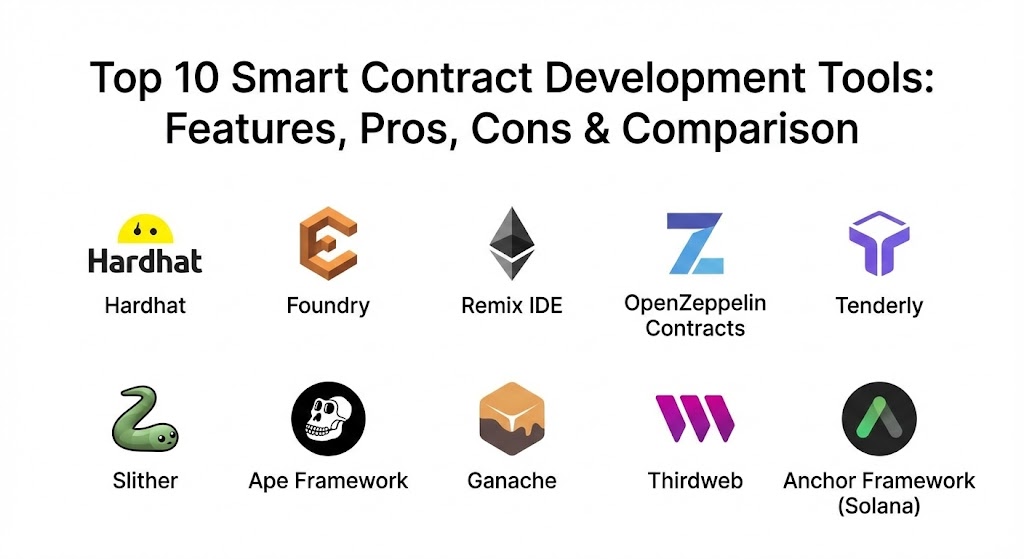
Top 10 Smart Contract Development Tools
1 — Hardhat
Hardhat has long been the “industry standard” development environment for Ethereum-based projects. It is a flexible, extensible task runner that provides a local Ethereum network designed specifically for development. Its “Hardhat Network” is famous for providing the best stack traces and error messages in the Solidity ecosystem.
- Key features:
- Hardhat Network: A local node that provides detailed Solidity stack traces and
console.logfunctionality. - Plugin Ecosystem: Over 100 community-built plugins for everything from gas reporting to Etherscan verification.
- Flexible Task Runner: Automate complex deployment scripts and repetitive development tasks.
- TypeScript Support: Native support for type-safe development and testing.
- Mainnet Forking: Test your contracts against a local copy of the live Ethereum mainnet.
- Integrated Debugger: Powerful tools to step through transactions and inspect state variables.
- Hardhat Network: A local node that provides detailed Solidity stack traces and
- Pros:
- The most mature and stable ecosystem with the largest library of tutorials and plugins.
- Excellent developer experience (DX) thanks to highly descriptive error messages.
- Cons:
- Performance can lag when running massive test suites compared to Rust-based tools.
- Relies heavily on Node.js, which some developers find “bloated.”
- Security & compliance: Supports FIPS-compliant cryptographic libraries; integrates with security plugins like
hardhat-security. - Support & community: Massive community on Discord and StackOverflow; maintained by Nomic Foundation with world-class documentation.
2 — Foundry
Foundry is the “speed demon” of the smart contract world. Written in Rust, it is a blazing-fast, portable, and modular toolkit for Ethereum application development. Unlike Hardhat, which uses JavaScript for testing, Foundry allows you to write your tests directly in Solidity, reducing context-switching for developers.
- Key features:
- Forge: An Ethereum testing framework that runs tests in parallel at incredible speeds.
- Cast: A versatile CLI tool for interacting with EVM smart contracts and sending transactions.
- Anvil: A high-performance local Ethereum node (Foundry’s equivalent to Ganache/Hardhat Network).
- Fuzz Testing: Built-in property-based testing that tries to “break” your contract with random inputs.
- Gas Snapshots: Easily track gas costs for every function during the testing phase.
- Cheatcodes: Special instructions to manipulate the state of the blockchain (e.g., changing time or account balances) during tests.
- Pros:
- Dramatic performance improvements—often 10x to 20x faster than JavaScript-based frameworks.
- Writing tests in Solidity ensures that developers don’t have to master two different languages.
- Cons:
- Steeper learning curve for those who are used to JavaScript/TypeScript testing libraries.
- The plugin ecosystem is smaller and newer than Hardhat’s.
- Security & compliance: Native support for fuzzing and symbolic execution makes it a favorite for security-first teams.
- Support & community: Very active GitHub and Telegram communities; documentation is highly technical but comprehensive.
3 — Remix IDE
Remix is the quintessential entry point for smart contract development. It is a web-based integrated development environment (IDE) that requires zero installation. It is the go-to tool for quick prototyping, learning Solidity, and deploying small-scale contracts directly from a browser.
- Key features:
- Zero Configuration: Works instantly in any modern web browser.
- Integrated Compiler: Supports multiple versions of Solidity with real-time error highlighting.
- Deployment Modules: Connect easily to MetaMask, WalletConnect, or local browser-based blockchains.
- Static Analysis: Built-in “Linter” that flags common security vulnerabilities and gas inefficiencies.
- Remix Desktop: An offline version for those who want a local development experience without the browser.
- Plugin System: Add functionality like formal verification (Certora) or external library links.
- Pros:
- Unbeatable for rapid prototyping and education; no environment setup required.
- Great visual interface for interacting with deployed contracts and inspecting variables.
- Cons:
- Not suitable for large, complex projects with many interlinked files and dependencies.
- Limited version control and CI/CD integration compared to CLI-based tools.
- Security & compliance: Local browser storage for safety; includes basic static analysis for common flaws.
- Support & community: Supported by the Ethereum Foundation; vast library of educational content on YouTube and Medium.
4 — OpenZeppelin Contracts
While not a “tool” in the sense of a compiler, OpenZeppelin is the most important library in the smart contract space. It provides a set of modular, reusable, and secure smart contract templates that serve as the foundation for the vast majority of tokens (ERC-20), NFTs (ERC-721), and DAOs.
- Key features:
- Access Control: Role-based systems to manage who can mint tokens or trigger withdrawals.
- ERC Standards: Battle-tested implementations of all major Ethereum Request for Comments.
- Security Utilities: Tools for reentrancy protection, safe math operations, and pausing contracts.
- Upgradeable Contracts: Patterns for deploying contracts that can have their logic updated.
- Governance: Pre-built modules for on-chain voting and proposal management.
- OpenZeppelin Defender: A separate platform for managing and automating contract operations.
- Pros:
- Drastically reduces the “surface area” for bugs by providing code that has been audited by experts.
- Industry standard; using OpenZeppelin increases user and investor trust in your project.
- Cons:
- Can lead to “bloat” if developers import the entire library instead of specific components.
- Requires a solid understanding of Solidity inheritance to use correctly.
- Security & compliance: Most audited library in history; frequently updated to patch emerging zero-day vulnerabilities.
- Support & community: Massive community forum; comprehensive documentation with clear “Why this is secure” explanations.
5 — Tenderly
Tenderly is a comprehensive Ethereum development platform that focuses on observability and simulation. It bridges the gap between the development environment and the live production network, allowing teams to “debug the mainnet.”
- Key features:
- Transaction Simulator: Test how a transaction will behave on the live mainnet without actually spending gas.
- Visual Debugger: A high-level interface to inspect the execution flow of any transaction.
- Alerting System: Get real-time notifications for specific events, failed transactions, or large transfers.
- Web3 Actions: Run custom serverless code in response to on-chain events.
- Analytics: Deep insights into how users are interacting with your contracts.
- Virtual Testnets: Create a private, high-speed copy of any public network for team testing.
- Pros:
- Unrivaled production monitoring; essential for maintaining large-scale dApps.
- The visual debugger is the best in the industry for understanding complex transaction failures.
- Cons:
- The most powerful features are behind a premium subscription model.
- Learning to use the full platform takes time due to the sheer number of features.
- Security & compliance: SOC 2 compliant; provides detailed audit logs for team activities.
- Support & community: Excellent enterprise support; active technical blog and documentation.
6 — Slither
Slither is the “gold standard” for open-source static analysis. It is a Python-based framework that scans Solidity code for vulnerabilities and identifies where best practices are being ignored. It is a mandatory tool in any modern CI/CD pipeline for smart contracts.
- Key features:
- Vulnerability Detection: Identifies over 90 common security flaws like reentrancy and shadow variables.
- Contract Summarization: Generates human-readable summaries of contract logic and access controls.
- Inheritance Graphs: Visualizes how different contracts and interfaces are linked together.
- Custom API: Developers can write their own custom detectors using Slither’s internal representation.
- High Speed: Scans even large codebases in seconds.
- Integration: Works seamlessly with Hardhat, Foundry, and Truffle.
- Pros:
- Catch critical errors before they reach an auditor, saving time and money.
- Provides a deep level of insight into code structure that manual review might miss.
- Cons:
- Produces “false positives” that require a human to filter out.
- Requires a Python environment to run, which might not be in every Solidity dev’s stack.
- Security & compliance: Built by Trail of Bits, one of the world’s leading blockchain security firms.
- Support & community: Extremely popular among auditors; strong GitHub support and documentation.
7 — Ape Framework
Ape Framework is the modern, modular successor to Brownie. It is a Python-based development environment that focuses on providing a plug-and-play experience for developers who prefer the Python ecosystem over JavaScript or Rust.
- Key features:
- Modular Architecture: Only install the plugins you need for specific chains or tools.
- Multi-Chain Support: Native support for Ethereum, StarkNet, Polygon, and more through plugins.
- Python Testing: Uses
pytest, making it very powerful for data-heavy testing scenarios. - Interactive Console: A robust Python shell to interact with contracts in real-time.
- Account Management: Secure, encrypted handling of local development and production keys.
- Compiler Integration: Supports Solidity and Vyper (the Python-like smart contract language).
- Pros:
- The best choice for data scientists or fintech developers who live in Python.
- Avoids the “dependency hell” often found in Node.js-based projects.
- Cons:
- The community and plugin ecosystem are smaller than Hardhat’s.
- Documentation is still catching up to the more established frameworks.
- Security & compliance: Standard encrypted key storage; adheres to Python’s strict security standards.
- Support & community: Active Discord; maintained by a dedicated team focusing on Web3 developer experience.
8 — Ganache
Ganache (part of the Truffle Suite legacy) remains one of the most widely used tools for creating a personal Ethereum blockchain. While Foundry’s Anvil and Hardhat Network are gaining ground, Ganache’s “One-Click” GUI version remains a favorite for developers who want a visual representation of their local chain.
- Key features:
- GUI & CLI: Choose between a graphical interface or a command-line tool.
- Instant Mining: Transactions are processed instantly, with no “wait time” for blocks.
- Account Customization: Start with 10 pre-funded accounts and custom balances.
- Transaction Inspection: Click into any transaction to see gas used, logs, and state changes.
- Workspace Persistence: Save the state of your local blockchain to resume testing later.
- Forking Support: Like its rivals, it can fork the mainnet for realistic testing.
- Pros:
- The GUI is exceptionally helpful for beginners to visualize how blocks and accounts work.
- Highly reliable and stable after years of development.
- Cons:
- The development of the GUI version has slowed compared to CLI-only rivals.
- Generally slower than Foundry’s Anvil for high-speed automated testing.
- Security & compliance: Purely local and private; excellent for air-gapped development testing.
- Support & community: Documentation is extensive; part of the foundational history of Ethereum dev.
9 — Thirdweb
Thirdweb is a developer platform that simplifies the Web3 development lifecycle. It provides pre-built, audited smart contracts, powerful SDKs for multiple languages, and a “dashboard” approach to managing your on-chain assets.
- Key features:
- Contract Hub: A library of audited, ready-to-deploy contracts for marketplaces, drops, and staking.
- Multi-Language SDKs: Connect your contracts to apps built in React, Unity, Python, or Go.
- Gasless Transactions: Built-in support for relayers so users don’t need ETH to interact with your app.
- Storage Integration: Native support for IPFS and Arweave for decentralized file storage.
- Auth Suite: Easy “Sign in with Ethereum” (SIWE) implementation.
- Deployment Workflow: Streamlined process that handles contract verification and dashboard setup.
- Pros:
- Reduces development time from weeks to hours for standard dApp architectures.
- Perfect for “web2.5” teams moving into the space who need a familiar SaaS-like experience.
- Cons:
- Less flexibility for highly bespoke, custom-logic smart contracts.
- Pricing becomes a factor as you scale and use their hosted infrastructure.
- Security & compliance: SOC 2 compliant; contracts are audited by top-tier firms like Zellic and SlowMist.
- Support & community: Very active Discord and high-quality video tutorials; excellent for “learn by doing.”
10 — Anchor Framework (Solana)
As the blockchain world becomes increasingly multi-chain, Anchor has emerged as the essential framework for Solana development. Just as Hardhat/Foundry defines the EVM experience, Anchor defines how Rust developers build on Solana.
- Key features:
- IDL (Interface Definition Language): Automatically generates a “map” of your contract for front-end integration.
- Safety Macros: Rust macros that significantly reduce the risk of common Solana-specific security bugs.
- Program-Derived Addresses (PDA): Simplified management of Solana’s unique account structure.
- Testing Suite: Integrated tools for local Solana cluster testing.
- CLI Tools: Easy project initialization, building, and deployment.
- Pros:
- Makes the notoriously difficult Solana development process significantly more accessible.
- The “Anchor Program” standard is the most widely adopted for Solana apps.
- Cons:
- Only useful for the Solana ecosystem; doesn’t translate to EVM chains.
- Requires proficiency in Rust, which has a much steeper learning curve than Solidity.
- Security & compliance: Includes built-in checks for account ownership and data validation.
- Support & community: The heart of the Solana developer community; supported by the Solana Foundation.
Comparison Table
| Tool Name | Best For | Platform(s) Supported | Standout Feature | Rating (Gartner/TrueReview) |
| Hardhat | Professional EVM Devs | EVM-Compatible Chains | Massive Plugin Ecosystem | 4.8 / 5 |
| Foundry | Performance / QA | EVM-Compatible Chains | Blazing Fast Rust-Engine | 4.7 / 5 |
| Remix IDE | Prototyping / Learning | Web Browser | Zero Setup Required | 4.6 / 5 |
| OpenZeppelin | Security Standards | EVM-Compatible Chains | Battle-Tested Templates | 4.9 / 5 |
| Tenderly | Monitoring / Debugging | Ethereum & L2s | Visual Debugger | 4.7 / 5 |
| Slither | Security Auditing | Solidity / Vyper | Static Analysis Engine | 4.8 / 5 |
| Ape Framework | Python Developers | Multi-Chain | Modular Plugin System | 4.4 / 5 |
| Ganache | Visual Testing | EVM-Compatible Chains | User-Friendly GUI | 4.5 / 5 |
| Thirdweb | Rapid App Building | Multi-Chain | Pre-built Audited Hub | 4.6 / 5 |
| Anchor | Solana Developers | Solana | Rust Macros for Safety | 4.7 / 5 |
Evaluation & Scoring of Smart Contract Development Tools
| Category | Weight | Evaluation Notes |
| Core Features | 25% | Includes compilation speed, local network quality, and deployment ease. |
| Ease of Use | 15% | Evaluates the learning curve and the quality of the developer interface (CLI/GUI). |
| Integrations | 15% | How well it fits with front-end libraries, CI/CD, and infrastructure providers. |
| Security & Compliance | 10% | Built-in safety checks, audit history of the tool, and PII protection. |
| Performance | 10% | Test execution speed and resource consumption on the development machine. |
| Support & Community | 10% | Availability of high-quality tutorials, active forums, and maintainer responsiveness. |
| Price / Value | 15% | The balance of cost (if any) versus the time saved and bugs prevented. |
Which Smart Contract Development Tool Is Right for You?
Selecting your stack depends on your technical background and the complexity of the project you are building.
- Solo Learners & Students: Start with Remix IDE. It is the fastest way to see code turn into a functional contract. Once you understand the basics, move to Hardhat to learn how “real” professional environments work.
- Small to Medium Businesses (SMBs): If you are building a standard token or NFT project, use Thirdweb. It will save you hundreds of hours on “boilerplate” code and front-end integration. If you need custom logic, rely on OpenZeppelin as your foundational library.
- High-Stakes DeFi Projects: Foundry is your best friend. Its speed and native fuzzing are essential when you need to run thousands of tests to ensure financial safety. Complement this with Slither in your GitHub Actions to catch bugs automatically.
- Enterprises & Institutional Builders: Hardhat remains the safest choice due to its massive ecosystem and stability. However, you should use Tenderly for production monitoring and transaction simulation to ensure zero downtime.
- Non-Ethereum Ecosystems: If you are building on high-speed chains like Solana, you really only have one choice: Anchor Framework. It is the standard for a reason.
Frequently Asked Questions (FAQs)
1. Is Solidity the only language for smart contracts? No. While Solidity is the most popular for Ethereum (EVM), you can also use Vyper (Python-like). On Solana and Polkadot, Rust is the primary language. Other chains like Sui use Move.
2. Do I need to pay for these tools? The vast majority of development frameworks (Hardhat, Foundry, Remix) are free and open-source. You typically only pay for cloud-based infrastructure or monitoring services like Tenderly or Alchemy.
3. What is a “local blockchain”? A local blockchain (like Ganache or Anvil) is a private version of a network that runs on your computer. It allows you to test transactions instantly and for free, without needing actual ETH or an internet connection.
4. Can I use multiple tools together? Yes! Most professional teams use a combination. For example: OpenZeppelin for the code, Foundry for testing, and Tenderly for production monitoring.
5. What is “fuzz testing”? Fuzz testing is an automated process where the tool sends thousands of random, unexpected inputs to your contract to see if any of them cause a crash or a security breach.
6. Is smart contract development harder than web development? Logically, no. But the “stakes” are higher. In web dev, you can push a fix in minutes. In smart contracts, once code is deployed, it often cannot be changed, and bugs can lead to total loss of funds.
7. How do I verify my contract on Etherscan? Most frameworks like Hardhat and Foundry have plugins that automatically “verify” your source code, making it human-readable for everyone on the block explorer.
8. What are “gas fees” in development? During development on local networks, gas is “fake” and unlimited. However, tools like Hardhat and Foundry provide “gas reports” to show you exactly how much real ETH your users would spend on each function.
9. Can these tools help with NFT development? Yes. Thirdweb and OpenZeppelin have specific templates for NFTs (ERC-721 and ERC-1155) that handle royalties, minting, and metadata automatically.
10. Do I need a powerful computer to develop smart contracts? Basic development can be done on any laptop. However, if you are running massive fuzzing test suites in Foundry, a multi-core CPU and more RAM will significantly speed up the process.
Conclusion
The smart contract development landscape in 2026 is defined by the convergence of speed and safety. While Hardhat remains the king of stability and the plugin ecosystem, Foundry has fundamentally changed the game with its Rust-powered performance. For those entering the field, the barrier to entry has never been lower thanks to Remix and Thirdweb, yet the ceiling for security has never been higher with tools like Slither and Tenderly. Ultimately, your “best” tool is the one that allows your team to ship secure code without being slowed down by the infrastructure.