Introduction
A Smart City IoT Platform is a centralized software layer that connects a vast array of physical sensors and devices (the “Internet of Things”) with actionable data analytics. These platforms aggregate information from diverse sources—such as smart streetlights, water meters, air quality sensors, and public transit GPS units—into a single, unified interface. By breaking down the “silos” of municipal data, these tools enable city leaders to make data-driven decisions that improve efficiency and reduce costs.
The importance of these platforms cannot be overstated. They are the backbone of urban resilience, helping cities respond proactively to challenges like heatwaves, traffic congestion, and infrastructure decay. Key real-world use cases include adaptive traffic signal control to reduce emissions, predictive maintenance on aging bridges, and smart grids that balance energy demand. When evaluating these platforms, decision-makers should look for massive scalability, robust security frameworks (including zero-trust architecture), and, most importantly, high interoperability between different hardware vendors.
Best for: Municipal governments, urban planners, and large-scale infrastructure providers (like utility and transport companies) looking to modernize city services. It is ideal for “mega-cities” with complex, fragmented systems that need a unified command-and-control center.
Not ideal for: Small residential communities or single-facility managers who may find the complexity and cost of a full city-scale IoT platform unnecessary. For these users, simpler building automation or localized facility management tools are more appropriate.
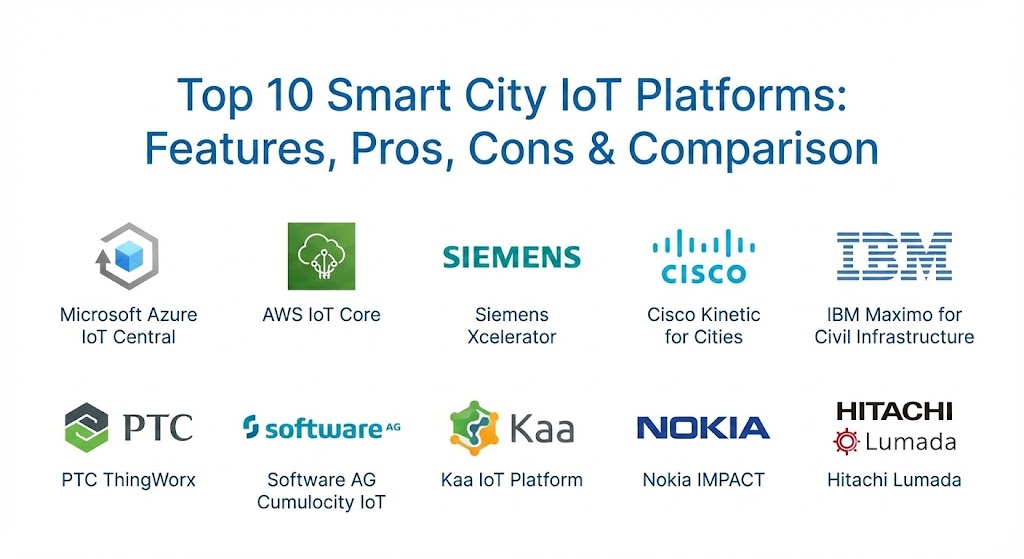
Top 10 Smart City IoT Platforms
1 — Microsoft Azure IoT Central
Microsoft Azure IoT Central is a highly scalable, cloud-native application platform that simplifies the development and management of large-scale IoT solutions. It is designed to remove the “heavy lifting” of cloud architecture, allowing cities to focus on building urban applications.
- Key features:
- “Digital Twins” technology to create virtual replicas of city assets.
- Out-of-the-box application templates for smart water and lighting.
- Seamless integration with Azure Maps and Power BI for visualization.
- Edge computing support via Azure IoT Edge for low-latency processing.
- Massive device connectivity capable of handling millions of endpoints.
- Automated rules engine for real-time alerting and action triggering.
- Pros:
- Rapid deployment thanks to no-code/low-code configuration tools.
- World-class global infrastructure ensuring 99.9% uptime.
- Cons:
- Can become expensive as the number of “messages per second” increases.
- Steep learning curve for advanced custom integrations outside the Microsoft ecosystem.
- Security & compliance: ISO 27001, SOC 1/2/3, GDPR, HIPAA, and FedRAMP compliant. Features Microsoft Entra integration for advanced identity management.
- Support & community: Extensive documentation, dedicated public sector support teams, and a massive global partner network.
2 — AWS IoT Core
Amazon Web Services (AWS) IoT Core is the industry standard for cloud-native cities that want complete control over their infrastructure. It is a powerful, reliable backbone designed for cities that want to build custom, high-performance applications.
- Key features:
- Highly secure Device Gateway for managing billions of messages.
- AWS IoT Greengrass for local compute and data caching at the edge.
- Integration with AWS SageMaker for AI-driven predictive analytics.
- Support for multiple protocols including MQTT, HTTP, and LoRaWAN.
- Fleet Hub for centralized monitoring of device health across the city.
- “Shadowing” capabilities to track the state of offline devices.
- Pros:
- Unmatched scalability and flexibility for “building your own” solution.
- Highly competitive “pay-as-you-go” pricing model for lean city budgets.
- Cons:
- Requires a highly skilled team of cloud architects to implement and maintain.
- Lacks the pre-built “industry-specific” UI found in some competitors.
- Security & compliance: FIPS 140-2, HIPAA, GDPR, SOC 2, and ISO 27001. Features fine-grained access control via IAM.
- Support & community: Global technical support, AWS re:Post community, and specialized “AWS for Government” professional services.
3 — Siemens Xcelerator (MindSphere)
Siemens Xcelerator, formerly known as MindSphere, is an industrial-grade IoT platform tailored for cities with a heavy focus on infrastructure, utilities, and transportation systems.
- Key features:
- Deep focus on “Digital Threads” that track asset lifecycle data.
- Advanced analytics for smart grids and water distribution networks.
- Open API architecture to connect with third-party city software.
- Predictive maintenance modules specifically for city vehicle fleets.
- Integrated “City Cockpit” for real-time operational visualization.
- Strong support for industrial protocols (OPC UA, Modbus).
- Pros:
- Unrivaled expertise in operational technology (OT) and physical infrastructure.
- Excellent for managing mission-critical utilities where failure is not an option.
- Cons:
- Integration with legacy non-Siemens hardware can be complex and costly.
- UI can feel more “industrial” and less “modern” than SaaS-first platforms.
- Security & compliance: IEC 62443 (Industrial Security), ISO 27001, GDPR, and SOC 2 ready.
- Support & community: Dedicated enterprise support and a vast network of engineering consultants globally.
4 — Cisco Kinetic for Cities
Cisco Kinetic is a network-centric platform designed to move data from the “street to the office” securely. It excels at managing the connectivity layer of a smart city.
- Key features:
- Data orchestration that routes data to the right application at the right time.
- Unified dashboard for managing streetlights, parking, and safety cameras.
- Built-in network security policies to isolate compromised devices.
- Edge-to-cloud data movement optimized for 5G and fiber networks.
- Open ecosystem with hundreds of pre-integrated sensor partners.
- Pros:
- Strongest platform for cities that already rely on Cisco networking hardware.
- Simplifies the “messy” data ingestion from thousands of different sensor types.
- Cons:
- Highly “vendor-locked” to the Cisco infrastructure for full functionality.
- Can be a premium-priced solution compared to pure cloud players.
- Security & compliance: Advanced audit logs, SSO, FIPS 140-2, and ISO-aligned standards.
- Support & community: Global professional services and 24/7 technical assistance center (TAC).
5 — IBM Maximo for Civil Infrastructure
IBM Maximo combines IoT data with traditional asset management, making it the premier choice for cities focused on “keeping the lights on” and the bridges safe.
- Key features:
- Cognitive analytics powered by IBM Watson for anomaly detection.
- Specialized modules for bridge, tunnel, and railway monitoring.
- Integration with city GIS (Geographic Information Systems) and ERPs.
- Automated work-order generation based on real-time sensor alerts.
- Long-term data archiving for historical infrastructure trend analysis.
- Pros:
- The best tool for predictive maintenance on large-scale physical assets.
- Deeply understands municipal workflows and government reporting needs.
- Cons:
- Complex setup and implementation often require long timelines.
- Higher licensing costs usually reserve it for major metropolitan areas.
- Security & compliance: Meets high government standards, including HIPAA, ISO 27001, and SOC 1/2/3.
- Support & community: Vast enterprise support network and deep industry-specific expertise.
6 — PTC ThingWorx
ThingWorx is an award-winning platform that excels at creating high-end visual applications and using Augmented Reality (AR) to assist city maintenance workers.
- Key features:
- Drag-and-drop “Mashup Builder” for creating custom city dashboards.
- Native AR integration (Vuforia) for heads-up maintenance instructions.
- Industrial-strength connectivity through Kepware.
- Real-time automated responses for energy and utility management.
- Scalable multi-tenant architecture for different city departments.
- Pros:
- Best-in-class visualization and AR capabilities for a modern workforce.
- Rapid development of custom apps without deep coding knowledge.
- Cons:
- Licensing can be expensive for very high device counts.
- Requires a robust internal team to maximize the “AR” value proposition.
- Security & compliance: Enterprise-grade security with SSO, role-based access, and GDPR readiness.
- Support & community: Robust training portal (PTC University) and a global community of developers.
7 — Software AG Cumulocity IoT
Cumulocity is known for its “Self-service” IoT philosophy, allowing city staff to build dashboards and rules quickly without being data scientists.
- Key features:
- “Buy & Build” approach that balances ready-to-use tools with custom SDKs.
- Vendor-independent architecture that works on any cloud or on-prem.
- Streaming analytics for real-time decision making.
- Digital Twin Manager to model complex urban interdependencies.
- “Thin-edge” support for low-power sensors and 5G networks.
- Pros:
- Very fast time-to-market; cities can be “live” in weeks, not months.
- Highly flexible and not tied to any single cloud provider like AWS or Azure.
- Cons:
- Community resources are smaller compared to the Microsoft or AWS ecosystems.
- Advanced AI features may require additional third-party integrations.
- Security & compliance: ISO 27001, SOC 2, GDPR, and built-in SSO encryption.
- Support & community: Excellent documentation and a proactive customer success team.
8 — Kaa IoT Platform
Kaa is an open-source-based platform that offers incredible flexibility for cities that want to avoid vendor lock-in and keep their budgets tight.
- Key features:
- Highly modular architecture—deploy only the parts you need.
- Can be deployed on a city’s own servers for total data sovereignty.
- Support for virtually any hardware or communication protocol.
- Powerful data collection and visualization “widgets.”
- Easy integration with existing city legacy software via APIs.
- Pros:
- Excellent cost-to-performance ratio, especially for smaller municipalities.
- Total control over data residency and infrastructure.
- Cons:
- Requires a capable in-house engineering team to manage and update.
- Lacks the “global concierge” support of giants like IBM or Siemens.
- Security & compliance: Includes advanced audit logs, SSO, and encryption; GDPR ready.
- Support & community: Strong community forums and professional services available through KaaIoT.
9 — Nokia IMPACT
Nokia IMPACT is optimized for 5G and Narrowband IoT (NB-IoT) networks, making it the logical choice for cities at the forefront of the 5G rollout.
- Key features:
- Carrier-grade reliability designed for massive device density.
- Real-time network optimization for 5G-connected sensors.
- Unified management of public safety and emergency response tools.
- High-performance video analytics for smart traffic and security.
- Multi-tenancy support for regional or provincial governments.
- Pros:
- Built for the 5G era; extremely low latency for critical applications.
- Trusted by telecommunications providers globally.
- Cons:
- Primary focus is on connectivity; application-level features are less “lush.”
- Can be difficult to acquire outside of telecom-led partnerships.
- Security & compliance: ISO 27001, GDPR, and carrier-grade security certifications.
- Support & community: World-class telecommunications support and global training programs.
10 — Hitachi Lumada
Hitachi Lumada provides a flexible, AI-driven platform for managing critical infrastructure like water systems, energy grids, and transportation.
- Key features:
- AI-driven operational insights for utility governance.
- Lumada Video Insights for advanced urban safety monitoring.
- Modular licensing (buy only the “Energy” or “Water” module).
- Integrated data lake for big-data urban planning simulations.
- Strong emphasis on sustainability and ESG (Environmental, Social, and Governance) reporting.
- Pros:
- Deep focus on “Social Innovation” and long-term sustainability.
- Exceptional at turning raw sensor data into financial/ESG reports.
- Cons:
- Very enterprise-focused; often too complex for small-to-midsize cities.
- High initial investment cost.
- Security & compliance: SOC 2, HIPAA, GDPR, and built-in governance models.
- Support & community: Extensive professional services for custom municipal digital transformation.
Comparison Table
| Tool Name | Best For | Platform(s) Supported | Standout Feature | Rating (Gartner Peer Insights) |
| Azure IoT Central | Mega-scale cities | Azure (SaaS) | Digital Twins & AI | 4.5 / 5 |
| AWS IoT Core | Cloud-native cities | AWS (Cloud) | Automation Rules Engine | 4.5 / 5 |
| Siemens Xcelerator | Utilities / Infrastructure | On-prem, Cloud | Industrial Reliability | 4.2 / 5 |
| Cisco Kinetic | Multi-vendor IoT | Edge-to-Cloud | Data Orchestration | 4.4 / 5 |
| IBM Maximo | Asset Maintenance | Hybrid Cloud | Civil Infrastructure AI | 4.3 / 5 |
| PTC ThingWorx | Visualization / AR | On-prem, Cloud | AR Maintenance Tools | 4.5 / 5 |
| Cumulocity IoT | Ease of Use | Multi-cloud, Edge | Vendor Independence | 4.5 / 5 |
| Kaa IoT Platform | Flexibility / Control | On-prem, Cloud | Modular Open-source | 4.4 / 5 |
| Nokia IMPACT | 5G-centric cities | 5G / Telecom | Network Optimization | N/A |
| Hitachi Lumada | Sustainability / ESG | Multi-cloud | Asset Intelligence | 4.4 / 5 |
Evaluation & Scoring of Smart City IoT Platforms
Choosing a city-wide platform involves more than just a feature check. It requires a long-term assessment of how the software will scale and how secure it remains under pressure.
| Category | Weight | Why it Matters |
| Core Features | 25% | Capacity for device management, data ingestion, and real-time rules. |
| Ease of Use | 15% | How quickly municipal staff can build dashboards and act on data. |
| Integrations | 15% | Compatibility with existing GIS, ERP, and diverse sensor hardware. |
| Security & Compliance | 10% | Ensuring citizen privacy and protecting critical infrastructure. |
| Performance | 10% | Speed of data processing (latency) and system uptime/reliability. |
| Support & Community | 10% | Access to expert consultants and a library of pre-built templates. |
| Price / Value | 15% | Maximizing the “Return on Investment” for taxpayer-funded projects. |
Which Smart City IoT Platform Is Right for You?
The right platform depends on your city’s technical maturity, existing hardware, and primary goals.
- Solo Users vs SMB vs Municipalities: Smart city platforms are built for the Municipality and Large Enterprise scale. For smaller private facilities (SMBs), a lighter IoT tool like Particle or Blynk might be more appropriate.
- Budget-conscious vs Premium: If budget is the primary driver, Kaa IoT (open-source roots) or AWS IoT (pay-as-you-go) offer the lowest barrier to entry. If budget is secondary to reliability and “out-of-the-box” features, Siemens or IBM are the premium gold standards.
- Feature Depth vs Ease of Use: Azure IoT Central and Cumulocity win on ease of use with their low-code dashboards. However, if you need deep, specialized features for bridge sensors or subway monitoring, the depth of IBM Maximo or Siemens is necessary.
- Integration and Scalability: If you have a 5G-first strategy, Nokia IMPACT is specialized for that. If you need to scale to millions of devices across multiple clouds, Azure and AWS are the only true options.
- Security Requirements: In 2026, government data sovereignty is paramount. If you must keep all data within your borders or on your own servers, Kaa or Siemens (on-premise versions) are the safest choices.
Frequently Asked Questions (FAQs)
1. What is the difference between an IoT Platform and a Smart City Platform? A general IoT platform manages devices and data. A Smart City platform includes specific municipal applications, like GIS mapping, citizen portals, and utility governance models, on top of that IoT layer.
2. Can these platforms integrate with “dumb” legacy infrastructure? Yes. Using “Edge Gateways” (like those from Cisco or Siemens), cities can add sensors to old water pipes or streetlights and connect them to a modern digital platform.
3. Is citizen data privacy guaranteed? Data privacy depends on the platform’s security and the city’s policies. Most top-tier platforms use data anonymization and encryption to ensure individual citizens cannot be tracked.
4. Do these platforms require 5G? No, most work with 4G, fiber, LoRaWAN, and even satellite. However, 5G is essential for “high-speed” use cases like autonomous buses or real-time high-def security video.
5. How do these tools help with sustainability? By monitoring energy and water usage in real-time, cities can reduce waste by up to 30%. Smart lighting alone can lower energy consumption by 50-70%.
6. What is a “Digital Twin” in a smart city? A Digital Twin is a virtual 3D map of the city that is updated in real-time by sensors. It allows planners to “simulate” things like floods or traffic jams before they happen.
7. Can one city use multiple platforms? It is common for cities to have a “system of systems.” For example, using AWS for general data and IBM Maximo for specialized bridge maintenance, linked via APIs.
8. Are there free smart city platforms? “Free” platforms rarely scale to city size. However, open-source options like Kaa or ThingsBoard offer free community editions for testing and pilot projects.
9. How long does a smart city rollout take? A pilot project for one department (like smart parking) takes 3-6 months. A full-city “command center” implementation can take 2-5 years.
10. What is the biggest mistake cities make? The biggest mistake is “vendor lock-in”—buying a platform that only works with one brand of sensors. Always prioritize interoperability and open APIs.
Conclusion
The choice of a Smart City IoT Platform is a generational decision for a municipality. In 2026, the best tools are those that don’t just “collect data,” but turn it into real-world efficiency and citizen safety. Whether you prioritize the AI-driven insights of IBM, the 5G readiness of Nokia, or the rapid deployment of Azure, the goal remains the same: a more resilient, sustainable, and livable city for all.