Introduction
Sleep tracking apps are digital solutions that utilize a smartphone’s hardware (like microphones and accelerometers) or connect to wearable devices (like rings and watches) to monitor sleep duration, quality, and stages. These tools analyze physiological signals—such as heart rate variability (HRV), respiratory rate, and movement—to provide a comprehensive “Sleep Score” or “Readiness Rating.”
The importance of these tools lies in their ability to bridge the gap between how we think we slept and how our body actually recovered. By identifying patterns—such as how late-night caffeine, blue light exposure, or room temperature impact REM and Deep sleep cycles—users can make evidence-based lifestyle adjustments. Key real-world use cases include managing sleep debt, identifying signs of sleep apnea, and aligning daily tasks with one’s natural circadian rhythm. When evaluating these tools, users should prioritize accuracy, ease of integration with existing health ecosystems, and the quality of actionable coaching rather than just raw data.
Best for: Health-conscious individuals, high-performance athletes, biohackers, and corporate professionals looking to optimize energy levels. They are also invaluable for those with mild sleep disturbances who want to track the efficacy of new habits.
Not ideal for: Individuals with clinical sleep disorders requiring medical-grade polysomnography (PSG) or those prone to “orthosomnia”—a condition where the anxiety of achieving perfect sleep data actually worsens sleep quality.
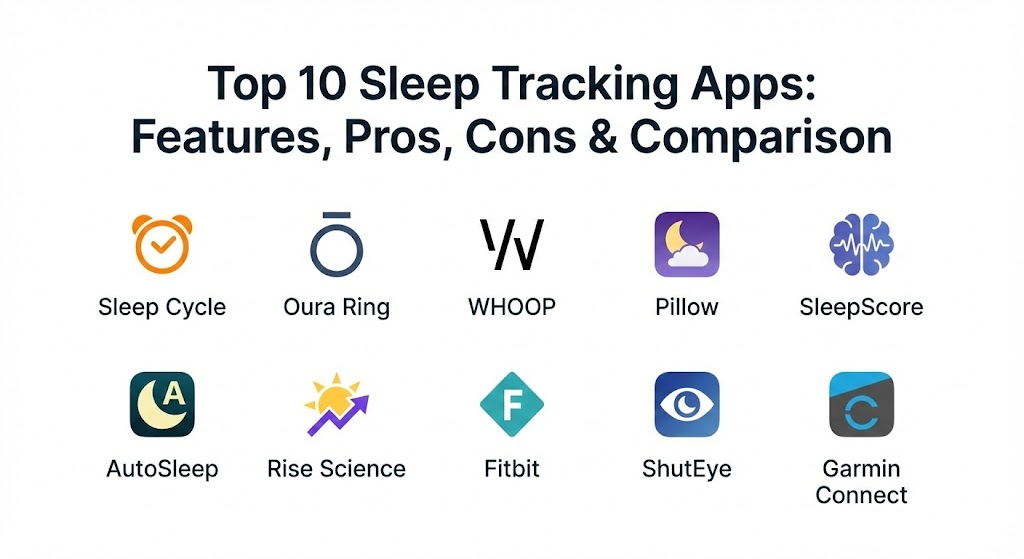
Top 10 Sleep Tracking Apps
1 — Sleep Cycle
Sleep Cycle remains a market leader in 2026 due to its patented sound-analysis technology. It uses the phone’s microphone to track movements and snoring without requiring any wearable hardware, making it the most accessible tool for the average user.
- Key features:
- Patented AI sound technology that tracks sleep stages via breathing and movement.
- Smart Alarm: Wakes you up during your lightest sleep phase within a 30-minute window.
- Snore and cough detection with audio recordings for health monitoring.
- “Luma” AI sleep coach that provides personalized habit recommendations.
- Extensive sleep aid library featuring soundscapes, stories, and meditations.
- Integration with smart home devices (e.g., Philips Hue) to simulate sunrise.
- Detailed long-term trend analysis and global sleep benchmarks.
- Pros:
- No wearable required; highly accurate monitoring just by placing the phone on the nightstand.
- The Smart Alarm is exceptionally effective at reducing morning grogginess.
- Cons:
- Microphone-based tracking can be disrupted by pets or partners in the same bed.
- Premium features are locked behind a relatively high annual subscription.
- Security & compliance: GDPR compliant, end-to-end encryption for audio recordings, and no third-party data selling.
- Support & community: Robust help center, active social media community, and fast email support for premium members.
2 — Oura Ring (App)
The Oura App, paired with the Oura Ring 4, represents the pinnacle of consumer sleep tracking accuracy. Because it measures biometrics from the finger—where the pulse signal is stronger than the wrist—it offers research-grade data on heart rate and temperature.
- Key features:
- Readiness Score: A daily holistic metric based on sleep, activity, and body stress.
- Advanced sleep staging (REM, Deep, Light) with 79% accuracy vs. clinical PSG.
- Body temperature sensing to detect early signs of illness or menstrual cycle phases.
- HRV (Heart Rate Variability) tracking to measure recovery and stress levels.
- “Symptom Radar” that alerts users when their vitals deviate from their baseline.
- Integration with over 100 apps, including Strava and Apple Health.
- Pros:
- Unmatched form factor; a lightweight ring is often more comfortable than a watch for sleep.
- The “Readiness” concept helps users decide when to push hard or take a rest day.
- Cons:
- Requires the purchase of expensive hardware (Oura Ring).
- Ongoing monthly subscription is mandatory to access almost all data.
- Security & compliance: ISO 27001, GDPR, and HIPAA compliant. Data is encrypted and anonymized.
- Support & community: Extensive “Oura On the Road” community events and a high-quality technical blog.
3 — WHOOP
WHOOP 4.0 is a screenless wearable and app designed for “serious” performance. It focuses heavily on the “Strain vs. Recovery” balance, making it a favorite for professional athletes and high-intensity fitness enthusiasts.
- Key features:
- Sleep Coach: Tells you exactly how much sleep you need based on the day’s physical “Strain.”
- Haptic alarm that vibrates on the wrist to wake you up at the optimal time.
- “Health Monitor” dashboard tracking blood oxygen, skin temp, and heart rate.
- Detailed “Weekly Performance Assessments” delivered via the app.
- Whoop Journal: Allows users to track over 100 daily habits (caffeine, magnesium, etc.).
- Screen-free design to minimize digital distractions before bed.
- Pros:
- The most detailed recovery metrics available in a consumer app.
- Excellent habit-tracking interface that proves which behaviors actually help you sleep.
- Cons:
- Subscription-only model; you never truly “own” the device or your data access.
- No step counter or clock face, which may frustrate general fitness users.
- Security & compliance: GDPR compliant; users have full control over data deletion and exports.
- Support & community: Elite-level support and “Whoop Live” features for community challenges.
4 — Pillow
Pillow is a sleek, highly visual sleep tracker built specifically for the Apple ecosystem. It leverages the Apple Watch’s sensors but also offers a standalone mode for those who prefer not to wear a watch to bed.
- Key features:
- Automatic sleep detection (no need to press “Start” on the Apple Watch).
- Heart rate analysis overlays that show how your pulse changes during sleep stages.
- Audio recordings for snoring, sleep talking, and apnea-related sounds.
- “Optimal Bedtime” recommendations based on your historical sleep data.
- Integration with Apple Health to compare sleep with steps, weight, and calories.
- Dedicated iPad and Mac apps for viewing long-term data on larger screens.
- Pros:
- One of the most beautiful and intuitive user interfaces on the App Store.
- One-time purchase option available (rare in the current subscription era).
- Cons:
- Features are heavily optimized for Apple; Android version is significantly limited.
- Standalone phone-only tracking is less accurate than the Apple Watch integration.
- Security & compliance: Utilizes iCloud for encrypted backups; no user registration required (Anonymous mode).
- Support & community: High-quality documentation and responsive developer support on Twitter/X.
5 — SleepScore
SleepScore claims to be the most “science-backed” app on the market. It uses non-contact sonar technology (similar to a bat’s echolocation) to track your breathing and movement without you ever touching your phone.
- Key features:
- Sonar Technology: Tracks sleep from the nightstand without needing a wearable.
- SleepScore “CheckUp”: A feature that screens for serious sleep disorders to share with doctors.
- Personalized “Sleep Sanctuary” advice to optimize your bedroom environment.
- Goal-setting tools based on your specific needs (e.g., “Boost Energy” or “Sleep Longer”).
- Validated recommendations for sleep products (pillows, lights) based on your data.
- Pros:
- No contact required; no need to wear anything or even put the phone on the bed.
- Highly professional reports that are actually useful for medical consultations.
- Cons:
- Requires specific phone placement and a quiet environment for sonar accuracy.
- The UI can feel a bit clinical and data-heavy for casual users.
- Security & compliance: HIPAA compliant (important for medical data) and GDPR ready.
- Support & community: Access to certified sleep coaches via the premium subscription.
6 — AutoSleep
AutoSleep is the favorite choice for Apple Watch users who value privacy and “set-it-and-forget-it” functionality. It is one of the few top-tier apps that does not require a subscription.
- Key features:
- Zero Interaction: Automatically tracks sleep the moment you lie down with your watch.
- “Sleep Rings”: Visual indicators similar to Apple’s Activity rings to show sleep quality.
- Readiness metric based on waking heart rate and HRV.
- “Lights Off” feature: Tracks exactly how long it takes you to fall asleep (latency).
- Deep integration with Apple’s native Sleep Stages data.
- Pros:
- No subscription fee; a one-time low price for life.
- Extreme focus on privacy; no data is ever uploaded to a developer server.
- Cons:
- The interface is dense and has a steep learning curve for new users.
- Only available for iOS and Apple Watch; no Android support.
- Security & compliance: Superior privacy; all processing happens on-device or on your personal iCloud.
- Support & community: Detailed online user guide and a dedicated cult-following on Reddit.
7 — Rise Science
Rise Science takes a fundamentally different approach. It doesn’t focus on sleep stages like “REM” or “Deep.” Instead, it focuses on the two metrics that matter most according to sleep science: Sleep Debt and Circadian Rhythm.
- Key features:
- Sleep Debt Tracker: Calculates exactly how many hours of sleep you “owe” your body.
- Energy Schedule: Predicts your daily energy peaks and “afternoon slumps.”
- Integration with all major wearables (Apple Watch, Oura, Fitbit, Garmin).
- Habit-building notifications for the “Melatonin Window” (optimal time to sleep).
- Simplified interface that focuses on energy rather than complex sleep graphs.
- Pros:
- The most actionable app for improving daily productivity and energy.
- Very easy to understand; “lower your sleep debt” is a simple, effective goal.
- Cons:
- Does not provide a breakdown of sleep stages (by design).
- Relies on other apps/wearables for the best data; standalone phone tracking is basic.
- Security & compliance: GDPR compliant; standard industry encryption for data syncing.
- Support & community: Active blog with deep dives into peer-reviewed sleep science.
8 — Fitbit (App)
Since the Google acquisition, the Fitbit app has integrated advanced AI features (powered by Gemini) to provide a holistic view of health. It is the best choice for users who want to see how their sleep interacts with their 24/7 activity.
- Key features:
- Sleep Profile: Assigns you a “Sleep Animal” once a month to describe your sleep style.
- Detailed Sleep Score (0-100) based on duration, quality, and restoration.
- Heart rate and oxygen saturation (SpO2) tracking during sleep.
- Smart Wake alarm and silent vibrating alarms.
- New “Gemini Health Coach” (2026 feature) for AI-driven conversational insights.
- Pros:
- Excellent balance of ease-of-use and technical depth.
- Superior 24/7 battery life on Fitbit devices compared to the Apple Watch.
- Cons:
- Many of the best insights require a “Fitbit Premium” monthly subscription.
- The hardware ecosystem can be confusing (Pixel Watch vs. Fitbit Charge vs. Sense).
- Security & compliance: Google-grade security, GDPR compliant, and SOC 2 Type II data centers.
- Support & community: Massive global community with social “Leagues” and challenges.
9 — ShutEye
ShutEye is a modern, AI-centric app that focuses on the “experience” of falling asleep and the sounds of the night. It is particularly popular for its detailed sound recording and AI-generated sleep aids.
- Key features:
- AI-powered sleep tracker using sound analysis (no wearable needed).
- Sound Recording: Captures snoring, sleep talking, and even “teeth grinding.”
- Customizable AI soundscapes that adapt to your preferences.
- Smart Alarm and a variety of high-quality wake-up melodies.
- Daily sleep diaries to track how food or mood affects your night.
- Pros:
- The best app for those who are curious about what they say or do in their sleep.
- Huge variety of calming audio content that is updated frequently.
- Cons:
- The “free” version is heavily restricted with aggressive upsells.
- Sound-based tracking is less accurate than heart-rate-based tracking.
- Security & compliance: GDPR compliant; users can delete audio recordings at any time.
- Support & community: Growing community with a focus on “ASMR” and relaxation trends.
10 — Garmin Connect
For the outdoorsy and data-obsessed, Garmin Connect offers some of the most advanced physiological metrics in the world. It is the go-to for those who already use Garmin devices for running or cycling.
- Key features:
- Body Battery: A real-time energy meter that shows how much “fuel” you have left.
- Advanced Sleep Monitoring (ASM) including Pulse Ox and Respiration.
- HRV Status: Measures your body’s response to training and sleep over 7 days.
- “Nap Detection”: Automatically tracks short periods of rest during the day.
- Training Readiness: Uses sleep data to tell you how hard you should exercise today.
- Pros:
- No subscription required to access all data and insights.
- Extremely durable hardware that lasts weeks on a single charge.
- Cons:
- The app interface can be overwhelming and “too technical” for casual users.
- Requires a Garmin wearable; no standalone smartphone tracking.
- Security & compliance: GDPR compliant, ISO 27001, and extensive privacy settings.
- Support & community: World-class technical support and a massive community of athletes.
Comparison Table
| Tool Name | Best For | Platform(s) Supported | Standout Feature | Rating (Avg.) |
| Sleep Cycle | Casual/Phone Users | iOS, Android | Sound Analysis AI | 4.7 / 5 |
| Oura App | Discreet Accuracy | iOS, Android | Research-Grade Vitals | 4.8 / 5 |
| WHOOP | Athletes/Recovery | iOS, Android | Strain vs. Recovery | 4.6 / 5 |
| Pillow | Apple Watch Users | iOS, WatchOS | Visual UI / Smart Alarm | 4.5 / 5 |
| SleepScore | Contactless Tech | iOS, Android | Non-Contact Sonar | 4.4 / 5 |
| AutoSleep | Privacy/One-time Buy | iOS, WatchOS | Zero-Interaction Tracking | 4.8 / 5 |
| Rise Science | Energy Optimization | iOS, Android | Sleep Debt focus | 4.7 / 5 |
| Fitbit | Holistic Wellness | iOS, Android | Sleep Animals / AI Coach | 4.3 / 5 |
| ShutEye | Sound Recording | iOS, Android | AI-Powered Sound Mixes | 4.6 / 5 |
| Garmin Connect | Athletes/Data-First | iOS, Android | Body Battery Meter | 4.5 / 5 |
Evaluation & Scoring of Sleep Tracking Apps
To help you decide which tool provides the most value, we evaluated the top contenders against a weighted scoring rubric based on current 2026 industry standards.
| Category | Weight | Criteria |
| Core Features | 25% | Sleep staging accuracy, smart alarms, and trend analysis. |
| Ease of Use | 15% | Onboarding experience, UI design, and automated functionality. |
| Integrations | 15% | Compatibility with Apple Health, Google Fit, and smart home tech. |
| Security & Compliance | 10% | Encryption standards, GDPR/HIPAA compliance, and data privacy. |
| Performance | 10% | Battery drain, sync reliability, and app stability. |
| Support & Community | 10% | Quality of documentation, forums, and customer support. |
| Price / Value | 15% | Cost vs. features (One-time buy vs. Subscription). |
Which Sleep Tracking App Is Right for You?
The “best” app is entirely subjective based on your goals and your willingness to wear hardware to bed.
- Solo Users vs. Professionals: If you are a solo user just curious about your snoring, Sleep Cycle or ShutEye are perfect. If you are a professional athlete or high-stakes executive, the Oura Ring or WHOOP provide the recovery data necessary to prevent burnout.
- Budget-Conscious vs. Premium: If you hate subscriptions, AutoSleep (for Apple) or Garmin (for athletes) are the clear winners. If you don’t mind paying for ongoing coaching, Fitbit Premium or Rise Science offer the best longitudinal insights.
- Feature Depth vs. Ease of Use: Rise Science is the easiest to use because it gives you one simple goal: reduce sleep debt. On the other hand, Garmin Connect and Pillow offer deep-dive graphs that require more time to interpret.
- Privacy Needs: If privacy is your #1 concern, AutoSleep is the standout, as it keeps your data on your device.
Frequently Asked Questions (FAQs)
1. Are sleep tracking apps as accurate as a sleep lab?
No. While devices like the Oura Ring 4 are reaching 80% accuracy, a sleep lab (PSG) remains the only way to measure brain waves directly. Apps are for tracking trends, not medical diagnosis.
2. Can these apps detect sleep apnea?
Some apps, like SleepScore and Sleep Cycle, can detect breathing interruptions and snoring patterns that suggest apnea, but they cannot legally diagnose it. Always see a doctor if alerted.
3. Does keeping my phone in bed for Sleep Cycle cause radiation issues?
Most apps recommend “Airplane Mode” or placing the phone on the nightstand rather than under the pillow. In 2026, low-energy Bluetooth and Wi-Fi are considered safe, but distance is always better.
4. Will these apps drain my phone battery overnight?
Sound-tracking apps like Sleep Cycle should be plugged in overnight. Wearable-based apps (Oura, AutoSleep) have minimal impact on phone battery as the watch/ring does the work.
5. Which app is best for Android users?
While many are cross-platform, Sleep as Android (an honorable mention) and Sleep Cycle are the most robust dedicated Android options.
6. Can I track sleep without a wearable device?
Yes. Sleep Cycle, SleepScore, and ShutEye all offer non-contact tracking using sound or sonar technology through your smartphone’s sensors.
7. Why does my “Sleep Score” differ between two different apps?
Every company uses a different proprietary algorithm. One might prioritize “Deep Sleep” time, while another might prioritize “Heart Rate Restoration.” Consistency with one app is more important than the absolute number.
8. Is it worth paying for Sleep Tracking subscriptions?
Subscriptions usually pay for AI coaching, large libraries of sleep aids, and cloud-based long-term trends. If you just want to see how long you slept, free versions or one-time buys are better.
9. Can these apps help me wake up less groggy?
Yes, via the “Smart Alarm” feature. By waking you up in a Light sleep stage rather than a Deep sleep stage, these apps significantly reduce “sleep inertia.”
10. What is the “Sleep Debt” mentioned in the Rise app?
Sleep debt is the difference between the sleep you needed (your biological requirement) and the sleep you actually got over the last 14 days. It is the best predictor of daily cognitive performance.
Conclusion
Choosing a sleep tracking app in 2026 is an investment in your long-term health. The market has shifted from simply telling you “how” you slept to explaining “why” you slept that way and “what” you can do to fix it. Whether you choose the research-grade precision of the Oura Ring, the actionable energy-tracking of Rise Science, or the privacy-first simplicity of AutoSleep, the key is to use the data as a mirror, not a judge. The best tool is the one that you will actually use every night and that motivates you to make small, sustainable changes to your routine.