Introduction
Semiconductor Yield Management Software (YMS) is an integrated data platform that collects, harmonizes, and analyzes massive volumes of data from various stages of the chip lifecycle—from initial design and wafer fabrication to final testing and assembly. By correlating inline metrology data with end-of-line test results, these tools identify “yield limiters”—the specific variables in the manufacturing process that cause chips to fail or perform below specification.
The importance of YMS lies in its ability to accelerate “Yield Learning.” In a modern fab, a single wafer can undergo hundreds of chemical and mechanical steps. Without YMS, finding the root cause of a defect is like looking for a needle in a haystack of petabytes of data. Real-world use cases include identifying Cp/Cpk (Process Capability) drifts in real-time, performing spatial signature analysis on wafer maps to find equipment-related patterns, and optimizing “Safe Launch” for new product ramps. When evaluating these tools, users should prioritize data ingestion speed (handling high-volume STDF files), the depth of their AI-driven root cause analysis (RCA), and how well they bridge the gap between “design intent” and “manufacturing reality.”
Best for: Integrated Device Manufacturers (IDMs), Foundries, Fabless companies, and Outsourced Semiconductor Assembly and Test (OSAT) providers. It is essential for product engineers, yield engineers, and quality managers who need to maintain high gross margins in high-volume manufacturing (HVM).
Not ideal for: Research labs producing one-off experimental chips or very small-scale specialty component manufacturers where the volume of data doesn’t justify the high infrastructure cost of an enterprise YMS.
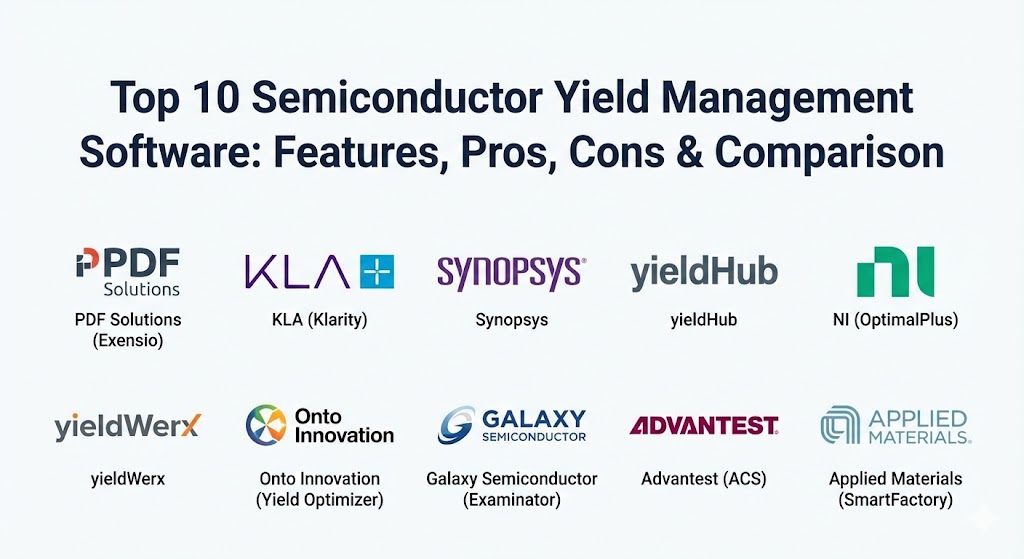
Top 10 Semiconductor Yield Management Software Tools
1 — PDF Solutions (Exensio)
Exensio by PDF Solutions is widely regarded as the most comprehensive yield management platform in the global market. It provides a “cradle-to-grave” view of the silicon lifecycle, connecting data from the fab, the test floor, and even in-field performance sensors.
- Key features:
- Massive data ingestion engine capable of handling multi-petabyte datasets.
- Integrated “DEX” (Data Exchange) for secure collaboration between foundries and fabless customers.
- Advanced Machine Learning for predictive yield modeling and anomaly detection.
- Semantic data model that automatically links test data back to physical design coordinates.
- Comprehensive wafer map visualization and binning analysis.
- Support for advanced packaging and heterogeneous integration data.
- Pros:
- Unmatched end-to-end visibility across the entire semiconductor supply chain.
- Highly scalable for the world’s largest high-volume manufacturing (HVM) environments.
- Cons:
- Significant implementation time and cost; requires a dedicated team to manage.
- The user interface can be overwhelming for casual users or small teams.
- Security & compliance: SOC 2 Type II, ISO 27001, GDPR, and deep encryption for cross-company data sharing.
- Support & community: Enterprise-grade support with global Field Application Engineers (FAEs) and an exclusive user community for top-tier partners.
2 — KLA (Klarity)
KLA is a titan in inspection and metrology hardware, and Klarity is its flagship software designed to turn those inspection images into actionable yield insights.
- Key features:
- Industry-leading defect management and spatial signature analysis.
- “Klarity Defect” for automated defect classification (ADC).
- Integration with KLA’s world-class inspection tools for real-time excursion detection.
- Advanced pattern grouping to identify systematic yield limiters.
- Seamless linkage between inline defect data and end-of-line electrical test results.
- Automated reporting and alerting for fab-wide process control.
- Pros:
- Best-in-class for managing front-end wafer fabrication defects.
- Deep synergy with KLA hardware provides a “closed-loop” feedback system.
- Cons:
- Heavily optimized for KLA hardware; integration with third-party metrology can be less fluid.
- Focuses primarily on the fab/wafer level rather than the back-end assembly/test data.
- Security & compliance: ISO 27001, HIPAA-level data privacy controls, and SSO support.
- Support & community: Global service infrastructure and a robust professional training portal for yield engineers.
3 — Synopsys (YieldExplorer & YieldManager)
Synopsys offers a design-centric approach to yield. While YieldManager focuses on fab-wide data collection, YieldExplorer is the gold standard for design-process-test correlation.
- Key features:
- Design-aware yield analysis that correlates physical layout to test failures.
- Integration with Synopsys TestMAX for diagnostics-driven yield learning.
- Volume Diagnostics to identify systematic layout-related defects.
- Advanced Statistical Process Control (SPC) and trend analysis.
- Customizable dashboards for real-time monitoring of yield ramps.
- Support for the latest 2nm and GAA (Gate-All-Around) architectures.
- Pros:
- The best tool for identifying “Design-for-Manufacturability” (DFM) issues.
- Powerful integration with the broader Synopsys EDA ecosystem.
- Cons:
- Can be complex for OSATs who do not have access to the original design files.
- Requires significant computational resources for layout-to-test correlation.
- Security & compliance: SOC 2, ISO 27001, and strict multi-tenant data isolation.
- Support & community: World-class technical support and deep integration with global EDA user groups.
4 — yieldHub
yieldHub is a modern, cloud-native (or on-premise) YMS that has surged in popularity among fabless startups and mid-tier semiconductor companies for its speed and ease of use.
- Key features:
- Automated data loaders for hundreds of different tester formats (STDF, ATDF, etc.).
- Virtual Fab modeling for fabless companies to monitor their foundry partners.
- Real-time automated alerts for yield excursions and binning shifts.
- Advanced Wafer Acceptance Test (WAT) and PCM (Process Control Monitoring) analysis.
- Collaborative “Workspace” for sharing reports with suppliers and customers.
- Fast, browser-based drill-down from high-level summaries to individual die results.
- Pros:
- Incredible ROI due to low overhead and rapid deployment (often within weeks).
- Extremely user-friendly; designed for engineers who want answers, not more software.
- Cons:
- Historically less focused on front-end “visual defect” management compared to KLA.
- May lack some of the deepest custom-scripting flexibility found in PDF Solutions.
- Security & compliance: ISO 27001, GDPR, and secure data archiving for multi-year traceability.
- Support & community: Highly praised customer support team and an extensive library of training videos and webinars.
5 — NI (OptimalPlus)
Acquired by NI (National Instruments), OptimalPlus is a leader in Big Data analytics, specializing in high-reliability sectors like automotive and aerospace electronics.
- Key features:
- Real-time “edge” analytics that run directly on the test floor.
- Adaptive Test algorithms that adjust test flows in real-time to maintain quality.
- Holistic view of the supply chain from wafer to final board assembly.
- Advanced “Outlier Detection” (PAT, G-PAT) for zero-defect automotive requirements.
- Robust data harmonization across diverse global manufacturing sites.
- Pros:
- The industry standard for automotive semiconductor quality and reliability.
- Exceptional at reducing “test time” through intelligent, data-driven pruning.
- Cons:
- Pricing is at the premium end of the market.
- Integration with NI hardware is seamless, but third-party ATE integration takes more effort.
- Security & compliance: SOC 2, ISO 27001, and automotive-grade data integrity standards.
- Support & community: Strong presence in the automotive ecosystem and expert-led global consulting services.
6 — yieldWerx
yieldWerx provides an enterprise-class YMS that strikes a strong balance between wafer-level and package-level analysis, making it a favorite for OSATs and test houses.
- Key features:
- High-performance processing of STDF and custom test data logs.
- Advanced “Lot Disposition” automation for fast-track production decisions.
- Multi-dimensional data correlation (e.g., temperature, voltage, equipment ID).
- Comprehensive binning and parametric analysis modules.
- Integrated SPC and quality management workflows.
- Scalable architecture for high-volume consumer electronics.
- Pros:
- Very strong “Back-End” (test and assembly) focus.
- Flexible pricing models that suit both mid-sized and large enterprises.
- Cons:
- Visualization tools are functional but less “modern” than some cloud-native competitors.
- Limited design-aware capabilities compared to EDA-specific tools.
- Security & compliance: SOC 2, ISO 27001, and SSO integration.
- Support & community: Responsive technical support and regular user training sessions.
7 — Onto Innovation (Yield Optimizer)
Onto Innovation (formed by the merger of Rudolph Technologies and Nanometrics) offers Yield Optimizer, a tool that excels at finding “invisible” yield limiters through multivariate analysis.
- Key features:
- Multivariate modeling that analyzes interactions between hundreds of process variables.
- Machine Learning recommendations for adjusting metrology targets.
- Integrated defect, metrology, and test data management.
- Advanced visualization for complex interaction effects.
- “Smart Data” approach that focuses on the most impactful parameters first.
- Pros:
- Exceptional at finding root causes in highly complex, multi-variable processes.
- Strong synergy with Onto Innovation’s metrology and lithography hardware.
- Cons:
- The sophisticated modeling can require a steeper learning curve for engineers.
- Smaller community compared to the Synopsys or KLA ecosystems.
- Security & compliance: Enterprise-grade security protocols, GDPR, and ISO standards.
- Support & community: High-touch engineering support with deep domain expertise in advanced packaging.
8 — Galaxy Semiconductor (Examinator)
Examinator (by Galaxy Semiconductor) is the classic “engineer’s tool,” known for its lightning-fast processing of test data files and focused analysis.
- Key features:
- Extremely fast loading of STDF, ATDF, and other standard test formats.
- “Quick Report” functionality for instant yield and parametric summaries.
- Robust characterization and validation tools for new product introduction (NPI).
- Comprehensive outlier detection (PAT) and part-average analysis.
- Portable data analysis—can be used on individual laptops or as an enterprise server.
- Pros:
- The most accessible “entry point” for test data analysis.
- Incredibly efficient for NPI and characterization tasks.
- Cons:
- Lacks the fab-wide “Defect Management” and “Design Correlation” of larger platforms.
- Not designed to be a centralized fab-wide “source of truth” for massive datasets.
- Security & compliance: Standard enterprise security; varies by deployment (desktop vs server).
- Support & community: Strong user base among test engineers and prompt technical support.
9 — Advantest (Advantest Cloud Solutions / ACS)
As the global leader in Automated Test Equipment (ATE), Advantest offers ACS to provide a real-time connection between their testers and the yield management ecosystem.
- Key features:
- Real-time “Edge AI” for making millisecond-level decisions on the tester.
- Secure data pipeline from the test head to the centralized yield cloud.
- Integration with third-party yield tools through a standard API.
- Dynamic test program adjustment to maximize yield and minimize test cost.
- Predictive maintenance modules for the ATE hardware itself.
- Pros:
- Zero-latency feedback loop between the data source and the analytics.
- Essential for companies heavily invested in the Advantest V93000 platform.
- Cons:
- Limited utility for fabs using non-Advantest testers.
- Focuses primarily on the “Test” portion of the lifecycle.
- Security & compliance: ISO 27001, SOC 2, and high-security cloud architecture.
- Support & community: Global service network with specialized test engineering support.
10 — Applied Materials (SmartFactory Yield Management)
Applied Materials is the hardware king of the fab, and their SmartFactory suite provides an integrated yield and defect management solution that is deeply embedded in the “Smart Fab.”
- Key features:
- Integrated Fab-wide yield data management and analysis system.
- “SmartFactory Defect Management” to eliminate manual defect classification.
- Advanced integration with Fault Detection and Classification (FDC) systems.
- Automated reporting and workflow engine for yield learning.
- 300mm fab optimization with specific focus on Q-time and throughput.
- Pros:
- The most integrated solution for full-factory automation (Industry 4.0).
- Reduces yield learning time by up to 80% through automated data alignment.
- Cons:
- Requires a high level of investment in the Applied Materials automation stack.
- Can be overly complex for fabless companies who don’t own the factory.
- Security & compliance: Enterprise-grade security, SSO, and SOC 2 compliance.
- Support & community: Massive global presence with extensive Field Application support.
Comparison Table
| Tool Name | Best For | Platform(s) Supported | Standout Feature | Rating (Approx.) |
| PDF Solutions | Full Supply Chain | On-prem, Cloud, Hybrid | End-to-End Traceability | 4.8 / 5 |
| KLA Klarity | Front-End Defect | On-prem, Server | Spatial Signature Analysis | 4.7 / 5 |
| Synopsys | Design-Process Correlation | On-prem, Cloud | Layout-Aware Diagnostics | 4.7 / 5 |
| yieldHub | Fabless & Startups | Cloud-Native, On-prem | Fast ROI & Ease of Use | 4.8 / 5 |
| NI OptimalPlus | Automotive/High-Rel | Edge, On-prem, Cloud | Real-time Adaptive Test | 4.8 / 5 |
| yieldWerx | OSATs & Test Houses | Web, On-prem, Cloud | High-Volume Lot Disposition | 4.5 / 5 |
| Onto Yield Optimizer | Multivariate Analysis | Cloud (SaaS), Server | ML Metrology Target Optimization | 4.4 / 5 |
| Galaxy Examinator | NPI & Test Engineers | Desktop, Server | Fast STDF Ingestion | 4.4 / 5 |
| Advantest ACS | Real-time ATE Analytics | Cloud, Edge (ATE) | Test-Edge Feedback Loop | 4.5 / 5 |
| Applied SmartFactory | Full Fab Automation | On-prem, Server | Unified FDC/SPC/Yield Platform | 4.6 / 5 |
Evaluation & Scoring of Semiconductor Yield Management Software
Selecting a YMS is a strategic decision that impacts the company for years. We use a weighted rubric to evaluate these tools based on their impact on a modern semiconductor business.
| Category | Weight | Evaluation Notes |
| Core Features | 25% | Capacity for STDF processing, spatial analysis, RCA depth, and SPC. |
| Ease of Use | 15% | How quickly an engineer can go from “data log” to “root cause identification.” |
| Integrations | 15% | Compatibility with MES, EDA tools, and diverse ATE vendors. |
| Security & Compliance | 10% | Critical for protecting IP in foundries and foundries-fabless collaboration. |
| Performance | 10% | Ingestion speed and system responsiveness with massive datasets. |
| Support & Community | 10% | Availability of FAEs and the size of the professional user network. |
| Price / Value | 15% | Total Cost of Ownership (TCO) vs. the projected yield improvement. |
Which Semiconductor Yield Management Tool Is Right for You?
The “best” tool is relative to your role in the semiconductor ecosystem.
- Solo Engineers & Small Product Teams: If you are managing 1-5 products and need to analyze test data quickly, Galaxy Examinator or the basic tier of yieldHub are your best options. They offer immediate insights with minimal IT overhead.
- Fabless Startups & Scale-ups: You don’t own the fab, so you need “Virtual Fab” visibility. yieldHub is specifically built for this scenario, offering a cloud-native platform that connects easily to your foundry and OSAT partners.
- Automotive & Mission-Critical ICs: When “zero defects” is the requirement, NI OptimalPlus is the industry standard. Its ability to perform Part Average Testing (PAT) and outlier detection at the edge is unmatched.
- Large Foundries & IDMs: For those managing the world’s most advanced nodes (5nm, 3nm, 2nm), PDF Solutions (Exensio), Synopsys (YieldExplorer), or KLA (Klarity) are the necessary heavyweights. These tools handle the “big data” complexity of thousands of process steps.
- Test Houses & OSATs: You need to move lots quickly and accurately. yieldWerx and Advantest ACS provide the high-performance test-centric workflows that keep the lines moving.
Frequently Asked Questions (FAQs)
1. What is the difference between a YMS and a generic BI tool like Tableau? A generic BI tool doesn’t understand semiconductor-specific data formats like STDF or wafer maps. A YMS is pre-built with the logic for binning, parametric correlation, and spatial signature analysis that would take years to build in a generic tool.
2. How much yield improvement can I expect? While results vary, many companies report a 1−3% yield improvement within the first year. In high-volume production, this can represent tens of millions of dollars in increased revenue.
3. Does YMS software require high-performance computing? For large-scale foundries, yes. However, modern cloud-native solutions like yieldHub or Onto Innovation provide “analysis-as-a-service,” where the vendor handles the heavy computational load.
4. Can these tools detect hardware failures in the fab? Yes. By using “Spatial Signature Analysis,” these tools can identify patterns (like a scratch or a ring) that are characteristic of specific machines, such as a faulty wafer handler or a misaligned lithography tool.
5. How do foundries share data with fabless customers without exposing IP? Tools like PDF Solutions’ DEX or yieldHub use “data masking” and strict access controls. They share the “yield results” (the symptoms) without revealing the specific “process recipes” (the IP).
6. What is “Design-Centric” yield management? It is an approach (led by Synopsys) that links test failures back to the specific physical features on the chip layout. This helps determine if a failure is due to a process error or a design that is too “tight” for the current process window.
7. Is STDF the only format used? No, but it is the most common for test. YMS tools also ingest WAT (Wafer Acceptance Test), PCM (Process Control Monitoring), MES (Manufacturing Execution System) logs, and GDSII (design) files.
8. How does AI improve yield management? AI can automatically classify thousands of defect images in seconds, find non-linear correlations between process variables that a human might miss, and predict yield “excursions” before they actually happen.
9. Can I run these tools on-premise? Yes. While cloud is growing, many semiconductor companies still prefer on-premise deployments to ensure maximum control over their most sensitive manufacturing data.
10. What is a “Yield Excursion”? An excursion is a sudden, unexpected drop in yield. The primary goal of any YMS is to detect these as close to real-time as possible to prevent “scraping” entire lots of expensive wafers.
Conclusion
The semiconductor industry is entering its most complex era yet. As Moore’s Law becomes harder and more expensive to maintain, the efficiency of yield management becomes the ultimate competitive advantage. Whether you are a startup aiming for a “first-time-right” launch or a global foundry maintaining 99% uptime, the right Semiconductor Yield Management Software is your most important ally. Choose a tool that doesn’t just store your data, but turns it into the intelligence you need to stay ahead of the next node.